The College of Law recently held a Disability Awareness Panel, a part of Syracuse’s Disability Cultural Center’s Disability Pride Month.
Rachel Dubin and Professor Cora True-Frost L’01, two of the featured panelists, shared their personal experiences and legal insights in navigating education for people with disabilities.
The two highlighted the challenges people face in education, including finding accommodations, and the need for legal intervention in preventing non-inclusive policy.
“Law really matters, and so the person who is protected needs to understand what their possible accommodations can be legally, and finding that answer can be very difficult for the person who has disabilities and is entitled to these protections,” said True-Fost.
Mercy Renci Xie LL.M.’20, who is currently pursuing an S.J.D. at the College of Law, recently had papers selected to be presented at Stanford’s Law & Humanities Workshop and the 2025 Law & Society Annual Meeting.
She will present her paper “Guanxi Paradox in Chinese Relational Legal Consciousness” at the Law & Humanities Workshop at Stanford University on June 9-10.
Her paper “Navigating Power Dynamics: Contingent Second-Order Legal Consciousness of Chinese Disabled People,” was selected to be presented at the 2025 Law & Society Annual Meeting in Chicago May 22-25.
Professor Katherine Macfarlane’s article “Higher Education’s Accommodations Mistake” was recently accepted for publication in the Georgetown Law Journal, where it will be published this Fall. A draft of Professor Macfarlane’s article is available here.
The article examines the “fundamental alteration” defense, which applies to claims brought pursuant to the Americans with Disabilities Act and Section 504 of the Rehabilitation Act, and how the defense impacts reasonable accommodation requests made by undergraduate and graduate students with disabilities. Professor Macfarlane is a leading expert in disability law and higher education accommodations.
She directs the College’s Disability Law & Policy Program and teaches Constitutional Law, Disability Law, and Civil Rights Litigation.
E.I. White Chair and Distinguished Professor of Law Robin Paul Malloy’s paper Network Capabilities in Land Use and Disability Law was published in 74 Am. U. L. Rev. 461 (2024).
In the abstract, Malloy writes “In addressing the relationship between land use and disability, we must consider three primary methods for conceptualizing disability. The first is the ‘medical model’, the second is the ‘social construction’ model, and a third, suggested in this Article, is a ‘network capabilities’ model. The network capabilities model frames disability in terms of the built environment and focuses on understanding human capabilities from a land use perspective—that is, in relation to an integrated system of property infrastructure, assistive technology, and inclusive design. This method addresses disability as a regulatory matter focusing on public health, safety, and welfare. It balances concerns for accessibility with pragmatically achievable land planning goals.”
This panel will focus on the potential contributions of Modern Monetary Theory (MMT) to socioeconomics and the study of law. In particular, the discussion will consider the role of the state, mechanisms for achieving full employment (including job guarantees), the relationship (or lack of one) between fiscal policy and inflation, the importance of community investment, and how to make these topics accessible and relevant to law students and legal scholars.
In many respects Fourth Amendment doctrine has evolved to expand law enforcement power to act on suspicions, frequently to the disadvantage of disfavored groups. Reversing these patterns is not just a matter of academic interest but a pressing need, amplified with the advent of more intrusive and pervasive surveillance technologies. Participants in this discussion will address the ways that suspicion is defined and constructed, its role (or failed potential) in constraining government power, the need for alternatives to suspicion to regulate mass data surveillance, and the potential for suspicion to serve as cover for bias.
In alignment with the conference theme of Courage in Action, this year’s program will focus on discussing the difficulties older adults experience in accessing basic needs, including healthcare and utilization of health technology; housing, aging in place, and long-term care; employment and retirement; and estate planning. As we age, we face significant life transitions that intersect with the law in these areas as well as others that can be challenging to navigate.
A key goal of the Section is to support our members in every aspect of their careers, including their scholarship. This panel provides section members with the opportunity to present a work-in-progress and receive feedback from senior scholars and other section members.
The Section believes that it is time to re-think the basic relationship between law and economics. Economics was introduced into legal scholarship as a tool for conservative political positions in the 1980s. It is time to recapture this valuable branch of modern knowledge and apply it to pressing topics such as climate change, automation and employment, and the relationships between the underregulation of finance, corruption, instability, and racial inequality. Participants will explore how a combined legal, economic, and social science approach can be productively applied to these topics.
It has been said that a “law degree is a leadership degree” and much has been written on the need for law schools to educate leaders. Fortunately, many legal educators have responded in interesting and courageous ways. Starting with visionaries like Dean Donald Polden and Professor Deborah Rhode–both of whom courageously fought for their vision of leadership development as part of legal education–the field has continued to evolve and grow. Fortunately, leadership development and leadership education–like leadership itself–is not limited to a one-size-fits-all approach. A plethora of different approaches to leadership development have emerged recently with different focuses, tactics, and desired outcomes. In this discussion group, we will discuss and celebrate these different approaches as we look at how law schools can best develop their students into good lawyer-leaders.
The Bloomberg Law article “Weight-Loss Drug Cases Push to Recognize Obesity as Disability” reviews a growing number of federal and state lawsuits that aim to gain health insurance coverage for GLP-1 obesity drugs based on the definition of a disability.
Professor Katherine Macfarlane, Director of Syracuse Law’s Disability Law and Policy Program, discussed a case in Maine where the plaintiff is diagnosed with a binge-eating disorder and sued their health insurer for coverage of the weight loss drugs. Several appeals courts have concluded that workers need to prove their obesity has an underlying physiological cause to bring an ADA claim.
“The addition of that [diagnosis] is savvy,” said Macfarlane. “It strengthens her case to the extent that they’re in front of a court that’s looking for an underlying condition as well.”
In a separate case, Cigna Life and Health Insurance Company is arguing that case law does not broadly recognize obesity as a disability and that the plaintiff is asking to categorize all obese people as disabled (estimated to be 40% of the U.S. population.)
Cigna is overstating the courts’ views under the US Court of Appeals for the First Circuit, according to MacFarlane. She pointed to the 1992 case of Cook v. Rhode Island, where the U.S. District Court for the District of Rhode Island suggested that no separate physiological diagnosis is needed for obesity to qualify as a disability. A longstanding tenet of disability law also requires case-by-case analyses, she said, rather than broad categorizations.
“I think the defendants are both misstating the plaintiff’s position and also overstating what federal courts have held in the context of obesity as a disability,” she said.
Syracuse University College of Law’s Disability Law and Policy Program recently hosted “A Body’s Work: A Discussion with Professor Britney Wilson. Professor Wilson is an associate professor of law and the director of the Civil Rights and Disability Rights Clinic at New York Law School. She discussed her experiences as a Black disabled woman, civil rights attorney, and law professor.
Her discussion was based on her paper “A Body’s Work: On Self and Peer Education as a Black Disabled Lawyer” published in the Journal of Legal Education. The essay and her Syracuse Law discussion explored the effects of an overall lack of disability inclusion in the law school curriculum and how it impacts the way she navigates life and work as a Black disabled woman and attorney.
Wilson also touched upon ongoing transportation services litigation that the Civil Rights and Disability Rights Clinic is litigating by applying the Americans with Disabilities Act and New York City Human Rights law.
Also, an accomplished writer and artist, Wilson has published short stories, poetry, and creative nonfiction essays. She was a featured poet on the HBO series Brave New Voices. She explained how creativity in other areas can positively affect making creative legal arguments.
Professor Wilson also met with DLPP students to discuss their experiences studying disability law and navigating law school with disabilities.
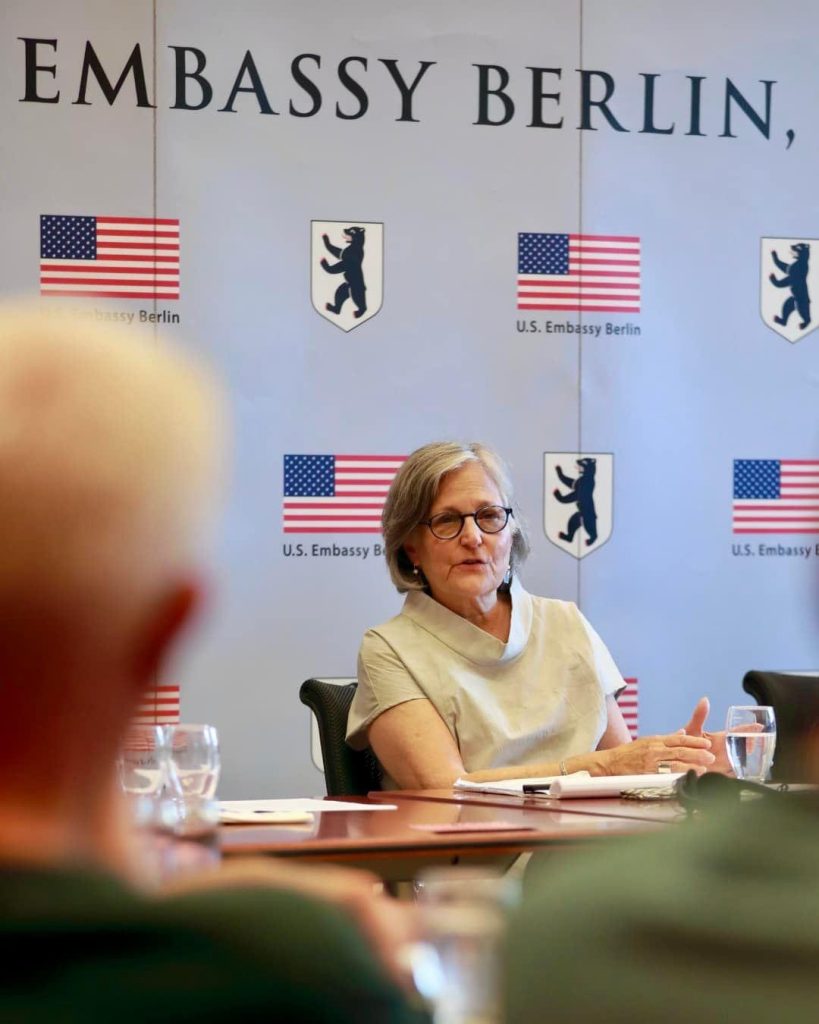
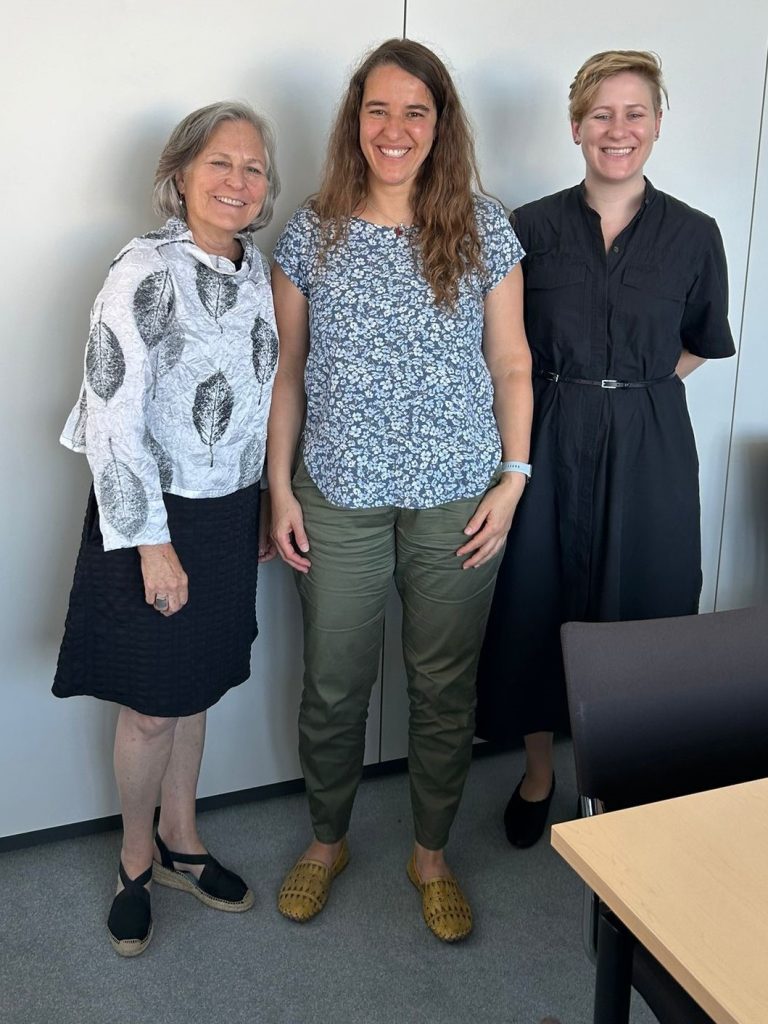
Professor Emerita Arlene Kanter recently spent a week in Berlin meeting with government officials and disability organizations to promote the development of disability laws and policies in Germany. Kanter’s visit was sponsored by the U.S. Department of State.
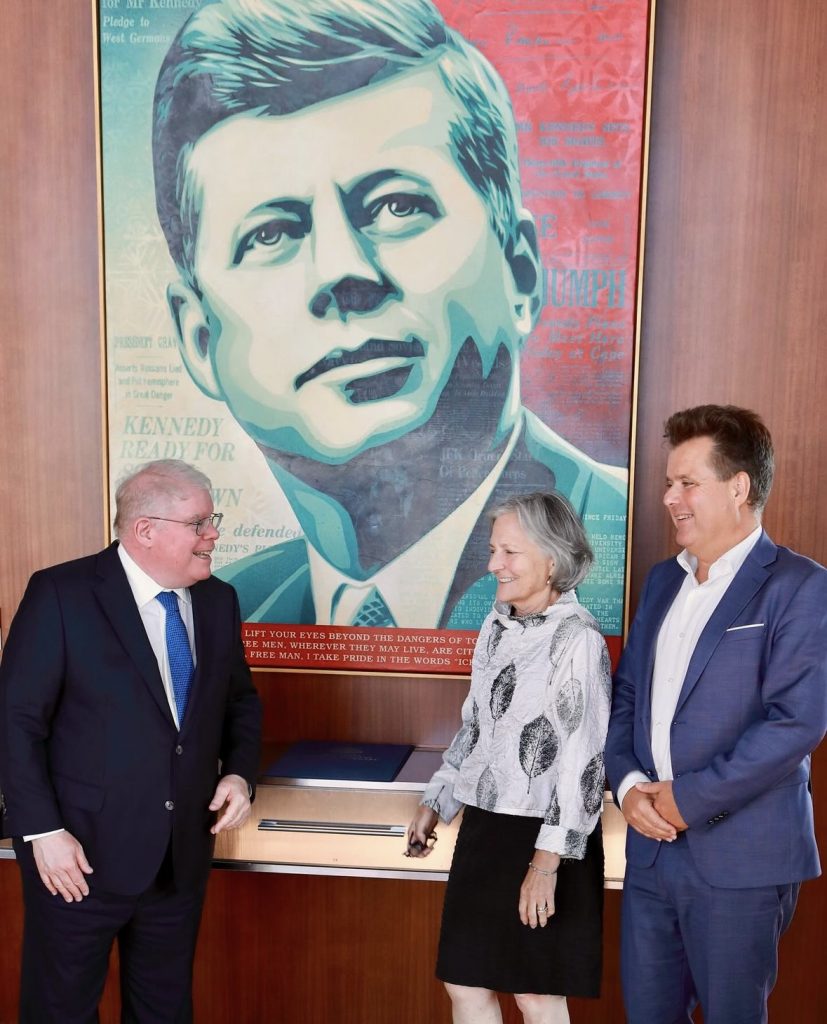
Kanter met with U.S. Embassy Deputy Chief of Mission Clark Price, Federal Government Commissioner for the Affairs of People with Disabilities Jürgen Dusel, and MdB Heike Heubach, the first Deaf member of the German Parliament, to discuss eliminating barriers that prevent disabled children and adults from participating in German society.
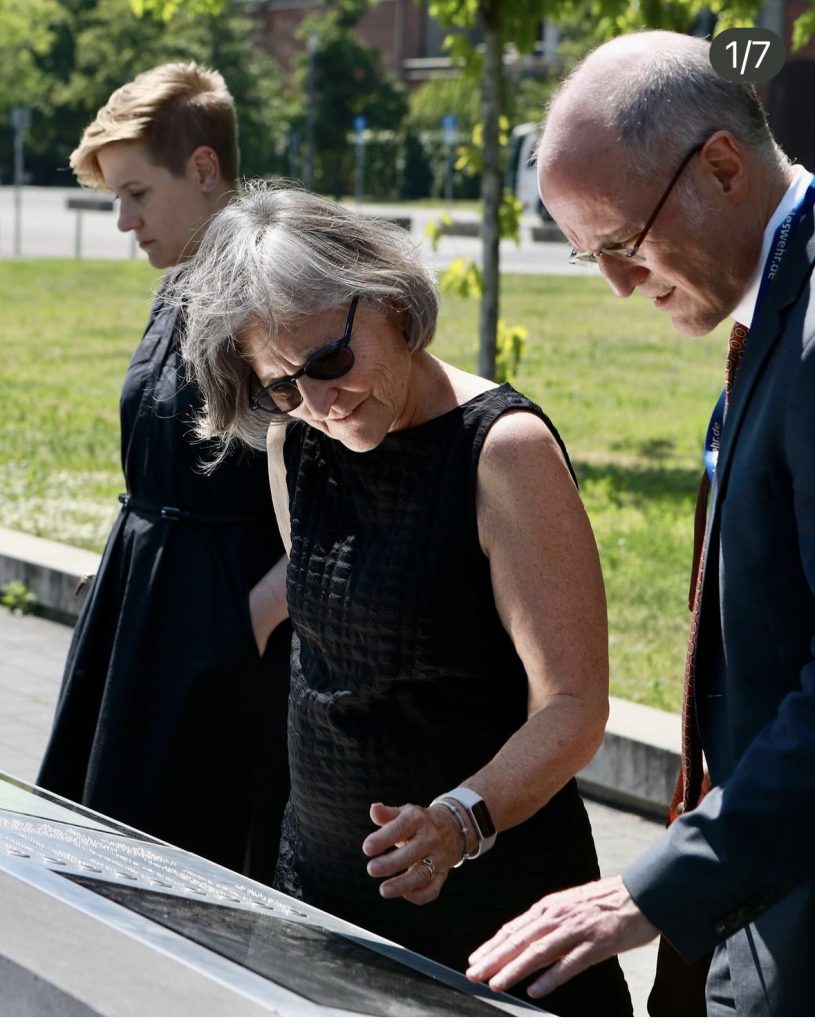
Kanter also visited the T4-Memorial to honor the victims of the Holocaust who were murdered by the Nazis because of their disability.
A roundtable discussion with over 50 representatives from local disability organizations as well as a separate roundtable with Embassy staff sparked lively conversations about access to higher education, discrimination in the workplace, efforts to combat violence against women with disabilities, the need for community-based alternatives to institutions, as well as how to develop laws and policies to conform to the United Nations Convention on the Rights of Persons with Disabilities (CRPD), which Germany ratified in 2009.
“Germany has made significant progress since it ratified the CRPD, by adopting new disability-related laws and policies. But more work needs to be done to implement these laws, especially in the areas of accessibility of private facilities, education, and workplace accommodations. As one who helped to draft the CRPD, it is meaningful for me to see this critical work of promoting greater disability inclusion being embraced by leaders within and outside the government of Germany,” says Kanter.
The article looks at a UCLA professor whose classroom hosts contentious debates and says she’ll fail any student who records classes or distributes another student’s work as a matter of academic freedom. Kanter discusses the legalities surrounding classroom accommodations.
Kanter said UCLA’s signing off on what she called a “blanket ban” on a disability accommodation is problematic. “No [blanket] ban is ever permissible, and there are many, many court cases that have held so,” she said.
“I’m surprised that UCLA would go that route and uphold the ban because there’s literally no court authority that would be on their side,” Kanter said. “The recording allows a student with a disability to be on equal footing and participating in that class with students without disabilities. To deny that opportunity is discrimination, pure and simple.”
When Craig Boise went to law school in the 1980s, there wasn’t much talk of a value proposition. He received a rigorous legal education at the University of Chicago and, of course, intensive study. Still, says Boise, “There was a real disconnect between the doctrine we were learning and how to use it. We had large stacks of books and no real sense of how it all would apply in practice. That’s the gulf I’ve tried hard to span.”
When he became Dean of the College of Law in 2016, Boise was determined to redefine the value proposition of law school. “We are focused on ensuring our students attain the kinds of jobs they dream about. Certainly, they receive an excellent education, but they also get the support they need to pass the bar, the connections to externships and the clinical work that positions them to excel when they graduate. Law school is an investment. We make it worth their while.”
Those who worked closely with Boise during his tenure as Dean—as advisors, colleagues, faculty and staff—and students who obtained their law degrees over the last eight years say they have reaped the benefits of his vision and determination.
“During my first trial assignment, one of the senior attorneys said to me ‘I had no idea you were so well trained.’ I didn’t have to be taught how to do a direct exam or develop a strategy for cross-examination. The core was all there and it shocked some of my colleagues. I can hold my ground because of the training I received at Syracuse University College of Law.”
Tyler Jefferies L’21, Deputy Attorney General, Pennsylvania Office of Attorney General
Tyler Jefferies L’21 is testimony to the value proposition Boise envisioned. Now Deputy Attorney General at the Pennsylvania Office of Attorney General, Jefferies says she’s the youngest in the office by far. “During my first trial assignment, one of the senior attorneys said to me ‘I had no idea you were so well trained.’ I didn’t have to be taught how to do a direct exam or develop a strategy for cross-examination. The core was all there and it shocked some of my colleagues. I can hold my ground because of the training I received at Syracuse University College of Law.”
Jefferies’ advocacy skills were honed through the many trial competitions and advocacy classes that bring distinction to the College. “I consider us an elite program,” says Professor Todd Berger, Director of Advocacy Programs. “We do things that are more creative and more innovative than any other law school in the advocacy space.” Berger credits Boise for targeting areas of distinction, such as advocacy, and providing the resources to expand and strengthen those programs.
“Dean Boise never turned down a new idea to innovate,” says Jefferies. “When Professor Berger proposed the idea of a 14-week competition that operates like professional sports playoffs, the Dean said ‘Great. Let’s hammer out the logistics and just try it!’ We have been a trailblazer in the competition world and other schools are trying to do similar things. Dean Boise’s ability to see the bigger picture and support it was really important to the growth of the program.”
Brian Gerling L’99 meets with students at a table in the Innovation Law Center
“Craig had a forward-thinking attitude toward growing the law school and providing students with the most well-rounded education possible and practical learning experiences and opportunities to make them more marketable and more successful graduates.”
Brian Gerling L’99, Executive Director of the Innovation Law Center
Trailblazer and innovator are words often used to describe Boise. “Craig had a forward-thinking attitude toward growing the law school and providing students with the most well-rounded education possible and practical learning experiences and opportunities to make them more marketable and more successful graduates,” says Brian Gerling L’99, Professor of Practice and Executive Director of the Innovation Law Center (ILC). Today, more than 97% of graduates are employed or enrolled in another graduate program within 10 months of graduation, an impressive achievement for law schools and just one of many measures of success realized during Boise’s tenure.
Gerling recalls that as a law student at Syracuse Law in the ‘90s, he was aware of professors and courses that were considered ahead of their time. But he credits Boise with investing in and structuring comprehensive programs that would bring new distinction to the College and success to students. “He infused enthusiasm and capital and leadership, engaging alumni and donors in supporting programs that are nationally recognized.”
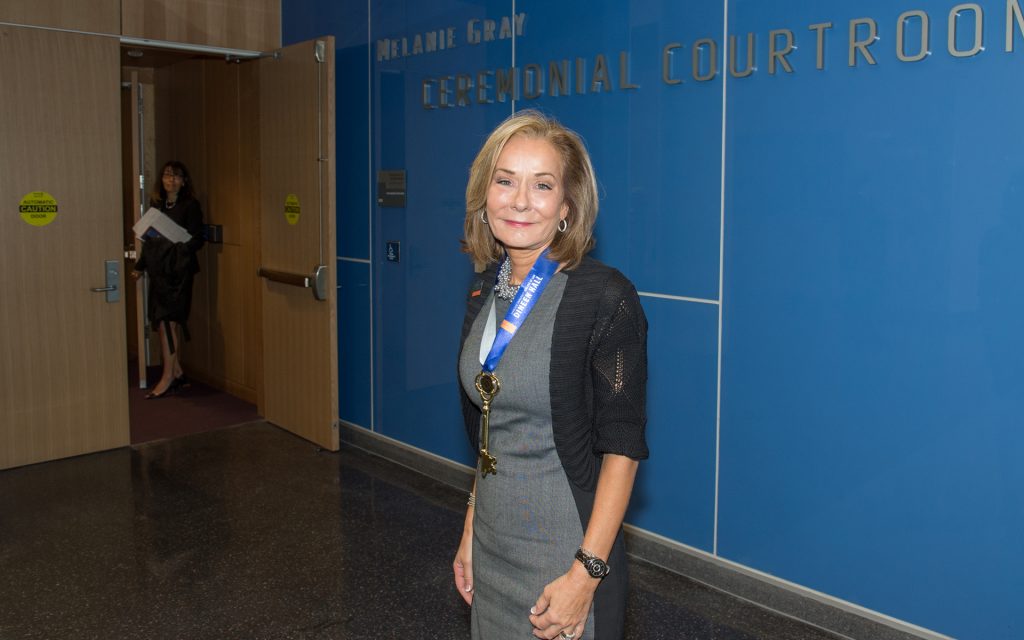
“We knew we needed a visionary leader with innovative ideas and a diversity of life experiences, who was also a team player and bold in vision and action,” says Melanie Gray L’81, who served on the University Board of Trustees and the College of Law Board of Advisors when Boise was hired. At the time, the College was running a multi-million dollar deficit and putting a drain on the university.
Melanie Gray L’81 standing outside of the Melanie Gray Ceremonial Courtroom.
“We knew we needed a visionary leader with innovative ideas and a diversity of life experiences, who was also a team player and bold in vision and action.”
Melanie Gray L’81, College of Law Board of Advisors, University Trustee
Chancellor Kent Syverud, himself an attorney and former law school dean, believed that Boise could turn things around with his bold vision and commitment to academic excellence. When Boise was appointed Dean in 2016, Syverud said “He is the ideal person to lead the College of Law into a new era.”
Craig Boise and Chancellor Syverud meet with students in Dineen Hall.
“Dean Boise’s creativity and drive helped the College of Law launch one of the first and one of the best online law degree programs in the nation. He has embraced and advanced priorities of the university, including disability advocacy and advocacy for veterans and military-connected students.”
Chancellor Syverud
“Dean Boise brought innovation to a discipline steeped in tradition,” says Chancellor Syverud. “Dean Boise’s creativity and drive helped the College of Law launch one of the first and one of the best online law degree programs in the nation. He has embraced and advanced priorities of the university, including disability advocacy and advocacy for veterans and military-connected students. I am so grateful to Dean Boise for his outstanding and entrepreneurial leadership over the last eight years and thank him for his distinguished service to Syracuse University.”
Boise says he was drawn to the opportunity because he knew the Chancellor truly appreciated the value of a top-notch legal education and describes Syverud as a mentor. “Still, it was a bit daunting,” he admits. And he had a lot more questions than answers. “How am I going to distinguish myself as a dean? What am I going to bring that is both important and instrumental in moving the institution forward?”
What Boise brought to the College was an incredibly diverse background of life experiences that uniquely qualified him to manage transition and lead through transformation. Raised in a small town in Missouri by Southern Baptist parents, he worked summers on a family farm in Nebraska and, at first, envisioned a career as a farmer or rancher. But his musical talent as a classical pianist earned him a scholarship to a conservatory and a new vision for his future. Then, economic realities set in and Boise left college for the workforce. He worked in a warehouse for a while, as a messenger in a law firm, and enrolled in the police academy. He still sips from his POLICE KCMO mug, a souvenir from his five years as an officer in Kansas City. That’s where he became interested in the law and a different vision for his future and enrolled at University of Chicago Law School. With his J.D. and later an LL.M. in taxation from New York University School of Law, he worked as a corporate lawyer, then switched to academia, eventually becoming dean at Cleveland State University’s law school.
Mark Neporent L’82 and Craig Boise pose for a photo after the fireside chat at the Denver JDinteractive Residency.
“Perhaps it was the police training, but like a good officer, Craig recognizes points of tension and embraces them. He knows how to deescalate situations and calm things down and bring people along to see his point of view. I’m a big fan and very appreciative of what’s he’s done for the law school and the University.”
Mark Neporent L’82, College of Law Board of Advisors, University Trustee
“There’s a force and energy within his lived experiences that stood out and differentiated him from all other candidates,” say Gray, who was on the Syracuse University search committee that recommended him for the position. Like Gray, Mark Neporent L’82 served on the Board of Advisors and was a University trustee. “Perhaps it was the police training, but like a good officer, Craig recognizes points of tension and embraces them,” says Neporent. “He knows how to deescalate situations and calm things down and bring people along to see his point of view. I’m a big fan and very appreciative of what’s he’s done for the law school and the University.”
In his first year as Dean, Boise launched an assessment of the law school’s assets to better understand what could distinguish it from the other 200+ law schools in the country. Four areas stood out: the Advocacy Program, Disability Law and Policy Program, Innovation Law Center, and the Institute for National Security and Counterterrorism (now known as the Institute for Security Policy and Law). “When we looked at the genesis of these programs, they were big innovations from the start,” says Boise. In fact, these programs provided a foundation for defining and securing the law school’s distinctive brand as an innovative law school. “We have a history of innovation that we could point to, which made it possible to tie the past to where we are going in the future.”
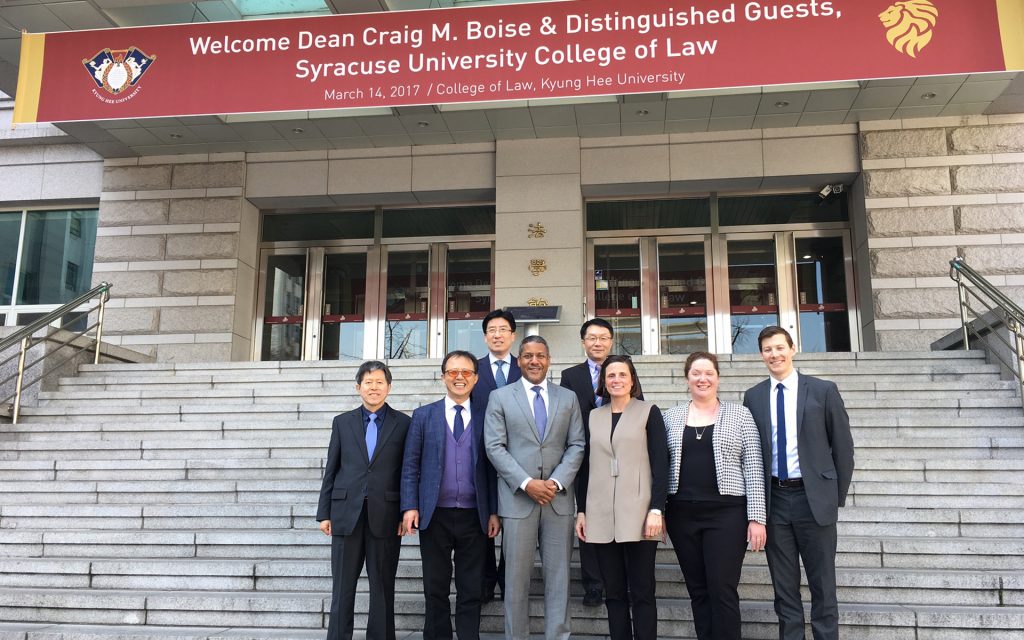
Craig Boise (middle front) and Sophie Dagenais (middle front) pose with colleagues at the College of Law at Kyung Hee University.
“Craig was steadfast in his determination to build on this history of innovation. To him, that was the brand and brand was mission critical. That meant providing the resources needed to deepen expertise, bringing in new faculty, expanding experiential learning opportunities in each area, engaging alumni, and telling the story of these assets and attributes more effectively to attract new students and drive philanthropic support.”
Sophie Dagenais, Former Assistant Dean for Advancement and External Affairs.
“Craig was steadfast in his determination to build on this history of innovation. To him, that was the brand and brand was mission critical,” says Sophie Dagenais, who served as Boise’s Assistant Dean for Advancement and External Affairs. “That meant providing the resources needed to deepen expertise, bringing in new faculty, expanding experiential learning opportunities in each area, engaging alumni, and telling the story of these assets and attributes more effectively to attract new students and drive philanthropic support.”
“We have a responsibility to our students to be at the forefront of legal innovation. When we are, we not only better prepare them for the future, but we also shape the future.”
Craig Boise, Dean
“There’s nothing I love better than new ideas and fresh ways of thinking about things, whether it’s curricular—what we are teaching our students—or new ways of teaching or innovation in operations. These things get me excited,” says Boise. “We have a responsibility to our students to be at the forefront of legal innovation. When we are, we not only better prepare them for the future, but we also shape the future.”
Perhaps nowhere is this innovative spirit and impact more apparent than in JDinteractive, the first hybrid online J.D. program of its kind in the nation, combining virtual class sessions with self-paced online instruction, short courses, in-person residencies and a legal externship. The concept of an online program was under development when Boise was hired, but there were questions about its viability. Boise worked closely with faculty to design a program that would get American Bar Association (ABA) support, bring new revenue to the law school, attract and expand a diverse pool of students, and enhance the law school’s reputation. “I was fortunate to work with faculty who were willing to help build the plane while we were flying it,” says Boise.
“It was like a field of dreams. We built it and they came,” says Nina Kohn, David M. Levy L’48 Professor of Law. Kohn who was Associate Dean for Research and Online Education when Boise was appointed dean, admits that she and other faculty members were skeptical at first, because online education was often perceived as low-quality by academicians. “One thing that the launch of a program like this offers is the chance to talk seriously with all constituents—our students, alumni and faculty—about who we are as a college of law and why what we do matters. Our goal was to offer the best possible legal education that meets the needs of the profession. We created a space for those individuals for whom the residential program was not an option: people who have jobs and are not living near excellent night programs; people who have caregiving responsibilities; people who are in the military and don’t live in one place for very long. The people we built this for are now our graduates, and many of them serve in communities that are historically underserved. So we are not only helping students get the legal education they dreamed of, we’re helping communities as well.”
“When Craig came on board, it was his passion that helped push the program forward,” says Shannon Gardner, Teaching Professor and Associate Dean for Online Education. “He’s leading for the future, committed to innovation and 22nd century lawyering.” Gardner teaches the first five-day on-campus residency course for the JDi students. “I just fell in love with the students. Most have wanted to go to law school for so long, but thought it was an unattainable dream. They have so much gratitude and it’s gratifying for us to see them be able to join the legal profession.”
“When Craig came on board, it was his passion that helped push the [JDinteractive] program forward. He’s leading for the future, committed to innovation and 22nd century lawyering.”
Shannon Gardner, Teaching Professor and Associate Dean for Online Education
“I went to Zoom school before it was cool,” says Tiffany Love ’22, who was in the first cohort of JDi students. A military spouse, she had put her law school dreams on hold. But while stationed in Germany, she was accepted into the JDi program. “I was literally in class from midnight to 4 am, and then worked full time as a paralegal for the Army JAG.” Though she was concerned at first about how her credentials would be perceived by potential employers, she says the quality of a Syracuse law degree was an asset, no matter how it was attained. Now, Love is a second year associate at Phelps Dunbar LLP in Tampa.
“The JDi program single-handedly changed the trajectory of my life; it made a law degree accessible with the reputation of a national security powerhouse. Along with other College of Law visionaries, Dean Boise created this future for me. I know my legal contributions made a difference. I am forever grateful.”
Meghan Steenburgh G’97, L’23, Assistant General Counsel with the Department of Defense
Meghan Steenburgh G’97, L’23 is also living her dream, thanks to JDi. Now Assistant General Counsel with the Department of Defense, she said the program allowed her to pursue a law degree while caring for her children and helping her parents while living in three different states. “The JDi program single-handedly changed the trajectory of my life; it made a law degree accessible with the reputation of a national security powerhouse,” says Steenburgh. “Along with other College of Law visionaries, Dean Boise created this future for me. I know my legal contributions made a difference. I am forever grateful.”
The popularity and success of JDi also changed the fiscal trajectory of the law school. Further, concerns about quality are a thing of the past, with increased LSAT scores among applicants and impressive bar passage rates. JDi’s success has had ripple effects throughout the university, with the creation of the nation’s only online joint J.D./MBA program, a significant expansion of the Center for Online and Digital Learning to provide support for other degree programs, and, the inclusion of JDi students in other stellar programs like Advocacy and Syracuse Law Review. For example, JDi students are included in virtual trial competitions, preparing students for more virtual practice in the real world. “They have a leg up,” says Jefferies, noting that she recently had three court cases in which she appeared virtually. She now coaches JDi students for virtual advocacy competitions.
A pilot program with JDi students will contribute to a significant expansion in enrollment in the ILC, says Gerling. Gerling also credits Boise with bringing the University’s tech transfer office into the ILC, giving law students the chance to do real-world work on commercializing new technology generated by researchers across the campus. “That’s a real feather in Craig’s cap,” says Gerling. “His vision and leadership led to a productive working relationship between the Office of Research and the law school. We’ve also developed internships with the Office of the General Counsel. Our students not only learn how to think like lawyers but practice the skills necessary for the practice of law.”
And it was Boise’s outreach to alumni that made it possible for students to develop so many new skills. “Craig engaged alumni in unique ways,” says Dagenais. “Our alumni stepped up and delivered content for JDi residencies, teaching short courses for a weekend or several days and enabling our students to do a deep dive into specialized sectors of the law.”
Boise’s ability to articulate the vision engaged alumni in ways that will benefit the law school for years to come. “He’s an impressive guy,” says Frank Ryan L’94, DLA Piper’s Global Co- Chair, Global Co-CEO and Americas Chair. Ryan rejoined the Board of Advisors in 2017 after Boise met with him in New York City and persuaded him to get re-engaged with his alma mater. “Craig’s ideas on how to transform legal education connected with me. He read the tea leaves and offered an understanding of how to compete against other law schools and how we as alumni could help.”
Now, Syracuse Law has the highest rate of alumni engagement of all twelve University schools and colleges, along with the highest alumni giving participation, exceeding its goals for the Forever Orange Campaign a year ahead of schedule. Ryan calls Boise an “exceptional team builder. He empowers people and then lets them go and do their jobs.”
Benita Miller L’96
“Craig just has a way about him. He was willing to hear the hard stuff and discuss the pain points shared by Black alumni from the 1990s like myself. He created space for diversity that did not alienate the traditions that were so important to the institution.”
Benita Miller L’96, Vice President of U.S. Programs for the Center for Reproductive Rights
Benita Miller L’96 credits Boise’s for engaging alumni in meaningful ways by “creating space for everyone at the table.” Now Vice President of U.S. Programs for the Center for Reproductive Rights, Miller says she had not felt “at home” at the law school until Boise reached out, painted the vision, listened to her concerns and ignited her passion to serve the students. Today, she is on the Board of Advisors and mentors JDi students. “Craig just has a way about him. He was willing to hear the hard stuff and discuss the pain points shared by Black alumni from the 1990s like myself. He created space for diversity that did not alienate the traditions that were so important to the institution.” Miller cites JDi and the Orange Advance pipeline program with HBCU institutions as innovations that “are really important to our profession. We’re contributing to a more expansive legal community.”
“Craig focused the value proposition of law school on opening the aperture for our students to have more career opportunities and reach life goals,” says Lily Yan Hughes, Assistant Dean of Career Services and Student Experience. Having had a prolific career in corporate law, Hughes was intrigued when Boise approached her in 2021 to help him reimagine career services. “My team’s ‘tagline’ is that we are not just resume readers or a job bank. We are here to help students think more strategically and to be CEO of their own careers.”
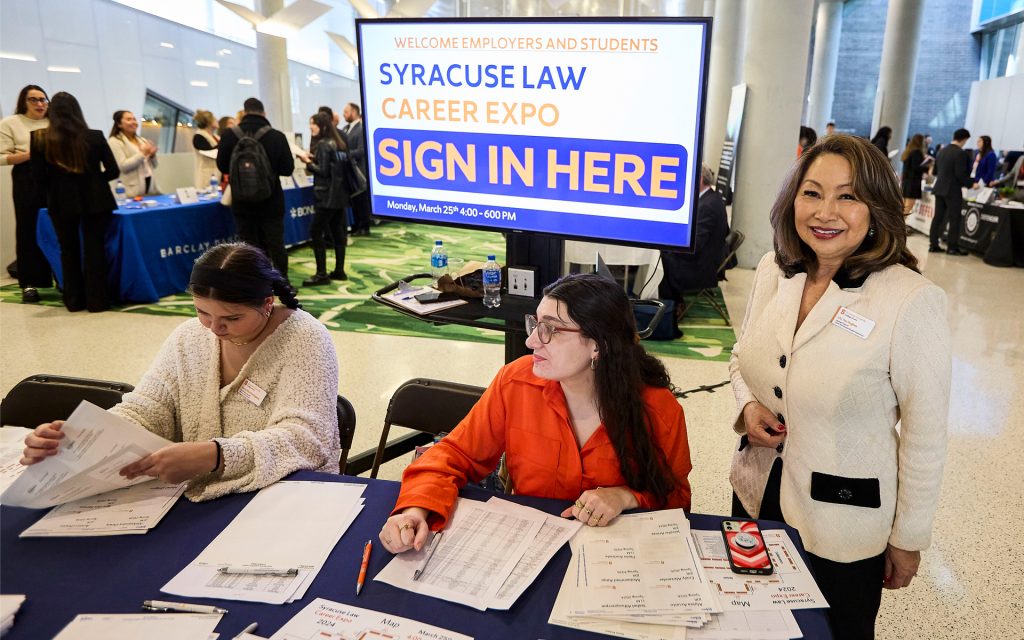
Lily Yan Hughes, Assistant Dean of Career Services and Student Experience and team at the Syracuse Law Career Expo.
“Craig focused the value proposition of law school on opening the aperture for our students to have more career opportunities and reach life goals.”
Lily Yan Hughes, Assistant Dean of Career Services and Student Experience
Evidence of the value proposition at work: The last four years have seen a 55% increase in overall student externship placements. Last year, 195 students were placed in externships in 29 states, many of them made possible because of the Orange alumni network. The rate of employment ten months after graduation jumped 21% from 2018 to 2023.
As graduates fan out into careers in the courtroom or the boardroom, in public service or private equity, and use their degrees to practice law or bring a different way of thinking to other industries, they are the living legacy of the tenure of a dean dedicated to innovation and bringing a new value proposition to their education.
The Board of Advisors recognized that legacy in creating a new scholarship in his name, to be awarded to a student who has demonstrated an entrepreneurial and innovative spirit. With emotion in his voice as the scholarship plaque was presented to him, Boise expressed his gratitude. “This was such a perfect gift because it reflects what I value most—opportunities for our students to pursue meaningful careers in a world that requires their vision, integrity and a steadfast commitment to justice.”
As Boise prepares to take his first sabbatical in 21 years, he’s looking forward to contributing to further innovations in legal education. He plans to teach a JDi course and work with the Center for Online Design and Learning to integrate new technologies into course design. But first, he says, he’ll focus on other passions. He’ll play more piano, especially the works of Rachmaninoff and Chopin who were both considered innovators in their time. He also plans to set sail, steering a boat through whatever turbulence he might encounter to find peace and calm in the expanse of the seas.