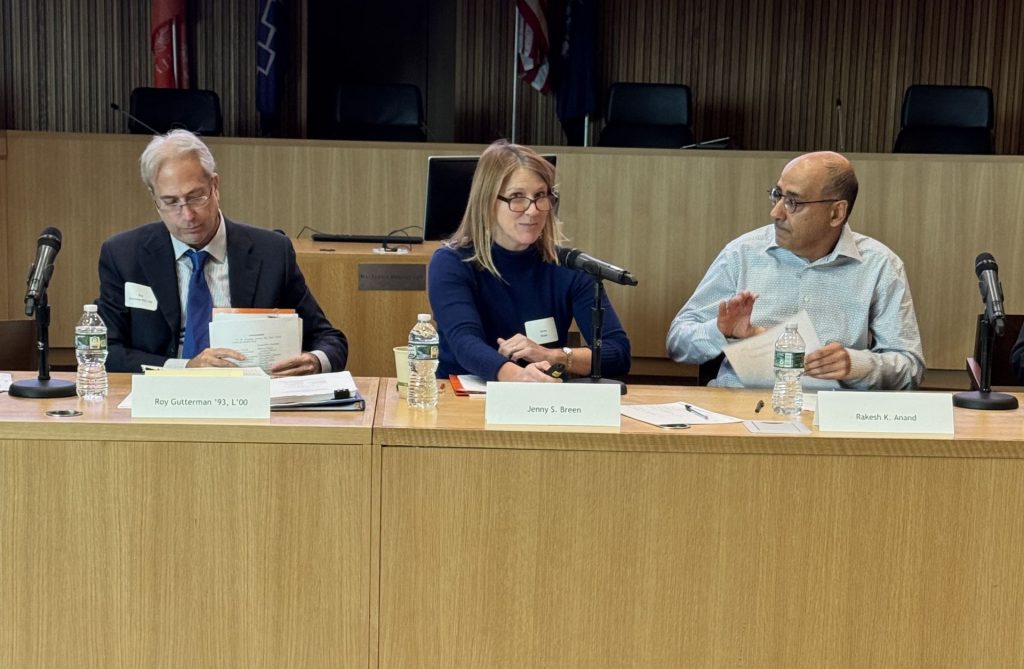
Syracuse University College of Law hosted its Ninth Annual Supreme Court Review and Preview, an event that brought together judges, scholars, and practitioners to analyze the upcoming U.S. Supreme Court term and reflect on the role of law, learning, and civic engagement. The day began with a luncheon keynote by Hon. Mae A. D’Agostino L’80, U.S. District Judge for the Northern District of New York, followed by an engaging lecture from David Lat, founder of Above the Law and Original Jurisdiction. The afternoon concluded with a panel discussion moderated by Dean Terence Lau L’98.
Judge D’Agostino opened the program with a reflection on the responsibility and reverence inherent in the judicial process. She spoke about her deep respect for the law and for the institution of the courts. She emphasized that maintaining public trust in the judiciary depends not only on judges but on lawyers, law students, and citizens who understand the courts’ vital role in preserving democracy. Civic education, she noted, is essential to that mission, and she encouraged students to see themselves as stewards of that trust.
Following lunch, Lat delivered his keynote address, “The Evolution of Judicial Clerkships.” With humor, candor, and historical perspective, Lat described how the judicial clerkship has evolved from a behind-the-scenes assistantship into one of the most prestigious and coveted positions in the legal profession. Lat explained the relationship between judge and clerk as a professional partnership that shapes opinions, careers, and the rule of law itself. Tracing the transformation of clerkship hiring across generations, Lat discussed the influence of elite institutions, the persistence of “feeder” judges, and the delicate balance between access, merit, and diversity.
After the keynote, the panel turned to the Supreme Court’s most anticipated cases of the 2025–26 term. Dean Lau began with Learning Resources v. Trump, a case examining whether the International Emergency Economic Powers Act (IEEPA) authorizes the president to impose tariffs. He explained that while IEEPA was designed for national security emergencies, its use in trade policy raises fundamental questions about the outer limits of executive authority. Dean Lau noted that the statute’s ambiguity makes the Court’s direction “incredibly difficult to predict,” as the justices weigh deference to executive discretion against Congress’s constitutional role in regulating commerce.
Professor Rakesh K. Anand began with Little v. Hecox, exploring how this case forces the Court to confront complex questions of gender identity, equality, and free speech. Reflecting on the Equal Protection challenges to laws restricting participation in women’s sports, he expressed uncertainty about how the justices will engage with evolving social perspectives. He also examined Chiles v. Salazar, a First Amendment case that tests the line between professional regulation and viewpoint discrimination, suggesting that the Court’s reasoning could reshape the boundaries of professional speech for decades to come.
Associate Professor Jenny Breen brought the conversation to the administrative state and executive power, focusing on Trump v. Slaughter and Trump v. Cook. She explained that both cases revisit presidential removal authority over independent agencies, raising the possibility that the Court could overturn Humphrey’s Executor v. United States, a cornerstone precedent protecting agency independence. Breen described the Court’s use of the “shadow docket,” emergency rulings without full briefing or argument, as one of the most consequential shifts in modern jurisprudence. She explained how the shadow docket is now not just being used for procedural reasons but rather substantively shaping the balance of power in ways the public often doesn’t see.
Professor Roy Gutterman L’00, Director of the Tully Center for Free Speech, discussed First Choice Women’s Resource Centers v. Platkin, Landor v. Louisiana Department of Corrections, and Cox Communications v. Sony Music Entertainment. Gutterman examined how these cases intersect free expression, religious liberty, and digital accountability, highlighting their implications for online platforms, statutory remedies, and modern speech protections.
Rounding out the program, Lisa Peebles L’92, Federal Public Defender for the Northern District of New York, offered a practitioner’s perspective on Case v. Montana, Villarreal v. Texas, and Hamm v. Smith. Peebles explained how these cases raise real-world questions under the Fourth, Sixth, and Eighth Amendments. In Case v. Montana, Peebles described the challenges law enforcement faces in determining when an emergency justifies warrantless entry, while Villarreal v. Texas revisits whether barring a defendant from consulting counsel during an overnight recess violates the Sixth Amendment. In Hamm v. Smith, she explored how the Court may refine its approach to assessing intellectual disability in capital cases. Her thoughtful remarks highlighted the human stakes behind doctrinal debates.
At the conclusion, the participants reflected on the breadth of issues before the Court and the lively exchange of ideas that defined the day. Through their discussions, the program reinforced the value of public dialogue and the importance of staying informed and engaged with the law as it continues to evolve. The program was organized by Associate Dean Lauryn Gouldin and 3L Bess Murad, on behalf of the Syracuse Civics Initiative, and with support from the Northern District of New York Federal Court Bar Association, the Tully Center, and the Institute for the Study of the Judiciary, Politics and the Media.