Syracuse University College of Law now offers the nation’s first joint J.D. and M.S. in Sport Analytics program in conjunction with the Syracuse University David B. Falk College of Sport. The joint program, to be offered starting the Fall 2026 semester, allows College of Law students to earn their J.D. and M.S. concurrently, typically graduating in three years and at no cost beyond that of the J.D.
College of Law on campus students entering their second year can apply for the J.D./M.S., the College of Law’s 13th joint program.
The master’s degree requires 36 credits. A total of 15 credits from the sport analytics program can be counted toward the J.D. Further, six designated law credits will count toward both the J.D. and the M.S. electives. Law students enrolled in the joint JD/M.S. must take 72 unique law credits and 30 unique M.S. credits. Therefore, obtaining the joint J.D./M.S. requires completing 102 total credit hours.
“This is a program that only Syracuse can offer. Our College of Law and the Falk College of Sport are literally next door to each other, and that proximity translates into a truly integrated curriculum. No other law school in the country can pair a J.D. with a world-class sport analytics program under one roof,” said College of Law Dean Terence J. Lau L’98.
The joint J.D./M.S. is designed for law students interested in working in the front office of sports teams, the legal departments of sports leagues, sports agents, sports gambling companies, and others involved in sports.
“Being able to combine a law degree with a master’s degree in sport analytics provides our law students with an advanced credential that will set them apart when entering the workforce,” said College of Law Professor Todd Berger.
The M.S. follows Falk College’s established graduate Sport Analytics curriculum that emphasizes Applied Statistics, Econometrics, Databases and Machine Learning, R/Python Programming, Sport Gambling Analytics, and Visualization, among other disciplines.
“There is increasing demand for professionals who can navigate the complex intersection of law, analytics, and sport business. The combined J.D./M.S. degree prepares graduates to meet this demand by equipping them with both legal acumen and advanced quantitative skills these roles increasingly require,” said Rodney J. Paul, Ph.D., Professor and Chair in the Department of Sport Analytics at the Syracuse University David B. Falk College of Sport.
“Analytics has been largely popularized in the sport industry, but it has the ability to impact many other industries. Based on my personal background as a sport lawyer, bringing analytics into the study of law is a natural extension for Falk College of Sport. But it is also an incredibly valuable tool for practicing attorneys and even judges to better understand trends and precedents in the law and to predict probable outcomes of cases,” said David B. Falk ’72, Syracuse University Life Trustee and Founder & CEO, Falk Associates Management Enterprises.
Graduates will be uniquely positioned for roles in compliance, regulation, governance, player representation, sport betting and gaming law, collective bargaining, and analytical decision-making across professional teams, leagues, sportsbooks, and regulatory agencies.
Where better to learn about international tax law than Switzerland? Its prominence in global taxation comes from a combination of low tax rates, financial privacy, and political stability, which has long attracted multinational corporations and wealthy individuals. With a sophisticated financial sector, favorable tax treaties, and a highly developed business environment, Switzerland is a hub for international wealth management and corporate structuring, making it a powerful influence in the field of international tax law.
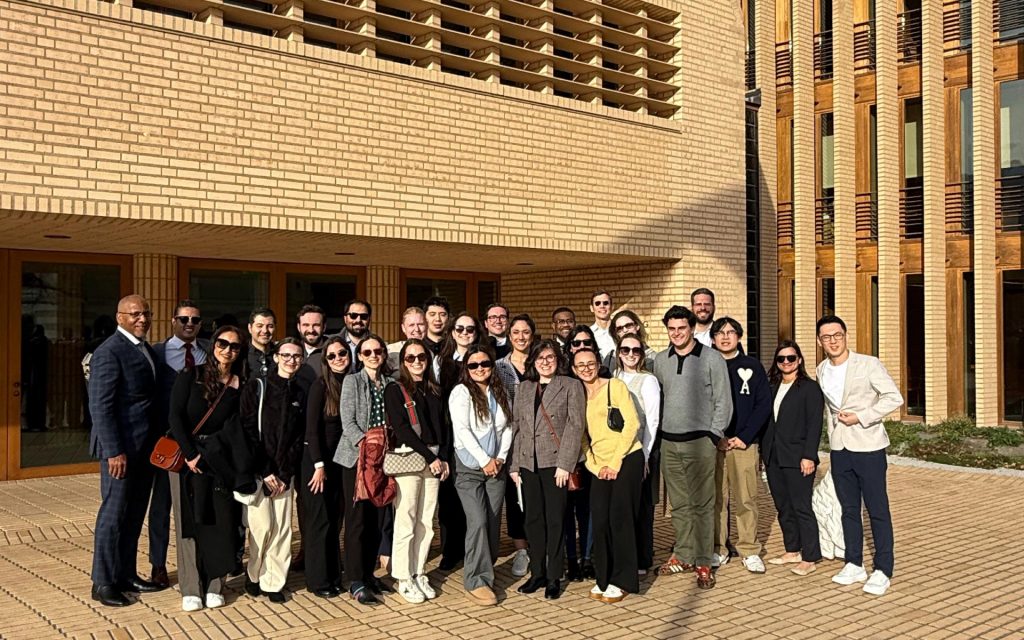
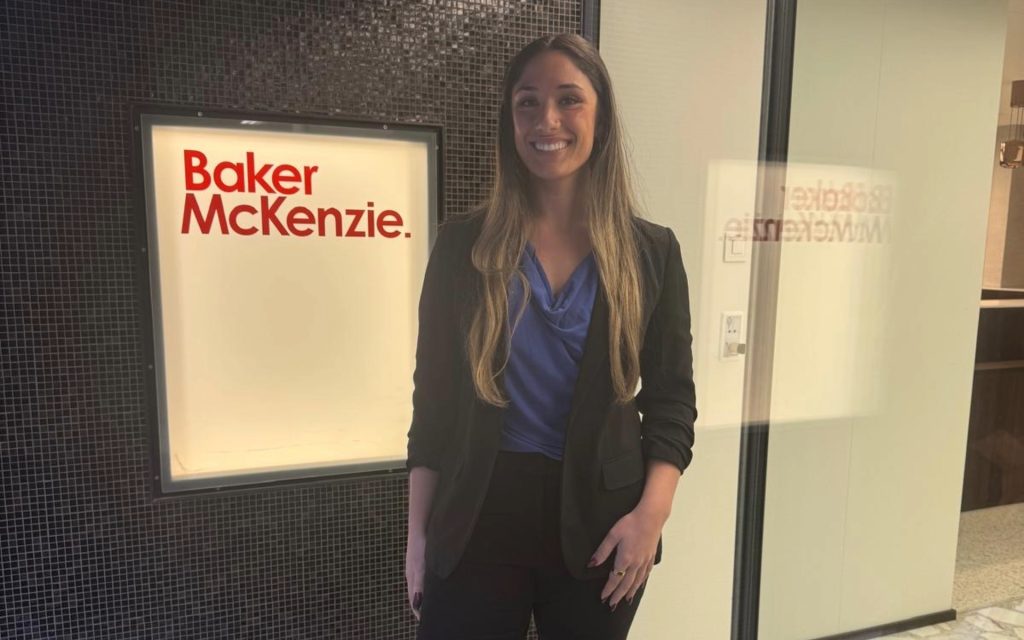
In March, 25 students from Syracuse University College of Law got an inside look as they traveled to Zurich to take part in a three-day course, The Evolving Role of International Tax, Transparency and Tax Equalization, led by Dean Emeritus and Professor of Law Craig Boise and Marnin J. Michaels G’96, L’96, a partner at global law firm Baker McKenzie Zurich, known for its high-end, cross-border corporate, finance, and tax expertise.
“Throughout this trip, students realized just how critical tax law is because taxes are one cost that every company, everywhere, has, and is always trying to reduce,” says Boise, who practiced tax law before entering academia. “This experience gave students insight into why tax planning is so important to how companies structure themselves around the world and how many corporate decisions are actually driven by taxes and tax laws.”
Open to on-campus and hybrid online JDinteractive (JDi) students, the course offered presentations from a prestigious slate of Swiss-based tax attorneys, government officials, and corporate experts brought together through Michaels’s extensive professional network. Topics included tax treaties, cross-border business structures, trade issues, trust and wealth planning, and the renewed interest, particularly in the U.S., in tariffs.
“What stayed with me most was a presentation by Pablo Bentes, a partner at Baker McKenzie, on the convergence of taxes, tariffs, and sanctions,” says Omar Ismael Nuno L’27. “What made it so impactful was the way he explained that there are no longer isolated policy tools but those that increasingly work together as revenue generating and geopolitical instruments. That really changed the way I think about international legal systems because it showed how economic policy, cross-border regulation, and global power can all intersect.”
The group was hosted by Baker McKenzie and also visited Bank Vontobel, a leader in private banking and investment service with global presence and vast expertise in wealth management services.
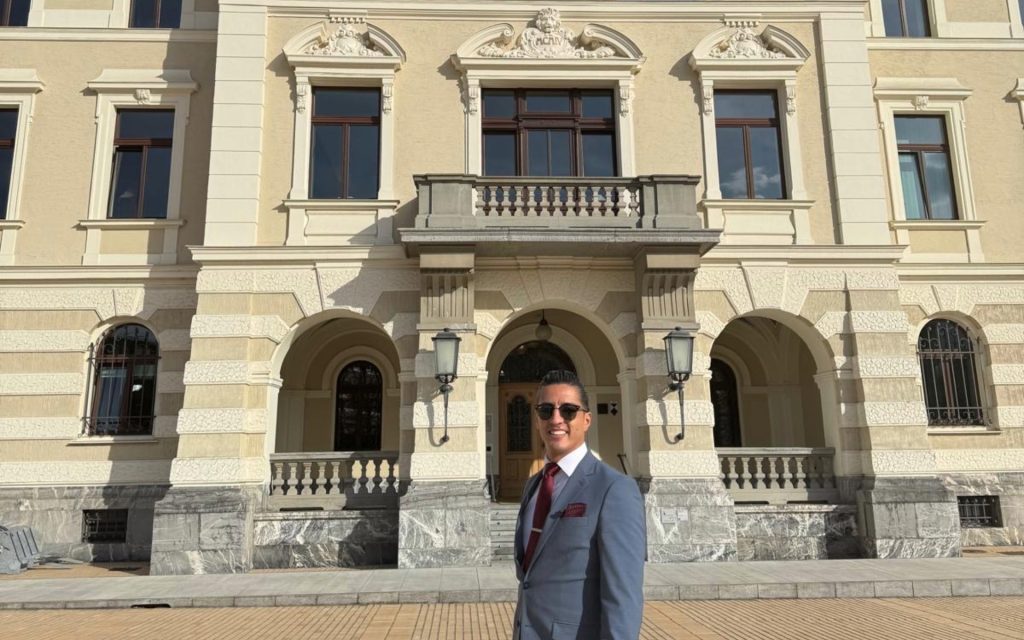
One of the three days was spent in Liechtenstein, where students visited Kaiser Partner, a family-owned financial service group and private bank specializing in wealth management, family office services, trusts, fund administration, and investment advice.
Students also had time to experience the people, sites, and culture of Switzerland. This is the third time Syracuse Law has offered a course on international tax law outside the U.S. with this being the largest group to date, a testament to its popularity. Olivia Roberson L’27 was most impressed by the long global reach of Syracuse Law.
“Marnin Michaels truly exemplifies that there are no boundaries for us as law students, as he went to Syracuse Law and now works at Baker McKenzie in Zurich,” she says. “This shows that our opportunities are endless, and our legal careers can bring us anywhere in the world.”
When Emma Boehme Grant L’29 was accepted into the Syracuse University College of Law’s JDinteractive (JDi) program, she looked forward to sharing experiences with others studying the law through the hybrid online program. However, Emma was fortunate to already have someone very special in her corner to help her acclimate to law school — a 3L who just happened to be her father, George Boehme L’26.
Shared Values Draw Father/Daughter to JDi Program
George is currently completing his last semester in the JDi program, after retiring from a successful career in newspaper publishing and starting his “second act” in his 60s by enrolling at Syracuse Law.
Feeling he hadn’t done enough to make the world a better place throughout his career, George decided that a law degree would allow him to offer pro bono legal services to those in need and possibly teach law at some point. Located in Houston, George found Syracuse Law’s JDi program allowed him to stay in Texas while achieving his goals.
Emma lives in Memphis, Tennessee, where she works full-time as the homeless management information systems director at the Community Alliance for the Homeless.
Emma Boehme Grant (orange scarf) at a January 2026 JDi Residency in Syracuse, NY with fellow classmates Jenny Blanch Dickinson, Heather Winnie and Jill Ayers.
She always wanted to contribute to the “greater good” and, at first, focused on art, culture, and community as a way of empowering people and creating change. Later, she chose to be a preschool teacher to impart good values, morals, and decision-making on young children.
“It was gratifying, but neither was fulfilling me the way I had hoped,” she says of her early career choices. However, Emma’s current job has shown her the many challenges organizations and the people they serve face that could benefit from someone with a formal legal background to guide them.
“Through a combination of my life experience and the current political climate, I see law school as a step in positively impacting the world around me,” she says.
Crossing Paths and Sharing Experiences
At the time, George was already enrolled in the JDi program, and Emma admits he was an inspiration to her. Seeing how much her father valued the JDi program, she decided to explore it herself and quickly realized that its flexibility and online courses could be an ideal fit for her, too.
“When my daughter first asked me about Syracuse’s JDi program, I was flabbergasted, as she had never mentioned an interest in the law before,” George says. “I wasn’t sure if she was serious at first, and I didn’t want to scare her off. But now that she is a student here, too, I am incredibly proud. I tend to be a big cheerleader for the Syracuse JDi program, as I can’t find a single flaw in my own experience, so I love telling others about it— and that included my daughter.”
Because George is two years ahead of Emma in the program and classes are held online, she did not expect much interaction with her dad. But she did not anticipate that he would serve as an academic success fellow for Civil Procedure during her first semester and for Contracts this semester.
“It just worked out that way, and it’s nice to know he’s there for me, but he doesn’t give me special privileges. He still makes me schedule office hours with him, and not just pop on the phone and say, ‘Dad, can you help me?’” Emma explains, noting that most people at the College of Law are aware that they are father and daughter.
“But, it is an advantage that he knows better than anyone how my brain works and how I process information, so, of course, he helps me and is very forthcoming with letting me know what resources are available to me at the law school,” she adds.
While Emma has a way to go in the program, she is eager to continue. George is preparing to graduate this May and start his legal career.
“Honestly, I’m disappointed that my Syracuse Law experience is about to be over, but I’m eager to see what’s in store for me after graduation, as I’ve been working hard towards that goal,” George says.
“I’m confident my daughter will have a similar experience over the next two years. And I can’t wait for the day I’ll be able to say that both father and daughter are alumni of Syracuse University College of Law.”
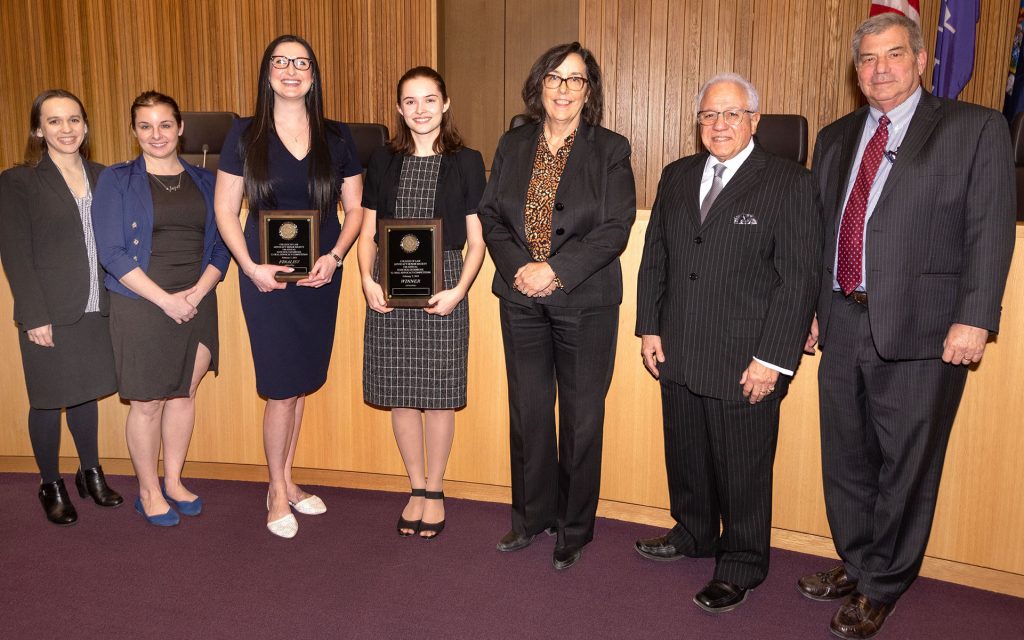
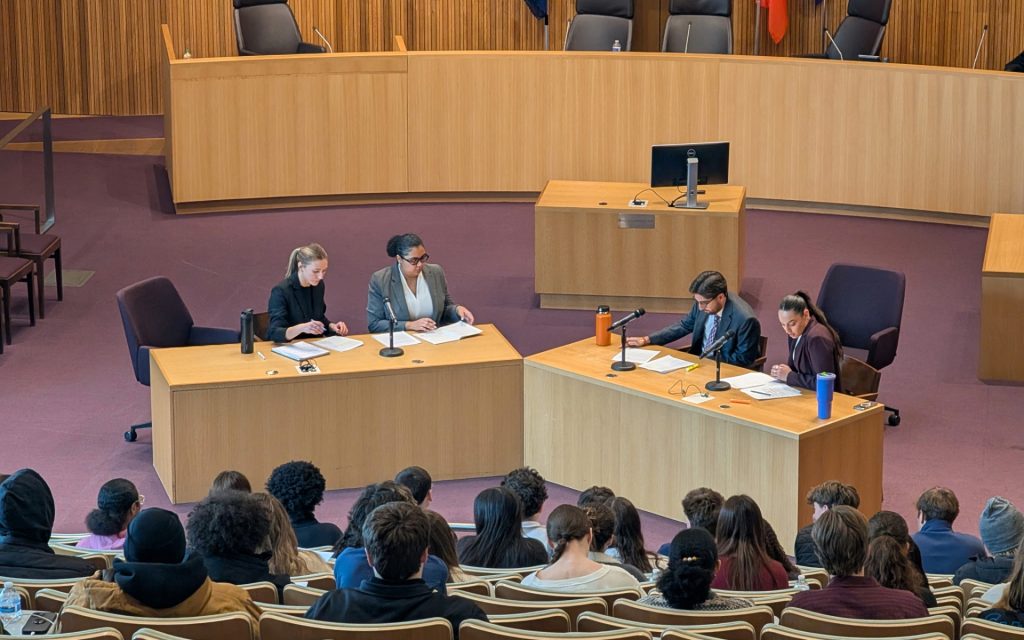
Matthew Cohn L’28 prevailed over Hannah Stacy L’28 in the 16th Annual Hancock Estabrook First Year Oral Advocacy Competition. The final round was judged by Hancock Estabrook partners Daniel Berman L’82, Mary D’Agostino, and John G. Powers L’96.
The competition featured 26 first-year Syracuse Law students.
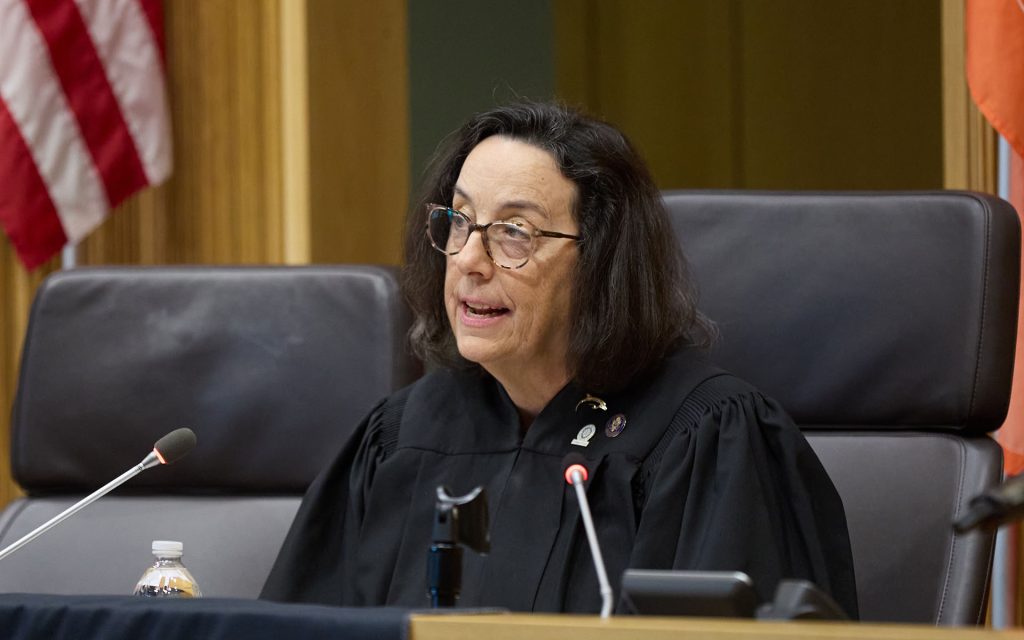
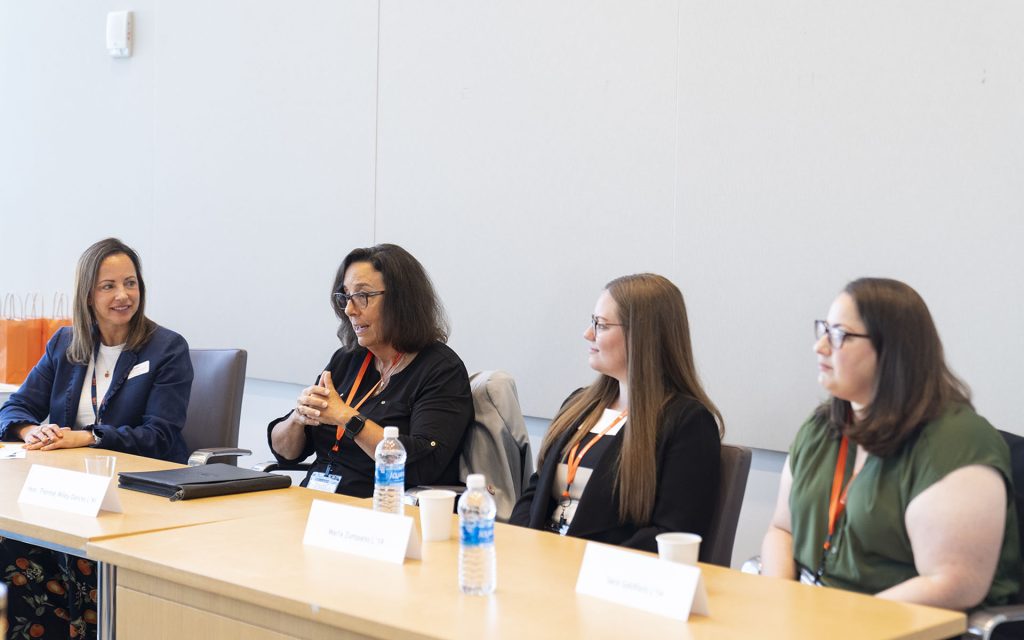
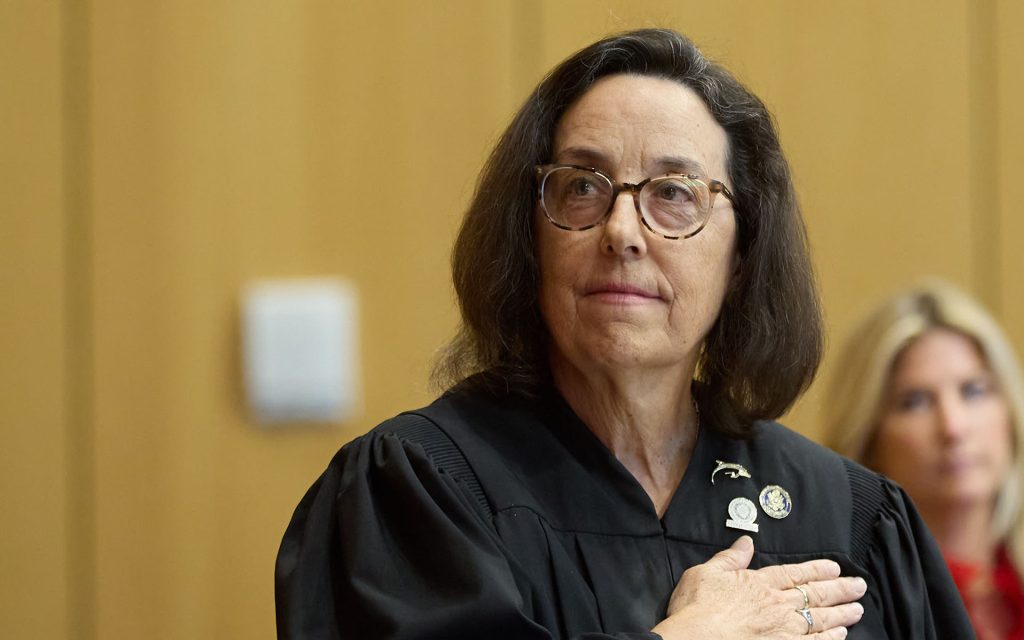
The Hon. Thérèse Wiley Dancks L’91 retired from the bench this February after a respected career that spanned several decades. Her accomplishments included serving as a federal magistrate judge for the U.S. District Court for the Northern District of New York since 2012, the first woman in this role; as a founding partner of the law firm of Gale & Dancks LLC with a focus on civil litigation and trial work; a highly involved member and leader of state, local, and specialty bar associations and community organizations, including past president of the Central New York Women’s Bar Association; and the recipient of numerous awards from Syracuse Law, legal organizations, and the Central New York community that reflect her contributions to the law.
Yet, despite all her achievements, Dancks believes one of her greatest has been mentoring law students and young lawyers, particularly women, as they navigate the legal field.
“It has been my mission throughout my career to pay it forward to the next generation of lawyers,” says Dancks, who has demonstrated that commitment at her alma mater, Syracuse University College of Law, by serving as a mentor to many and offering externships to numerous Syracuse Law students, as well as those at a few other law schools.
She also credits her law clerks who always enthusiastically embraced helping the law students who worked in chambers.
Giving Back and Paying It Forward
Growing up in East Syracuse, New York, as the youngest of eight children, Dancks loved to read and always knew she wanted to help people. Her mother was an early influence, often sharing stories of her job as a court reporter. As an undergraduate at Le Moyne College, Dancks credits her father, who was a professor there, for encouraging her to explore her options and take business law classes. The experience sparked her interest, though she didn’t earn her J.D. from Syracuse Law until age 30. After reaching that milestone, Dancks became committed to helping others do the same.
“Right out of law school, I didn’t necessarily have the financial resources to give, so I gave my time to the College of Law. I always enjoyed talking to groups of students or speaking to them one-on-one, and I also helped to judge moot court and other competitions,” she explains. “I did this in the hope that students, particularly women, would see someone who graduated from the same law school they were attending had been successful and know they could do the same.”
While her career thrived, her commitment to Syracuse Law never wavered. When she became a judge, she continued to guide students at the College of Law.
“I loved having student law clerks in my chambers because they are fresh and new, and it’s all very exciting to them,” she says. “It helped me from becoming jaded, and it was refreshing to see the law through young people’s eyes.”
“I give out my email and tell students to reach out to me. Or if they want to talk we go to lunch, although students never pay for lunch—that’s my rule,” she adds.
“I just ask that they pay it forward and be a mentor or role model for other law students and help them on their career paths. If that’s my legacy, that would be awesome.”
Dedication Earns Respect of Colleagues
Her dedication has not gone unnoticed by her colleagues, including the Hon. Deborah Karalunas L’82, administrative judge for the Fifth Judicial District and an adjunct professor at Syracuse Law.
“Her energy in support of others—particularly in advancing gender equality—is boundless,” says Karalunas, who also applauds Dancks’s commitment to the legal community through her work with the Central New York Women’s Bar Association, Vera House, and the Onondaga County Bar Association.
“Her commitment to the legal community began when she was a new lawyer and never wavered. Thérèse has given students exposure to practical legal experience, and she has helped them hone written and analytical skills critical to their success,” she adds.
Student and Alumni Cherish Her Time and Attention
What gives Dancks the most satisfaction, however, is knowing she has made an impact on Syracuse Law students who will contribute to the legal field in their own unique ways.
During an oral advocacy competition, Grace Frey L’25 first saw Dancks as she confidently led the event and gave kind but solid feedback to students.
“When I learned of Judge Dancks I didn’t yet know what a magistrate judge did, but people at the law school spoke so highly of her that I knew I had to work for her,” says Frey.
She eventually secured a “very rewarding” clerkship with Dancks. “Despite her busy schedule, Judge Dancks was available to me, especially in helping me decide what type of law I wanted to pursue. Not all judges would take the time,” Frey says. “When I passed the bar, Judge Dancks called and asked how my new job was going. She inspired me 1,000% and instilled in me the importance of giving back as you move forward.”
Frey is now a term law clerk to the Hon. Debra C. Poplin and the Hon. Jill E. McCook in the Eastern District of Tennessee, and she credits Dancks’s guidance for helping her secure the role.
Other Syracuse Law alumni have had the privilege of getting to know Dancks through organizations within the legal community.
“Judge Dancks is one of the most generous humans, and she had a truly demanding job yet would still go above and beyond,” says Colleen Gibbons L’17, current president of the Central New York Women’s Bar Association. “She is very thoughtful and genuine in a way that was really helpful to me—explaining her own career path, sharing her experiences, both good and bad; helping develop a strong network of women, and still having a depth of humility that is astonishing.”
Judge Dancks with the winning team from the 2024 Hancock Estabrook 1L Oral Advocacy Competition.
Finding Her Next Chapter and Not Failing at Retirement
Dancks will probably never know quite how many people she has left a positive impression on, as there are too many to count. What she is certain of, however, is that she is “not going to fail at retirement.”
“I want to read by the water without having to drag work along with me,” she says. “I’ll keep my license for a few years, so I can do some pro bono work, possibly in landlord tenant court or small claims arbitration. Maybe at some point I’ll teach a class or a seminar. They know where to find me.”
Dancks also intends to volunteer for local organizations, which will probably include a cat shelter, a hospital, and reading programs in elementary schools, including the Read Across America Program, an initiative that the Central New York Women’s Bar Association has taken on to make sure children learn to love reading.
“It’s going to be a different rhythm, but I want some time to explore and see what I want to do in my next chapter,” Dancks says. “Whatever that is, I’m certain I’ll continue to work for justice in some way to help make the world a little bit better.”
Syracuse University College of Law’s annual Youth Law Day event recently welcomed more than 120 high school students from across Central New York to Dineen Hall for a wide-ranging introduction to the legal profession. The students also learned about the role of an attorney in society and how to begin their path to law school.
Students heard from a panel of legal professionals who shared their unique journeys to law school, featuring Jimmie McCurdy G’09, L’09; William Wolfe L’20; Marisol Estrada Cruz L’23; Shira Levin G’25, L’25, and Professor Thomas Leith. Professor Suzette Meléndez organized and moderated the panel.
Then, students divided into groups to tackle a negotiation strategy session led by College of Law students. Students were able to network with members of the local, state, and federal judiciary during lunch. A question-and-answer panel of current Syracuse Law students followed, with the students sharing their path to law school, best ways to prepare for law school, and more. The panel was moderated by Anthony Ruscito L’27 and featured Kayzjah Charles L’26, Eric Boutros L’27, Elizaveta Bukraba-Ulanova L’27, and Mira Gaitanis L’28.
Closing remarks were provided by Professor Courtney Abbott Hill L’09, who coordinated this year’s event.
An oil portrait of alumnus and 46th U.S. President Joseph R. Biden Jr. L’68, H’09 will go on permanent display in the College of Law’s Dineen Hall Law Library after a ceremony in April.
Syracuse University will unveil a portrait of alumnus and 46th U.S. President Joseph R. Biden Jr. L’68, H’09 in Dineen Hall at the College of Law during a private ceremony with the former president on Tuesday, April 14, 2026.
The artwork, painted by distinguished American portrait artist Michael Shane Neal, is an oil-on-canvas portraiture completed in 2025-2026. The portrait was commissioned by Syracuse University to honor one of its most prominent alumni. Neal is one of America’s foremost portrait artists, whose works hang in the U.S. Capitol, the Smithsonian’s National Portrait Gallery and the Pentagon, among other prominent institutions.
“Syracuse Law is proud to count a former president among our many outstanding alumni,” College of Law Dean Terence J. Lau L’98 says. “President Biden has never forgotten where his legal career began, and we have never forgotten him. His portrait in Dineen Hall will remind every student who passes through our doors that a Syracuse Law education doesn’t just open doors. It can change the course of history.”
Biden earned a juris doctor from the College of Law in 1968 and has maintained a close connection with the University ever since. He delivered the College of Law Commencement address on four occasions—in 1994, 2002, 2006, and 2016—and returned to campus in 2009 to deliver the University’s Commencement address and receive an honorary degree.
Biden received the University’s Chancellor’s Medal in 1974; the Law Alumni Association’s Distinguished Service Award in 2003; and the George Arents Pioneer Medal, the University’s highest alumni award, in 2005. In 2018, he was honored with a prestigious Syracuse Law Honors Award from the Syracuse University Law Alumni Association and the College of Law.
The portrait will be on permanent display in the college’s Law Library Reading Room, where the public can view the painting during normal library hours.
Professor Katherine Macfarlane, Director of the Syracuse University College of Law’s Disability Law and Policy Program, was elected to Chair the Association of American Law Schools (AALS) Section on Women in Legal Education (WILE), the largest AALS section.
She was previously the section’s Chair-elect and Treasurer. Macfarlane has also served as chair of the AALS Section on Disability Law and co-founded the first AALS affinity group for disabled law professors and allies. She frequently presents and writes about students, lawyers, and professors with disabilities, and the challenges they face in obtaining reasonable accommodations.
“It is an honor to lead this important and influential section,” said Macfarlane. “I am excited for this opportunity to give back by providing leadership and mentorship to all women in legal education.”
According to the AALS, “The Section on Women in Legal Education provides information to its members respecting the integration of women and women’s concerns into the legal profession and the law, promotes the communication of ideas, interests and activities among members of the Section, makes recommendations on matters concerning the administration of law schools and on the status of women in legal education and makes recommendations on matters of interest in the teaching and improvement of the law school curriculum.”
At the recent WILE Conference held at Boston University School of Law, Macfarlane participated in the Gender and Status in the Legal Academy and Profession panel.
Macfarlane teaches Civil Rights Litigation, Constitutional Law, and Disability Law and is a Senior Fellow at the Burton Blatt Institute. He scholarship has appeared in or will appear in the Georgetown Law Journal, Ohio State Law Journal, Washington Law Review, North Carolina Law Review, Fordham Law Review, Alabama Law Review, Yale Law Journal Forum, Columbia Law Review Forum, American University Law Review, William and Mary Bill of Rights Journal, and the Stanford Journal of Civil Rights and Civil Liberties, among others.
Please join the Disability Law and Policy Program (DLPP) on March 17, 2026, from 6:00 pm – 7:30 pm, for a webinar featuring Mary J. Goodwin-Oquendo L’09 focused on “Accommodations in Higher Ed & Professional Licensing.” Her remarks will address her experience as a civil rights lawyer who represents people with disabilities. The webinar will be co-moderated by DLPP Director Professor Katherine Macfarlane, and Disabled Law Students Association leaders Kaitlin Sommer and Emely Recinos.
Goodwin-Oquendo advocates for individuals with cognitive, physical, and psychiatric disabilities who have experienced discrimination in school and/or require accommodations on high stakes admissions and licensing examinations. Prior to starting her own practice, she worked closely with activist, attorney, and NYS Assembly Member Jo Anne Simon of Jo Anne Simon P.C. During her time at Jo Anne Simon P.C., Ms. Goodwin-Oquendo collaborated with various affinity groups to provide vital feedback to the United States Department of Justice and Equal Employment Opportunity Commission, which was incorporated into the agencies’ final rules enforcing the Americans with Disabilities Act Amendments Act of 2008.
Mary Goodwin-Oquendo L’09
Goodwin-Oquendo is a member of the New York State Bar Association, and an appointed member of the association’s Committee on Disability Rights. She has developed continuing legal education coursework and currently serves as one of the editors of the New York State Bar Association’s disability treatise. She is also a member of the Disability Rights Bar Association, the National Employment Lawyers Association/New York, the New York City Bar Association, the American Bar Association, and previously served on the executive board of the New York Urban League Young Professionals and the National Urban League Young Professionals Programs Committee. She also serves as a Fordham University School of Law adjunct professor. She earned her BA in History and Political Science from St. Joseph’s College, where she was class valedictorian, and her J.D. from Syracuse University College of Law. Goodwin-Oquendo was recently featured in a Syracuse University Today profile, available here.
If you require accommodations for the webinar, please contact Anna Dallam, atdallam@syr.edu.
Each semester, the Office of Clinical Legal Education at Syracuse University College of Law marks an important milestone for its clinic students: the Clinic Swearing-In Ceremony. The event formally welcomes students into their roles as student attorneys and underscores their professional and ethical responsibilities to the clients they will serve.
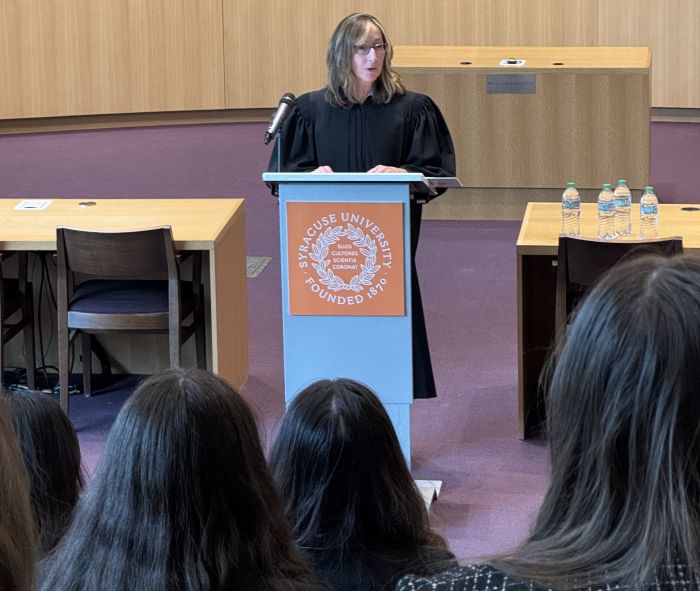
On February 5, 2026, 81 law students participating in Syracuse Law’s clinical programs took the Student Attorney Oath during a ceremony presided over by the Hon. Wendy A. Kinsella L’95, United States Bankruptcy Judge for the Northern District of New York. The ceremony was held in the College of Law’s Melanie Gray Ceremonial Courtroom and brought together students, faculty, and administrators to celebrate the start of the students’ clinical practice experience.
During the ceremony, students pledged to act in the best interests of their clients, uphold the New York Rules of Professional Conduct, and serve with integrity, diligence, and courage; commitments that mirror the responsibilities they will assume as licensed attorneys.
“You are no longer just students of theory,” Judge Kinsella said. “You are now practitioners in training, ready to use your skills for service and advocacy. This journey ahead will be very demanding, but it is also immensely satisfying.” Judge Kinsella reminded students that lawyering is as much about listening and compassion as it is about knowing the law. She emphasized the importance of treating clients as people, not problems, maintaining respect and integrity in every interaction, and earning trust as counselors and advisors.
Syracuse Law offers seven in-house clinics that allow students to represent real clients under faculty supervision, applying doctrinal learning in high-impact, hands-on settings, and is among the very few law schools nationwide to offer fully online, in-house clinical experiences as part of an ABA-approved hybrid JD program. Three clinics, the Sherman F. Levey ’57, L’59 Low Income Taxpayer Clinic, Transactional Law Clinic, and Bankruptcy Clinic, are offered online through the College’s innovative JDinteractive (JDi) program.
The JDi program is a flexible, ABA-approved hybrid Juris Doctor pathway designed for students who cannot relocate or attend law school full time on campus. JDi students complete the same curriculum, meet the same academic standards, and participate in the same experiential learning opportunities as residential students, including live-client representation through Syracuse Law’s clinical programs.
“Clinical education is where students begin to see themselves as lawyers,” said Professor Jessica Murray, Director of the Transactional Law Clinic. “Whether students are working in person or online, the clinic experience demands accountability, empathy, and real-world problem-solving. The oath they take at the swearing-in reflects the ethical responsibilities to their clients that they will uphold in their clinical work and in practice once they are admitted to the Bar.”
The ceremony was hosted by the Office of Clinical Legal Education and opened by Professor Suzette Meléndez, Director of the Syracuse Medical Legal Partnership. Dean Terence Lau L’98 also addressed the students, emphasizing the seriousness of the oath and the responsibility that comes with representing underserved and often marginalized clients.
“This ceremony reflects who we are as a law school,” said Professor Beth Kubala, Executive Director of the Office of Clinical Legal Education. “Our clinics place students in positions of real responsibility, serving clients who may not otherwise have access to legal representation. The oath they take today is the foundation of ethical lawyering, and the beginning of a transformative professional journey.”
For students, the ceremony marked a powerful transition from classroom learning to client-centered advocacy.
“Taking the oath marked a shift in our legal careers,” said student attorney Pamela Reynolds L’26. “Knowing that real people are relying on our work carries weight far beyond an assignment. That responsibility is humbling, motivating, and central to why I came to law school.”
The Spring 2026 Clinic Swearing-In Ceremony reaffirmed Syracuse Law’s long-standing commitment to experiential education, access to justice, and preparing students—across modalities—for meaningful, service-driven legal careers.