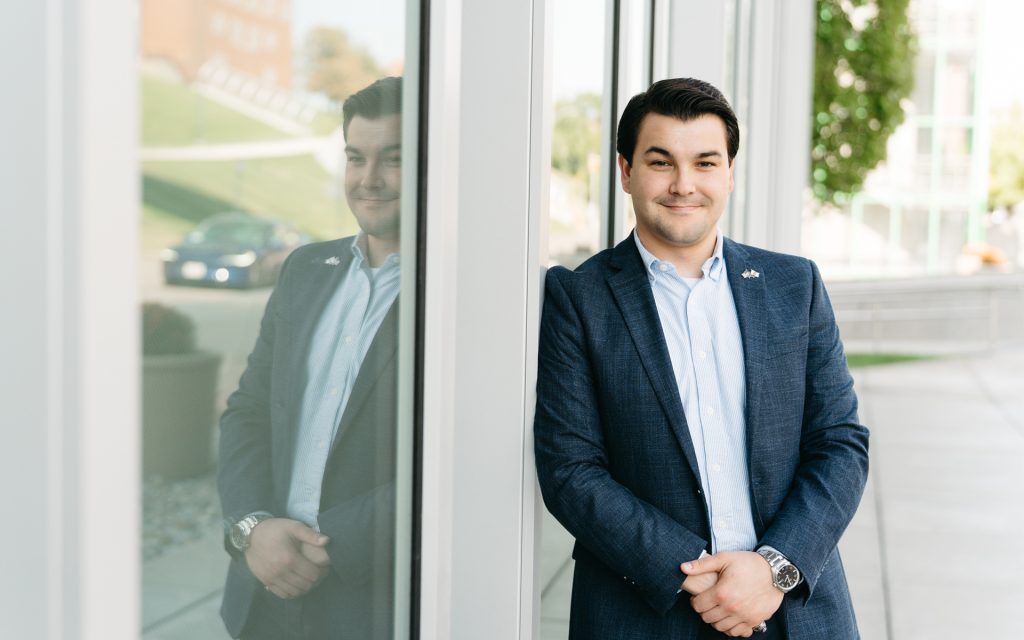
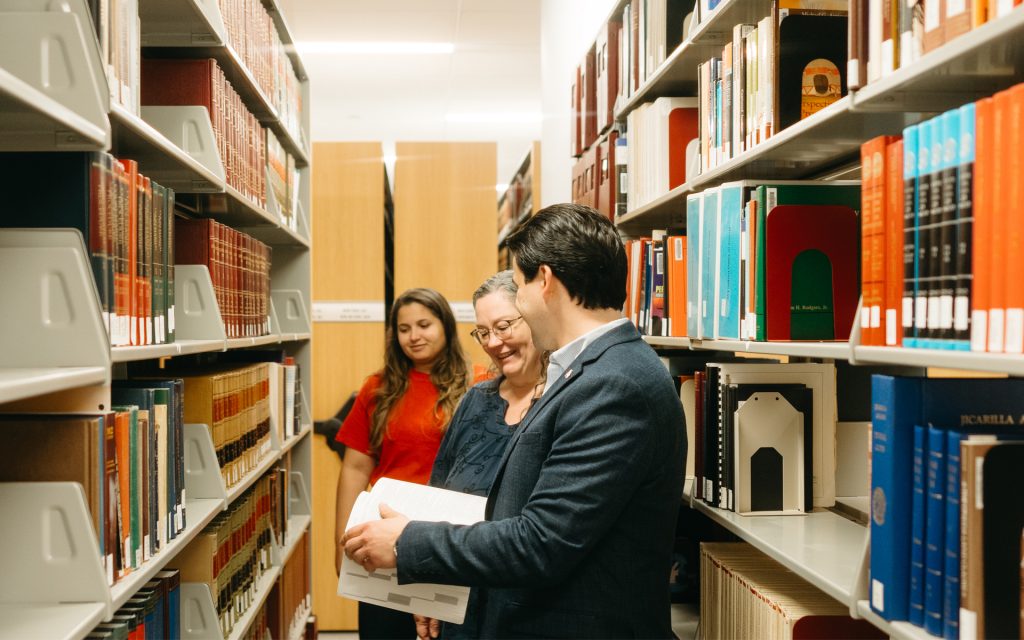
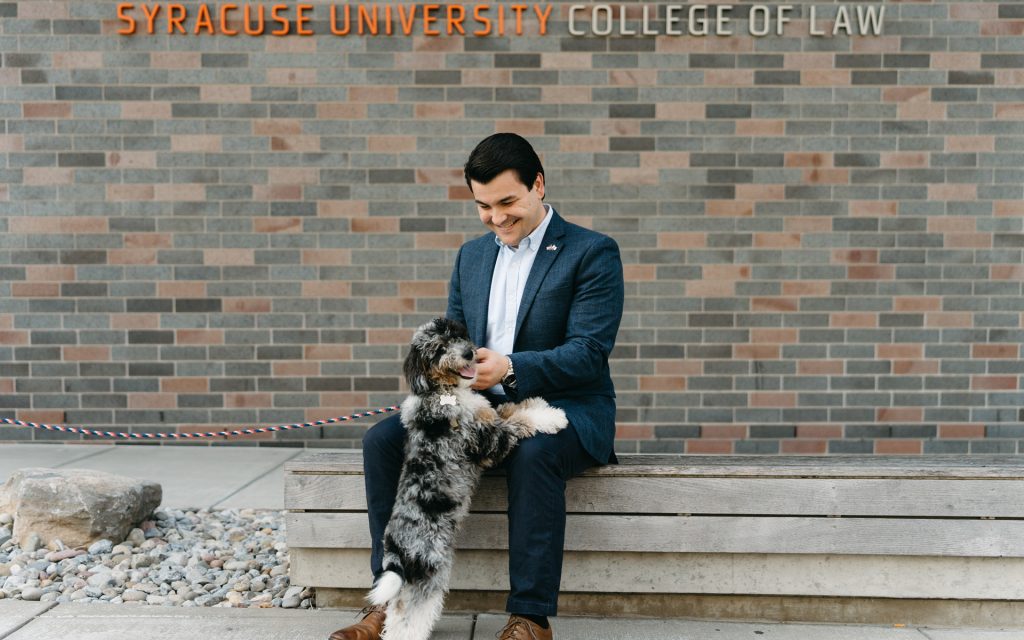
Garrison Funk L’25 was named the recipient of the Rhoda S. and Albert M. Alexander Memorial Scholarship for the 2024-2025 academic year. Funk was selected after a competitive application process by the Alexander Memorial Scholarship Committee to receive this significant scholarship in recognition of his commitment and dedication to public service.
Funk focuses his time during law school by volunteering for the Volunteer Lawyer’s Project of Central New York, serving as a student attorney for the Cornell University Farmworker Legal Assistance Clinic, externing and interning with the Department of Defense, and working as a legal researcher for the Syracuse Institute of Security Policy & Law. Funk is also pursuing his master’s degree in international relations at the Maxwell School. These experiences have influenced his desire to pursue a career in public service after graduation.
“I am deeply honored and grateful to be named the Rhoda S. and Albert M. Alexander Memorial Scholarship recipient for the 2024-25 school year. Thank you to all of my wonderful mentors, friends, and family for giving me the tools I needed to pursue my path to service,” says Funk.
The Rhoda S. and Albert M. Alexander Memorial Scholarship was established by College of Law Board of Advisors Member and Syracuse University Trustee Richard M. Alexander L’82, Chairman of Arnold & Porter, and his wife Emily.
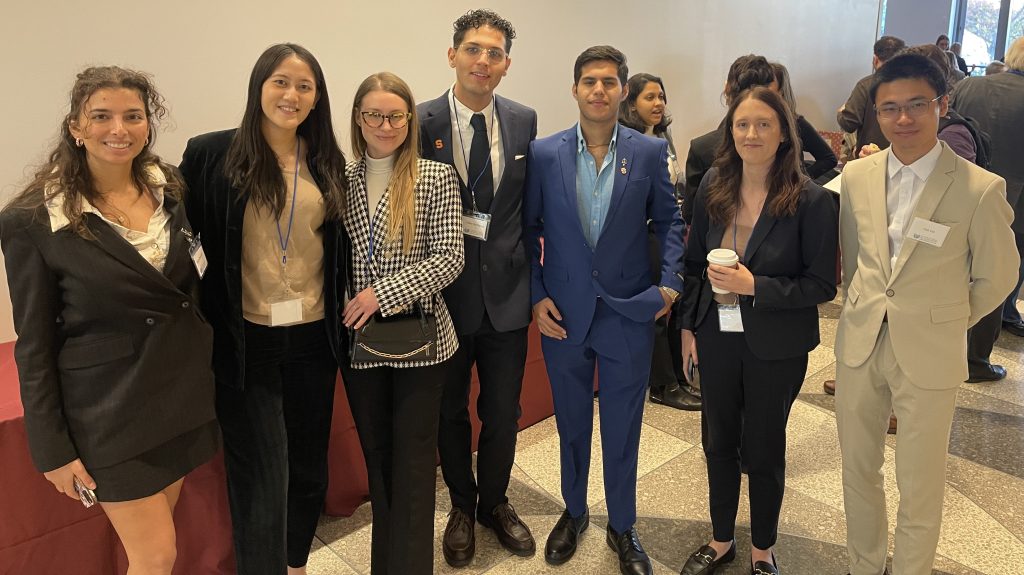
Several Syracuse Law students from the International Law Society (ILS) recently attended the International Law Weekend Conference (ILW), hosted by the American Branch of the International Law Association (ABILA). The students were accompanied by Professor Cora True-Frost G’01, L’01, Faculty Advisor to the ILS, the most recent cohort in a longstanding tradition of Syracuse Law students attending the ILW.
At the conference, students participated in panels addressing some of the most pressing legal challenges facing the world today, including space law, immigration law, and labor regulation enforcement. They also had the chance to network with leading experts in international law, gaining valuable insights and perspectives on the global legal landscape.
“The conference gave students the opportunity to think through the legal problems they will address in their careers, both immediately after graduating and throughout their lifetimes, while also networking with attorneys from around the world and exploring job opportunities in various fields of international law,” says Zoe Tkaczyk L’25, president of the ILS. “The weekend in New York gave us the opportunity to get to know our classmates better and to spend time together and with alumni.”
Omar Sabbatini, an exchange student from the University of Rome Tor Vergata in Italy, who is spending the fall 2024 semester at Syracuse Law, highlighted the significance of the conference. “The ABILA’s ILW allowed us to engage with prominent figures in international law, including individuals who might seem distant from us—such as the author of our international law textbook, who participated in a panel alongside the Swiss and Chinese ambassadors,” he said. “Our attendance enabled us to establish meaningful connections with students and professionals while delving into lesser-known areas of international law, such as the law of people at sea. It also illuminated pressing issues, such as the situation of women in Afghanistan, through direct and authentic testimonies.”
“The International Law Weekend Conference provided Syracuse Law students with a unique platform to expand their global perspectives, deepen their understanding of international law, and connect with a diverse community of legal scholars and practitioners,” says True-Frost.
Many students at the Syracuse University College of Law aim to work as general counsel at some point in their careers. And, while most have a sense of what that job title entails, Syracuse University College of Law students who participated in the General Counsel Symposium, sponsored by the Corporate Law Society (CLS) in Dineen Hall, had a unique opportunity to network and gain face-to-face insights from prestigious alumni and guests willing to share their own experiences working as general counsel for leading corporations around the globe.
“Every single alumnus I reached out to said ‘yes’—a true testament to the Orange alumni network.”
—Brett VanBuren L’25
The concept started last February when Brett VanBuren L’25, president of the CLS, proposed the idea of organizing a General Counsel Symposium to Lily Yan Hughes, assistant dean of career services and student experiences. After getting the green light, VanBuren and his team of Nicholas Troia L’25, Gabriella Amaturo L’25 and Dana Krinsky L’25, as well as Director of Alumni Relations Adrienne Lutz, started to assemble a diverse lineup of alumni and a few others with outstanding experience working as general counsel.
“Every single alumnus I reached out to said ‘yes’—a true testament to the Orange alumni network” said VanBuren.
Alumni Paired With Student Organizations on Current Issues
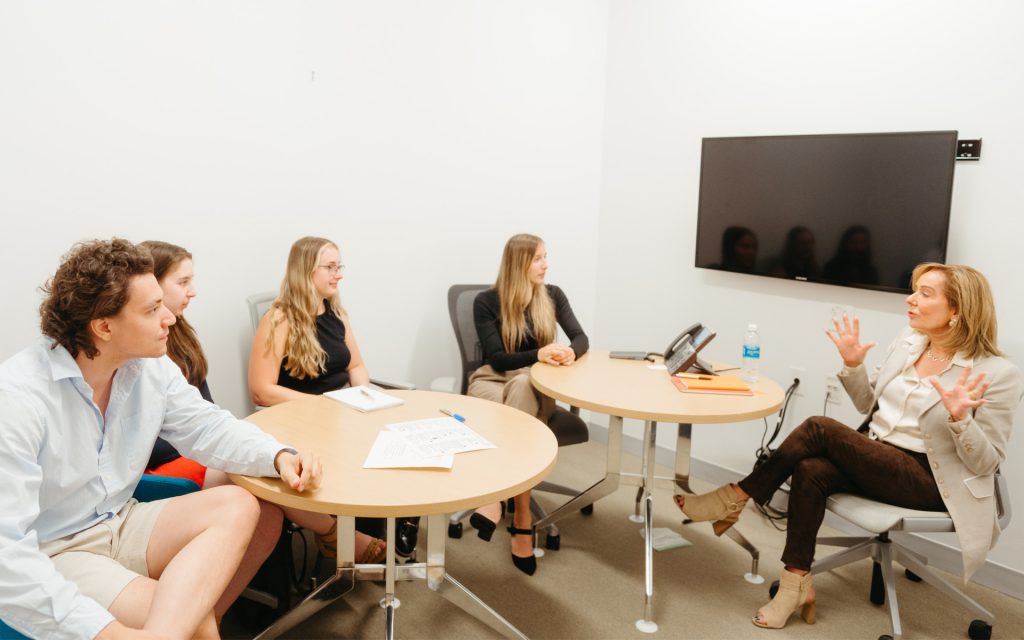
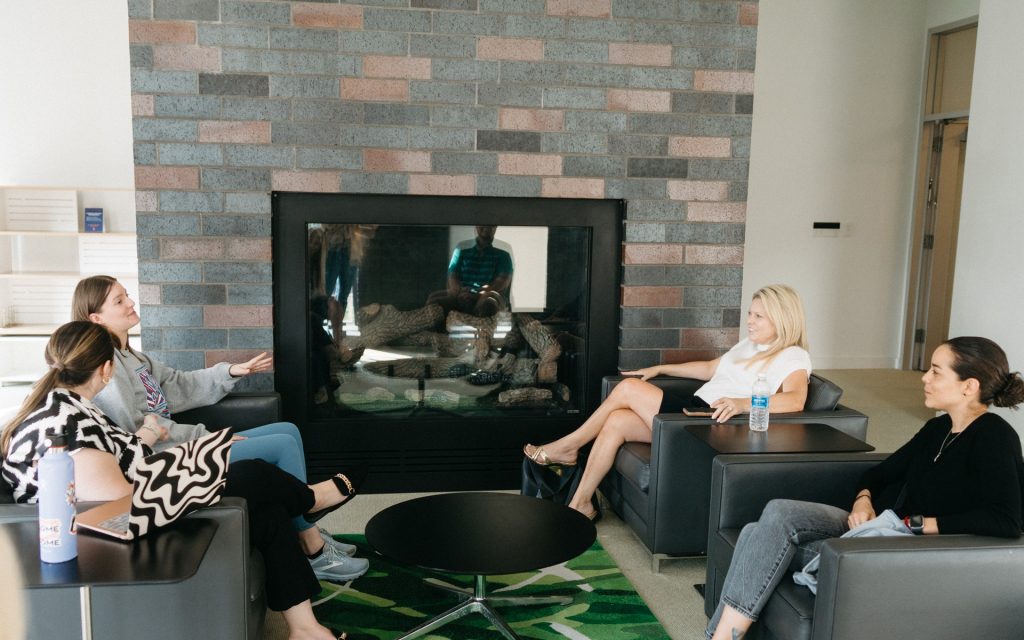
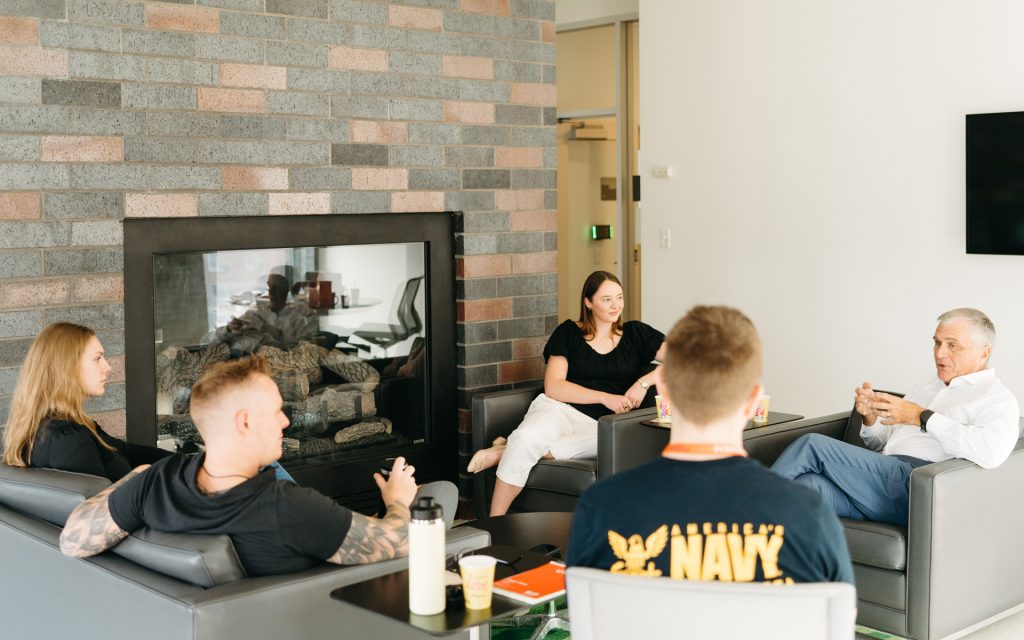
Early in the day, alumni and other guests were paired with various Syracuse Law student organizations based on areas of interest and expertise.
Students from the Bankruptcy Clinic had the opportunity to meet with Melanie Gray L’81, former chair, Syracuse University College of Law Advisory Board and Syracuse University trustee, who practiced complex commercial law and was lead attorney on behalf of Enron during its Chapter 11 bankruptcy filing, which, at the time, was the largest corporate bankruptcy in U.S. history.
Leslie Park L’95, assistant general counsel and senior vice president, legal & business affairs, Hallmark Media, explained some of the challenges faced by her company, primarily due to its extensive movie library, to the Entertainment and Sports Law Society (ESLS). “Leslie Park provided such an eye-opening perspective on the different ways in which the law intersects with the entertainment industry,” said Krinsky, president of the ESLS. “She shared candid advice about how to break into the industry and truly took the time to listen to members’ goals and respond with tailored recommendations.
A former lead articles editor of Syracuse Law Review, Aaron Tidman L’07 met with current editors outlining his non-traditional career path that eventually led him to his current work as assistant general counsel and director of compliance at Pinterest.
Rebecca Peters ’00 MPA (MAX), L’00, director of public policy, semiconductor policy, Samsung, met with the Women’s Law Student Association for a conversation about her own career path, along with changes being made in the legal profession today.
Jim Dixon, retired senior vice president and chief legal officer, RWE Clean Energy, met with students from the Veterans Law Society and the Environmental Law Society. “We were allotted about 30 minutes, but Jim conversed with us for over an hour-and-a-half,” said Luke Overdyk ’22 (Falk), L’26. “Much of our career pursuit is internet based, and it can be difficult to navigate. It was encouraging to hear from a professional like Jim in person and speak candidly. He welcomed our many questions and offered his best advice for aspiring environmental lawyers.”
Panel Discussions Gave Students Practical Insight From Prestigious Thought Leaders
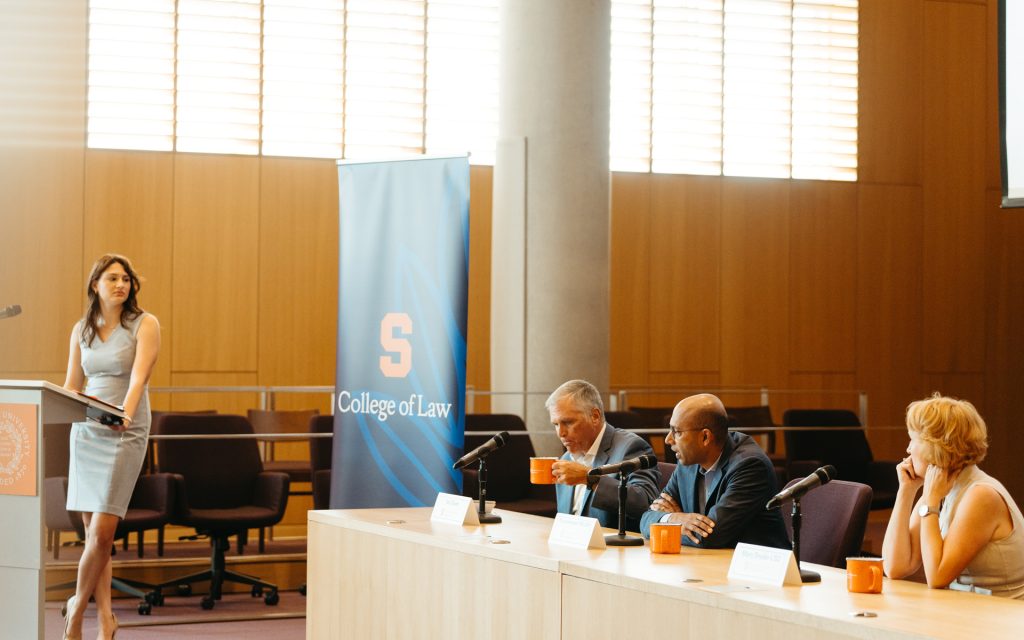
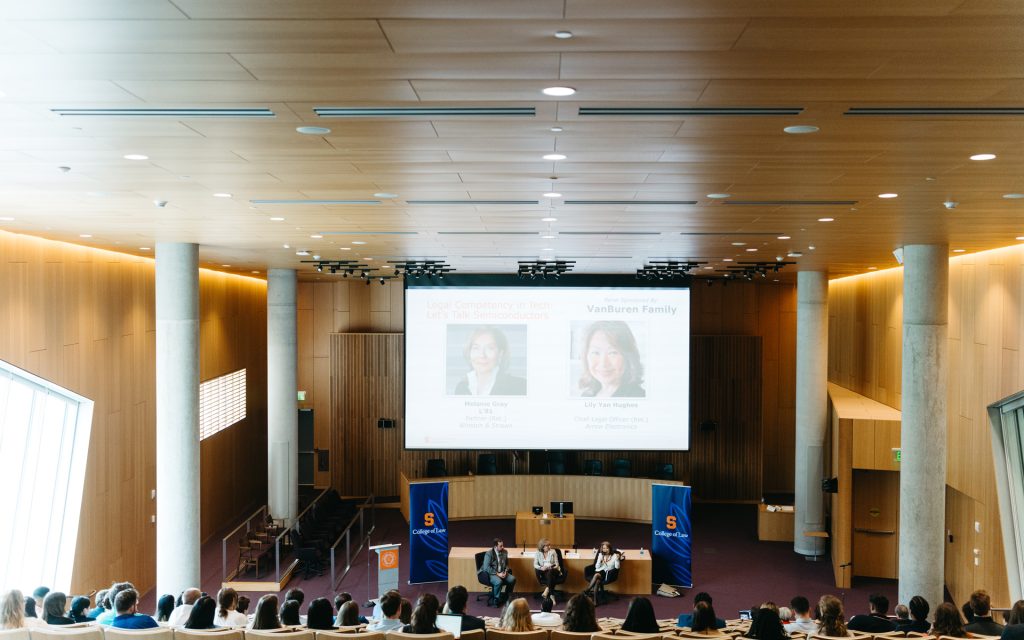
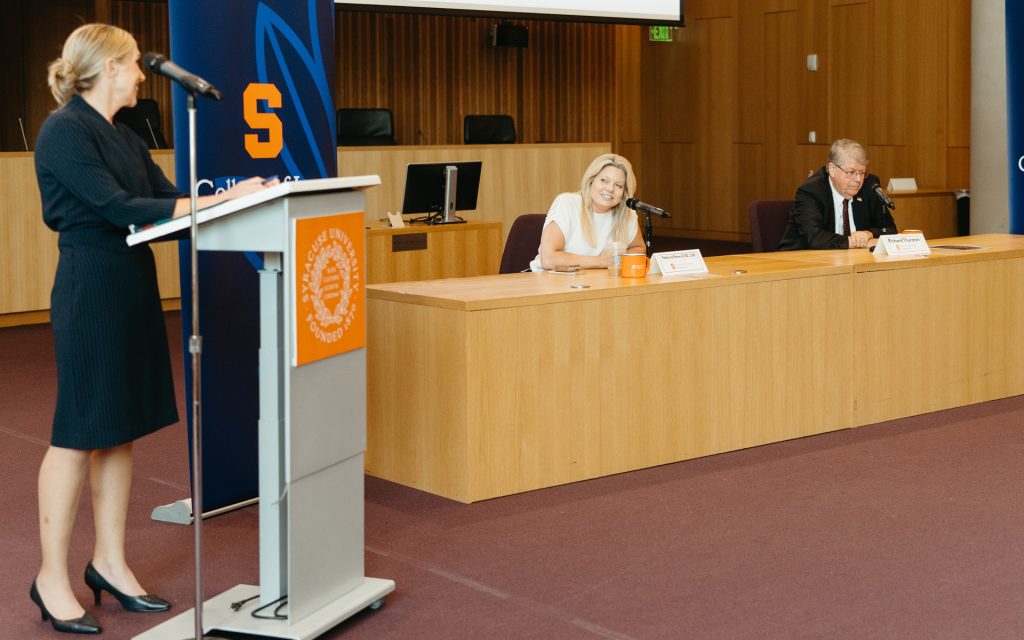
In the afternoon, Syracuse Law Dean Terence J. Lau L’98 welcomed attendees to the Melanie Gray Ceremonial Courtroom.
“This symposium is an outstanding example of the bonds that Syracuse Law forges between students, alumni and industry partners through mentorships that span generations and philanthropy that opens doors for the next wave of legal minds,” said Lau. “To our students here today—look around. These accomplished professionals were once where you are now. And, they’re here today because they believe in you and your potential to change the world.”
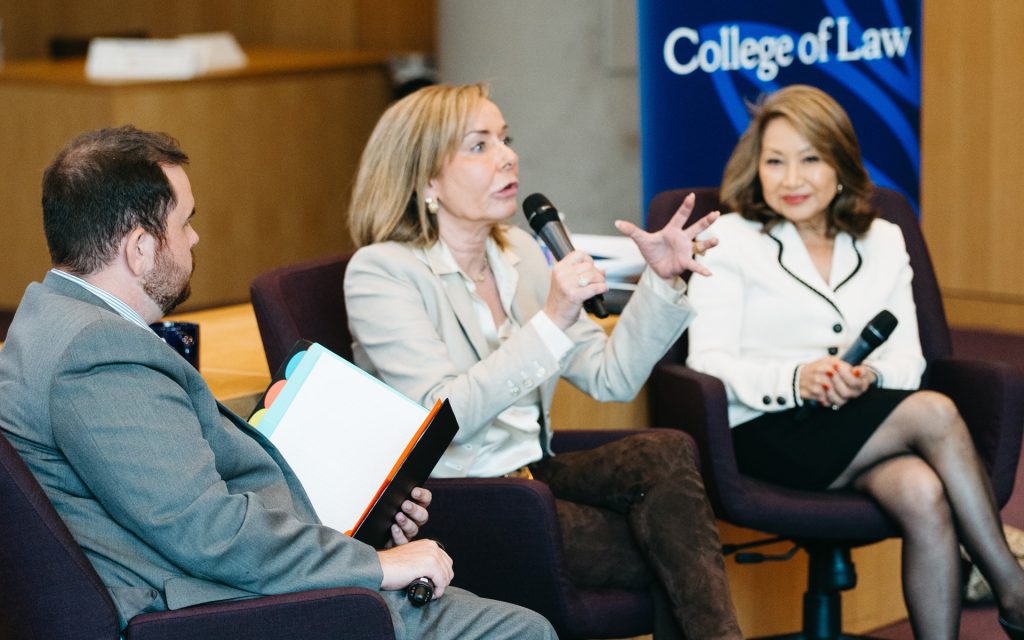
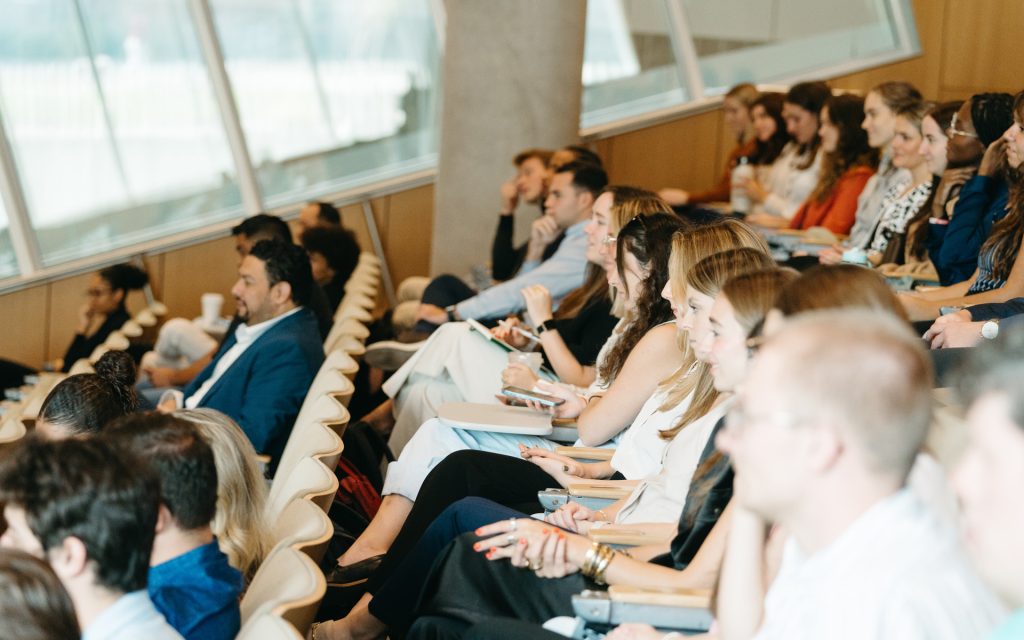
Following the dean’s remarks, four discussion sessions were offered to students, including Syracuse Law’s JDinteractive (JDi) students, who were able to participate through a livestream. Each session was comprised of a panel of several alumni or other guests with specific expertise as general counsel. These sessions included:
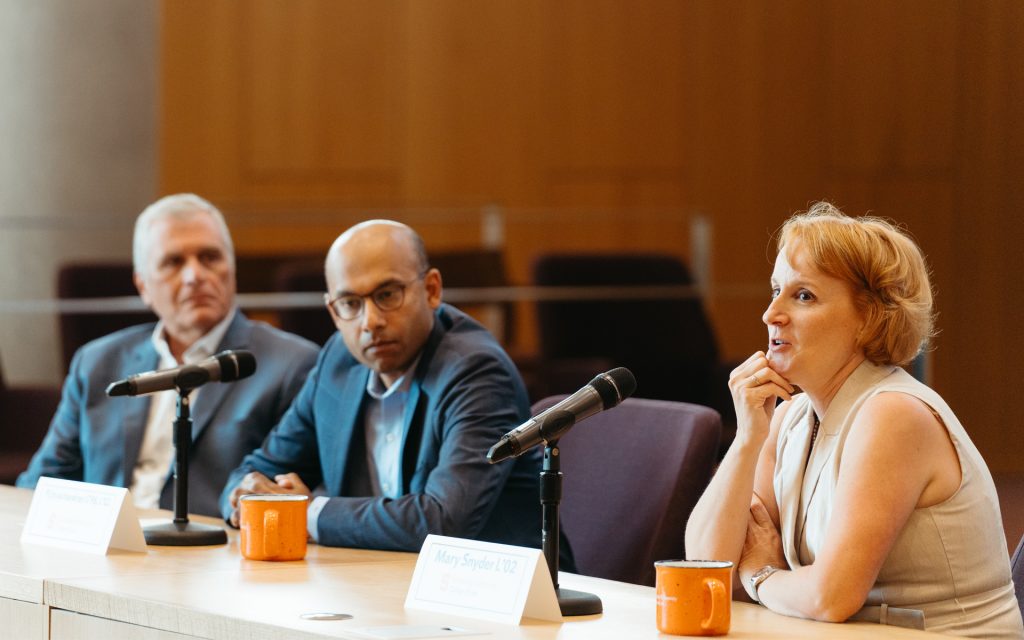
Left to right: Jim Dixon, Prashanth “PJ” Jayachandran ’98 MPA, L’98, and Mary Snyder L’02
Welcome to In-House: The Role of General Counsel with panelists Dixon, Mary Snyder L’02, executive vice president & general counsel, SRC; and Prashanth “PJ” Jayachandran ’98 MPA, L’98, senior vice president & chief supply chain counsel, Colgate-Palmolive, and a distinguished lecturer at Syracuse Law. This session helped clearly define what a general counsel does, as well as understand how a solid knowledge of business can influence senior leadership by offering new ideas or measures that mitigate risk.
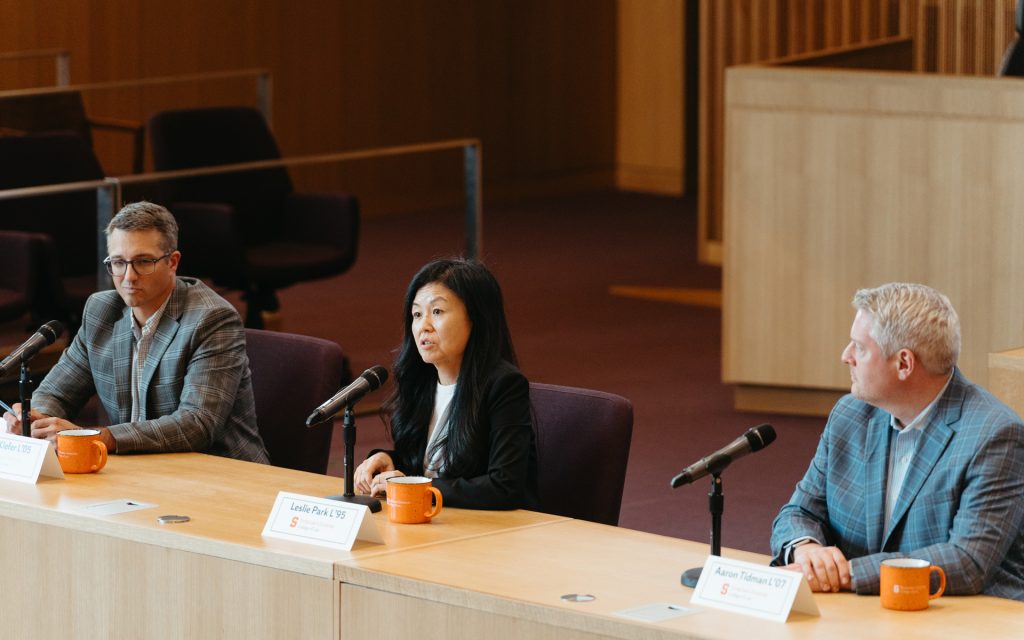
Left to right: Kris Kiefer L’05, Leslie Park L’95, and Aaron Tidman L’07
Getting to the Boardroom: The Path to In-House Success with panelists Park, Tidman and Kris Kiefer L’05, assistant general counsel and director, National Grid. Many students attending this session were interested in hearing about what companies are looking for when hiring a general counsel, as well as the importance of developing excellent soft skills, like listening, communicating and wanting to do the right thing.
Legal Competency in Tech: Let’s Talk Semiconductors with panelists Peters and Richard Thurston, current chairman, CEO and chief legal officer, Hudson Valley Fast Fab; founder of RLT Global, a semiconductor consulting firm, and retired senior vice president, general counsel, Taiwan Semiconductor Manufacturing Co., was particularly valuable, as the Syracuse community prepares for Micron Technologies to build a $100 billion chip manufacturing facility in Central New York.
Left to right: Brett VanBuren L’25, Melanie Gray L’81, and Lily Hughes.
Leadership Challenges: Handling the Best and the Worst Days of a Company with panelists Gray and Hughes, who, before joining Syracuse Law, was a former chief legal officer at Arrow Electronics and vice president and associate, general counsel for corporate finance and mergers and acquisitions at Ingram Micro, a former Fortune 100 New York Stock Exchange-listed company. Students heard how every successful career comes with some mistakes along the way and were encouraged to “own up to it and disclose it,” by Hughes, who said most problems have solutions if they are identified quickly.
Evening Session Focused on Negotiations, Competition
After a reception where students were able to further engage with participating alumni and guests, Jeff Gewirtz, executive vice president, business affairs chief legal officer, Brooklyn Sports and Entertainment Global, Zoomed in from New York City to speak to the group on negotiations, as well as how his law degree has set him up for success in the business world.
Bringing the day to a close was the final round of the inaugural Corporate Law Society’s Business Negotiation Competition (BNC), sponsored by local firm Bousquet Holstein. Two teams of law students who made it through to this final round negotiated a real world business scenario in front of judges that included Gray, Park and Thurston.
Sixteen competitors in teams of two participated in the BNC, which is a hallmark of Syracuse Law’s intercollegiate advocacy competitions. Through three preliminary rounds held earlier in the month, students worked on fictitious legal scenarios until two teams made it to the finals. Austin Dewey L’26 and Gregory Patrick L’26 went head-to-head against Krinsky and James Cameron III L’25 in a scenario involving negotiating a new terminal, additional routes and a percentage of local hires for an airline establishing a new hub. In the end, the team of Cameron and Krinsky walked away with the win.
Overall, the first General Counsel Symposium was a great accomplishment, according to VanBuren. “I think it was a success thanks to the openness of our alumni who were willing to share their own stories,” he said. “I knew every one of them was going to be a hit, as each person not only has already had an accomplished career but was honest, passionate and humorous. I think the outcome of the day was witnessing how wide-ranging the work of a general counsel can be. There was something for everyone—from employment law to legal ethics to emerging technology. I hope the General Council Symposium continues to happen every year and only grows in impact.”
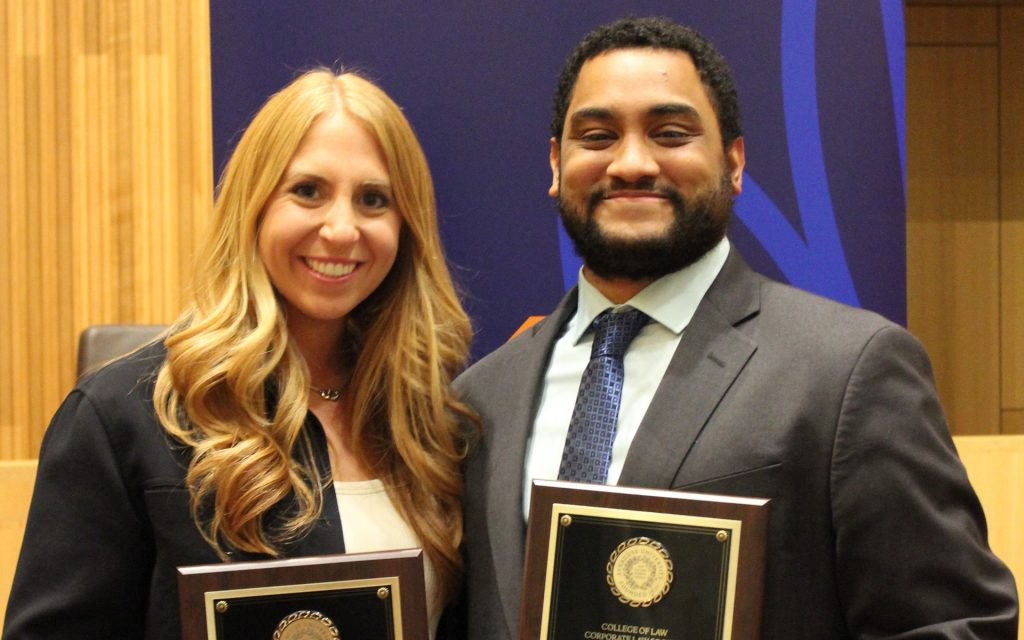
Austin Dewey L’26 and Madison Mahar L’26 prevailed over William Baldwin L’27 and Brady Sterpe L’27 in Syracuse Law’s First Annual Entertainment Negotiation Competition (ENC), hosted by the Entertainment and Sports Law Society (ESLS).
The final round was judged by Veronica Ramirez L’18 Owner and Lead Attorney at Curator Counsel; Barry Slotnick L’72, Chair of Intellectual Property and Entertainment Litigation at Loeb & Loeb; and Payton Sorci L’22, Legal Assistant at Endeavor.
The ENC covered various entertainment law topics, including Intellectual Property, Contracts, and Finance. Teams negotiated terms for a fictional series of fact patterns centered on Justin Bieber: a record deal between Bieber and Universal Records; a brand endorsement deal between Bieber and Balenciaga; a movie deal between Bieber and Marvel Studios; and for the final round, a Vegas residency deal between Bieber and Caesars Palace.
The ESLS will host its 5th Annual Sports Negotiation Competition in Spring, 2025.
Alexa Connaughton L’25 and Elyse Maniccia L’26 recently competed in the National Veterans Law Moot Court Competition (NVLMCC), the nation’s most prestigious veterans law appellate competition. Seth Owens L’24, Betty and Miachel D. Wohl Veterans Legal Clinic Staff Attorney, coached the team and was assisted by Army JAG Major Nick VanErp.
The students were judged 1/3 on the content of their brief, 1/3 on their first argument, and 1/3 on their second argument. While the Syracuse Law team did not advance past the initial round, they proudly represented the College of Law. They had a positive experience learning the unique complexities of veterans law.
“I am very proud of their effort; both students were great ambassadors for Syracuse Law. One may even be interested in changing their preferred career path to pursue veterans law after this experience,” says Owens. “I would also like to note that we were the only team eliminated on day one to attend all rounds of the final arguments. The students enjoyed watching the competitors and used it as an opportunity to further their advocacy skills and self-reflect.”
First organized in 2009, NVLMCC is sponsored annually by the U.S. Court of Appeals for Veterans Claims (CAVC), the Court of Appeals for Veterans Claims Bar Association, and the George Washington University Law School (GW Law). The NVLMCC is the nation’s premier moot court focusing on veterans law. Hosted close to Veterans Day each fall in Washington, DC, the NVLMCC brings together 28 teams of two students from around the country to argue cutting-edge veterans law issues before panels of distinguished practitioners and judges.
The NVLMCC prides itself on the authenticity of the problems and the quality of its judges. The record on appeal and the documents included look like what would be found in a real veterans law case. The judges for the briefs and the oral arguments are drawn from the ranks of experienced veterans law practitioners. In particular, the final round of each NVLMCC is presided over by a panel of judges from the CAVC in their courtroom. Few moot court competitions can boast an experience that is so true to actual practice.
George Saad L’25 won the Best Cross-Examination award at the Buffalo-Niagara Trial Competition. His cross-examination was deemed the best out of 96 cross-examinations during the preliminary rounds. The Syracuse Law team of Tania Rivera-Bullard, Dannah Henderson, Lisa Musto, Saad, Kaylee Searcy, and Taylor Shawver finished in 5th place out of 24 teams.
This is the gripping story of Jimmy L. Thyden Gonzáles L’21 who recently discovered his status as a child who was stolen at birth and the various international legal responses that have taken place and continue to be pursued by Jimmy and others.
The National First-Generation College Celebration is celebrated annually on November 8 to mark the anniversary of the signing of the Higher Education Act of 1965.
Being a First-Generation Law Student (FGLS) presents unique challenges, unfamiliar surroundings, and new experiences for those pursuing a J.D. The journey through law school can be demanding, but the accomplishment of reaching this stage is significant.
Each entering class at Syracuse Law includes many FGLS, creating a supportive network of peers with shared goals. Additionally, many faculty and staff at Syracuse Law were first-generation students in college and/or law school and are available to serve as mentors, advisors, and sources of support throughout the experience.
Chief among them is Professor Courtney Abbott Hill L’09, a Syracuse native and Syracuse Law alumna who obtained her J.D., magna cum laude, in 2009. In addition to teaching Legal Communication and Research (LCR) to first-year students, she is also the Faculty Advisor to the First-Generation Law Student Association (FGLSA).
Like many law students, her path to the legal profession was not traditional. “I was a political science major at Nazareth College, and everyone asked if I was going to law school. At the time, pursuing a career as an attorney was not something I had really considered. After graduating, I was teaching and working on a master’s in education, but going to law school was always in the back of my mind. I finally took the LSAT to see whether I could get accepted at Syracuse, which was the only school I applied to.”
As a proud lifelong resident of the area, being accepted to Syracuse Law meant the world to Professor Abbott Hill. She excelled at law school, serving as Managing Editor of the Syracuse Law Review and receiving the honors of Order of the Coif and the Justinian Honor Society, among many others.
Returning to her alma mater after serving as an Appellate Court Attorney at the New York State Appellate Division, Fourth Department, and then as a regional director for a national bar prep company, meant she was able to combine her love of teaching and the law in her role on the faculty.
“I returned to Syracuse Law to teach in the bar success program. Later, I had the opportunity to teach an LCR class and fell in love with it. I was fortunate to have mentors like my first-year LCR Professors, Ian Gallacher and Aliza Milner, who recognized I’d be good at this before I did and encouraged me to apply for a full-time position teaching LCR. I am so grateful for that encouragement because I have the greatest job in the world.”
Abbott Hill can trace her passion for teaching and mentoring back to spending summers working as a camp counselor and later as a teacher and coach at a Syracuse high school. “Even if I didn’t always know I wanted to teach in law school, in hindsight, it all makes sense,” she says.
“FGLSA is an amazing organization. Student leadership purposefully doesn’t define what a first-generation law student is because they want it to be the most inclusive, supportive organization for any student, residential or JDi, that wants to be a part of it.”
—Professor Courtney Abbott Hill L’09
These experiences help inform how Abbott Hill teaches first year law students in LCR, where they learn how to research and apply law to complex factual situations. She sees teaching or assessing students through the rigors of LCR as a not one-size-fits-all proposition. “I see my job as helping students identify goals for their legal education and partnering with them to achieve those goals. There is a steep learning curve the first semester of law school, so I’m willing to try non-traditional things in the classroom to help students understand and execute difficult legal concepts.”
As the Faculty Advisor to the FGLSA, Abbott Hill uses all her skills and experiences as a lifelong mentor and educator to make an impact on Syracuse Law students. “FGLSA is an amazing organization. Student leadership purposefully doesn’t define what a first-generation law student is because they want it to be the most inclusive, supportive organization for any student, residential or JDi, that wants to be a part of it.”
The FGLSA facilitates several programs for its members, including pairing first-year and upperclassmen as “buddies”, hosting panels and symposia on issues important to FGLS, networking events, and other opportunities to build community.
“We want to make that transition to law school a little smoother to those that may feel like a fish out of water,” says Abbott Hill.
Anthony J. Ruscitto ’22, ’23 MPA, L’27, has lived a life of service since he enlisted in the U.S. Marine Corps at age 17. And, while he’s no longer flying in military helicopters around the world, he has landed in a place close to home where he can be a voice to those in need: the Syracuse University College of Law.
Ruscitto served for five years as a CH-53H Super Stallion helicopter crew chief, which included two deployments overseas as a sergeant, weapons and tactics instructor, responsible for training enlisted aircrew at the squadron level. He received the Navy and Marine Corps Achievement Medal (2nd award), Marine Corps Good Conduct Medal, and Sea Service Deployment Ribbon (2nd award) for honorable service.
It was the military that first showed him how critical it is to master the basics before you practice something and dig deep to fully understand rules and regulations. Ruscitto has since adapted those lessons to navigate his continuing commitment to helping others, as well as drill down into military regulations and learn what options, resources and benefits are available to him and other veterans.
After completing his military service, the Central New York native earned a bachelor’s degree in psychology and forensic science from Syracuse University’s College of Arts and Sciences paid for entirely through the Post 9/11 G.I. Bill. Next, through the G.I. Bill and with scholarships available to veterans at Syracuse University, he was able to earn a master’s degree in public administration (MPA) from the University’s Maxwell School of Citizenship and Public Affairs.
After earning his master’s degree, Ruscitto spent a year working as an administrative intern at the Onondaga County Veterans Service Agency, where he assisted veteran service officers with preparing and submitting claims for benefits from Veterans Affairs, as well as interacted with local advocacy agencies to bring a greater awareness of the needs of local veterans.
This fall, he returned to campus with a new mission: becoming a lawyer who could assist the military community by pursuing public interest or criminal defense law. His law school tuition was covered through the Veteran Readiness Program and the Department of Veteran Affairs.
“The idea that I can be the person in a courtroom who advocates for others, particularly those who have served our country, is very important. I can be a louder voice for the people who need one, and I believe that’s what public service is really all about.”
—Anthony J. Ruscitto ’22, ’23 MPA, L’27
Ruscitto’s approach to the challenges of law school is also rooted in his time in the military. “Every time I start something new, I go back to what I learned in the Marines: be honest, work hard and be humble,” he says.
“I know that I’m not the smartest person in the room and acknowledge that each person can teach me something. That encourages me to listen more closely to others’ perspectives. This mindset—that we can learn from everyone around us —comes from the Marines and has led me to continued success in ways I never thought possible,” Ruscitto adds.
Already, Ruscitto is finding his niche. He is the first-year representative for the Syracuse University Military and Veteran Legal Society, And, he is enjoying part-time work as a Syracuse Law ambassador, giving tours and introducing the law school to prospective students.
“I recently had the chance to interact with an undergraduate who is also a student-veteran, and I could tell he was uncertain about whether he could make it in law school,” Ruscitto explains. “So, I was excited to be able to show him that I am a student, I am a veteran—and I’m getting it done, and you can, too! The following week, we met up again. When you’re a veteran, it’s not always easy to see a clear path to law school, so I wanted to show him it was possible.”
Ruscitto is also enthusiastic about volunteering in the Syracuse Veterans Legal Clinic while at Syracuse Law. He says, “What better way to learn and apply the law than by helping veterans and their spouses in applying for the benefits they already earned?”
When Ruscitto graduates and adds “lawyer” to his long list of accomplishments, he intends to continue to advocate for veterans and members of the military. “I hope to stay in my own back yard and help veterans and citizens right here in the Syracuse community. Maybe that will be as a prosecutor or as a defense attorney. I don’t know yet, but, in the end, I’ll get to help people,” he says. “It’s a duty, and it’s an opportunity. No one should have to worry if they are getting fair treatment, even if they find themselves on the wrong side of the law. The idea that I can be the person in a courtroom who advocates for others, particularly those who have served our country, is very important. I can be a louder voice for the people who need one, and I believe that’s what public service is really all about.”
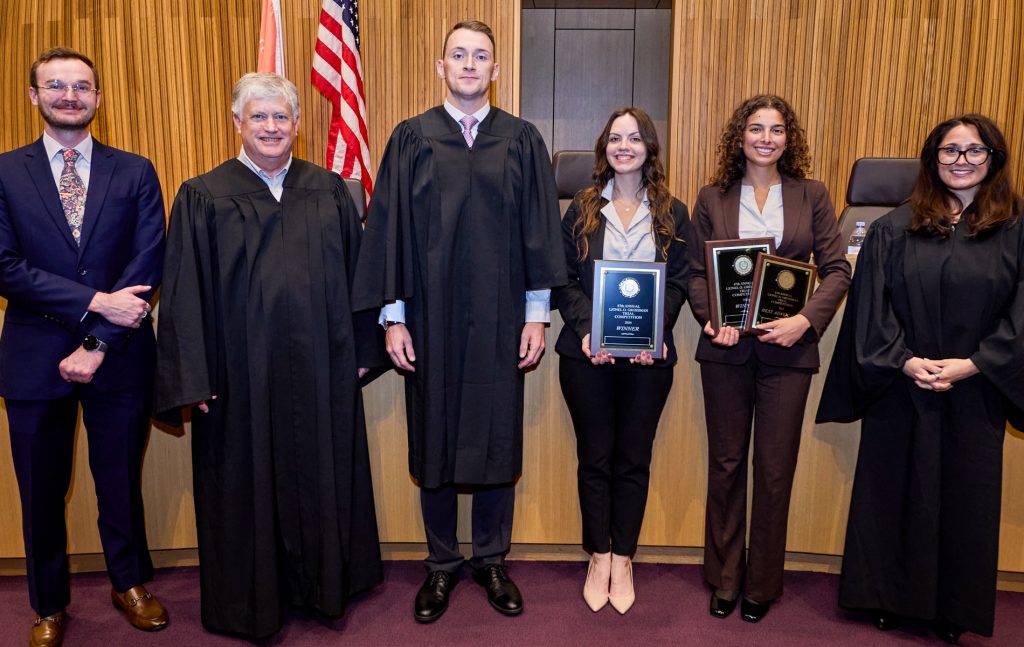
3Ls Savana Conrade and Suzan Elzawahry prevailed over 3Ls Nathan Hankey and Olivia Murphy in the 47th Annual Lionel O. Grossman Trial Competition. Elzawahry was selected as the Best Advocate.
Dennis Scanlon L’19, Associate at Goldberg Segalla was the presiding judge with Nicole Macris L’18, Associate at Bond, Schoeneck, & King, and Thomas Taylor L’87, of Counsel at Bousquet Holstein serving as judge/evaluators.
From Left: Jacob Samoray (Competition Director). Thomas Taylor L’87 (Judge/Evaluator – Bousquet Holstein, PLLC), Dennis Scanlon L’19 (Presiding Judge – Goldberg Segalla), Savana Conrade, Suzan Elzawahry, and Nicole Macris L’18 (Judge/evaluator – Bond Schoeneck & King.)