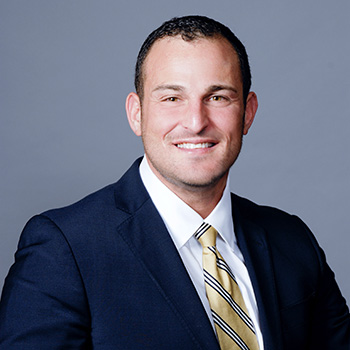
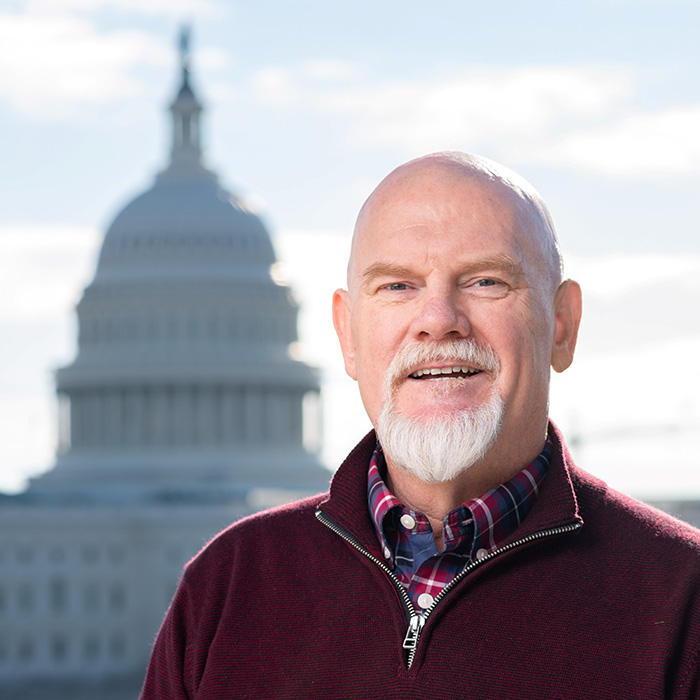
When you ask Adam Katz G’04, L’04why he wanted to be a lawyer, you can feel his exuberance for the very familiar reason many decide to pursue law: to serve the public and do the right thing, every day.
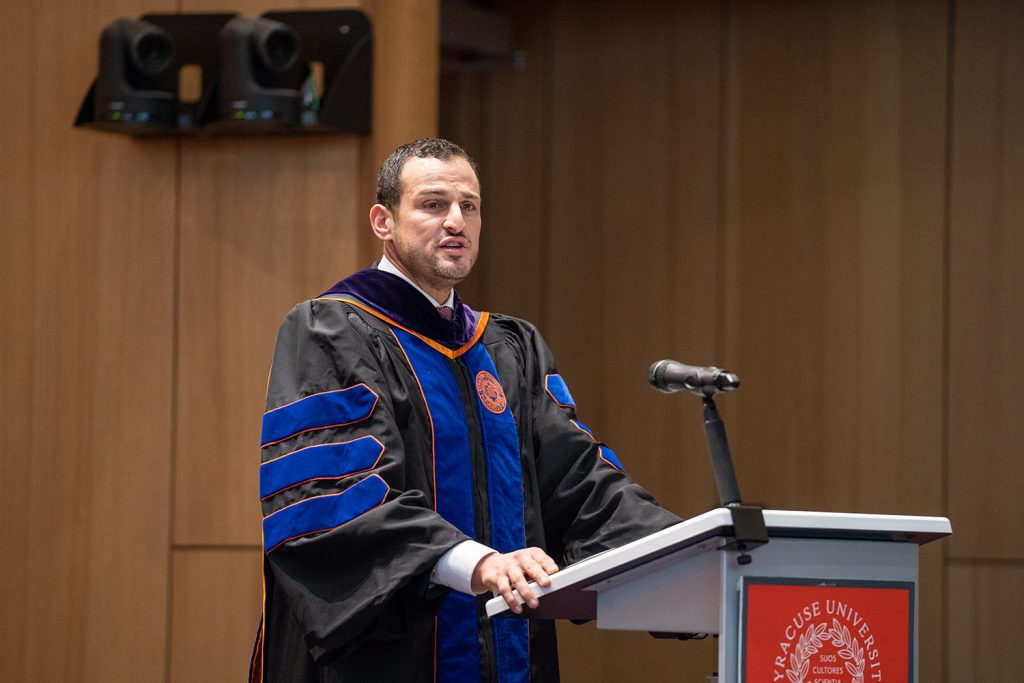
College Of Law Opening Convocation Keynote Speaker 2019 – Adam Katz G’04, L’04
“I’ve wanted to pursue a career in law and public service for as long as I can remember—at least since middle school. I always enjoyed learning, particularly about government and history and contemporary societal issues and observed that the very few lawyers I knew growing up seemed to have intellectually stimulating and challenging careers. I felt that I could use a career in the law to make a difference in society, particularly if I devoted a career to public service,” explains Katz.
Katz, a native of Miami, FL, started on his journey to a career in public service at the University of Maryland for his undergraduate studies then applied to the Syracuse University Maxwell School of Public Affairs to obtain a Master of Public Administration (M.P.A.) before applying to law school. “I planned to do that for a year, and then pursue a career in law, but decided to apply for the accelerated J.D./M.P.A. program with the College of Law which allowed me to pursue both degrees in three years, and have never regretted that decision,” says Katz.
It was a fortuitous decision for many reasons, laying the groundwork for his personal life and professional career. First and foremost, he met his future wife, Michelle (Cavalieri) Katz L’04, early in his law school days. “She’s been my best friend since day one of law school. She did far better than I did academically and she’s an all-around terrific person. Yet, despite all her great qualities, she still agreed to marry me.”
Academically, Katz recalls how impressed he was with Professor William Wiecek, Chester Adgate Congdon Professor of Public Law and Legislation Emeritus. He found Wiecek intellectually stimulating and demanding of his students while being a kind and well-rounded person. “He would teach about the 5th Amendment in the morning, and, in his spare time, teach at Maxwell and deliver babies as an EMT. I admired that,” he recounts.
Becoming an Assistant U.S. Attorney (AUSA) and establishing a home in Upstate New York were both outcomes of his time at the College of Law. Two internships, at the encouragement of the Office of Career Services, influenced his career path. First was an internship at the Onondaga County District Attorney’s Office during the summer after his 1L year. The second was when he heard that the Hon. Norman A. Mordue ’66, L’71 was seeking interns. Knowing Judge Mordue was an alumnus of the Onondaga County DA’s office and the College of Law, Katz applied and was hired to be an intern. He served in that role for two years when Mordue was a U.S. District Court Judge for the Northern District of New York. It was there that Katz watched the work of AUSAs in that court and decided to make it his professional goal to become an AUSA in an area closer to his wife’s family in Albany (rather than return to sunny Miami.)
While interning with Judge Mordue, Katz developed a close personal and professional relationship with the judge that would carry forward until Mordue passed away in December 2022. “I learned so much about law and life from a man who had seen—and endured—during his life more than most could imagine. He embodied public service at its finest. And, beyond that internship, he remained my professional mentor, helping me land my first job out of law school, connecting me with former law clerks when I was searching for jobs, all with the understanding that my ultimate goal was to obtain sufficient experience to one day serve as an AUSA in his district.”
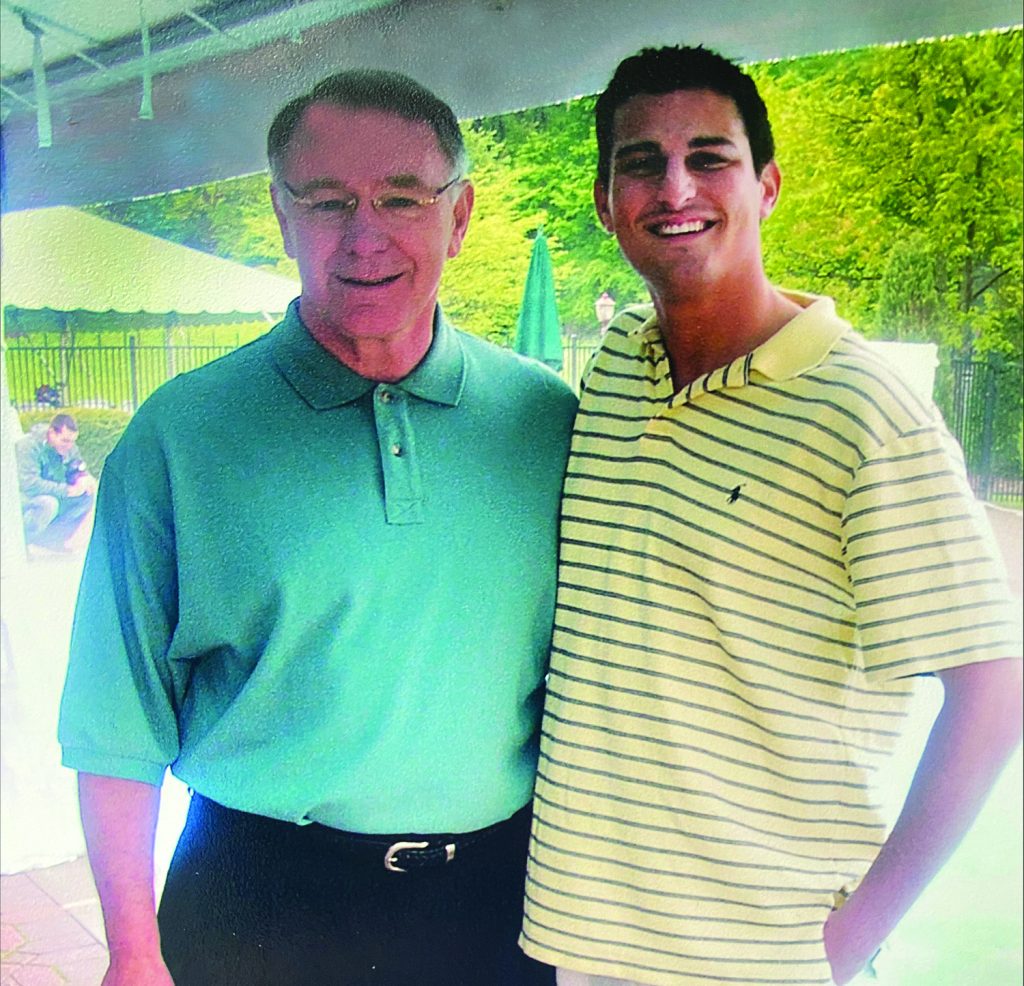
Judge Mordue ’66, L’71 with Adam Katz G’04, L’04 at Katz’s graduation from the College of Law.
After taking positions at firms in Washington, D.C. post-graduation and then at the Department of Justice, Katz’s goal of becoming an AUSA in the Northern District of New York became reality in 2012 when he was hired to be an Assistant United States Attorney for the Northern District of New York in the Albany office. Today, he coordinates the district’s Affirmative Civil Enforcement and Civil Health Care Fraud programs.
Being new to the Albany area and the U.S. Attorney’s Office, Katz did what many have done in a similar situation; he sought out professional organizations that would introduce him to colleagues and provide a sense of community. “When I moved to town in 2012, I didn’t know a soul aside from my wife and her family. I wanted to meet like-minded people, and the Federal Court Bar Association’s mission statement appealed to me: to foster the highest ethical and professional standards for attorneys practicing in the Northern District of New York,” says Katz.
Not only did he join the Federal Court Bar Association for the Northern District of New York (FCBA NDNY), he also held the presidency for two terms, the last ending in December 2023. During this time, he points to the development and implementation of a free trial advocacy training program for attorneys who practice in the district as a distinct highlight of his presidency. “The district court was faced with two issues: First, there are fewer trials these days, so there are fewer opportunities for attorneys (especially younger attorneys) to get experience in the court. Second, several civil pro se cases are trial ready where the court wanted to appoint pro bono counsel,” explains Katz.
Working in partnership with court leadership, the FCBA decided to create a trial-skills training program where experienced litigators would provide hands-on training to newer attorneys who agreed to handle a civil rights case on a pro bono basis. Late last year, the FCBA graduated the first class of 12 attorneys to complete the training program. Each of those trained attorneys will provide pro bono representation to a litigant, giving them experience in the courtroom and helping to ensure access to justice for the client.
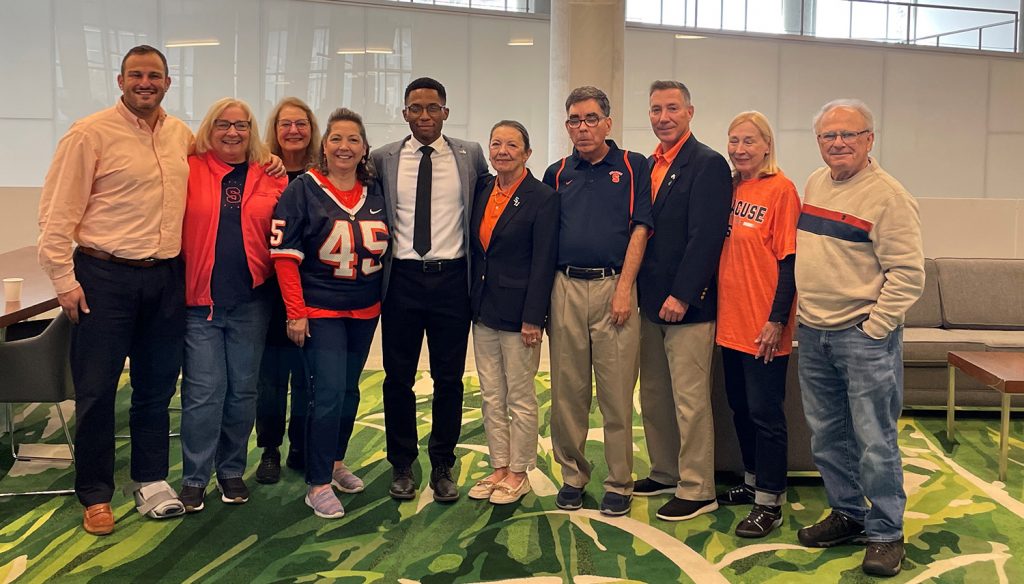
Adam Katz (far left) and Tyriese Robinson (middle) join family and friends to celebrate the contributions Judge Norman Mordue ’66, L’71 made during his extraordinary life.
Another lasting achievement from Katz’s time as president of the FCBA was the establishment of the NDNY FCBA Hon. Norman A. Mordue ’66, L’71 Law Scholarship. Katz spearheaded a campaign that successfully endowed the scholarship in 2023 in honor of his mentor. The Scholarship provides Syracuse Law students with the means to pursue a legal education and follow in Judge Mordue’s footsteps with a preference for military-connected students. The first scholarship was awarded in September 2023 to 2L Tyriese Robinson,a U.S. Air Force veteran.
“It’s incredibly gratifying to see how much money we were able to raise for the Mordue Scholarship in such a short time and from many people that are not Syracuse Law alums, which speaks volumes about the man and the countless lives that he touched, including my own.”
Each semester, the College’s LL.M. program for foreign-trained attorneys brings highly accomplished and experienced attorneys to the College for an education on American laws. While most return to their home countries with this knowledge, some choose to remain in the States, even the Syracuse area.
Three recent LL.M. graduates —Chiebuka Christiana Okezie LL.M.’23, Beheshta Rasekh LL.M.’22, and Ahmad Raza Riaz LL.M.’23— have made Syracuse their destination to pursue professional opportunities for meaningful impact. All are Law Associates with the Hiscock Legal Aid Society (LAS) in the Immigration Program, working under the supervision of a licensed attorney.
The LAS Immigration Program serves 18 counties in Central and Upstate New York, with funding from the New York State Office for New Americans. The program provides a full suite of immigration legal services except for H-1B Visas and sponsorship for employment. Riaz focuses on the Central New York area while Okezie works in the southern Mohawk Valley. Rasekh works directly with fellow natives from Afghanistan who are in the Syracuse area after the U.S. evacuation from Afghanistan in August of 2021.
Gregory Dewan, Executive Director, President, and Chief Executive Officer of the Hiscock Legal Aid Society, is grateful that an international law school is in their backyard. “When we post open positions, we are looking for the best people we can find. We’ve had great success finding highly qualified, educated, motivated, experienced graduates from the LL.M. program,” says Dewan.
Dewan notes that the immigration system moves incredibly slowly, with cases pending for years. Even with the drawn-out legal processes, the impact of the LL.M. graduates is being felt in the Central New York community. “We’ve had tremendous success as a program. There are a lot of avenues to relief for people that are incredibly complex to navigate so assisting people through that process is rewarding. Beheshta, who has been with us for two years now, has had success getting Afghan clients’ asylum applications approved which gives them status in the U.S., thus they don’t have to return to a country that is unsafe for them.”
“Having our LL.M. students come to Syracuse from all corners of the globe, gain further legal education, and apply their unique experiences and perspectives that address a need in our community has been a dream of mine since the College established the LL.M. program,” says Andrew Horsfall L’10, Assistant Dean of International Programs. “The alumni benefit by gaining valuable hands-on legal experience and exposure to another legal culture, and our community benefits from their skills as judges and lawyers, second and/or third language proficiency, cultural competency, and a desire to contribute meaningfully to the important mission of the Legal Aid Society.”
Chiebuka Christiana Okezie LL.M.’23 (Nigeria)
Okezie received an LL.B. from Babcock University in Ogun State, Nigeria in 2019 where she held several internships assisting with human rights litigation, contracts, and compliance matters. Okezie also worked at law firms where she handled various legal matters, with a particular focus on criminal and human rights cases.
While Okezie came to the College of Law to study under the distinguished faculty, the University’s commitment to fostering a supportive and inclusive learning atmosphere played a pivotal role in her decision. In addition, she was the recipient of the JAF Foundation scholarship award that is dedicated to fostering the growth of LL.M. students from developing nations in Sub-Saharan Africa with a profound and demonstrated passion for social justice. While at the College of Law, she served on the Class Act! Committee.
She echoes the LAS’s commitment to justice and ensuring accessibility to legal services for underserved communities and individuals. “My role aligns perfectly with my passion to help people,” she says.
“Working in immigration law is important to me because as an immigrant myself, I understand firsthand the struggles and uncertainties that immigrants face, which drives my passion for advocating on their behalf and assisting them according to the provisions of the law,” she says. “It also gives me the opportunity to help individuals navigate complex legal systems and overcome significant challenges.”
That experience allows Okezie to build trust and rapport with clients from diverse backgrounds, effectively communicate with them, and tailor legal strategies that address their specific needs and concerns. “My personal experiences navigating immigration processes gives me insight into the challenges my clients may encounter, allowing me to provide more informed and compassionate representation,” she says.
Beheshta Rasekh LL.M.’22 (Afghanistan)
Rasekh embarked on her journey at the College of Law as a distinguished recipient of the Fulbright award, following the completion of an LL.B. degree at the American University of Afghanistan in 2020. Prior to Syracuse Law, she contributed significantly as a Program Assistant at Afghans for Progressive Thinking, a non-governmental organization committed to fostering dialogue on critical issues such as women’s rights, peace, education, and democratic principles within Afghanistan’s academic landscape. Subsequently, she furthered her impact as a legal fellow at a nonprofit organization, orchestrating workshops and training sessions tailored for legal professionals, including lawyers and judges. Upon graduation, Rasekh was awarded a Fellowship at the Hiscock Legal Aid Society (HLAS), where she enriched her practical experience in immigration law.
Rasekh chose the College of Law’s LL.M. program due to Syracuse University’s excellent academic reputation, diverse programs, and strong alumni network. She decided to remain in Syracuse for several reasons. “The city’s diverse community and the presence of a diverse immigrant population allowed me to continue working with the Afghan community and contribute to the local immigrant support network. Syracuse also provides a supportive and collaborative environment for professionals in the legal field, making it an ideal place for me to continue my work with Hiscock Legal Aid’s Immigration Program.”
Working in immigration law is essential to Rasekh because it allows her to impact the lives of individuals and families directly seeking a better life in the U.S., specifically Afghans. “As an Afghan immigrant myself, I understand the challenges and complexities of the immigration process firsthand, and I am passionate about helping others navigate this journey,” she says.
Her clients directly benefit from working with someone who has first-hand knowledge of the U.S. immigration system along with language skills which are hard to find in Central New York. “Being an immigrant gives me cultural sensitivity, linguistic skills, and a deep understanding of immigrants’ challenges. This personal connection allows me to establish trust with my clients, empathize with their experiences, and effectively advocate for their rights. Moreover, my immigration journey equips me with insights into the intricacies of the system, enabling me to offer more personalized and informed guidance to those seeking legal assistance,” she says.
“I plan to stay in Syracuse for the foreseeable future,” says Rasekh. “I am committed to making a positive difference in the lives of immigrants, and I believe that by staying in this community, I can continue to contribute to the ongoing efforts to provide legal aid and access to immigration pathways.”
Ahmad Raza Riaz LL.M.’23 (Pakistan)
Riaz holds an LL.B. from the University of Punjab, Lahore and is a Licensed Attorney in the Lower Courts and High Courts of Punjab, Pakistan. Since graduating in 2015, he worked as a legal associate at a private law firm. After passing the bar exams in 2016, he worked at a private law firm as an Attorney representing clients all over the Punjab, Pakistan.
Much like his colleagues, Riaz chose the College of Law’s LL.M. program due to the curriculum that provides a nuanced exploration of different areas of the law. “I was impressed by the faculty’s research and expertise in their field which I believed would provide me exceptional mentorship and learning opportunities. Moreover, the program’s diverse student body and robust alumni network offer unmatched possibilities for networking and building connections within the field. I am happy with my decision as the expectations I developed during the program have came true.” Riaz excelled in his studies, culminating with a CALI Excellence for the Future Award (The Center for Computer-Assisted Legal Instruction) for his top performance in the Professional Responsibility course.
Landing a job in his chosen field, immigration law, in Syracuse after graduation meant Riaz could stay in a city he grew to love during his studies. “I fell in love with the city’s pleasant weather and the welcoming community, which made it an easy decision to put down roots here. Additionally, I appreciate the city’s vibrant cultural scene, outdoor recreational activities, and small-town charm. I was blessed with the birth of my daughter Anfa right before my graduation and have grown to appreciate the quality hospitals and doctors that are located so close to campus.”
For Riaz, working in immigration law is important because he believes in the fundamental principle of equal opportunities and rights for all individuals, regardless of their national origin or immigration status. He continues, “I want to help ensure that everyone has access to a fair and efficient process and that families are reunited and protected from persecution. I’m driven by the desire to make a positive impact on people’s lives and contribute to a more inclusive society.”
Like his colleagues, Riaz sees his background as an immigrant as a distinct advantage when working with his clients. “Being from another country provides me with a unique perspective and understanding of diverse cultural backgrounds, which helps me better relate to and empathize with clients from various countries and backgrounds. I’m able to ask informed questions, understand cultural nuances that might impact a case, and develop tailored strategies that consider multiple perspectives. This diverse experience allows me to provide more comprehensive and thoughtful representation for my clients.”
Just over five years ago on January 7, 2019, a motivated group of 32 students became the inaugural cohort of JDinteractive (JDi) at a residency in Dineen Hall (Adam Katz G’04, L’04 served as the opening convocation speaker). The students arrived from all corners of the U.S. and abroad to become legal education pioneers alongside the College of Law’s faculty and staff.
From this modest beginning, JDi has rapidly grown to become the standard for online legal education. JDi faculty and administrators were called upon frequently by other law schools during the COVID-19 Pandemic to learn how to effectively conduct online legal education.
“We launched JDinteractive with the goal of expanding access to a legal education, recognizing that many talented people could not pursue a traditional, residential program due to their circumstances,” says ProfessorNina Kohn,who led the design and launch of the program and served as the College of Law’s first Associate Dean for Online Education. “It’s incredibly rewarding to see how this program is changing the lives of its graduates. And how its graduates are, in turn, bringing the benefits of a legal education back to the communities that they serve and which they are embedded.”
110 students have now graduated from JDi, with 250 currently enrolled in the program. With the fifth year upon us, we wanted to catch up with students from the first two cohorts to see how their Syracuse Law degree has impacted their lives and communities.
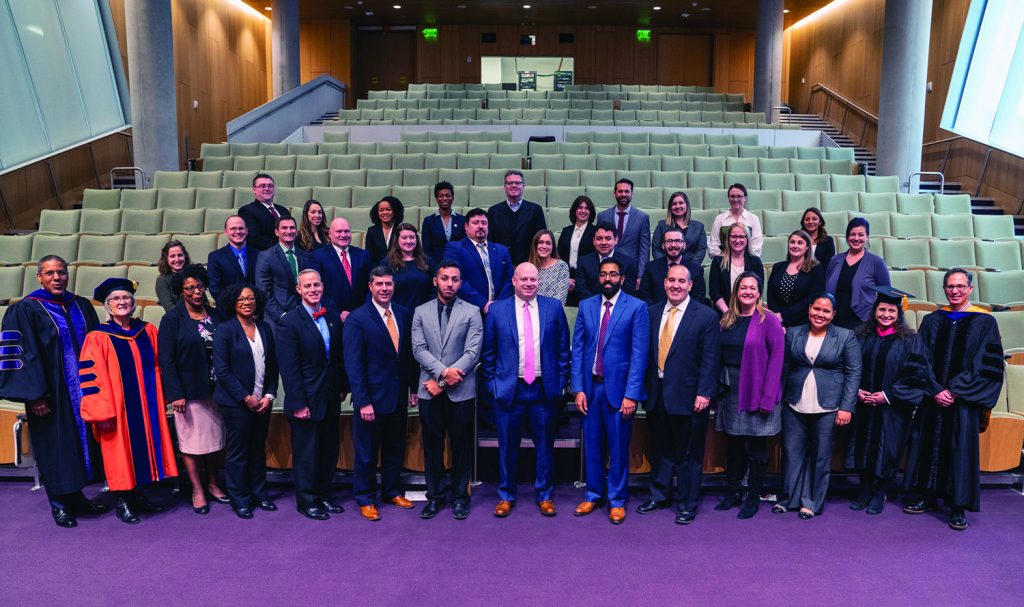
College Of Law JDi Class at Opening Convocation in 2019
Many Paths, One Destination
Ramsey Hilton L’22
Patent Attorney, Cooley LLP
The main reasons for me were flexibility and convenience. Going into the program, I was working full-time as a patent agent at a law firm, which already had a demanding workload. Adding coursework to that is intimidating, and I was starting to question whether there were enough hours in a week to get everything done. On top of that, in a traditional night school setting a lot of time is lost commuting from work to school and then back home, settling into class when you arrive, all of which can cost you a couple of hours each week. While in the JDi setting, we log in and get down to business right away. As a working professional, this was exactly the efficiency I needed in a law school program.
Ahimsa Hodari L’22
Associate Attorney, DLA Piper
I had a full-time job and wanted a law degree. I wanted a program that would accommodate my schedule and allow me to pursue my degree in a non-traditional way as I didn’t think I could quit my job and become a full-time student. I looked for a program that understood and embraced that and could work around my very busy schedule.
Andrew Lloyd L’22
Curriculum Leader, Hampton, VA City Schools
I chose the program for the flexible, online schedule. It allowed me to continue working while obtaining my law degree. Also, I’m from Rochester, NY so getting a degree from Syracuse University made it even more appealing.
Sarah Roberts L’22
Assistant Public Advocate, Office of Public Advocacy, AK
When I was applying to law school, I was living in Alaska where there are no law schools. I was trying to find something I could do remotely. This was the only program that enabled me to sit for the bar in my state and still be remote.
Meghan Steenburgh G’97, L’22 Assistant General Counsel within the Department of Defense
Syracuse University College of Law JDi was the only program of its kind involving a university with a stellar reputation. The unique program allowed me to continue to be present with my kids, help my parents and attend law school while providing the flexibility to move across the nation and live in three different states; the Syracuse University College of Law name provided legitimacy and access.
Making Dreams and Plans Come True
Hilton: All my previous education and professional experiences were in engineering. I was working as a pipeline engineer until 2018 when a legal recruiter contacted me and asked if I ever thought of working in patent law for a law firm. It had never crossed my mind but was open to it. While I was not required to go to law school to work at the firm, earning my law degree is definitely an advantage in my career.
Hodari: Law school was a thought in the back of my mind, off and on. I graduated college in 2005 with a degree in public policy and pursued a master’s in public policy as I started working. As I began working closer to the law but also in a private sector operation capacity, I started thinking more deeply about this. After talking with my family, I started looking at law schools in 2017 and started the Syracuse program in 2019.
Lloyd: I had wanted to go to law school for a very long time. It was a career idea I had in high school, but ultimately, I didn’t pursue it right away and went into education. After years in public education, the itch to go to law school wouldn’t let up. So in 2018 I started to look at law schools and am very thankful that Syracuse had the JDi program that allowed me to continue working professionally while working toward my J.D.
Roberts: I needed to change careers as my youngest child had started school. I opted to become a lawyer as a profession to meet my personal and family goals.
Steenburgh: I dreamt of going to law school for about 30 years. My dad was an attorney, and it was always in the back of my mind; however, other opportunities presented themselves so the dream just stayed there—in the back of my mind. When the opportunity was ripe, this program allowed that dream to come true.
Allowing for Growth and Impact
Hilton: Having a law degree and having passed the bar exam significantly broadens the scope of what I can do professionally. While being a patent agent is a great career, the scope of the matters I can advise on and the scope of my practice grows significantly now that I am a patent attorney.
Hodari: This degree means a lot to me. It has been a dream of mine and something I wanted to do. When you layer on being an older student, a non-traditional student, it meant a lot of sacrifice in family time, work time, and community time. There were a lot of personal things I had to wrestle with, such as: can I do this, do I have time to do this, can I do this well, can I thrive? My degree is now one of the things I am most proud of. It really takes a village and am very grateful to everyone who came alongside me to help me achieve this goal.
Lloyd: Having a law degree opens many doors. I am very excited about what the future will bring.
Roberts: My J.D. means freedom and independence. While in law school my husband had some serious health complications, and we weren’t sure if he would be able to continue working. I was so grateful to be in the program and knew no matter what happened, I would be able to work and support our family.
Next Stop: Many Destinations
Hilton: After graduating and passing the Massachusetts bar exam, I transitioned from being a patent agent to a patent attorney at Cooley LLP in their Boston office.
Hodari: I am a patent litigation associate. I typically support defendants who are accused of patent infringement and support their efforts to litigate matters in federal court. Coupling my law degree and educational experiences allows me to better fight for educational equity. I am excited about what the future holds.
Lloyd: I am currently the Curriculum Leader for the World Languages and English Language Learners department and Title III Coordinator for the Hampton City Schools in Hampton, VA. I oversee two program staffs and work closely with students, parents, staff, administrators, and district leadership to ensure we have robust programming for our students and to ensure that our English language learners have equal and equitable access to our educational programming.
Roberts: I am currently working for the state of Alaska as a public advocate for the Department of Public Advocacy. I represent respondents in guardianship cases and parents in cases where the state has stepped in and taken custody of children.
Steenburgh: I am currently an assistant general counsel in the Office of the General Counsel for an agency within the Department of Defense. I so enjoy national security lawyering that I cannot express my excitement and love for lawyering in words. The strength of College of Law professors (with an extra dose of gratitude for my National Security professor, Judge Jamie Baker) enabled me to conduct impactful legal reviews from day one.
The Importance of the Residencies
Hilton: Our class had a bit of an unusual situation. For our first residency in August 2020, we had to meet remotely due to COVID restrictions. Our second residency in August 2021 was our first time meeting in person for most of us. We knew each other from an academic setting quite well, but did not know each other personally. At the second residency, I finally got some good face time with some of my classmates and really developed a great kinship with these folks. I’ve gone through three different degree programs at three different universities, and the kinship I have with the folks I met during the JDi program is the best level of connectivity I’ve had with a cohort. It’s ironic because it’s a program that is a majority online. That second residency was a great week where we got a lot done academically and had a great time with our colleagues.
Hodari: Even though the program was fantastic from a remote perspective, I had a great time being in person as well. I enjoyed attending the in-person residencies and getting to know my classmates in a casual setting, even renting a house together for residencies, and creating study groups when we were not in person. The residencies and friendships are the hallmark of the program. The cherry on top at the end is the law degree.
Lloyd: My favorite part was the residencies. From meeting my cohort to hands-on experiences to discovering Syracuse, the residencies provided us with a lot of wonderful experiences that forged lasting relationships that helped us as we went through the classes and in study groups where we relied on each other when things got rough.
Roberts: My favorite times were Zoom study sessions with my study group and study partner for three years straight, multiple times a week. These people knew me the best and commiserated with me and knew what I was going through. Lou Lou Delmarsh introduced me to my study partner night one and she’s become my lifelong bestie. I would never have made it through law school without that connection.
Steenburgh: My favorite time during JDi was during a residency when I was staying up late working on a project in the law library and my study buddy was with me, entertaining herself as I worked. We left at probably three in the morning and there was a snowstorm. We were crossing campus and were just silly kids in the storm heading back to the hotel from the library knowing we had a presentation to make in just a few hours. I think that the beauty of this program is that you create such strong connections, and you have these moments and memories that mean so much. It has nothing to do with the law but everything to do with this program.
Time Inc. merges with Warner Communications. Time Warner acquires Turner Broadcasting. AOL acquires Time Warner. NBC Television acquires Telemundo, Bravo and Universal Studios. Viacom splits into CBS Corporation and a second Viacom (liquidating the famed Desilu Productions). CBS does a spin-off REIT of CBS Outdoor. CBS spins off CBS Radio. Viacom and CBS merge to create Paramount Global.
Big names in the entertainment industry and big dollar deals. And Richard M. “Rich” Jones ’92, G’95, L’95 has been involved in all of them, and more, including successfully arguing a seminal tax case before the U.S. Court of Claims (CBS Corporation v. United States, No. 10-153T).
Jones majored in accounting, and received his master’s in accounting from Whitman School of Management and his law degree from the College of Law the same year. He also holds an LL.M. in corporate, international and tax law from Boston University School of Law. “Tax issues are prevalent in every single transaction,” says Jones, who is executive vice president, general tax counsel, and chief veteran officer for Paramount Global.
Attorney and CPA Jones says it’s critical to be able to translate the financial implications of every deal into terms that business leaders, boards, judges, policy makers and the general public can understand. He regularly testifies before Congressional committees on the economic benefits that the entertainment industry brings to communities. “We spend about $20 billion a year investing in content, and it’s critical that we recover some of those costs through tax benefits,” says Jones. “The fact is that television productions are the life blood in many cities, supporting countless workers who bring these productions to life. I love this industry because it’s about storytelling but it’s also about serving the hardworking people behind and in front of the cameras.”
The desire to serve others has always driven Jones. He was a non-commissioned officer in the U.S. Army, where he served honorably as a member of the 75th Ranger Regiment and 10th Mountain Division. After six years of service, he was medically retired from the Army after being critically injured when his parachute malfunctioned during an Airborne Assault Training Mission. But he never left his comrades behind, even after earning multiple academic degrees, a clerkship in the New York State Supreme Court, a decade at Ernst & Young in their media, entertainment and transaction advisory services practice, and positions at GE (NBC Universal) and Viacom. He founded the Paramount Veterans Network to support the hundreds of veterans who work at Paramount Global with education, training and employment opportunities.
Jones also serves on the board of the D’Aniello Institute for Veterans and Military Families (IVMF) Board, the Office of Veteran and Military Affairs (OVMA) Advisory Board, and the Syracuse University Board of Trustees.
Jones sees his work in the entertainment field as an opportunity to impact the way the entire nation views and supports veterans. “Not only do our shows provide employment and career opportunities for countless veterans and their families, but they bring authenticity to the stories we tell,” says Jones. He cites the example of the CBS hit series, Seal Team, now in its seventh season. One of Jones’ good friends pitched the original idea for the series to CBS leadership and the rest is history.
Jones hears regularly from a Gold Star Mother who loves to watch Seal Team, even as she still grieves for her son who was among the 30 U.S. service members, including 22 Navy Seals shot down in 2011 during Operation Enduring Freedom in Afghanistan. “This mother texts me each time she watches the show and tells me how it helps her by keeping her son’s memory alive,” says Jones. “I brought her to meet the cast members which reinforced that what they do is more than just playing a character on television.”
“I love having a job where I can practice law at the highest level, driving great value for stakeholders and still serve veterans and entire communities with the kind of entertainment that informs and inspires,” says Jones. “It’s storytelling at its finest. Storytelling with a higher purpose.
The precision with which 38 Rockettes on stage individually perform 160 eye-high kicks in unison in every show is stunning. Audiences are mesmerized, never thinking about the lawyers behind the scenes who enable this extraordinary entertainment with their own precision and discipline.
“If you’re involved in the production of live or taped shows, you’re dealing with contracting, music rights, film rights, intellectual property, and union/labor issues,” saysStephanie Jacqueney, G’82, L’82, who spent more than two decades as Vice President of Legal and Business Affairs for Madison Square Garden. Jacqueney didn’t learn all that she needed to know in law school. But it didn’t matter.
“I didn’t take a copyright class, but I did learn how to read a statute and cases, and how to be analytical. That’s what matters,” says Jacqueney, who has been a member of the College of Law’s Board of Advisors since 2020. She entered law school with a strong interest in public policy, drawn to Syracuse because she could obtain both a J.D. and a Master’s from the Maxwell School. She had worked in human services and intended “to save the world and do something in the public interest.” But the compensation from those jobs generally can’t pay off law school debt. So, she headed to corporate law.
While at Cadwalader, Wickersham & Taft, she worked on a case involving a prominent singer in a dispute against her manager. Jacqueney found her first venture in entertainment law “fascinating.” At Manhattan Cable TV, a Time Warner subsidiary where she was General Counsel, she struck the balance between general legal work and lobbying/public policy. Then came Madison Square Garden, with its TV productions, Radio City Christmas Spectacular, Super Bowl, and other stadium halftime shows. She handled agreements for Diana Ross, Stevie Wonder, Gloria Estefan, and other entertainers.
It wasn’t the glamour of it all that fascinated her. It was the complexity of legal issues and the need for creative and rapid solutions. She cites the example of one Super Bowl Halftime show threatened by a copyright infringement accusation. “In this case, the set design included hundreds of feather flags. Just days before the scheduled show, someone claimed to have a copyright on the flag design,” she recalls. There was no time to fight the claim in court. She recommended giving the designer an acknowledgment in the post-show credits. Problem solved. After all, the show must go on.
Similarly, it took an army of lawyers, flight engineers, safety, and insurance personnel to successfully pull off Diana Ross’ helicopter exit after her Super Bowl Halftime performance before 100,000 fans at Tempe Arizona Stadium. “We spent weeks working on making those few seconds happen,” says Jacqueney. The event has since been hailed as one of the greatest Super Bowl Halftime exits ever!
Though her work with Madison Square Garden was fulfilling, it was all-consuming. “I was moonlighting as the mother of triplets.” When her two sons and daughter were in high school planning their college moves, their mom made her own, setting up her own consulting firm. It gave her the flexibility she needed to help her kids make their transitions.
Her triplets excelled in college (two at Syracuse University and the third at the University of Miami) and Jacqueney still laughs at the memory of coordinating with her husband, Mark Edelstein, for their presence at their triplets’ convocations and commencements, all scheduled for the same weekend. “It was all about logistics.” She made it happen. After all, the show must go on.
Jacqueney’s clients include ABC/Disney and skating rink operators in iconic locations such as Central Park. Her career trajectory stands as a model for young lawyers who might feel stuck. “If you’re analytical, diligent, and work hard, you can change gears. Take a CLE. Seize opportunities. The truth of the matter is that I fell into this specialty.”
When Joe Di Scipio L’95 was in law school, he wasn’t especially interested in mergers and acquisitions (M&A). He had his eyes set on politics, perhaps the U.S. Attorney’s office, and thrived on the trial team. Today, Di Scipio is heavily engaged in business negotiations and regulatory compliance in a field that involves a whole lot of politics.
As Senior Vice President for FCC Legal & Business Affairs for Fox Corporation, Di Scipio is involved in the buying and selling of television stations, brokering distribution deals on streaming and digital platforms, and negotiating licensing deals for the retransmission of Fox TV programming. “This isn’t the M&A we studied in law school. Selling broadcast is not like selling a building or real estate,” says Di Scipio.
Having worked at the Federal Communications Commission (FCC) both before and after law school, Di Scipio knows how regulations impact a rapidly evolving field. “How we consume media is changing by the minute,” he says. “I actually had predicted the demise of the field I work in several times, and it just hasn’t happened. In 2005, I thought over-the-air broadcast television would go away, particularly the network affiliation distribution model. I figured cable and satellite would replace that model, but that was not to be. Now, people can download or stream anything they want.”
He says the skills he acquired in prepping for trials are most relevant today as he works through the morass of regulations governing media and negotiating with the FCC on policy changes. “At the federal level, a lot of times the decisions being made are more political than they are legal,” says Di Scipio. “You have to understand the politics involved to get to the desired legal decision.”
For example, when Fox stations started airing college football games, they wanted to offer extended pre-game programming. But the FCC required broadcast stations to carry a certain amount of children’s television, which typically aired at the same time. “Fortunately, we were working with a Republican administration that had a deregulatory bent, but getting them to change the rule and allow greater flexibility in how children’s programming was provided is still a huge deal.”
Di Scipio credits Professor Emeritus Travis Lewin and JudgeElijah “Chip” Huling who worked with the trial team for instilling in him the skills to succeed. “It is the ability to think strategically on your feet when you’re negotiating, to get the other party to move toward your ultimate goal,” he says.
In many broadcast distribution deals, the two sides are partners in desiring to disseminate programming, “but we are diametrically opposed because one side wants to get paid a lot of money and the other doesn’t want to pay anything,” says Di Scipio. “If you can’t figure out how to get the deal done, you’ll go dark. Nobody wants that.” He prides himself on having developed a reputation for being tough, but fair.
Di Scipio says he “trades on trust” in this fast-paced field. Trust that comes from years of building relationships, and involvement with the National Association of Broadcasters, Federal Communications Bar Association, FCBA Foundation, Syracuse University Alumni Association, and Syracuse University Law Alumni Association.
“My advice to students or new lawyers is to invest time in developing relationships outside of their work. It gives you legitimacy. It earns you trust.”
Like most kids his age growing up in Syracuse in the 70s, Peter Carmen L’91 didn’t reflect on Indigenous lands or tribal sovereignty. It wasn’t part of the public consciousness then. That makes the story of how he became one of this nation’s leading advocates for tribal sovereignty and a driving force behind the success of Turning Stone Enterprises, LLC all the more intriguing.
Today, Carmen is the Chief Operating Officer (COO) of the Oneida Indian Nation and its enterprises in gaming, hospitality, entertainment, retail, and technology, including the Turning Stone Resort Casino in Verona, NY. Before stepping into his current role in 2010, Carmen was General Counsel and Senior Vice President. He has been a member of the College of Law’s Board of Advisors since 2022.
“I knew in high school I wanted to be a lawyer,” says Carmen. “I had so much fun in mock trials, drawn to issues of fairness.” His first philosophy course at Brandeis University focused on Socrates. “Finding the truth through the Socratic method resonated with me. My honors thesis tackled the cosmological argument for the existence of God.”
At the College of Law, he was inspired by professors in constitutional law and the appellate team. He is grateful for the discipline demanded by professors like Christian Day. “I remember how he ripped apart my first brief,” says Carmen. “He shaped how I write today. Lawyers shouldn’t write like philosophers. Philosophers wax on. Attorneys must make the point and get out. Every sentence must advance the point from the previous sentence. If it doesn’t, it’s superfluous.”
Carmen was working at Mackenzie Hughes LLP in Syracuse when he met Oneida Indian Nation leader Ray Halbritter ’85. “I was immediately intrigued by the variety and complexity of issues,” he says. Halbritter asked for help on an internal tribal issue and was impressed enough with the results that he engaged Carmen and his firm to assist Oneida’s formidable legal team. “They wanted a ‘green light lawyer’ who could envision solutions and work through roadblocks. We were aligned in our values and culture.”
So aligned that Carmen accepted Halbritter’s offer to join Oneida as its General Counsel in 2005. The years since have proven the law to be a powerful tool in the hands of a resourceful and values-driven organization to achieve fairness and prosperity for the tribal community and the region.
Carmen says the highlight of his career was teaming with Halbritter and another College of Law alum (Oneida’s current General Counsel) Meghan Murphy Beakman G’00, L’00, to negotiate the 2013 historic agreement with the state of New York and local counties that resolved every outstanding legal issue related to land, tax, cultural and gaming disputes, while bringing significant revenue to local economies.
Carmen’s focus shifted to operations when he became COO in 2010, working with Halbritter to oversee one of the region’s largest employers and a respected partner in community and economic development with an estimated annual economic impact exceeding $1 billion.
When Oneida announced last year that it was entering into the cannabis business (from seed to sale), with the Verona Collective, one prominent news commentator said: “They will follow whatever professional standards there are in that industry and they will do it far faster and far more affordably. Everything (they) have touched has, over time, turned to gold because they used common sense and hard work.”
For Carmen, who never imagined himself in the gambling or marijuana business, it’s the principled approach to the practice of law and business that drives him. “At the end of the day, our business is a people business. And I have the honor and privilege of working for the Oneida people.”
Shawna Benfield L’09 was drawn to the entertainment industry early on—but always worked behind the scenes. “I was way too shy and utterly lacking in talent,” she laughs, “But I loved seeing how things were created.” She was the first non-musical theater major to take a course in the history of musical theatre at the University of Miami, where she majored in sports administration. So it was probably inevitable that she would end up in entertainment law, but it was not a straight career path out of law school.
As a first-generation college student, a law degree represented stability and respect. “I fell into the same mold as many law school students,” she says, studying for a career in litigation or corporate law, soaking up essential skills and being inspired by certain professors. She wasn’t drawn to tax law, for example, but loved classes taught by Professors Robert Nassau andGregory Germain, who became trusted mentors.
Following graduation, Benfield clerked for federal judges and worked in a big law firm doing commercial and securities litigation, but she never lost her passion for the entertainment business. Her husband Andrew K. Benfield L’09,a tax attorney, encouraged her to career course-correct. She reached out to a network of colleagues and alumni. “I did the awkward thing, talked to strangers, and asked for help,” says Benfield. She demonstrated that her skills were transferrable to an industry that is essentially “a mishmash of potential legal issues.”
Bringing her legal acumen into the creative process, Benfield, who is now associate principal counsel for Walt Disney Television and the FX network, gets involved in everything from contract negotiations with agents to issues related to freedom of expression here and abroad, to labor law and international contracts. The consumers of entertainment are unaware of the legal complexities behind the scenes. Benfield offers this example from when she was a production attorney for The Voice. During a live broadcast, a contestant went missing, forcing producers and directors to quickly decide (during a commercial break) how to cover the time. Benfield advised on measures that were equitable to other contestants and in compliance with rules governing competition shows. “The worst thing a lawyer can do is ruin the vibe of the show,” says Benfield.
“We never want to hamstring the creative,” says Benfield. She works closely with production teams to facilitate storytelling that entertains, enlightens, and impacts viewers around the world. Sometimes it’s about solving logistical problems: “Can we go to Iceland to shoot that scene? Do we need visas if we only work there for a week?”
Sometimes, it’s about managing legal risks to empower the storyteller. For example, in working with a journalist on the production of a docudrama, Benfield considers “wildly different rules” governing free speech and defamation in different countries. “I’ll tell the writer, ‘Put your pen to paper, be your best, and we will figure out the rest.’ Sometimes the very best stories carry risk. But just because it’s risky doesn’t mean you shouldn’t be doing it.”
Having taken some risks herself in redirecting her own career, Benfield couldn’t be happier: “There’s nothing better than helping people with creative talent succeed, and being able to play a small role in that is just wonderful.”
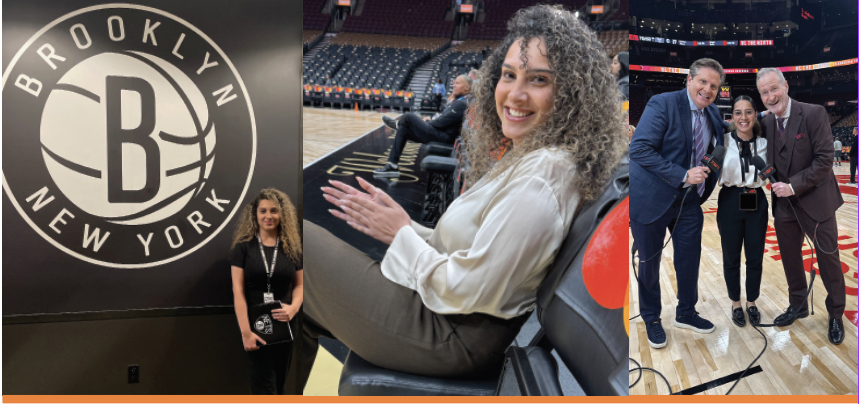
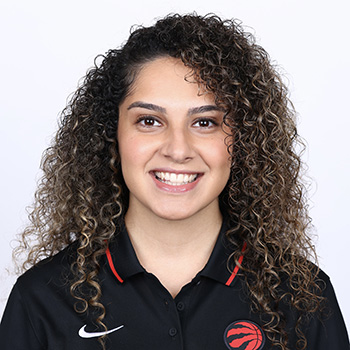
Each year, hundreds of students apply for the Wayne & Theresa Embry Fellowship, an opportunity for Canadian citizens “to gain firsthand experience in a professional basketball environment over the course of a full National Basketball Association (NBA) season” with the Toronto Raptors. Requiring a video submission as an application, the initial candidate pool is narrowed down, and only two winners are chosen, following an intense interview process. In 2023, Niloofar Abedzadeh L’23 was selected as one of the 2023-24 Wayne & Theresa Embry fellows.
Now, she works with the Toronto Raptors front office, focusing on salary cap strategy, scouting, and Collective Bargaining Agreement (CBA) analysis. She has also gained experience in each Raptors’ department, participating in practical work to better understand how everything is integrated and communicated between departments.
Abedzadeh L’23 first externed with the Brooklyn Nets (left) before landing her Fellowship with the Toronto Raptors (center and right.)
A Unique Intersection
Born in Iran and raised in Toronto, ON, Abedzadeh began her law studies at the College of Law in 2020. It was not until her second year, however, that she realized she wanted to work in sports and entertainment law. As an active member of the Travis H.D. Lewin Advocacy Honor Society, Abedzadeh competed in various competitions, including the Tulane Professional Basketball Negotiation Competition (TPBNC), which focuses on player contract negotiation. With a pre-existing love for basketball, Abedzadeh was starting to see an opportunity to combine her strengths and passions. After meeting numerous NBA figures with law degrees at the TPBNC, she was exposed to the “unique intersection” of sports and law.
“That’s when I initially thought this could be a career,” Abedzadeh said. “I never thought there was room for me to work in basketball, but meeting the right people and being in the right spaces introduced me to a career in sports.”
After discovering the world of sports law, Abedzadeh pursued courses that complemented her new interest, with Professor Gregory L. Germain fueling her passion for contract law and inspiring Abedzadeh’s hobby of studying player contracts. She also worked with Professor Margaret M. Harding, who instilled attention to detail, and even advised Abedzadeh through a Syracuse Law Review paper that earned her a scholarship.
Alongside her classes, Abedzadeh worked with Lily Yan Hughes, Assistant Dean of Career Services and Student Experience, to participate in an externship with the Brooklyn Nets following her second year. Hughes connected Abedzadeh with Jeff Gewirtz, Executive VP of Business Affairs and Chief Legal Officer at BSE Global, the owners of the Nets. Gerwitz was the first person to give Abedzadeh an opportunity to work in sports and served as her mentor during her time with the Nets, providing her with a formal introduction to NBA and law through work with the legal and business departments of the Nets.
“Lily helped me with my application process for the Brooklyn Nets and without that externship, I wouldn’t be here today,” said Abedzadeh. “The Raptors understood that I had this experience, and I had the interest and the skill sets to work at a high level, so thank you to the College of Law for creating the opportunity to do that externship so I could be where I am now.”
“Working in the NBA has been the perfect intersection of all the things I am passionate about. I am so grateful for the three years I spent at Syracuse.”
Niloofar Abedzadeh L’23
Teamwork in the College of Law
As Abedzadeh’s graduation date approached, she discovered the application for the Wayne & Theresa Embry Fellowship. The program rotates two fellows through different departments in the Raptors organization, such as coaching, player development, team service, and the NBA draft, while they concentrate on an area of interest.
“This is definitely a unique path for someone with a law degree, so I was a little bit hesitant and I wasn’t sure if it was the right thing,” said Abedzadeh. “After speaking with Career Services, they saw my passion for professional sports and working in the NBA, so they told me to just go for it.”
After realizing she needed a video for her application, Abedzadeh immediately contacted the Office of Career Services to assist in the production of her video and to guarantee it stood out, communicating the message she wanted. Working with Dafni Kiritsis, Director of Externships and Career Services, Abedzadeh was connected to the Syracuse Athletics department, who gave her access to the basketball court for various clips in her submission.
“The Career Services staff all played a role in getting my video out,” said Abedzadeh. “Dafni would always make herself available to speak with me and I found a lot of comfort in going to her, even if she was just encouraging me, being positive, or giving me that boost of confidence that I can go for it. It was challenging to even pursue this fellowship so having that access to her and being able to weigh all my options was huge.”
Looking back to when she began law school, Abedzadeh was filled with uncertainties about her career path. The Fellowship has solidified Abedzadeh’s passions for being a part of a team and being in the NBA, creating a well-rounded individual who has discovered her strengths across various realms.
“Working in the NBA has been the perfect intersection of all the things I am passionate about,” said Abedzadeh. “I am so grateful for the three years I spent at Syracuse and I hope that whatever is next for me, I can be my best self, continue to learn and inspire others along the way. I am certainly excited for what the future holds but most importantly, I try my best to be present in the moment and enjoy the ride.”
Dr. Günther Schirmer, head of the Secretariat of the Committees on Legal Affairs and Human Rights and on the Election of Judges at the European Court of Human Rights at the Council of Europe’s Parliamentary Assembly, recently spent time at the College of Law for a talk on Russian reparations for the war in Ukraine and to meet with students interested in an International Law career.
His discussion topic, “Accountability for Russian Aggression: A Frontline Perspective from Europe” examined the various avenues for Russian reparations to Ukraine and the international legal and political barriers that need to be addressed to hold Russian leaders accountable. The approaches discussed included establishing a special tribunal to address criminal and financial repercussions, including financial aspects of international law that are being discussed in Europe.
Dr. Schirmer also met with law students to discuss careers in international law. His advice focused on having the ability to speak another language, experience traveling abroad, and seek out internships that open your network to those involved in international law.