Around Syracuse Law

“May You Live in Interesting Times” 

By Robert Nassau, Associate Director, Office of Clinical Legal Education, and Director, Low Income Taxpayer Clinic; and Teaching Professor

CLINIC DIRECTOR’S REPORT

Professor Robert NassauProfessor Robert Nassau

The precise origin of the phrase “may you live in interesting times” is unknown, and it’s also unclear if it is meant as a blessing or a curse. But whether a blessing or a curse, or a little bit of both, that phrase certainly has rung true for the student attorneys and directors of the College of Law’s eight clinics during the 2020-2021 academic year.

Below, we summarize some of the amazing work performed by our student attorneys and clinic directors during these interesting and challenging times. These summaries are just the tip of the iceberg for all that we have accomplished this past year. 

And while the coronavirus pandemic has created significant obstacles, it also—as Associate Dean of Clinical and Experiential Education Deborah Kenn wrote in last year’s Clinic Director’s Report—provided teachable moments and learning opportunities that will better prepare our student attorneys for legal practice in a post-pandemic world.

Why am I writing this year’s report rather than Professor Kenn? It is because she has stepped down from her position as clinical program director due to a terminal illness diagnosis. Deb arrived at the College in the fall of 1989 when she started the Community Development Law Clinic. For the past 10 years, under her leadership as Associate Dean, the Office of Clinical Legal Education has added the Bankruptcy Clinic and the Betty and Michael D. Wohl Veterans Law Clinic, and the College dramatically expanded its experiential learning opportunities, consistent with new ABA and state requirements. 
Deborah KennProfessor Deb Kenn

On top of her leadership of the College of Law’s clinical and experiential education, Deb has taught doctrinal courses in, among other things, Animal Law, Property, and Nonprofit Organizations Law, and she led three study abroad trips to South Africa.

All of her colleagues in the Office of Clinical Legal Education will miss Deb’s camaraderie, leadership, and dedication to our clients and our students. None more than me. And more importantly, the hundreds of students whom Deb has taught, guided, and mentored over the decades will remember her fondly and gratefully throughout their careers.

To paraphrase another unattributable proverb, but one that perfectly encapsulates Deb’s tenure at the Syracuse Law: “She left it better than she found it.”

Clinic Reports

Bankruptcy Clinic
Lee WoodardProfessor Lee Woodard
Director: Adjunct Professor Lee E. Woodard

During 2020-2021, the Bankruptcy Clinic produced results for its clients despite challenges presented by the coronavirus pandemic. Various legal aid societies and numerous other sources continued to refer clients and bankruptcy courts continued to conduct hearings and process filings virtually.

Appearing in court or at meetings of creditors virtually presented its own challenges, such as having clients sign petitions and schedules and then getting the originals filed with the court. A combination of Zoom, FaceTime, phone, e-mail, and regular mail was used, and the clinic was able to file all its cases.

With in-person instruction starting again in fall 2021, student attorneys are looking forward to interacting with clients directly, sitting down with them to go through their financial information world and helping them create a fresh start.

Betty and Michael D. Wohl Veterans Legal Clinic
Professor Beth KubalaElizabeth Kubala Portrait
Executive Director: Professor Elizabeth Kubala

Over the past year, the coronavirus pandemic has changed the practice of law, and student attorneys in the Betty and Michael D. Wohl Veterans Legal Clinic (VLC) have adapted and evolved to continue to best serve our community’s veterans.

While many courts closed or suspended operations, the US Department of Veterans Affairs continued processing disability claims, requiring students to find innovative ways to meet with clients and maintain good client relationships.

In fact, the significant shift to virtual proceedings meant increased opportunities for student attorneys to participate in hearings and appeals. And because classes were delivered virtually, the clinic was able to integrate JDinteractive students who benefited from experiential learning opportunities provided by the clinic.

Student attorneys performed a broad array of administrative and court appeals to challenge wrongful denials of federal veterans’ benefits, adapting seamlessly to the VA’s tele-hearing format and regularly appearing before the Board of Veterans Appeals.

Students also collaborated for their appearance before the US Court of Appeals for Veterans Claims on a still-pending, novel case involving a veteran suffering from military sexual trauma. Finally, two student attorneys worked as part of a national team to draft an amicus brief filed before the US Supreme Court that addressed issues involving veteran suicide rates, Gulf War Illness, and military sexual trauma.

Children’s Rights and Family Law Clinic
Professor Suzette MeléndezProfessor Suzette Meléndez
Director: Professor Suzette Meléndez

Despite the pandemic—and perhaps because of it—the Children’s Rights and Family Law Clinic (CRC) was hard at work this past academic year with students engaged in the active representation of their clients even while the courts had to severely reduce the matters heard. 
CRC students were able to finalize an adoption for a family that had taken in a teenager after a very unstable and abusive childhood and was now adopting him as an adult after 18 years. The whole family showed up in the Zoom courtroom for the event.

The Clinic was able to process divorce matters in multiple counties. In one of our cases, we are resolving the divorce for a client experiencing debilitating PTSD, who was referred to us by the VLC. VLC Law Fellow Matthew Bulriss was a critical bridge in forming a successful attorney/client relationship. 

The CRC also helped a young mother regain significant custodial rights and parenting time for her child after the mother successfully recovered from a drug addiction that led to a jail sentence. Additionally, the CRC engaged in representations that required significant research and detailed written analysis seeking legal options for our clients about how best to move their cases forward once courts resume normal activity. 

Our clients retained us for the following matters:

  • Joint tenancy issues and options for a partition action for an unmarried couple
  • Bankruptcy issues related to marriage
  • Issues of property division when workers’ compensation settlement proceeds were used to buy a marital home
  • Inherited property and claim against the marital home purchased with said inheritance 

Additionally, CRC students assisted clients in an expungement hearing arising from an erroneous determination after a child welfare inquiry; the preparation of annulment paperwork after a bigamous marriage was discovered, and the pursuit of an order of protection necessary to extract a woman and her children from a violent home. Students also participated in mediation training and observations in cases where alternative dispute resolution was offered.

Criminal Defense Clinic
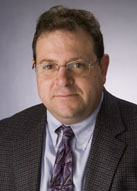
Gary PieplesProfessor Gary Pieples
Director: Professor Gary J. Pieples

The Criminal Defense Clinic (CDC) had several successes during the 2020-2021 academic year. Victoria Lezette L’21 and Michael Stoianoff L’21 represented a client charged with a series of minor, victimless charges, mostly resulting from her substance abuse and mental health issues. After Stoianoff developed a motion based upon statements from her family and social workers detailing her mental and physical condition, the court agreed to dismiss all charges.  

In another case, James Thyden L’21 and rising 3L Katherine Davis convinced the judge and prosecutor to reduce the charges and reduce the protective order prohibiting their client from being in his family home. His mother wanted him home to help with the younger siblings while she cared for her ailing husband. As a result of the negotiated plea, no convictions were added to the client’s history, and he was able to move back home.

The CDC also successfully got a client’s case dismissed because of prosecutorial violations of updated New York discovery rules. A team of Donatello Lazarati L’21, Andrew Rahme L’21, and rising 3Ls Lilian Baah and Shannon Edwards researched, filed, and argued several motions arguing numerous discovery violations. On the eve of trial, the judge ruled that dismissal was warranted after multiple failures by the assistant district attorney to provide required discovery.

Disability Rights Clinic
Professor Michael SchwartzProfessor Michael Schwartz
Director: Professor Michael A. Schwartz

The following are five exemplary accomplishments of the Disability Rights Clinic (DRC) during the past year:

DRC partnered with a Rochester, NY-based law firm to file a lawsuit against a franchisee of the Kentucky Fried Chicken chain in the United States District Court for the Western District of New York, alleging violations of Title III of the Americans with Disabilities Act and New York state anti-discrimination law. The case concerns a Deaf driver who was refused service at the franchise’s pick-up window because he could not use the ordering kiosk. Initial mediation is mandatory.

DRC joined a local non-governmental organization in defending a lawsuit brought by a roofing company against the clinic’s client, an elderly Deaf man, in Small Claims Court. The clinic, in turn, filed a discrimination claim against the company with the New York State Division of Human Rights, which found probable cause to go to a public hearing.

DRC continues to advocate for snow removal and maintenance of sidewalks for wheelchair users in a suburb of Syracuse.

An Institutional Review Board approval was obtained for a study of educational policies and practices involving members of the Deaf New American community. 

The clinic continues to advocate for accessible access to healthcare facilities for people with disabilities, including immigrants with disabilities.

Elder and Health Law Clinic
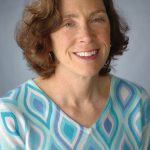
Mary Helen McNealProfessor Helen McNeil
Director: Professor Mary Helen McNeal

Despite the many challenges of COVID-19, the Elder and Health Law Clinic (EHLC) shifted quickly to virtual representation. Students executed wills, powers of attorney, health care proxies, and living wills; handled appeals of public benefit denials; assisted clients with minor probate issues; litigated a financial exploitation case; and represented family members seeking guardianship of parents with end-stage dementia. 

As students learned the law, they simultaneously faced the challenges of virtual representation, including clients’ limited access to technology, limited ability to use technology, social isolation, and declining physical and mental health. While many people faced these challenges over the last year, they were exacerbated for many older people.
Student attorneys represented several patients residing in the long-term care unit at the Veterans’ Administration Hospital who were seeking end-of-life documents. One client’s situation exemplifies the challenges both clients and students faced. The client, who had advanced amyotrophic lateral sclerosis, wanted a will and power of attorney. He had neither access to—nor the ability to use—technology. With the assistance of a VA social worker, student attorneys Dianne Jahangani L’21 and Benjamin Kaufman L’21 met virtually with the client, whose health was deteriorating rapidly. 

After several meetings, they drafted a will and arranged for a “virtual signing,” with final documents signed virtually, transmitted via email, and then virtually notarized pursuant to New York’s COVID-related executive orders. While Jahangani and Kaufman had intended to complete other legal tasks for the client, he unfortunately passed away within days of the will signing. As Jahangani and Kaufman wrote in their closing memo: “He was a wonderful client whom we had the pleasure of working with and ensuring that his final wishes were memorialized.” 

In spring 2021, the EHLC participated in launching the “Enhancing Services for Older Victims of Abuse and Financial Exploitation” project, a collaboration among Vera House, the Center for Court Innovation, Christopher Communities, and Syracuse University. A major goal of the project is to offer restorative justice options as an alternative to litigation for those impacted by elder financial exploitation. EHLC and Elder Justice Fellow Allison Wick are integral parts of this project, providing legal information, training, referrals, and limited representation.

Low Income Taxpayer Clinic
Professor Robert NassauProfessor Robert Nassau
Director: Professor Robert Nassau

In addition to its typical array of casework—such as helping clients obtain rightful refunds or fend off debilitating collection activity—student attorneys participated in the Low Income Taxpayer Clinic’s (LITC) first-ever Remote Tax Court Trial and increased their expertise in all three of our government’s pandemic-related stimulus payments.

The trial involved a taxpayer’s claim that she had signed an Extension of Time to Assess Tax under duress. Student Attorney Meredith Wallen L’21 examined the taxpayer at trial while rising 3Ls Justin Lange and Michael Towey assisted with a post-trial briefing. 

Regarding the stimulus payments, LITC helped numerous taxpayers obtain payments, which—for reasons ranging from a failure to file a return to having been fraudulently claimed by another taxpayer—they had wrongfully been denied. The clinic anticipates a similar tax activity in the coming year in connection with the expanded Child Tax Credit.

Transactional Law Clinic
Professor Jessica MurrayProfessor Jessica Murray
Director: Professor Jessica Murray

While continuing to work with clients who are starting and operating businesses and not-for-profit organizations during the unusual circumstances of a global health crisis, the Transactional Law Clinic (TLC) took advantage of online meeting technology to invite alumni to share experiences in their transactional law practices since graduating from Syracuse Law.

Alumni speakers included:
Erin Chrzanowski L’19, Corporate Legal Counsel Americas for Dassault Systèmes, joined the class from Massachusetts to discuss her in-house practice, which includes work similar to that done by student attorneys.
Haley DeCarlo L’18, an associate at, Block, Longo, LaMarca & Brzezinski PC in Syracuse, provided an overview of practicing residential real estate law in Central New York.
Marysia Mullen L’13, an associate at Latham & Watkins, and Tyler Mullen L’13, Government Contracts Attorney, U.S. Defense Information Systems  Agency, both joined the class from  Washington, DC, discussing how TLC experiences impacted their careers. 
Austin Judkins L’18, an associate at Boylan Code in Rochester, NY, talked about the business and corporate finance practice of a medium-sized firm. 

The visiting alumni also discussed life-work balance, career opportunities, changes resulting from COVID-19, and diversity initiatives at their workplaces. These online visits proved so popular that the clinic will continue them even after students return to the classroom, and some student attorneys have already expressed interest in returning to the clinic as future alumni guest speakers.

Beginning a New Chapter 

By Dafni Kiritsis ’97, Director of Externships and Career Services

EXTERNSHIP PROGRAM 

DAFNI S. KIRITSIS '97Dafni Kiritsis ’97

I’m very excited to have joined the College of Law as Director of Externships and Career Services. In this position, which I started in June 2021, I report to the Assistant Dean of Career Services, and I will help to design and implement programs and services for the Office, in part by expanding our already robust Externship Program. In doing this, I look forward to using my diverse legal and human resources experiences and to engaging with our alumni base, which already provides such extraordinary support to our externs.

A little about myself. I’m a Syracuse native, the daughter of Greek parents who immigrated to Central New York from Northern Greece. An Orange alumna, I graduated from SU in 1997 with a B.A. in International Relations and French Language, Literature, and Culture, and a minor in Women’s Studies. I also met my husband as an undergraduate!

After earning my J.D. in 2000 from Albany Law School, I began my law career as an associate in the Albany, NY, firm of Whiteman Osterman & Hanna LLP. I then joined Green & Seifter (now Bousquet Holstein PLLC) as a senior associate and stayed with the Syracuse firm for nine years, practicing employment law and litigation.

I then worked as an attorney for the US Department of Veterans Affairs, Office of District Counsel for eight years, providing counsel, conflict resolution, and legal representation to VA Medical Center facilities in the North Atlantic District.
In 2018, I returned to my alma mater as a Senior HR Business Partner, counseling senior leaders in the University’s Business Finance Administrative Services group, as well as College of  Law staff and faculty.

As I pick up the reins of the Externship Program, I thank my colleagues for so ably overseeing it during such a challenging—and, we hope, unique—time in its history. The coronavirus pandemic disrupted work for almost all of us, and that’s no less true for our spring 2021 externs. Nevertheless, and with the invaluable assistance and patience of our hosts and alums, we continued to provide our students with critical applied learning experiences through remote placements.

“As I pick up the reins of the Externship Program, I thank my colleagues for so ably overseeing it during such a challenging—and, we hope, unique—time in its history.”

Deborah O’Malley, the 2020-2021 NYCEx and PhillyEx Director, notes that even though they were not on-site with their employers, our students impressed their site placement supervisors. “Each participant in the NYCEx and PhillyEx programs for the spring semesters received excellent final evaluations,” she says.

The New York City/Philadelphia course seminar was also continued via Zoom, with guest lectures from Everett Gillson L’85, Chief Administrative Officer, Defender Association of Philadelphia; Kimberly Lau L’06, Partner, Warshaw Burstein LLP; Kevin Belbey L’16, Sports Media Agent, Creative Artists Agency; and Jesse Feitel L’16, Media Associate, Davis Wright Tremaine LLP.

Overseen by Professor Terry Turnipseed, Faculty Director of Externship Programs, the Washington, DC, program also continued its strong placement track record, with DCEx placing nine students across government, nonprofit, judicial, and corporate organizations. “I was quite pleased with the quality of the positions,” he says. “For instance, we placed five participants at the US Department of Justice, including two in the Tax Division for the first time.”

All DCEx placements were remote, except an in-house placement at Orbis Technologies, hosted by Erin Lawless Miller L’10, Vice President of Corporate Business Services. Rachel Stanley Nguyen L’07 and Joe Di Scipio L’95 were among alums offering insights and advice during the DCEx seminar series.

Looking to the future, I look forward to executing Dean Boise’s vision of integrating our Externship Program within the Office of Career Services as part of our efforts to achieve the highest level of placement outcomes for our students.

Because the number of students in the JDinteractive program is the highest it has been since JDi was implemented, the main focus will be on finding these students’ top externship opportunities.

This coming year, we will not only continue to grow our externship opportunities for our residential students, we will place our JDi students in their first externships of their law school journey. We’ll also begin to implement our Third Year Away program, allowing students to spend their final year of law school in a city of their choice. These 3L students will earn their final credits in a combination of externship placements and online classes.

I look forward to working with our alumni on all these fronts. College of Law alumni have been an integral part of our student’s successes in our Externship Program—and post-graduation, too!

Spring 2021 Externship Placements

CNYEx
City of Syracuse
Alumni Host: Kristen Smith L’05,  Corporation Counsel
Hon. Deborah H. Karalunas L’82, Presiding Justice, Supreme Court  of the State of New York, Commercial Division (Onondaga County) 
Hon. Thérèse Wiley Dancks L’91, US Magistrate Judge, Northern District of New York
Nave Law Firm
Alumni Host: Dennis Nave L’14,  Managing Partner
SRC
Alumni Host: Mary Snyder L’03,  Executive Vice President, General Counsel
DCEX
Insured Retirement Institute
Orbis Technologies
Securities and Exchange Commission, Division of Trading and Markets
US Department of Housing & Urban Development, Office of Hearings & Appeals
Alumni Host: Hon. J. Jeremiah Mahoney L’69, Chief Administrative Law Judge
US Department of Justice, National Security  Division
US Department of Justice, Office of Legal Policy
US Department of Justice, Tax Division
US Department of Justice, US Attorney’s Office for the District of Maryland, Southern Division
NYCEX
Goldman Sachs
Alumni Host: Timothy Paul L’84  Chief Fiduciary Officer, Goldman Sachs Trust Company
Northern Manhattan Improvement Corporation 
Alumni Host: Kimberly Warner L’14, Assistant Director for Housing
Shihadeh Law PC
Sony Music Entertainment PC
Superior Court of New Jersey
Alumni Host: Hon. Rodney Thompson L’93, G’93 Presiding Judge, Family Division
PHILLYEX
York County (PA) District Attorney’s Office

How a “Small but Mighty” LL.M. Cohort Forged Ahead During Lockdown 

By Andrew S. Horsfall L’10, Assistant Dean of International Programs 

OFFICE OF INTERNATIONAL PROGRAMS


Andrew Horsfall, a white man with short brown hair, wearing a navy suit jacket over a white collared shirt with a navy tie, smiles in front of a white background.Andrew Horsfall L’10

In early spring 2020, weekly enrollment reports showed that applications to the LL.M. program were soaring well above where they usually are. I was holding weekly admission interviews with applicants from nearly every corner of the globe and working with incoming students on their visa paperwork (a good sign that one has committed to Syracuse Law).

It felt as though we were on track to exceed our enrollment goals for the fall 2020 semester until talk of a pandemic began to be all too real. Looking back, it is easy to think that everything changed overnight—lockdowns, mask mandates, and canceled plans—but there was still hope through the late spring and early summer that we would be back to normal sometime during summer and that it would be business as usual by fall.

However, summer brought border closures, student visa restrictions, and near-hourly requests from students to “defer to a later semester.”

“Throughout, there was a refrain of gratitude for the opportunities to learn and engage with the Syracuse Law community.”

I couldn’t blame anyone for wanting to delay their LL.M. experience. Many applicants would be accessing Zoom lectures from up to 12 hours ahead or behind Syracuse time. Although admissions numbers started to evaporate, I was struck by the optimism and determination of a small group of students who committed to starting their LL.M. studies with us in August.
In total, 10 students from eight countries enrolled. This class was extended across different locations and time zones: three students were located in Syracuse, another three were elsewhere in the Eastern Time Zone, and four studied from their homes in Mexico, Kenya, Germany, and Ghana.

By Labor Day 2020, with orientation behind us and the first weeks of classes over, I was afraid our small but mighty group would become even smaller with students deciding that this “wasn’t for them.” Despite the usual growing pains of a new semester, the requests to drop or defer didn’t come in. Nor did they come in September, nor after mid-terms, and nor leading up to final exams. They had done it! 

Every LL.M. student who started in the fall successfully completed the semester, and then went on to do the same in the spring. Indeed, our “small but mighty fall” cohort was joined by 13 new LL.M. students for spring 2021.

Our LL.M. students not only attended classes—sometimes well past midnight their time—but they participated in student organizations, made meaningful editorial contributions to student journals, and formed relationships with one another and their professors. Throughout, there was a refrain of gratitude for the opportunities to learn and engage with the Syracuse Law community. The LL.M. program is always a transformative experience for our students, and over the 2020-2021 academic year our students—our “COVID Class”—were asked to transform and adapt to many more challenges than they could have foreseen. 

Not that we have surmounted the obstacles of that year, we can proudly look ahead to a return to in-person classes and the opportunity to welcome one of our largest incoming cohorts of LL.M. students—from more than 20 countries! Having thrived in their studies during a pandemic, the COVID Class has set a very high bar for our future students, and I look ahead with all the optimism and determination that our students demonstrated over the past year.

Assisting Uzbekistan with Disability Rights Building Capacity

In December 2020, Dean Boise joined Chancellor Kent Syverud, Provost John Liu, Syracuse Law colleagues, and representatives from three Republic of Uzbekistan institutions to sign an agreement that strengthens academic ties between the University and the republic. The agreement includes a collaboration to create a disability law clinic at Tashkent State University of Law, led by Professor Michael Schwartz, Director of Syracuse Law’s Disability Rights Clinic.

“Syracuse Law enjoys institutional relationships with more than two dozen foreign law schools and government agencies,” says Dean Boise. 

“This agreement marks our first in Uzbekistan. It will be among our most robust partnerships, bringing together parties and interests across various strata of civil society, including academia, governmental, and nonprofit organization.


Syracuse University signs an MOU with representatives from three Uzbek institutions.
Syracuse University signs an MOU with 
representatives from three Uzbek institutions.

In Memoriam


Zaiden Geraige NetoZaiden Geraige Neto

The College of Law mourns the passing of Master of Laws student Zaiden Geraige Neto in March 2021.  Zaiden was a prestigious and well-respected class action lawyer and law professor in Sao Paolo, Brazil, who held an LL.B., Masters, and Ph.D. from Pontifical Catholic University.

“I knew Zaiden as a perennially positive and optimistic person who was excited about his studies with us and always enjoyable to see,”  reflects Assistant Dean of International Programs Andrew S. Horsfall L’10.

Where Law, Technology, and Business Intersect 

INNOVATION LAW CENTER

ILC students and faculty partner across disciplines, helping clients bring next-generation products to market.

When rising 3L Jake Goldsmith was a biology major in the College of Arts and Sciences, he had no idea that he would parlay his education into the courtroom—and the boardroom.

“There’s not much difference between science and law,” he says. “In both cases, I’m organizing data to be understood by others.”

Today, Goldsmith is a student at the Innovation Law Center (ILC) and an aspiring intellectual property attorney. ILC not only gives Goldsmith hands-on legal training but also enables him to help innovators, entrepreneurs, and companies bring their ideas to life.

For more than 30 years, ILC has been a pioneer in technology commercialization law, which encompasses the legal, business, and technical aspects of product development. In addition to offering a graduate-level practicum, ILC is New York State’s only official science and technology law center and is a sought-after legal incubator.

Students such as Goldsmith work with faculty experts at ILC, which advises more than 60 clients a year, ranging from startups and established companies to federal laboratories and other research institutions. Most clients, he says, seek out ILC for actionable research analysis about early-stage technologies. The center responds with a detailed landscape report covering the technology’s intellectual property rights, competition, marketplace, and regulatory environment.

“I came to Syracuse because of ILC, whose entrepreneurial environment reminds me of the West Coast.” –Viviana Bro L’21

Recent projects include an amphibious, all-terrain vehicle; a wind tunnel simulation-testing tool; a gas turbine for an unmanned aerial system; and an at-home catheterization and sterilization system.

“We help clients figure out what to do next,” says ILC Director M. Jack Rudnick L’73. “If the technology is sound, we recommend they contact a patent attorney. If it isn’t, we encourage them to go back to the drawing board. Either way, ILC provides something of value at little or no cost.”

Adds Goldsmith: “We help clients understand what they don’t know.”

Success Breeds Success

ILC is open to students of all majors. Most are second or third-year law students, but Rudnick has noticed a surge in M.B.A. candidates from the Martin J. Whitman School of Management and graduate students from the College of Engineering and Computer Science.

One such participant is Patrick Riolo ’20, G’21, an M.B.A. and a B.S. graduate in bioengineering. He recently proved his interdisciplinary mettle by conducting marketing research for several ILC clients, including a major cybersecurity firm.
Viviana Bro L'21 and Patrick RioloViviana Bro L’21 and Patrick Riolo ’20, G’21

“ILC has changed how I view my audiences,” says Riolo, who appreciates the reciprocity between technology and the marketplace. “Here, I’m not writing for a professor or an imaginary judge, I’m writing for a real-world client who is emotionally invested in their product and understands the technology behind it. I like to put myself in their shoes and wonder how their invention might look to an angel investor or a venture capitalist.”

The first in the nation to apply scholarly legal analysis and experiential education to product commercialization, ILC has enjoyed a strong upward trajectory. Its designation as the New York State Science and Technology Law Center in 2004, followed by Rudnick’s arrival in 2013, has enhanced the state’s role as a global leader in unmanned vehicles, medical, and infrastructure technologies.

“Success breeds success. We went from six to 60 clients almost overnight. Now we have more than 120,” says Rudnick. “I’m always thinking about how ILC students can benefit other students on campus and companies throughout the region.”

Ergo his emphasis on effective client management—asking the right questions at the right time to achieve clarity and understanding.

Viviana Bro L’21 discovered this during her first day on campus when she met Rudnick at a student-faculty luncheon. “I came to Syracuse because of ILC, whose entrepreneurial environment reminds me of the West Coast,” says Bro, a veteran of California’s semiconductor industry. “The program has taught me that a lawyer can be a fundamental partner or ally instead of someone who always says ‘no.’”

Bro’s projects also reflect ILC’s commitment to diversity and inclusion. The Chilean-born scholar recalls working with three entrepreneurs on an app that connects people who are deaf and hard of hearing to American Sign Language interpreter services. “Today, the app is widely available,” she says. “We hope it becomes as ubiquitous and easy-to-use in the Deaf community as Uber is for city passengers wishing to hail a ride.”

Supporting the Innovation Ecosystem

David Eilers ’80, who teaches part-time in ILC, says the program’s success is measured in different ways. “Sometimes, the best thing we can do for a client is deliver bad news, saving them millions of dollars down the road. Other times, we’re able to hand them off to a good patent attorney or an investor who helps get their product off the ground.”

An adjunct professor in management and law, Eilers credits ILC for staying nimble amid an uncertain global economy. The key to ILC’s longevity, he surmises, is being different things to different people.

“If you’re a client from New York state, we can serve you as the NYS Science and Technology Law Center. If you’re from out of state or overseas, we can work with you as a tech incubator, with no territorial restrictions,” says Eilers, who also teaches in the National Science Foundation’s Innovation Corps program. 

“Thanks to support from Empire State Development [New York’s chief economic development agency], we can do pro bono or low bono work and pay our students.”
Eilers is struck by the similarity between scientific and legal literacy. “Just as there’s a hypothesis to prove in the scientific method, there’s a business thesis needing to be attacked through a rigorous discovery process. Good data is key.”

Nowhere is this rigor more evident than within Central New York’s thriving innovation ecosystem, where ILC enjoys longstanding relationships with Blackstone LaunchPad & Techstars at Syracuse University Libraries, the Syracuse Center of Excellence in Environmental Energy Systems, the Center for Advanced Systems and Engineering, and the CNY Biotech Accelerator.

“Some of our most gratifying projects are those conceived and cultivated in our own backyard,” says Rudnick, recalling a recent collaboration with the SUNY College of Environmental Science and Forestry involving tissue engineering. “We want to make New York State and the world a better place to live.” 

ILC’s Student-Led Research Reports Give Innovators an Edge

During 2020-2021, Innovation Law Center students’ applied learning experiences continued apace with virtual student teams developing research reports for clients who brought a spectrum of technologies to the Center, including innovations in green building systems, plastics recycling, medical sensors, biometrics, 6G cell service, streaming media,  and infrastructure logistics.

That variety was matched by the research tasks students performed, among them prior art searches, the potential for patent infringements, and commercialization pathway mapping. 
This research offers invaluable work experience, as Nikkia Knudsen L’21 discovered when assisting biotech firm Triton Bio. “My team helped Triton narrow down what their technology could look like and then created a report based on potential technological iterations,” says Knudsen, who recently joined the health care practice at Columbus, OH, firm Vorys, Sater, Seymour and Pease LLP. “This process helped me learn how to guide a client and help them figure out exactly what type of research is useful to them.”
Selected 2020-2021 NYSSTLC Clients

Icarus Biomedical—Icarus’ Knoggin technology is a mobile application that allows the user to perform tests to assess the cognitive state of a person with a head injury.
Intermix—A copolymer that adheres the various polymers found in mixed post-consumer plastics, helping increase the amount of plastic that can be effectively recycled.
MicroEra Power—Solutions for retrofitting existing  HVAC systems in commercial buildings to make them more cost-effective and energy-efficient.
Organic Robotics—Developed at Cornell University, this platform technology uses networks of sensors to read athletes’ body movements.
NSION Technologies—A media streaming and data management platform that provides real-time, multi-source situational awareness for events and disasters.
Soctera—This Cornell University-based start-up has developed a high-speed, high-voltage transistor to improve radar sensitivity for future 6G cell service.
Skip-Line—Real-time information on fleet location, material usage, and application performance for contractors completing road work.
Optimed—Commercializing University at Buffalo technology, Optimed is currently assessing the patentability of 3D-printed dentures. 
Triton Bio—Novel technology to isolate microbes from biological samples for medical diagnostics.
Vita Innovations—A “smart” face mask for emergency rooms and similar clinical environments that monitors patients’ vital signs with embedded technology.   

The Innovation Review

In the fall of 2020 ILC launched a series of student-written articles to assist inventors and start-ups navigate common issues in IP and regulatory law. The articles are published in The Innovation Review, a monthly newsletter produced on behalf of the New York State Science and Technology Law Center. Read the newsletter at nysstlc.syr.edu/innovation-review.

Viviana Bro L’21: “Has the COVID-19 Pandemic Ushered in the Drone Age?”
Kaitlyn Crobar L’21: “General Wellness v. Medical Device Considerations”
Nikkia Knudsen L’21: “Has Crowdfunding Become the Best Way for Start-Ups to Raise  Funds? Not So Fast!”
Sehseh Sanan L’21:“Implications of Van Buren v. United States and the Reach of the CFAA”
Sohela Suri L’21: “Considerations for Choosing a Business Entity”

Human-Machine Teaming: SPL Research Asks How Law and Ethics Can Best Regulate AI 

By Matthew Mittelsteadt G’20, AI Research Fellow, SPL

INSTITUTE FOR SECURITY POLICY AND LAW 

We are amidst an artificial intelligence (AI) revolution. If the last decade was the dawn of the “Age of AI,” then this decade has seen the technology mature as it has begun to be widely deployed. Its growth and use in the next few years will be exponential. However, the use of AI opens a Pandora’s box of legal and security challenges. The law has yet to catch up. 

Led by the Hon. James E. Baker and Professor Laurie Hobart, Institute for Security Policy and Law (SPL) researchers are currently exploring these challenges—and trying to bridge the gap between AI reality and AI regulation—funded by a research grant from the Center for Security and Emerging Technologies (CSET). 

Our focus: Ethical decision-making, bias, and data regulation so that the national security community can maximize the benefits of AI and minimize and mitigate the risks.
The central question of our research is posed in Baker’s landmark book, The Centaur’s Dilemma: National Security Law for the Coming AI Revolution: What is the appropriate mix of human and AI decision-making?

This is the puzzle known as the “Centaur’s Dilemma.” Just as a centaur is part man and part horse, with AI we must ask the question with each AI application what part should be machine-driven and what part reserved for human decision. The dilemma is in reaping the benefits of operating at machine speed with machine capabilities while maintaining appropriate legal and ethical human control. 

SPL Publications: Breaking New Ground

As nearly every AI legal and policy question involves a variant of the Centaur’s Dilemma—and recognizing that policymakers have done little to address AI up until now—SPL research sets out to determine how law and policy can be applied to make AI more accurate and effective while also maintaining necessary human control.  

“Twenty-first-century lawyers will need to understand the constellation of technologies known as AI, or they will be left behind.”

We recognized that the answer must start with Socratic inquiry, asking questions such as: What is the purpose? Where is the data from? Is there bias? What laws, if any, can we use to guide AI regulation? And where do gaps exist? 

In his policy paper, “A Defense Production Act (DPA) for the 21st Century,” Baker addresses these questions by turning to the US Code, noting that there are few statutes that explicitly map federal AI authority. To fill this void, policy—and therefore law—must be flexible. The DPA, for instance, can be extended to AI to promote robust research and development and to adapt to AI’s rapid evolution.

Turning to the courtroom, in Baker, Hobart, and my forthcoming guide “AI for Judges,” we seek to give judges a legal reference, outlining appropriate processes to guide their jurisprudence while flagging the questions they will address when AI issues arise in court. This first-of-its-kind work will offer a primer to judges as they attempt to define AI’s legal scaffolding and answer the Centaur’s Dilemma.  

Furthermore, my issue brief—“AI Verification: Mechanisms to Ensure AI Arms Control Compliance”—in turn, recognizes that many have called for AI controls, but no one has explained exactly how that will be achieved. How, for instance, will we verify that a state or an application is complying with the law or ethical principles? Without verification, it is hard to apply law and ethics. The brief attempts to do just that, proposing first-of-their-kind technical mechanisms that can be used to inspect AI “arms” and providing a means whereby regulatory authorities and the international community can be confident that AI regulations are being respected. 

A National Symposium 

In each of these publications, our guiding philosophy has been an emphasis on explaining technology in “plain language.” We believe anyone can understand AI if given the proper guidance, and we aim to make the field accessible to non-technologists, including lawyers. 
This philosophy guided an AI symposium for national security lawyers that SPL hosted in October 2020. Acting as a live AI security policy discussion, we first offered the audience a primer on how AI works. Three live panels followed: AI and the Law of Armed Conflict; AI and National Security Ethics: Bias, Data, and Principles; and AI and National Security Decision-Making. 

Top experts and policymakers fielded audience questions, debated the core policy issues, and introduced the audience to the many challenges and benefits AI will create. The Symposium concluded with a conversation between Baker and CSET Founding Director Jason Matheny (now Deputy Assistant to the President of the United States for National Security and Technology, and Deputy Director of the Office of Science and Technology Policy) about the way AI will transform—or should transform—how and where national security lawyers practice law.  

The bottom line? Twenty-first-century lawyers will need to understand the constellation of technologies known as AI, or they will be left behind. The symposium provided attendees with an overview of the emerging field and broadcasted the importance of AI policy in light of the Centaur’s Dilemma. 

Ultimately, the Centaur’s Dilemma is a “wicked problem” only answerable by a slate of ethically grey solutions. Recognizing this, SPL’s research recognizes there is no single, definitive answer to this problem. In the past year, however, the SPL and CSET collaboration has made strides toward clarifying the legal landscape, crystallizing the process, and deepening understanding. 

AI is here to stay, and it requires serious policy and legal attention. Our hope is that our work will inspire the vigorous thought needed to maximize the benefits of human-machine teaming while mitigating the risks. Visit securitypolicylaw.syr.edu for updates and further reading on AI.

New Frontiers in AI: Policy Briefs and Reports
A DPA for the 21st Century
Read and download at: securitypolicylaw.syr.edu/AI-research.
“A DPA for the 21st Century,” by the Hon. James E. Baker
The Defense Production Act can be an effective tool to bring US industrial might to bear on national security challenges, including those in technology. If updated and used to its full effect, the DPA can encourage the development and governance of AI. 
“Ethics and Artificial Intelligence: A Policymaker’s Introduction,” by the Hon. James E. Baker 
A primer on the limits and promise of three mechanisms to help shape a regulatory regime that maximizes the benefits of AI and minimizes its potential harms.
“AI Verification: Mechanisms to Ensure AI Arms Control Compliance,” by Matthew Mittelsteadt G’20 
A starting point to explore “AI arms control,” defining the goals of “AI verification” and proposing several mechanisms to support arms inspections and continuous verification.
“National Security Law and the Coming AI Revolution,” by the Hon. James E. Baker, Laurie Hobart G’16, Matt Mittelsteadt G’20, and John Cherry
Observations from the October 2020 AI law and policy symposium hosted by SPL and the Georgetown Center for Security and Emerging Technology.

Inclusion, Empowerment, and Participation in Community: BBI’s Year in Review 

The Burton Blatt Institute (BBI) at Syracuse University builds on the legacy of Burton Blatt, former dean of SU’s School of Education and a pioneering disability rights scholar, to better the lives of people with disabilities. 

With its focus on research, education, and outreach in law and public policy, BBI incorporates cross-disability issues, focusing with an intersectional lens across the whole of life, to advance the civic, economic, and social participation of people with disabilities, while building on the University’s longstanding commitment to diversity and inclusion. 

Below are highlights of BBI’s impactful work this year.

July 2020

Toward Creating a Disability-Inclusive Law School Environment

BBI co-hosted a national symposium of leading law schools titled “Call to Action: Creating a Disability-Inclusive Law School Environment” from July 7-9. The symposium convened top law schools to work on disability inclusiveness and accessibility to share ideas and resources, identify existing barriers, and ultimately form a task force that creates a more disability-inclusive future in legal education. 

Symposium topics included (1) how ableism and racism function together; (2) racial disparities in COVID-19 that impact students of color; (3) race-based trauma; and (4) the need to combat anti-blackness in disability advocacy. Co-hosts included the ABA Commission on Disability Rights, National Disability Law Student Association, Law School Admissions Council, and Coelho Center for Disability Law, Policy, and Innovation at Loyola Law School.

ADA@30

Thirty for ADA@30

For the 30th anniversary of the Americans with Disabilities Act, University Professor Stephen Kuusisto, Director of the BBI Office of Interdisciplinary Programs and Outreach, published 30 short essays about the law, the anniversary, and the cultural impact of ADA@30. According to Kuusisto, “I’m doing this as a disabled person who’s lived half his life before the ADA. I’m reflecting on the ‘before and after’ of the law.” Read the essays at bbi.syr.edu/2020/07/thirty-for-thirtieth-ada-anniversary

August 2020

Addressing Digital Access and Accessibility

The Aug. 3, 2020, edition of ADA Live!—a podcast produced for the Southeast ADA Center by BBI—took a deep dive into access for students receiving special education during the coronavirus pandemic. The podcast addressed the shift to online instruction for schools across the United States, which has exposed troubling gaps in digital access and accessibility, especially for low-income students and students with disabilities. “Schools now face the difficult task of re-imagining what instruction will look like in the future,” explain the hosts. 

September 2020

Analyzing D&I in the Legal Profession

BBI and the American Bar Association published a groundbreaking report in September 2020, uncovering prevalent reports of discrimination faced by disabled and LGBTQ+ lawyers. The study of 3,590 lawyers from every state and the District of Columbia was among the first and largest undertaking of its kind to focus on lawyers who either identify as having disabilities or who identify as LGBTQ+ in their workplaces. BBI Chairman and University Professor Peter Blanck, lead author of the study, wrote that “the longer-term objective is to help measurably enhance the professional lives of lawyers and others in the profession by understanding and mitigating pernicious sources of attitudinal stigma and structural bias.”  

Particularly noteworthy, the study examines individuals with multiple identities that intersect, such as people of differing sexual orientations and gender identities who also have disabilities. Read the study at americanbar.org/groups/diversity/disabilityrights/initiatives_awards/aba-bbi.

Disabilty Law and Policy

Professor Blanck Publishes “Disability Law and Policy”

Released to mark the 30th anniversary of the ADA, Professor Blanck’s 2020 book is a compendium of stories about how the legal system has responded to the needs of impacted individuals. 

The Foreword to Disability Law and Policy (Foundation Press) is written by Lex Frieden, an internationally distinguished disability rights scholar and advocate, and former Chairperson of the US National Council on Disability. “My story is one of many in the modern disability rights movement,” writes Frieden. “In Disability Law and Policy, Peter Blanck retells my story, and the personal experiences of many others living with disabilities, in a master tour of the area.”

BBI to Lead National Center on Employment Policy for Persons with Disabilities

In September 2020, BBI received $4.3 million from the National Institute on Disability, Independent Living, and Rehabilitation Research to lead a new national Rehabilitation Research Training Center (RRTC) on “Disability Inclusive Employment Policy.” RRTC’s goal will be to design and implement a series of studies that produce new data and evidence on policy levers to increase employment rates of persons with disabilities, with the objective of informing current and future policy and program development.

According to principal investigator Professor Blanck, RRTC will “ambitiously look across the employment lifecycle, to enhance employment entry, economic outcomes, and career growth.” The five-year project will develop a post-COVID-19 policy framework to accelerate opportunities for employment, career pathways, entrepreneurship, and economic self-sufficiency for youth and adults across the spectrum of disability.

November 2020

The Future of Workplace Accommodation

To commemorate the ADA’s 30th anniversary, the Journal of Occupational Rehabilitation presented a special section of articles guest-edited by Professor Blanck. At the heart of the ADA’s drive for inclusion was the workplace accommodation principle; the special section highlights emerging research, policy, and law on the future of employment and the accommodation principle for people with disabilities, envisioning a potential future of full disability-inclusive employment. Read JOOR Vol. 31, No. 2 at link.springer.com/journal/10926/volumes-and-issues/31-2. 

Imagining Inclusive Public Spaces

In November 2020, BBI and the University of Leeds announced a project to investigate problems caused by unequal access to streets in 10 cities around the world and the way law and government respond to them. As part of its research, the Inclusive Public Space (IPS) project asks pedestrians about their experiences, in particular people with disabilities, older adults, and parents or caregivers. IPS is a five-year project

December 2020

Professor Peter Blanck and Professor Paul Harpur

Exploring New Norms in Public Health Surveillance 

Professor Blanck and BBI International Distinguished Fellow Paul Harpur were awarded a Social Science Research Council Just Tech Covid-19 Rapid-Response Grant—funded by the Ford Foundation and the MacArthur Foundation—in December 2020. 

Their project—“The Unsettling of Old Norms by a New World of COVID-19 Public Health Surveillance”—asks, How has COVID-19 public health surveillance shifted social norms pertaining to health status in public spaces? How are new health norms created by COVID-19 health surveillance creating new sites of disablement in society? How do disability discrimination and ability equality measures apply to people disabled by COVID-19 health surveillance?  How can this unsettling of abled and disabled be used to help make a more inclusive society?

February 2021

A Crip Reckoning

Postponed by the coronavirus pandemic, the University’s celebration of the ADA@30 took place in February 2021. “A Crip Reckoning: Reflections on the ADA@30” featured a distinguished panel of thought leaders and scholar-activists from the worlds of disability culture, education, advocacy, and innovation. Discussion topics included ableism, cultural change, equity, creativity, and intersectionality. “This event was not a day late and a dollar short,” said Professor Kuusisto. “By taking extra time, we’ve been able to focus on how diverse the disability community really is.”

Reporting on Alternatives to Guardianship 

A collaboration between BBI and The Arc of Northern Virginia, February 2021 saw the release of a report on the findings and recommendations of the Virginia Supported Decision-Making Pilot Project. This report provides background information and foundational research on supported decision-making as an alternative to guardianship and a way to increase self-determination and enhance the quality of life for people with disabilities. Among the report’s findings, project participants who used supported decision-making showed improved independence and decision-making skills, made better decisions, and had enhanced quality of life.

April 2021

Professor Stephen Kuusisto

Kuusisto Awarded Guggenheim Fellowship

In April 2021 Professor Kuusisto received a John Simon Guggenheim Memorial Foundation fellowship, awarded to individuals who have demonstrated exceptional capacity for productive scholarship or creative ability in the arts. In addition to directing BBI’s Office of Interdisciplinary Programs and Outreach, Kuusisto is a poet and writer who has authored the memoirs Planet of the Blind, Eavesdropping: A Memoir of Blindness and Listening, and Have Dog, Will Travel: A Poet’s Journey, as well as the poetry collections Only Bread, Only Light and Letters to Borges. 

Inclusivity Through Universal and Sustainable Design 

Professor Blanck spoke at the April American Institute of Architects symposium “Inclusivity in Sustainable Design: Global Universal Design Commission—How Architecture Can Transcend Accessibility, Innovate, and Serve All.” Blanck is also Chairman of the Global Universal Design Commission. 

The discussion focused on insights, design details, and a critical paradigm shift toward the implementation of Universal Design principles that allow the development of built environments usable by all people to the greatest extent possible, without the need for retrofitting or specialized design. 

Eleven Up: Advocacy Program’s Reputation Goes from Strength to Strength 

ADVOCACY PROGRAM

Advocacy Ranking

Given the challenges presented by the coronavirus pandemic, the Travis H.D. Lewin Advocacy Honor Society could have been forgiven if it had stepped back this year and waited for the dust to settle.

But in 2020-2021, students, professors, coaches, and judges did quite the opposite. They embraced virtual tournaments; added, launched, planned—and hosted—competitions; and boosted Syracuse’s national reputation to such an extent, Syracuse Law is now ranked number 11 in the nation for Trial Advocacy by U.S. News and World Report, having climbed 16 places in two years. That’s on top of placing number seven in Fordham Law’s 2020 Trial Competition Performance rankings. 

Among the highlights of this academic year, two teams won their regional rounds for the second year in a row: the Black Law Students Association Trial Team and the National Moot Court Competition Team. The BLSA team then progressed to the elite eight of their national tourney, the Constance Baker Motley Mock Trial Competition.

In February 2021, Syracuse swept the National Trial Competition Region 2 tournament, also for the second year in a row, meaning the Program again sent two teams to the NTC national finals and lifted the Tiffany Cup—awarded by the NYSBA Trial Lawyers Section, which sponsors the NTC New York Regional—for the third year in a row. 

Syracuse’s national reputation undoubtedly was boosted by the excellence of hosted competitions. In October 2020, the second Syracuse National Trial Competition became one of the first live-streamed tourneys in the nation. The SNTC organizers convened 22 top teams, managed nearly 50 trials, and gathered an awe-inspiring 150 volunteer evaluators, including many of our alumni. Loyola Law School Los Angeles prevailed over Georgetown Law in the final round. 

The Program then launched a new international competition in March 2021. The Transatlantic Negotiation Competition—a collaboration with Queen’s University, Belfast—brought together 60 students and judges (including alumni) from 23 countries, with Liberty University School of Law winning the inaugural tournament.

Next year, these two hosted competitions will be joined by the new National Disability Law Appellate Competition. Co-hosted by Syracuse Law and the National Disabled Law Students Association, NDLAC will feature a minimum of 12 teams from law schools across the United States competing in an appellate brief writing component and an oral argument component. 

BLSA Mock Trial Team
BLSA Trial Division Team

“NDLAC is the first national appellate advocacy competition to focus exclusively on disability law. It will enable students to develop their oral advocacy skills while simultaneously navigating a challenging and important area of disability law,” says Professor Michael Schwartz, Director of the Disability Rights Clinic.

With the addition of NDLAC, Syracuse Law now boasts three invitation-only competitions in each of the recognized advocacy divisions—Alternative Dispute Resolution, Appellate, and Trial.

In intracollegiate tournaments, notably, this was the first year that JDinteractive students competed, and JDi students won both the Hancock Estabrook Oral Advocacy Competition and the Bond, Schoeneck & King Alternative Dispute Resolution Competition. 

In sum, rather than diminishing or even shutting down advocacy tournaments and training during the coronavirus pandemic, faculty, students, and alumni volunteers embraced online competition, allowing new opportunities to be seized.  

2020-2021 INTERCOLLEGIATE COMPETITION HIGHLIGHTS

  • In late November 2021, there was good news from Boston, where Joseph Tantillo L’21 and rising 3Ls Kelsey Gonzalez and Olivia Stevens won the Boston Regional of the appellate division National Moot Court Competition. Tantillo also won Best Oralist. This success marked the second consecutive year Syracuse won the Boston Regional, and Tantillo took home his individual award. Emily Brown L’09 and David Katz L’17 coached the team.
  • In February 2021, the Black Law Student Association trial division team—Ken Knight L’21, Sharon Otasowie L’21, and rising 3Ls Abigail Neuviller and Alexis Eka, coached by John Boyd II L’16—advanced from the Constance Baker Motley Mock Trial Competition regionals for the second year in a row.
  • Sharon Otasowie L’21 and rising 3L Robert Rose posted award-winning performances at the 2020 Buffalo-Niagara Trial Competition in October 2021. Otasowie won Best Overall Advocate and Rose offered the Best Direct Examination.
  • In March 2021, Syracuse swept the National Trial Competition Region 2 tournament for the second year in a row. This double win meant that the College once again sent two teams to the NTC national finals and took home the NYSBA’s Tiffany Cup for the third year in a row. Joanne Van Dyke L’87 and Peter Hakes coached rising 3Ls Marina DeRosa and Amanda Nardozza,  who took first place, and runners-up Joe Celotto L’21 and Christy O’Neil L’21. 

2020-2021 INTRACOLLEGIATE COMPETITION HIGHLIGHTS

  • Audrey Bimbi L’21 and Carly Cazer L’21  won the 49th Mackenzie Hughes LLP Edmund H. Lewis Appellate Advocacy Competition. The final round, on Oct. 1, 2021, marked the first-ever virtual moot court competition hosted by the Travis H.D. Lewin Advocacy Honor Society. Bimbi also won Best Advocate. 
  • Rising 3Ls Penny Quinteros and Margaret Santandreu won the 2020 College of Law Bond, Schoeneck & King Alternative Dispute Resolution Competition. The final—held virtually 
  • in October—was judged by the Hon. Joanne F. Alper ’72, Circuit Court of the Seventh Circuit of Virginia (Ret.); James L. Sonneborn, of Bousquet Holstein PLLC; and Brian Butler L’96, a managing member for Bond, Schoeneck & King PLLC.
  • In March 2021, Allyssa-Rae McGinn won the 11th Hancock Estabrook 1L Oral Advocacy Competition, judged by Dean Boise; the Hon. Mae A. D’Agostino L’80 and the Hon. Thérèse Wiley Dancks L’91, both of the US District Court for the Northern District of New York; and Timothy P. Murphy L’89, Managing Partner, Hancock Estabrook LLP. 
  • Alex Eaton L’21 and Tyler Jefferies L’21 won the 43rd Annual Lionel O. Grossman Trial Competition. Jefferies took home the Best Advocate award. Held virtually for the first time in its history in March 2021, the final round was judged by the Hon. Glenn T. Suddaby L’85, US District Court Judge, Northern District of New York; the Hon. Rodney Thompson L’93, New Jersey Superior Court Judge; and the Hon. Bernadette Romano Clark L’89, New York State Supreme Court Justice. 
  • Rising 2Ls Payton Sorci and Nicco Vocaturo prevailed in 
  • the second annual Entertainment and Sports Law Society Negotiation Competition held on April 8, 2021. The competition was held in conjunction with the seventh annual Entertainment and Sports Law Symposium, the first time both events were held completely online. Competition judges were Professor Elizabeth August L’94; Kevin Belbey L’16, Sports Media Agent, Creative Artists Agency; and Beverly Sarfo, General Counsel, TVO. 

2021 AWARD AND SCHOLARSHIP WINNERS

  • Executive Director’s Award: Tyler Jefferies L’21
  • Ralph E. Kharas Award: Joseph Tantillo L’21
  • Faculty Advocacy Director’s Award: Sharon Otasowie L’21
  • International Academy of Trial Lawyers Award: Joseph Celotto L’21 & Christy O’Neil L’21
  • Richard Risman Appellate Advocacy Award: Joseph Tantillo L’21
  • Emil Rossi L’72 Scholarship Award: Rising 3L Amanda Nardozza
  • Lee S. Michaels L’72 Advocate of the Year Scholarship Award: Rising 3L Marina De Rossa
  • Models of Excellence in Advocacy Award, given in Honor of Everett Gillison L’85: Rising 3Ls Kelsey Gonzales & Olivia Stevens
  • Order of the Barristers: Carly Cazer L’21, Joseph Celotto L’21, Lisa Cole L’21, Kenneth Knight L’21, Allison Kowalczyk L’21, Christy O’Neil L’21, Sharon Otasowie L’21, Joseph Tantillo L’21

A 360° View: Remarks by Professor Todd Berger at the 2021 Travis H.D. Lewin Advocacy Honor Society Banquet, April 2021

Professor Todd Berger

Syracuse might well be the only law school in the country with a large student organization whose students are deeply integrated into an academic program—our Advocacy Program—which encompasses the fields of trial and appellate advocacy, as well as alternative dispute resolution.

No school in the country has five internal advocacy competitions. Few schools host a trial competition as competitive as the Syracuse National Trial Competition. There is only one other school in the world—our co-hosting partner, Queen’s University, Belfast—that holds an international negotiation competition, the Transatlantic Negotiation Competition. 

There are few schools that match our record of intercollegiate success and offer scholarships to high-performing student advocates, both upon entry to law school and based on their advocacy success while in school. And there are only 10 other law schools with a higher U.S. News ranking. 

I’m also proud of our advocacy-focused curriculum, which includes our basic advocacy courses and more advanced offerings, such as advanced trial practice, deposition practice, and jury selection. 

While some schools might do a few of these things, in short, Syracuse is doing all of them. 

High Praise

Hon. Glenn T. Suddaby
Hon. Glenn T. Suddaby L’85

As he rendered the panel’s decision on the final round of the Lionel O. Grossman Trial Competition in March 2021, the Hon. Glenn T. Suddaby L’85, Chief United States District Judge, US District Court for the Northern District of New York, addressed the four finalists*, observing:

“I’ve been doing this a long time, since law school. I’ve judged a lot of moot court competitions. The four of you are four of the best I’ve ever seen. Those were the two best opening statements in a moot court competition since I’ve been doing this. I’m just so impressed with all of you. You have a great future ahead of you.”

*Alex Eaton L’21 and Tyler Jefferies L’21 (winners); rising 3Ls Will Hendon and Nate Kelder (runners-up)

College of Law Introduces Cultural Competency Curriculum

DIVERSITY, EQUITY, AND INCLUSION

In May 2021, Dean Boise shared two important developments addressing efforts to achieve a more diverse, inclusive, and equitable law school community. 

First, following recommendations by the Curriculum Committee and the Inclusion Council (formerly the Inclusion Initiatives Committee), a new three-pronged Cultural Competency Curriculum will be launched in fall 2021, applicable to all students beginning with the Class of 2024. 

The new curriculum consists of:

  1. A diversity, equity, and inclusion (DEI) primer module for Orientation and JDinteractive residencies.
  2. A 1L DEI Summer Initiative to develop themes and materials that will become part of the 1L curriculum.
  3. A graduation requirement, applicable to students beginning with the Class of 2024, which may be satisfied by selecting a cultural competency-related course from a list of existing courses and new courses to be developed. 
Hon. Sandra Townes L'76
Hon. Sandra Townes L’76

Second, the new Hon. Sandra L. Townes L’76 Diversity, Equity, and Inclusion Student Resource Center will open in the fall 2021. Named for the pioneering jurist and educator—who was the first Black woman appointed as a federal judge in the Eastern District of New York— the Center will be located in the Susan K. Reardon L’76 Room in Dineen Hall’s Law Library.

Developed in coordination with the Black Law Students Association (BLSA), the Center will be a space for students and faculty to convene and curate resources for sharing, experiencing, and actualizing diversity, equity, and inclusion at the College and in the law profession.

“We envision the center to both serve as a space to promote diversity and cultural competence and a safe space for minority students to engage with one another,” says rising 3L Mazaher Kaila, 2021-2022 Student Bar Association President, who was President of BLSA in 2020-2021. “The Student Resource Center will begin as an extended library space where students can access computers, printers, whiteboards, and books, as well as hold discussions and plan events. Our vision is for this Center eventually to offer student advising, mental health support, support for students with disabilities, and training and other tools essential for reaching diversity and inclusion goals.”

Professor Meléndez Named Associate Dean for Equity and Inclusion

Professor Suzette Meléndez

Dean Boise has appointed Professor Suzette Meléndez as Syracuse Law’s first Associate Dean for Equity and Inclusion. 

“In this position, Professor Meléndez will work with me and across the entire College to lead ongoing efforts to foster a learning community that seeks to address and eradicate racism and other forms of discrimination, that values and builds on our community’s diversity, and that equips our students with the cultural competence necessary to function effectively and ethically in 21st-century legal practice,” says Dean Boise.

In doing so, Professor Meléndez will draw and continue upon her work as Chair of the Inclusion Council, which will continue to meet regularly to evaluate the College climate and make recommendations for actions to create and sustain inclusivity. In addition to her new duties, Professor Meléndez will continue her teaching in the area of Family Law.

College of Law Student News

2020-2021

Lisa Cole Honored with Ms. JD Fellowship

Lisa ColeLisa Cole

In August 2020, 3L Lisa Cole was among 12 law students from around the country honored with a Ms. JD Fellowship. According to Ms. JD—a non-profit, non-partisan organization that seeks to support and improve the experiences of women law students and lawyers—fellows are selected based on their academic performance, leadership, and dedication to advancing the status of women in the profession.

The Father-Daughter Duo Taking on the College of Law
Scott and Lauren DeutschScott and Lauren Deutsch

In November 2020, father and daughter law school students Scott and Lauren Deutsch were profiled by Syracuse University News: “He told me how welcoming the school was,” Lauren—a rising 2L—says, referring to her father’s advice about choosing Syracuse Law. “I want to be at a school where everyone is welcome, where the diversity is enormous, and I’ve found that here.”

In the story, rising 3L Scott—an Army veteran—notes Syracuse’s strong commitment to veterans and their families: “It’s a major point of pride; you see why veterans are drawn to campus.”

Powers Awarded Scullin Scholarship
Leita PowersLeita Powers

At a December 2020 ceremony, rising 3L Leita Powers was awarded the Northern District of New York Federal Court Bar Association Scullin Scholarship. The award—named for the Hon. Frederick J. Scullin Jr. L’64—is given each year to an exemplary College of Law student who shows a keen interest in federal practice.

Yanez Chosen for Prestigious AAPD Summer Internship
Matthew YanezMatthew Yanez

In January 2021, rising 2L Matthew Yanez—recipient of a Dean’s Scholarship and a JK Wonderland Scholarship—was chosen to be an American Association of People with Disabilities (AAPD) summer intern. “This is a prestigious summer internship that receives hundreds of applications each year from undergraduate and graduate students with disabilities from all academic fields within the US,” explains Professor Arlene Kanter, Director of the Disability Law and Policy Program. “Only a fraction of those students are selected each year.”

Frimpong Becomes the First Black Student to Lead Syracuse Law Review
Hilda FrimpongHilda Frimpong

In February 2021, rising 3L Hilda Frimpong was elected by her peers as the first Black student to lead the Law Review as Editor-in-Chief since it began publishing in 1949. “I am honored to break down barriers as the first person of color and first Black woman in this role. I am proud that my expertise and unique perspective will be added to the legacy of the Law Review,” says Frimpong.

Added Law Review Faculty Advisor Professor Robin Paul Malloy, “This is wonderful news for Hilda, the Law Review, and the College. I am proud to serve as Advisor during this groundbreaking and overdue moment in its history.”

Thevenin Trades Her Running Spikes for Law Books 
Tia TheveninTia Thevenin

In her March 2021 Syracuse Stories profile, rising 2L Tia Thevenin ’18—a former standout Syracuse University hurdler—discusses picking herself up from the disappointment of not competing for Team Canada in the 2020 Olympics due to the coronavirus pandemic: “I had planned to go to law school anyway, so I sped up my timeline. Walking away from the sport—and Team Canada—was one of the hardest decisions I’ve ever had to make. It’s also exciting to do something new.”  

Thevenin adds, “Studying law is not so different from running track. My goal is not to compete with my classmates but to inspire them to reach their fullest potential.”

Jasper Pursues His Dream of a Law Degree Online
Joseph JasperJoseph Jasper

In his March 2021 Syracuse Stories profile, Joseph Jasper—a rising 2L and US Army Chief Warrant Officer—spoke about  how the “stars aligned” after transferring to Fort Drum in  Upstate New York and learning about Syracuse Law’s JDinteractive program: “I was enticed by the hybrid format and  the fact that it was accredited by the American Bar Association.” For Jasper, attending law school is a “dream come true:” “I have  not stopped being excited about the opportunity to attend such  a reputable university in pursuit of my legal education.”

A Powerful Voice for Justice
Mazaher KailaMazaher Kaila

In the third March 2021 profile, Syracuse Stories turned the spotlight on rising 3L Mazaher Kaila, an immigrant from Sudan who is driven by civic engagement: “It’s a core value for me. I have always aspired to help the communities I’m from.” Kaila is not waiting until she graduates to assume the role of advocate and change-maker. She serves as President of the Black Law Students Association and is leading efforts to help the University administration address issues of diversity and inclusion.

Marquette Receives Best for Vets Award
Ryan MarquetteRyan Marquette

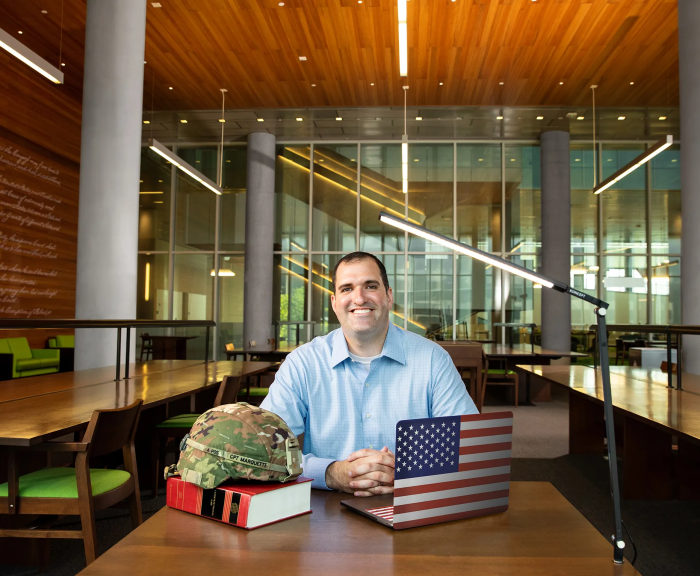
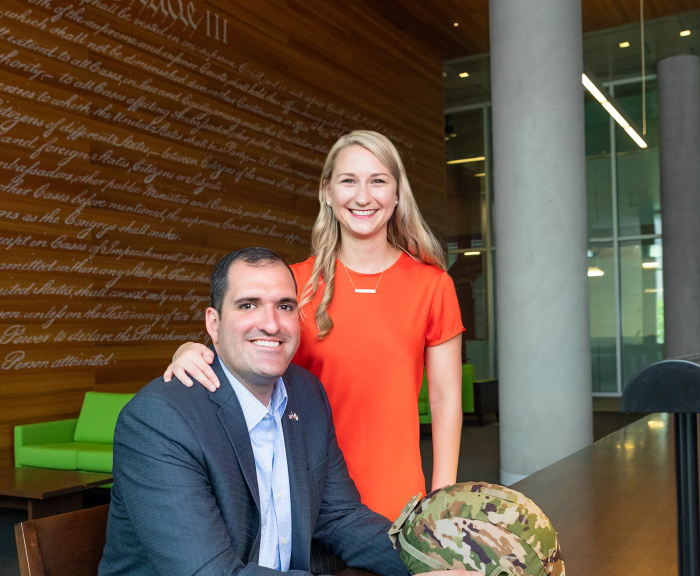
At its May 2021 awards ceremony, rising 3L Ryan Marquette received the Student Veterans Organization’s Best for Vets Award, given to the student veteran who has done the most to help fellow student vets succeed on and off campus. Marquette serves as President of Veterans’ Issues, Support Initiative, and Outreach Network (VISION) and President of the National Security Student Association.

Otasowie MCs ROTC Review 
Sharon OtasowieSharon Otasowie

Sharon Otasowie L’21—an Air Force ROTC Cadet and US Air Force JAG Corps graduate law candidate—had the honor of performing MC duties at the 104th Chancellor’s ROTC Review Ceremony in April 2021. The Chancellor hosts the annual ceremony to recognize the distinguished performance of cadets in the University’s Army and Air Force ROTC programs. 
Law Students Awarded ICCAE Downey Scholarships
ICCAE
Rising 3Ls Abigail Neuviller ’19, Penny Quinteros, and Meghan Steenburgh G’97, and rising 2L Miriam Mokhemar, were among a group of 13 undergraduate, graduate, and law students awarded Downey Scholarships by the Syracuse University Intelligence Community Center for Academic Excellence (ICCAE) in May 2021. The award recognizes academic excellence, commitment to public service, and potential to bring diverse and distinctive backgrounds and experiences to the US Intelligence Community.

IN MEMORIAM
John GoernerJohn Goerner
The College of Law mourns the passing of John P. Goerner, a Class of 2023 student in the JDinteractive program, in April 2021. An avid hockey and rugby player, Goerner held a B.S. in Information Systems from Bellevue University, Nebraska, and an M.B.A. from Alvernia University in Reading, PA.

John planned to use his law degree to represent the less fortunate. “John was a fighter,” Associate Dean for Online Education Kathleen O’Connor told The Daily Orange. “He was a wonderful student and an exemplary man.”

College of Law Faculty News

2020-2021

AUGUST 2020 

Professor Ghosh Submits Public Interest Statement to Trade Commission

Professor Shubha Ghosh

Submitted to the US International Trade Commission, Professor Shubha Ghosh’s Public Interest Statement raises questions around a finding that Daewoong Pharmaceuticals had misappropriated Medytox’s trade secrets in developing and importing Nabota, a competing botulinum toxin product. Ghosh expressed concerns about the anti-competitive effects of the administrative judge’s determinations.

Professor Johnson Appointed to Judicial Commission

Professor Paula Johnson, Co-Director of the Cold Case Justice Initiative, was appointed to the Franklin H. Williams Judicial Commission. The Commission advises decision-makers throughout the New York court system on issues affecting both employees and litigants of color. All members are appointed by the Chief Judge of the New York Court of Appeals.

Professor Kanter Moderates Fulbright ADA Panel 

Arlene Kanter
Arlene Kanter Portrait

Professor Arlene Kanter, Laura J. and L. Douglas Meredith Professor of Teaching Excellence and Director of the Disability Law and Policy Program, moderated a panel discussion in celebration of the 30th Anniversary of the Americans with Disabilities Act. Part of the Fulbright Impact in the Field Panel Series, the discussion convened more than 300 Fulbright alumni scholars with disabilities, accessibility and inclusion advocates, and legal experts.

Beth Kubala Appointed US Army Civilian Aide 

Professor Beth Kubala joins fellow civilian aides to the Secretary of the Army at an August 2020 swearing-in ceremony.
Professor Beth Kubala joins fellow civilian 
aides to the Secretary of the Army at an 
August 2020 swearing-in ceremony.

Teaching Professor Beth Kubala, Executive Director of the Betty and Michael D. Wohl Veterans Legal Clinic, was named one of six civilian aides to the Secretary of the Army. CASAs promote good relations between the Army and the public and advise the secretary on regional issues.

Thanking the new CASAs, Secretary of the Army Ryan D. McCarthy said, “These are unprecedented times, and the Army is fortunate to have you in the community interacting with civic leaders, educators, and businesses.”

SEPTEMBER 2020

Professor Barnes Named Associate Dean for Faculty Research

Professor Kristen Barnes

Kristen Barnes—an expert in property and housing law, anti-discrimination, and civil rights—succeeded Professor Lauryn Gouldin as Associate Dean for Faculty Research.

“As Associate Dean, Professor Barnes leads the College’s continued placement of faculty scholarship in top-tier law journals, brings noted law experts to Dineen Hall to facilitate the exchange of ideas, encourages grant-funded research projects, and broadens our faculty’s involvement with noted institutions around the world,” says Dean Boise.

Professors Ghosh and Gouldin Appointed as Crandall Melvin Professors

Recognizing their significant scholarship and thought leadership, as well as their excellence in teaching, Dean Boise re-appointed Professor Shubha Ghosh as Crandall Melvin Professor of Law and appointed Professor Lauryn Gouldin as Crandall Melvin Associate Professor of Law, each for a five-year term.

NOVEMBER 2020

DHS Senior Executive Matthew Kronisch Joins SPL

Professor Matt Kronisch

The Institute for Security Policy and Law (SPL) welcomed Matthew L. Kronisch as a Distinguished Fellow-in-Residence. Kronisch is the first-ever Department of Homeland Security Office of the General Counsel Senior Executive assigned to an academic institution under the Intergovernmental Personnel Act.

Kronisch conducts research, teaches homeland intelligence topics, and serves as a career advisor for the Syracuse University Intelligence Community Center of Academic Excellence. 

DECEMBER 2020

Professor Dorfman Publishes 2020 Israeli Municipal Accessibility Index

Professor Doron Dorfman

For the second year—in his capacity as an affiliated researcher at aChord-Social Psychology for Social Change—Professor Doron Dorfman led a study on attitudes toward disability in Israel and the state of disabled Israelis. The Municipal Accessibility Index also examines Israeli public opinion about experiences during the COVID-19 pandemic.

JANUARY 2021

Faculty Participate in Society of Socio-Economists Annual Meeting

Several College of Law faculty members participated in the 2021 Society of Socio-Economists Annual Meeting, hosted by the College of Law and titled “Pressing Social Issues.” Joining Professor Robert Ashford, Program Co-Chair for the AALS Section on Socio-Economics were professors Christian Day, David Driesen, and Shubha Ghosh.

APRIL 2021

Professor Gardner Receives Meredith Teaching Recognition Award

Shannon Gardner
Professor Shannon Gardner

Teaching Professor Shannon Gardner was awarded a Syracuse University 2021-2022 Meredith Teaching Recognition Award for Continuing Excellence in Teaching, recognizing her contributions to teaching and learning. The award is one of the highest teaching honors bestowed by the University.

MAY 2021

Wentworth-Mullin Appointed to NYSBA Committee on Veterans

Chantal Wentworth-Mullin
Chantal Wentworth Mullin

Chantal Wentworth-Mullin, Managing Director of the Betty and Michael D. Wohl Veterans Legal Clinic, was appointed to the New York State Bar Association Committee on Veterans.

Wentworth-Mullin will assist her colleagues in program development, advocacy, and strategic collaborations that address the legal issues and needs of military servicemembers, veterans, and their families.

Dean Boise Appointed SU Board of Trustees Representative 

Dean Craig M. Boise
Dean Craig M. Boise

As Dean Representative to the Board of Trustees, appointed by Chancellor Kent Syverud, Dean Boise will participate, ex officio, on the Board of Trustees Academic Affairs Committee, and report to the Board at Executive Committee and full Board meetings.

JUNE 2021

Professors Berger and Gouldin Promoted

Dean Boise announced that—with the concurrence of Chancellor Syverud— and the University Board of Trustees, professors Todd Berger and Lauryn Gouldin have been promoted to the rank of full professor.