
Innovation Law Center Students & Faculty Help Hoplite Power Commercialize Its On-the-Go Smartphone Chargers
It’s a frustration many can relate to. You’re on the go with your smartphone, juggling business and personal calls and texts, when you suddenly realize you’re low on power. No worries. Just dip into a friendly café with your charger and power up while you are getting coffee’d up. So you reach into your bag for the charging cable …
Of course, it’s not there. Enter Hoplite Power, a Long Island, NY-based startup company that has created a remarkable and convenient solution for those inevitable times when you leave home without your charger or when there are no power outlets nearby.
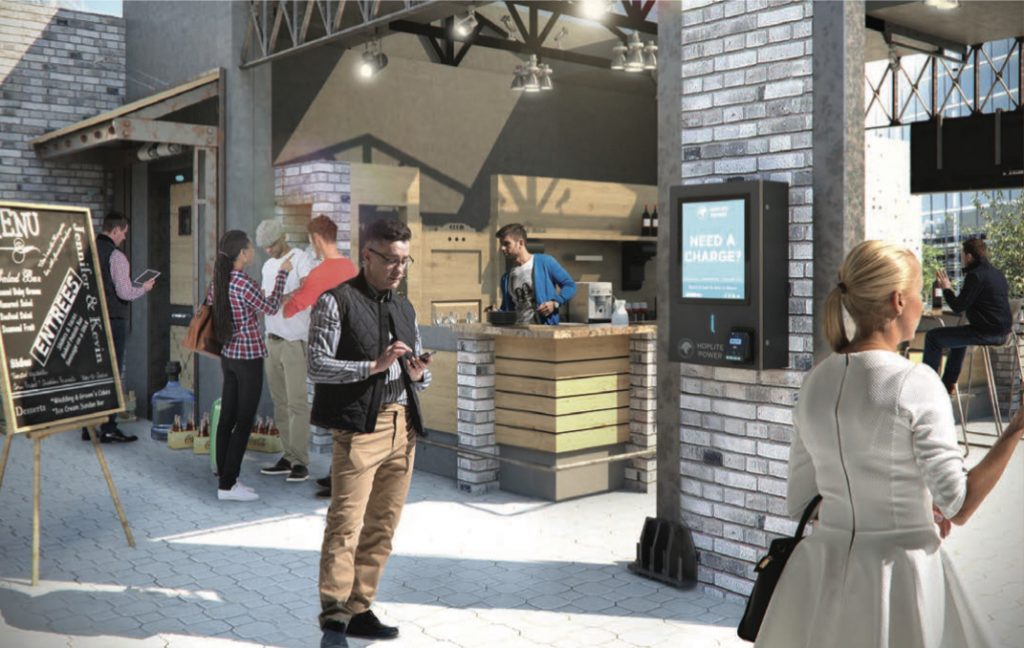
Assisted by students and faculty at the New York State Science and Technology Law Center (NYSSTLC)—part of the Innovation Law Center (ILC)—Hoplite Power has developed a smartphone charge-sharing system. “Any customer who is low on battery can go to one of our kiosks in network and rent a portable battery pack to charge their phone on the go,” says Co-Founder and Chief Technology Officer Nikolas Schreiber, adding that the kiosks operate in a similar way to a RedBox DVD dispenser or CitiBike bike rental kiosk.
Each kiosk—called a Hoplite Hub—stores, dispenses, re- accepts, and automatically recharges Hoplites, which are small, ergonomically designed, universal battery packs for smartphones. These packs can be rented from and returned to any Hoplite Hub in the network.
“This means the customer can charge when and where they need it, not having to remember to bring a battery or be tied down to an outlet. This system is perfect for high-density and high-value areas such as sports stadiums, live venues, and convention centers,” notes Schreiber. Schreiber discussed how NYSSTLC— and specifically rising 3L Viviana Bro and Adjunct Professor Dominick Danna ’67, ’71—have helped Hoplite Power commercialize its novel technology:
How did you discover the NYSSTLC/Innovation Law Center and the services it provides businesses and entrepreneurs? We are working with NYDesigns Incubator, Futureworks, FuzeHub, the Industry Trade Advisory Committee, the Medical Technology Enterprise Consortium, the Manufacturing and Technology Resource Consortium, and finally the Clean Energy Business Incubator Program (CEBIP). It was CEBIP that made the direct introduction to the Innovation Law Center and NYSSTLC.
What assistance has Hoplite Power received from NYSSTLC? We were able to consult with NYSSTLC on a full intellectual property (IP) strategy, including prior art, freedom to operate, and patentability.
How useful has the NYSSTLC research and proprietary report been for your commercialization process? It was incredibly assuring to look through some patents and understand that we did have freedom to operate where before we had some concerns. Not just that, we learned that there might be specific aspects of our technology—especially given a number of unique mechanisms—that could be patented, where, again, we had had doubts.
Now that you have engaged NYSSTLC, what are the next steps for Hoplite Power? Following the launch of our version two pilot, we plan to file additional IP protections, including both design and utility patents. A strong IP and a functioning pilot will allow us to raise more capital.
What advice do you have for an entrepreneur looking to commercialize a new technology, based on your experiences so far? There are so many ways to go with this, but I think one thing that gets lost is proving the product market fit. Your new technology might be cool, but if it does not serve a market need, then it is not a company.