Dean Terence Lau L’98 recently spoke with the media on the impact of rapidly changing tariff policies on the automotive industry.
Lau, a former trade expert for Ford, noted that automakers are looking for a consistent policy, which is not what they have witnessed in recent weeks as tariffs on Canada and Mexico were switched on and off, and as Trump continues to threaten higher tariffs on others.
“It’s impossible to keep up with day-to-day or week-to-week changes,” he said. “The auto industry makes plans months in advance, if not years. So it’s just impossible to plan.”
But he said the Detroit Three are sure to keep up their behind-the-scenes lobbying efforts in coming weeks and will continue to seek a “partnership with the administration” where both sides can come away with something from the tariffs, and tariff threats.
“I mean, there is a shared goal here, which is American competitiveness and profitability of American car companies,” Lau said. “That is a shared goal. Well, how do you reach that without creating what Farley calls a giant hole in the U.S. auto industry?”
Glenda Criss L’28 and Sarah Peck L’28 recently placed second in the Northeast Regional of the National Patent Application Drafting Competition. The competition is hosted by the United States Patent and Trademark Office. Criss and Peck, students in Syracuse Law’s JDinteractive online J.D. program, were coached by George McGuire ‘91 L’96, a Member of Bond, Schoeneck, and King, and an Adjunct Faculty member at Syracuse Law since 1998.
The competition involves taking an invention statement and conducting a prior art search, developing a search strategy, drafting a complete patent application, and drafting a summary of the search strategy and the claim drafting strategy. The competition also had the students write an information disclosure statement (a statement under 37 CFR 1.56 required by patent applicants to disclose material prior art), prepare a slide presentation, and give an oral presentation and Q&A session before a panel of judges.
“The competition is, in essence, a 2 to 3 credit course on patent preparation/prosecution that Glenda and Sarah took on at the end of the fall semester of their first year of law school and worked on diligently over break and subsequently competed against other northeast law schools in February,” explains McGuire.
Following the oral presentations, the top three rated schools out of the nine in the region advanced to the regional finals where they were required to conduct a second round of presentations before a larger panel of judges. The College of Law was amongst the top three scorers from the opening round and advanced to the Regional Finals where Syracuse Law finished second.
“Needless to say, Glenda and Sarah did a tremendous job. Their determination, unbelievable work ethic, and brilliant legal work reflect very positively on Syracuse Law. Neither of these students had any prior experience with intellectual property law, let alone patents and patent application preparation and prosecution. They studied, learned, and remarkably applied their skills. They are both destined for great legal careers!” says McGuire.
Criss and Peck are very grateful for McGuire’s coaching. McGuire is a registered patent attorney and member of Bond’s intellectual property and technology practice. “We competed against teams of 2L and 3L students who have a more solid grounding in patent work and were able to finish in 2nd place. The judges indicated that one of our claims was so well drafted that it could likely be approved right away! This is largely due to George’s guidance and support. We have learned so much through this process, and we cannot express our gratitude enough.”
Dean Terence Lau L’98 was impressed by the students’ strong results. “Your dedication to mastering complex patent application concepts in such a short timeframe is truly impressive. Taking on this challenge during the end of the fall semester and over break demonstrates exceptional commitment to your legal education. The judges’ comments about your draft claims being potentially approval-ready speak volumes about the quality of your work. You took the initiative, you learned a great deal, and you demonstrated how powerful Syracuse Law can be on the national stage.”
Lau was also thankful for McGuire’s mentorship. “I cannot thank you enough for volunteering your time and expertise to coach our students. Your approach of guiding rather than doing the work for them exemplifies the best of legal education. The weekly meetings and patient mentorship made a tremendous difference in helping Glenda and Sarah navigate unfamiliar legal territory. This achievement highlights the caliber of our students and faculty at Syracuse Law.”
Professor Robert Nassau, director of the Sherman F. Levey ’57, L’59 Low Income Taxpayer Clinic, commented on the Wallet Hub 2025 Tax survey’s finding that two out of three people describe tax preparation companies that advertise free tax filing services as “bait-and-switch” schemes.
In the CPA Practice Advisor, he reacted “Some are, some aren’t. There are definitely free tax filing services (I’ve helped people use them), but one has to be careful when using them not to be ‘tricked’ into paying for something they don’t need. And sometimes people expect more from the service than the service is willing to provide for free; to me, that’s not really what I would call bait and switch.”
Growing up in southeastern Pennsylvania as the son of a small-business owner, John Lawrence saw first-hand some of the challenges faced by family-run businesses. Later on, he didn’t agree with some of the decisions coming out of Pennsylvania’s capital in Harrisburg, so in 2010 he decided he could best serve his community by throwing his hat into the ring to run for the House of Representatives as a Reformer. In 2011, Lawrence was sworn in to serve the 13th Legislative District, located in Chester County, and he hasn’t looked back.
“Serving as an elected official is humbling and a great honor,” says Lawrence, who is now in his eighth term.
A graduate of Penn State University with a degree in business, Lawrence has built a reputation for bringing a common sense approach to state government. He has authored bills to consolidate redundant government services, reform budgeting practices and even require state legislators to submit to drug tests. Putting his words into action, Lawrence refuses to take a state pension, per diems, drive a state vehicle or take advantage of other perks that come with the job.
This past session, Lawrence authored floor amendments to be sure citizens are aware of their right to counsel, that disabled veterans receive constitutionally mandated property tax relief and that police officers working in some of the most challenging areas in the state are rewarded. He has also had legislation signed into law to ensure victims of domestic violence are not required to financially support their convicted abusers during an ongoing divorce.
Outside of work, Lawrence is active in his church and community, and he and his wife are heavily involved in their two children’s high school activities.
With all of that going on, how is Lawrence possibly going to law school? Through the JDinteractive program at Syracuse University College of Law.
After college, Lawrence went to work at J.P. Morgan Chase as an account officer. Pursuing law was in the back of his mind, and he knew a legal background would be helpful in his line of work. After transitioning to politics, he considered part-time traditional law programs, but they were either too far away from his family and community or conflicted with his other obligations. So, when he discovered Syracuse Law’s hybrid JDi program, Lawrence thought it just might work.
“I did a lot of research before applying and visited the campus several times,” he says. “Before making the commitment to law school, I wanted to make sure I could make it work with my schedule. The JDi program gave me the flexibility to make it happen.”
Today, he is taking asynchronous classes and completing other tasks and activities online around his busy schedule through Syracuse Law’s JDi. He notes that one of the best things about the program has been the other students in his cohort.
“The caliber of others in my cohort is remarkable,” he says. “It’s such a diverse group with very different life experiences—a doctor, a dentist, several working on Wall Street. These people have great perspectives and bring some interesting experiences to the program. Most tend to be a little older than those in traditional law school, and, in a way, it’s helpful that we’re all dealing with the pressures of career, family, community and more. I think I’ve learned as much in law school through the others in my cohort as I have from my professors.”
Living about five hours from Syracuse University, Lawrence has attended several residencies on campus, including one on cryptocurrency just a few months ago. Now a 2L, he is preparing for higher level classes, and while he intends to keep serving the people of Pennsylvania, Lawrence also knows that a degree from Syracuse Law will allow him to expand his work and make him a better policymaker.
“Enrolling in the Syracuse Law JDi program was a great decision,” Lawrence says. “People might wonder if a hybrid online program can be engaging and rigorous, I can assure you that the program at Syracuse Law is both. I know that my experiences during the program and attaining a law degree will help me in ways that would not otherwise have been possible.”
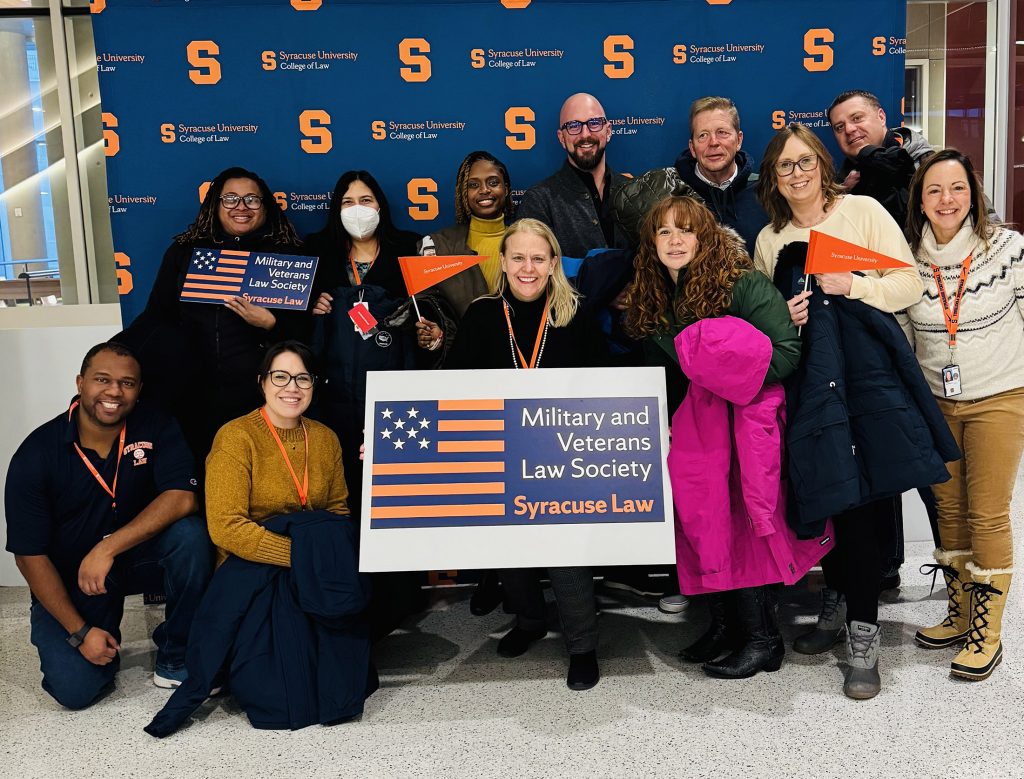
In January, JDinteractive (JDi) students came to the Syracuse University College of Law for several in-person residencies. Many brought heavy winter coats, hats, mittens and scarves, not just to endure the snowy Syracuse weather themselves but, more importantly, to donate to military veterans in need.
Operation Veteran Warm-Up was the idea of Inge Gedo L’25, a 3L in the JDi program who wanted to create a way for the JDi students to feel more connected to Syracuse Law by participating in a service project similar to what some of the Law School’s residential students do throughout the academic year.
A retired U.S. Air Force officer who lives in Virginia, Gedo bounced the idea off a few others during a residency on mediation held in Miami in December. It was well received, so she approached the Syracuse Law Military and Veterans Law Society (MVLS) and its faculty advisor Teaching Professor Elizabeth Kubala, who is also the director of veteran and military affairs; the executive director of the Betty and Michael D. Wohl Veterans Legal Clinic (VLC); and the director of clinical legal education at Syracuse Law.
The MVLS agreed to facilitate the project and decided that this year’s Operation Veteran Warm-Up would support an initiative that the VLC was already involved with in the greater Syracuse community. In partnership with the Syracuse VA Medical Center, The Altamont Program operates a transitional housing facility with 55 beds for unhoused veterans, both male and female, and provides case management, therapy and other services with the intention of finding veterans permanent housing and helping them get back on their feet. Operation Veteran Warm-Up complemented the efforts that the wider University holds each winter to assist students in need through its Operation Orange Warm-Up, as well as Syracuse Law and the entire University’s long-standing commitment to veterans in the community.
With only a few weeks until the on-campus residency, Gedo sprang into action to get the word out to the JDi students from the classes of 2025 to 2028 who planned to come to the Law School in January. She even set up a way for students to purchase through Amazon, so they wouldn’t have to pack items in their luggage. Delivery to Dineen Hall was difficult at this time of year, however, as the building was closed prior to the residency for the University’s annual winter break Orange Appreciation Days. Thankfully, Kubala stepped up and volunteered her home address for package delivery, and soon the items started rolling in. Donations even came from JDi students who were not attending the January residency.
Another wave of donations arrived when the residency began on campus, as JDi students brought winter clothing with them or purchased items locally when they arrived and heard about the service project. At the end of the residency week, some students from warmer parts of the country even donated the gently used coats, hats and scarves they had bought for themselves specifically for the trip to chilly Syracuse. In the end, more than 100 items were donated to Operation Veteran Warm-Up and distributed to those in the transitional housing program.
“Inge is the kind of person who gets behind something and makes it happen,” says Kubala, who got to know Gedo when she worked as her research assistant. “The participation and generosity of our JDi students and the willingness of the MLVS to facilitate Operation Veteran Warm-Up was simply amazing. Our residency programs are always a way for our JDi students to connect on a more personal level and get acquainted with the Syracuse Law campus, but this time it was even more special as the service project gave so many of the students an added sense of belonging by working together to meet a real need in the local veteran community.”
Gedo, who currently works as a legal intern at the Fairfax County General District Court in Virginia, will complete her degree in August 2025, but she is hopeful that the MLVS will continue to facilitate Operation Veteran Warm-Up with the JDi program annually and expand it, possibly including residential students, too.
“We intended to just start small this year, and we weren’t sure what the response would be,” says Gedo. “But, we were thrilled with the donations, and the feedback from the JDi students has been so encouraging. Not only did we assist veterans, which is, of course, very near to my heart as a veteran myself, but we also added another level of camaraderie to the JDi program. It turned out to be a very special project that I hope will continue in the years ahead.”
Professor Jenny Breen spoke with the Washington Post for the article “Supreme Court says judge can force Trump administration to pay foreign aid”. The article discusses the recent 5-4 order in Department of State v. AIDS Vaccine Advocacy Coalition on USAID funding.
Breen said it was difficult to draw sweeping generalizations from a single case, but “if we are going to take away anything, it might be that the Supreme Court is going to pay attention when the government does not comply with court orders.”
But Breen said the fact that four justices signed on to the dissent indicates “a tolerance for a very expansive notion of executive power” in a significant segment of the court: “The 5-4 split here makes clear there is definitely turbulence ahead here, and there is going to be division.”
“There’s always been a question of whether China has been respecting intellectual property rights, and that gets very complicated with respect to fashion,” given the complex application of IP law to fashion, said Ghosh.
Rebeca Puente Chavar L’27 prevailed over Nicholas R. Hardy IV L’27 in the 15th Annual Hancock Estabrook First Year Oral Advocacy Competition.
The competition was judged by the Hon. Thérèse Wiley Dancks L’91, U.S. Magistrate Judge for the Northern District of New York; S. Alexander Berlucchi L’18, an associate at Hancock Estabrook; Michelle Whitton Cowan L’07, Managing Attorney, AmTrust Financial Services Inc.; and Gabriela Groman L’23, an associate at Hancock Estabrook.
Thirty-three first year students participated in the competition.
Professor Lauryn Gouldin will be a panelist on the 6th Association for the Advancement of Artificial Intelligence (AAAI) Workshop on Privacy-Preserving Artificial Intelligence. This workshop is part of the 39th Annual AAAI Conference on Artificial Intelligence. She will participate in an interdisciplinary panel discussion on Understanding and Regulating the Privacy Risks in an Embodied Agents World.