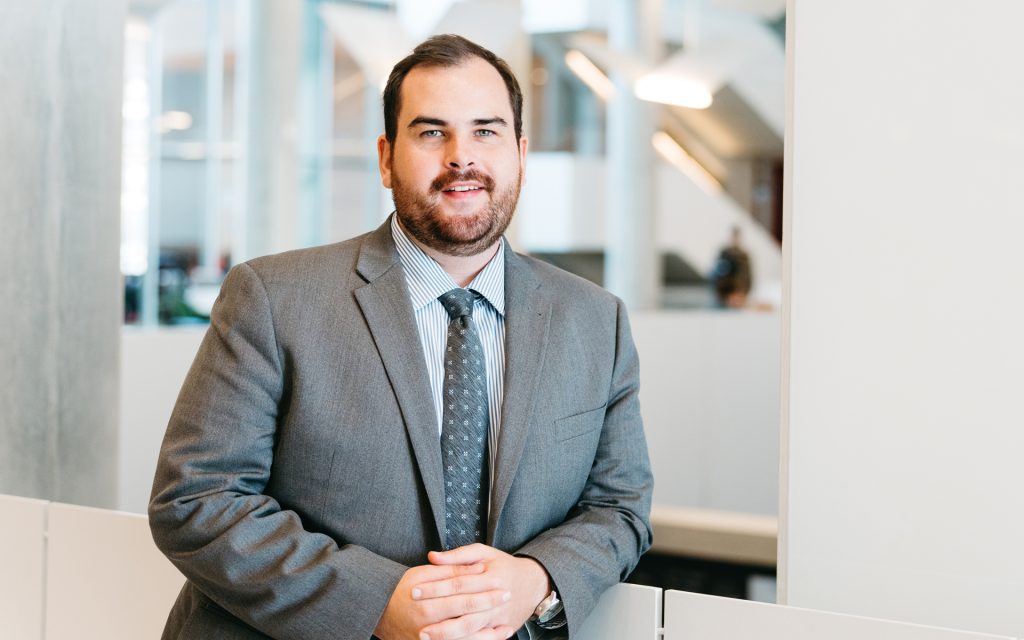
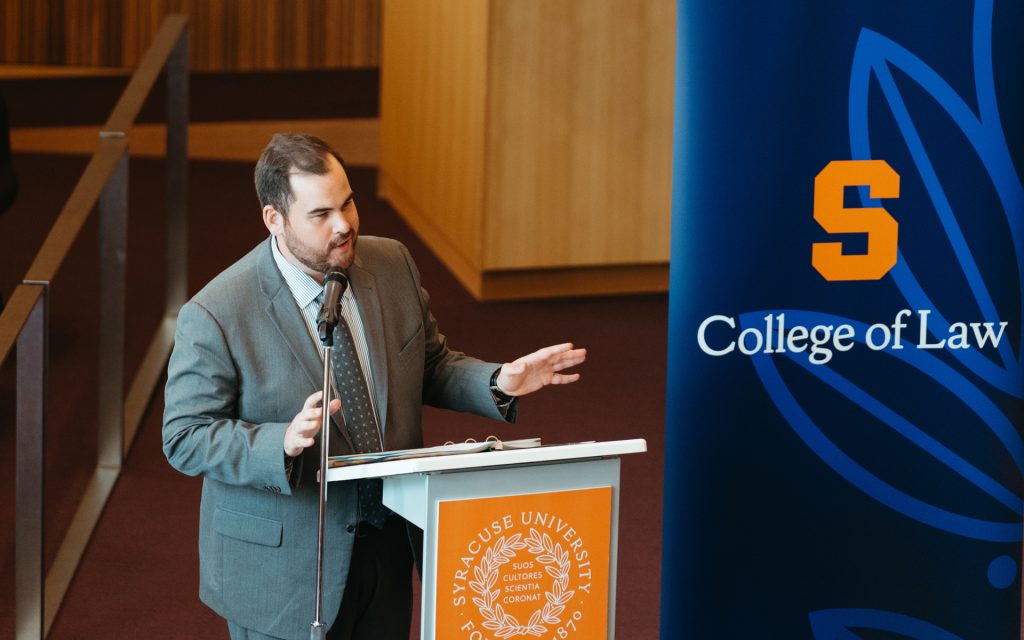
Dean Terence Lau, a former international trade expert at Ford Motor, spoke with CNBC on automotive industry tariffs being proposed by President Trump.
Lau said that the automotive industry is built on free trade as is adaptable to change. “The car industry can adjust to anything. Really, it can. It’s always going to make product that customers want to buy because personal mobility and transportation is a human need all around the world,” he said. “What the car industry cannot do well is pivot on a dime.”
Lau argued that a single-digit tariff can be a “nuisance,” but once they hit 10% or more, that’s when additional costs can really begin eating into the margin on products.
Dr. Amanda Higginson L’25 and Dr. Tobias Mattei L’25 are featured in the ABA Journal article “Jurist Doctors: Physicians Return to Law School for New Challenges.” The article examines the trend of physicians returning to school to obtain a law degree. Higginson and Mattei attended the College of Law’s hybrid online JDinteractive program.
Dr. Mattei, Chief of Spine Surgery and Associate Professor, Division of Neurological Surgery at St. Louis University, decided to attend law school during COVID-19 to assist in his review of potential legal cases and other instances where he was an expert witness.
Dr. Tobias Mattei L’25
“I just wanted to be smarter than the attorneys I was dealing with, to make sure I could understand the framework” of legal cases,” says the spinal cord specialist who has a few patent applications. “Very few doctors, especially neurosurgeons, have this special knowledge.”
Dr. Higginson, Associate Dean for Student Affairs, Clinical Sciences, and Clinical Professor of Pediatrics at the Brody School of Medicine at East Carolina University, is a U.S. Navy veteran who used the GI Bill to attend the College of Law.
“Our office handles all of the policies surrounding the medical students,” she says. “I view those now in a slightly different way, in terms of the language used.”
Some people know from an early age that they want to be lawyers. For others, the path to a law degree comes later, shaped by life experiences and schooling. What is undeniable is that a J.D. degree offers incredible flexibility to chart a successful career, no matter the challenges or circumstances that come along the way.
That’s the experience of Danielle Wild L’15, an Associate Teaching Professor at Syracuse Law and a member of the Legal Communication and Research (LCR) faculty.
Wild’s path back to her alma mater—and into teaching—was not direct or fully intentional.
She originally planned to pursue a career as a forensic psychologist, earning a B.A. in Psychology with a minor in Criminal Justice at Roberts Wesleyan College (now University). During her undergraduate studies, she became more aware of and passionate about restorative justice, the Innocence Project, and wrongful convictions.
“When my interests started going in that direction, I decided to graduate early and gain experience in the legal field,” she explains. “Several professors encouraged me to consider law school. I worked as a paralegal for a year, and that confirmed I wanted go this route [to law school].”
While she applied to many law schools, she chose Syracuse Law to stay close to family and accommodate fast life changes. “I grew up in Syracuse, and my whole family is here,” she says. “I was living in Rochester when I decided I wanted to go to law school. I got married a month before starting law school while my husband was finishing graduate school. We decided we wanted to stay near family.”
That decision turned out to be a very fulfilling one for Wild. At Syracuse Law, she competed on the National Trial Team and was a member of the Moot Court Honor Society (now the Travis H.D. Lewin Advocacy Honor Society). Additionally, she served as the Secretary of the Justinian Honor Society, a Law Ambassador, and an editor on the Syracuse Law Review. As a 3L, she was a Legal Communication and Research Assistant to Professor Shannon Gardner.
Wild remembers law school fondly: “I loved law school. I made the most of a variety of opportunities while here. I thrived, and as soon as I left, I missed it. A part of me always thought I’d return to academia, but I didn’t expect to teach until later in my career.”
After graduating, Wild worked at a criminal defense firm in Rochester for two years, handling a spectrum of criminal matters at trial and on appeal. Working at the firm ended up not being a good fit for Wild for various reasons, and when starting a family came into the picture, the flexibility of her J.D. became a lynchpin for her next career step: opening a solo practice focused on criminal appeals and post-conviction advocacy.
“I opened a solo practice because of the flexibility and autonomy it gave me. My first son was only a few months old when I left the firm. I quickly wrapped up my trial cases and focused on appellate work, which gave me more control over my schedule. What started as a necessity based on life circumstances turned into a successful practice. I carved out a niche in the Rochester area and earned a strong reputation. I received some offers to join other firms over the years, but I declined them because I couldn’t see myself practicing law any other way.”
While her practice continued to grow, along with her involvement in the Monroe County Bar Association, the call to return to law school beckoned in Fall 2022, when she was presented with an opportunity to join the Syracuse Law faculty as an adjunct professor. “The doors started opening to teach classes here and there. I loved it, and that led me to pursue a full-time position,” she says.
“I prioritize the mastery of skills alongside legal doctrine. I try to show students how what they’re learning translates into practice and informs the everyday work that lawyers do.”
—Danielle Wild L’15
That full-time position came to fruition in Spring 2024, when Wild joined the LCR faculty, also teaching courses in criminal law and advocacy. Wild draws on her experiences both as a firm lawyer and solo practitioner to shape her teaching.
“I prioritize the mastery of skills alongside legal doctrine,” Wild explains. “I try to show students how what they’re learning translates into practice and informs the everyday work that lawyers do. In my legal writing classes, for example, we work through a mock case over the semester. We begin with preliminary research to understand a discrete area of law, then engage in fact-gathering—such as a client consultation or other simulated exercise—before conducting additional research and refining our analysis. We translate that work into legal writing. I believe this approach helps students see legal analysis as an essential skill and understand how it fits into real-world practice.”
Wild and Setzer meet to discuss coursework in Dineen Hall.
Julian Setzer L’25 had Professor Wild for LCR II and was so impressed with her teaching style he is now taking her Appellate Advocacy class. “Professor Wild communicates her goals for the class very clearly since in law school, there’s not a lot of black and white, there’s a ton of gray areas. The assignment she has given us in the appellate class is very practical.”
“I identify with the level of professionalism and work ethic that it takes to be a professor, a practitioner, and a parent and at the same time be a decent human being. To do all that and smile through it is an admirable trait.”
—Julian Setzer L’25
Wild’s career path is a testament to the versatility of a J.D. degree—one that helped her find her way back to her alma mater and a place she loves.
“I identify with the level of professionalism and work ethic that it takes to be a professor, a practitioner, and a parent and at the same time be a decent human being. To do all that and smile through it is an admirable trait. And I think every law student should take Professor Wild to learn how to achieve that,” says Setzer.
What makes a good legal writer?
Being able to make your point clearly and concisely. Your reader should only need to read your work once to understand—and agree with—your analysis or argument.
I often tell my students to think of legal analysis like a lab report. Legal analysis is a thought experiment, and like a lab report, it must be meticulously structured and detailed so the reader can follow each step, replicate the experiment, and reach the same result.
University Professor David Driesen discussed the “unitary executive” theory with ABC News.
In the article “Trump and the ‘unitary executive’: The presidential power theory driving his 2nd term”, Driesen says “I think they are setting up test cases, and this Supreme Court is very likely to expand the theory and overrule other cases that are in tension with it.”
The United States Court of Appeals for the Second Circuit will hold oral arguments at Syracuse University College of Law on March 28 from 10 A.M. to 11:30 A.M. The oral arguments are free and open to the public. Seating is limited.
The court session will be held in the Melanie Gray Ceremonial Courtroom in Dineen Hall, 950 Irving Avenue, Syracuse, NY 13244.
The United States Court of Appeals for the Second Circuit is one of the thirteen United States Courts of Appeals. Its territory covers the states of Connecticut, New York, and Vermont, and it has appellate jurisdiction over the U.S. district courts in the following federal judicial districts: District of Connecticut. Eastern District of New York. Northern District of New York. Southern District of New York, Western District of New York, and District of Vermont.
The U.S. Court of Appeals sits just below the Supreme Court of the United States in the judicial branch of the federal government.
“The Court of Appeals from the Second Circuit is one of the most influential courts in the country. It is of great honor for the College of Law to host the Court and provide our students, faculty, and the community at large an opportunity to see jurisprudence in action at the highest level,” says College of Law Dean Terence Lau.
The case and panel of judges will be updated by the Court on their calendar closer to the court session date.
Cameras and video recording devices are not permitted in the courtroom during arguments.
Professor Gregory Germain spoke with Newsweek for the story “Can Pam Bondi Reverse Donald Trump’s Conviction? Experts Weigh In”.
“She [Attorney General Pam Bondi] has no power over the state courts. She can try to investigate and harass the D.A. and the judge maybe, although I don’t think the courts will put up with political interference,” said Germain.
Professor Katherine Macfarlane’s article “Higher Education’s Accommodations Mistake” was recently accepted for publication in the Georgetown Law Journal, where it will be published this Fall. A draft of Professor Macfarlane’s article is available here.
The article examines the “fundamental alteration” defense, which applies to claims brought pursuant to the Americans with Disabilities Act and Section 504 of the Rehabilitation Act, and how the defense impacts reasonable accommodation requests made by undergraduate and graduate students with disabilities. Professor Macfarlane is a leading expert in disability law and higher education accommodations.
She directs the College’s Disability Law & Policy Program and teaches Constitutional Law, Disability Law, and Civil Rights Litigation.
Brett VanBuren L’25 went to college at the U.S. Military Academy at West Point with the intention of serving his country. But, his college plans were sidelined by an injury that resulted in an honorable discharge. Still, he remained true to West Point’s mission of creating “leaders of character” who were “ready for a lifetime of service” on a new path that led him to Syracuse University College of Law.
After finishing his bachelor’s degree at Marist College and working in marketing in New York City, he enrolled at Syracuse Law in 2022. Today, VanBuren is a 3L who has made the most of his time at Syracuse Law, taking on leadership roles in several of the School’s societies, including president of the Corporate Law Society and treasurer of the Military and Veterans Law Society, the Intellectual Property Law Society and the International Law Society.
During the 2022-2023 academic year, he served as president of the Class of 2025. And, in 2023, VanBuren was issued the Unsung Hero Award by the Syracuse Student Bar Association (SBA) in recognition for the hard work and achievements in organizing many in-person and virtual events, volunteering at SBA functions and raising the most money in recent history for a first-year class at Syracuse Law. VanBuren is the former law school representative to the Syracuse University board of trustees, which is the highest appointed leadership position for a Syracuse Law student.
“I’m involved in a lot of activities. When I was a 1L, I was the person organizing a happy hour during orientation week, so we could all get to know each other, or, this year, planning the General Counsel Symposium through the Corporate Law Society that brought students together with alumni and other general counsels from across the country,” he explains. “I’m grateful that others see me as a leader and someone who will advocate for them or acknowledge that their complaints or ideas have been heard. I think it’s important to be a leader wherever you go.”
His original intention was to work in corporate law. But, it was Teaching Professor Elizabeth Kubala, director of Veteran and Military Affairs and Executive Director of the Betty and Michael D. Wohl Veterans Legal Clinic, who knew VanBuren had attended West Point and asked if he’d ever considered the U.S. Army Judge Advocate General’s Corps (JAG). According to VanBuren, JAGs serve as lawyers in a wide range of legal roles for the Army, covering a wide gambit of topics. In a legal assistance capacity, JAGs help with divorce, child custody issues, immigration, writing wills and any other legal assistance that soldiers, veterans or their dependents need. They also handle administrative law issues related to labor and employment, environmental law, working with international partners, and issues related to laws or war and laws of armed contract, as well as criminal law and court-martials.
With his interest piqued, VanBuren was accepted into the highly competitive JAG Corps Intern Program, which only takes 30 1Ls each summer from across the country. Following his first year of law school, he spent the summer at Fort Sill in Oklahoma, where he helped soldiers and their dependents in the Legal Assistance Office. The following summer, he continued with the program, this time in Italy, where he was sent to Caserma Ederla, an Italian military base outside of Venice. There he worked with Italian legal authorities and assisted the commander of the U.S. 173rd Airborne Brigade, a contingency response force in Europe. He also enjoyed having the chance to soak up the culture of Italy during his three-month stay. These experiences convinced him that the JAG Corps would be an excellent career path for him. So, when VanBuren was recently offered a commission into the JAG Corps following the completion of law school, he was honored to accept.
“My career path wasn’t the one I had originally planned, but it seems it is working out. Syracuse Law has been a big part of making my dream of being a lawyer come true, while at the same time helping me find my way back to the U.S. Army.”
—Brett VanBuren L’25
“I’m excited to work not only as a lawyer but also as an army officer. It forces me to not only be competent in my legal tasks but also my warrior tasks,” he explains, noting that while he doesn’t yet know where he’ll be stationed, he hopes to work his way up to be a brigade judge advocate, someone who serves as a general counsel to a brigade commander. “It’s really rewarding work assisting a commander in getting the mission done.”
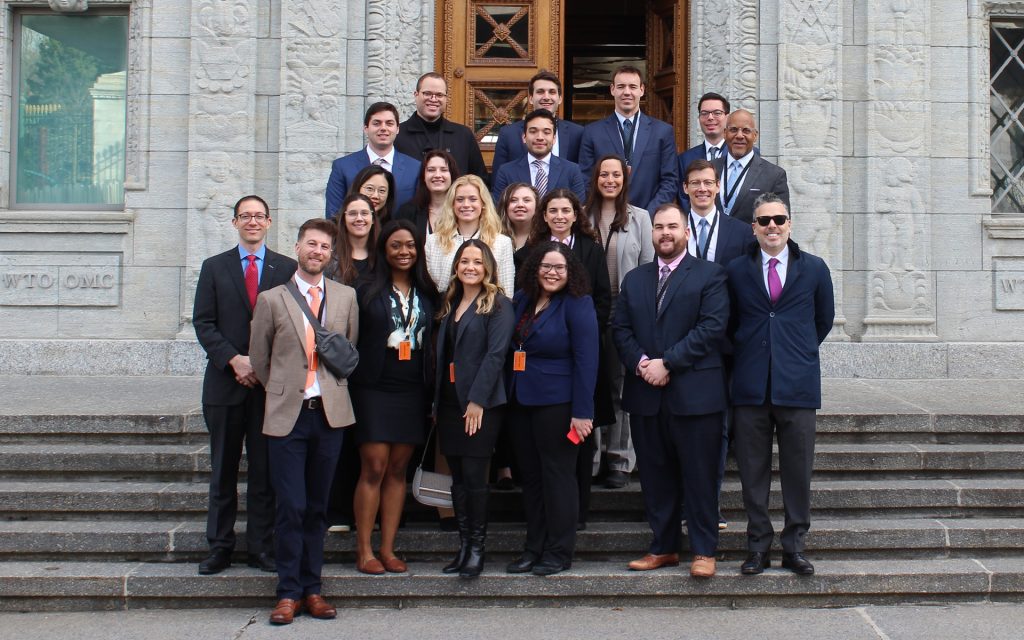
VanBuren poses with classmates and professors outside the World Trade Organization in Geneva, Switzerland during the International Tax Law short course in 2024.
While VanBuren plans to stay with the Army for a while, his long-term goal is to be a general counsel for a Fortune 500 company. However, for now, he is concentrating on his studies as a 3L and passing the New York State bar exam, while continuing to be involved with various activities at Syracuse Law.
“My career path wasn’t the one I had originally planned, but it seems it is working out. Syracuse Law has been a big part of making my dream of being a lawyer come true, while at the same time helping me find my way back to the U.S. Army,” he says. ”I’m grateful for everyone here who was part of my law school experience.”
On succession planning, Landaw says boards should approach CEO succession “like the general manager of a sports team seeking to build a championship-caliber franchise. Rather than filling vacancies on an ad hoc basis, they must plan ahead, have a keen understanding of the skills and experiences required to meet the company’s evolving needs, and have the gumption to replace CEOs and directors who are no longer the best fit.”
University Professor David Driesen spoke with the Washington Post about Presidential powers, the Supreme Court’s interpretation of the unitary executive theory, and Humphrey’s Executor decision that established the constitutionality of independent agencies overseen by multimember boards.
Driesen said allowing presidents to remove members of those agencies without cause could create a dangerous concentration of power, which he likened to countries such as Hungary that have slid toward authoritarianism.
Most functioning democracies have independent agencies overseeing critical sectors such as elections, the news media, banks, and law enforcement to keep them from being politicized, Driesen said. In the United States, concerns about guardrails for criminal and civil investigations have for decades given the Justice Department more independence from the White House than other Cabinet-level agencies.
“It’s very, very dangerous to operate under the unitary executive theory when you have a president with autocratic tendencies,” Driesen said. “If a president had control of prosecution, he could protect his friends and attack his enemies. If the president has control over the election commission, he can tilt elections in his favor. If he controls communications commissions, he can get rid of opposition media.”