Professor Jenny Breen discusses the 10th Amendment and sanctuary city laws in the Politifact article, “Trump leaders say Minnesota officials withhold detained immigrants from ICE. Is that true?”
Breen said sanctuary city laws, including in Minneapolis, recognize the right of states and cities to refuse to do the work of the federal government. “States may not refuse to permit the federal government itself from doing that work, but they are not obligated to enforce federal laws themselves,” said Breen.
Who is allowed to work in the United States—and under what conditions—has long been shaped by the intersections of immigration and employment law. While these questions are frequently in the national spotlight today, the complex layers and legal frameworks behind them have been evolving for decades.
Recognizing both the historical significance and modern urgency of these issues, Syracuse University College of Law launched its first JDinteractive (JDi) residency focused on the interweaving of immigration and employment statutes and regulations, drawing students eager to explore how policy, economics, and legal precedent converge.
The Intersections of Immigration and Employment Policy and Law: In the Courts, the Agencies, and in the Congress, a four-day residency option designed for JDi students and open to on-campus students, took place last December in Washington, D.C. This popular residency drew a diverse group of students— including a union steward, a sheriff, an individual with an H-1B visa, and many other professionals working in a variety of fields—all of whom brought interesting perspectives to the classroom.
The residency was led by the Hon. Randel Johnson, Chair and Chief Judge, Administrative Review Board, U.S. Department of Labor (presenting on his own behalf) and a distinguished immigration law scholar with more than 25 years of experience working in immigration and employment law on Capitol Hill, with the Department of Labor, and in the private sector.
The Hon. Randel Johnson teaching in class with Camille Olson.
According to Johnson, the residency was not designed to concentrate on immigration under the current administration, although those issues were certainly discussed. Instead, it offered a much broader perspective, looking at how conflicts between the courts and enforcement agencies are resolved using a review of general statutory interpretative principles and court cases that examine the interactions of immigration and employment laws. The residency also examined other legal conflicts as exemplified under the Federal Arbitration Act; the congressional deliberations surrounding the Border Security, Economic Opportunity, and Immigration Modernization Act; and the Administrative Procedure Act, well as some of the more influential court decisions handed down over the past six years, such as Loper Bright, v. Raimondo, SEC v. Jarkesy, and Muldrow v. City of St. Louis.
“This residency clarified that immigration law, employment law, and administrative law do not operate as separate systems but continuously shape one another— and that their interaction has long-term consequences beyond individual cases,” says attendee Kate Fioravanti L’26, who is a full-time school administrator in a Connecticut urban public school district and the president of the local union affiliate of the AFL-CIO.
“Through discussion of doctrines like Hoffman Plastics, mandatory arbitration, agency deference, and cases such as Plyler v. Doe, the course highlighted how legal rules governing work authorization, enforcement, and access to institutions ultimately influence who participates in the workforce, who remains economically stable, and how communities develop,” she says. “For me, the important takeaway was understanding how these legal frameworks collectively affect the country’s labor force, schools, and economic capacity, making them questions of structural design rather than isolated doctrinal debates.”
Jacie Rodriguez L’26 also found the residency enlightening.
“The best thing I took away was that immigration policies and laws are not simple,” says Rodriguez, a bilingual claims specialist for the U.S. Social Security Administration. “There are many parties invested in the outcome of immigration law, and reform can come to a near standstill without compromise. Policymakers, administrative agencies, Supreme Court decisions, public interest groups, and the president himself—everyone has a role that will either stagnate or propel momentum.”
Extensive Network of Speakers Added Unique Expertise
Not only did Johnson utilize case studies and examples from his extensive career in immigration and employment law, but he also tapped into his vast network of experts in this space to speak to and network with the JDi students, adding to the richness of the experience.
Gene Scalia guest speaking in class with Hon. Randel Johnson.
“I’m blessed to have such a huge network of professional colleagues—and I’m grateful they took time out of their very busy lives to share their views and experiences with our JDi students,” says Johnson. “When I was going through the students’ final exams, everyone identified different speakers and their appeal, as well as the opportunity to hear about various career backgrounds and, to some degree, think about post-graduation opportunities outside of big law.”
Students left the residency with a greater knowledge and understanding of U.S. immigration and employment law, including the layered complexities within each area. They also gained insight into how courts resolve seemingly inconsistent mandates between statutes, and how to effectively advocate for clients when confronted with conflicting and/or overlapping mandates. They further honed their skills by analyzing immigration law cases and looked closely at how trends shape the law and Congressional deliberations.
“I believe the JDi students walked away with a sense of how this topic is more than just today’s headlines but is a blend of the law and societal mores, and that, as these societal mores change, the law does not remain static,” adds Johnson. “The skills shared at the residency are transferable to a lot of other aspects of the legal field. So no matter what area of the law they choose to pursue, I hope the experience gave them another arrow in their quiver as they go through life and represent clients.”
Residency Welcomes High-Level Thought Leaders
The following joined the JDi residency to share their expertise on various topics related to immigration and employment law.
Jon Baselice, Executive Vice President and Head of Government Affairs, Vantoe, explained negotiations over the worker program in S. 744 and why employers were quite willing to overrule Hoffman while unions thought it would be a win
Josh Bernstein, Director of Immigration Policy/Director of Immigration for the Service Employees International Union SEIU, U.S. Chamber, immigration programs, spoke about immigration policy, Capitol Hill negations with the U.S. Chamber, and immigrant worker programs
Joshua Breisblatt, Democrat Chief Counsel, Immigration Subcommittee, U.S. House Judiciary Committee: Immigration negotiations on Capitol Hill.
Kristie De Pena, Vice President for Policy and Director of Immigration Policy, Niskanene Center, gave an update and observations on recent immigration developments and chance of reforms
Danny Kaufer, Partner, Borden Ladner Gervais, Montreal, spoke about lessons and parallels under Canadian employment law
Roger King, Senior Labor and Employment Counsel for the HR Policy Association, presented the basics of the NLRA and crossroads with immigration law.
Camille Olson, Partner, Seyfarth Shaw, and Chair, U.S. Chamber’s EEO subcommittee, presented on statutory overlaps.
Laura Reiff, Shareholder at Greenberg Traurig and Co-chair of GT’s Immigration Practice, talked about union management negotiations and compliance issues
Gene Scalia, past Secretary of Labor and Solicitor of Labor, explained the balancing legal interpretations of statutes and review of key Supreme Court decisions relating to the APA
Chris Thomas, Partner, Holland & Hart, spoke about immigration enforcement focus and practical problems faced by employers
I am deeply saddened to share that Professor Martin Fried has passed away.
Marty was a distinguished member of our community who dedicated his career to excellence in teaching and service. He earned his B.A. from Antioch College in 1955, his J.D. from Columbia Law School in 1958 as a Harlan Fiske Stone Scholar, and his LL.M. from New York University in 1968. After practicing in New York City and teaching at Washington University, the University of Iowa, and the University of Cincinnati, he joined our faculty and was named the Crandall Melvin Professor of Wills & Trusts in 1990.
Marty was a gifted and dedicated teacher who trained countless attorneys in federal income taxation, trusts and estates, and property law. He authored Taxation of Securities Transactions and numerous articles on tax and trusts and estates. His commitment to students extended well beyond the classroom—he was known for his encouragement and mentorship, helping students find their path even in difficult moments. One alumnus, now a partner at Baker & McKenzie, recalled: “When I was 20 years old and a 1L, and others were telling me to drop out, Marty told me: Let’s see how they would be doing at 20. Stick with it. Find your way. I became a tax lawyer because of him.”
Beyond teaching, Marty served the Law School and broader community in many ways. He served as Associate Dean for Academic Affairs, founded and directed our LL.M. in Taxation Program in the 1990s, coached intercollegiate tax teams, and helped reform the Moot Court Program. He was deeply involved in faculty governance at both the College and University level, and volunteered at Housing Court helping those facing eviction. He was a member of the American Law Institute and later served as of counsel at Hancock & Estabrook LLP.
Marty was also a devoted internationalist who traveled abroad with our Law in London program. Together with his late wife Daisy Fried, who worked in Syracuse University’s Study Abroad program, Marty and Daisy were fixtures on campus and beloved members of our broader University community. Marty was also an avid runner and tennis player, part of the College of Law “runners club” whose members could be seen jogging around campus.
On a personal note, Professor Fried was my 1L Property professor. He will be greatly missed.
Services:
Synagogue Service Thursday, February 5th at 11:00 AM Temple Beth Shalom 1050 S Tuttle Ave Sarasota, FL 34237 (941) 955-8121
Cemetery Service Sunday, February 8th at 10:00 or 11:00 AM Temple Adath Yeshurun Cemetery 924 Jamesville Avenue Syracuse, NY 13210
The College of Law hosted “Contributing to Justice: Making an Impact in the Courtroom and Beyond” event in honor of the Dr. Martin Luther King Jr. Day of Service. The program featured Syracuse Law alumni and other legal professionals who discussed nontraditional and traditional career paths, professional impact, and the many ways legal training can be used to serve communities and promote justice within and beyond the courtroom.
In his opening remarks, Dean Terence Lau L’98, said, “Legal training is not a narrow credential. It’s a versatile foundation for leadership and impact. The question isn’t just ‘What kind of lawyer will I be?’ but ‘How will I use what I learn here to serve?’ Some of you will find your answer in the courtroom. Others will find it in boardrooms, classrooms, legislative chambers, or community centers. All of these answers are valid. All of them are needed.”
The collaboration between the College of Law, the Franklin H. Williams Judicial Commission, and the Black Law Students Association brought necessary attention to the ways that all members of the legal profession serve not only individual or institutional clients, but also communities and society.
“These were important conversations. Dr. King said that ‘anyone can serve.’ Judges, lawyers, and other legal professionals serve in unique and essential ways. Principally, by upholding the rule of law, ensuring access to the law and legal services, making sure that everyone who interacts with the legal system is treated fairly and with respect, and observing the highest ideals of democracy,” said Professor Paula Johnson.
The first panel, moderated by Brianna R. Jones L’28, featured the Hon. John Boyd II L’06, Associate Court Attorney, Fifth District New York State Unified Court System, and Town of Manlius Judge; Sara Lowengard, Director, Fifth District Help Center and Family Law Attorney; Professor Grace Orsatti, Syracuse University College of Law; and the Hon. Ramón Rivera L’94, Court of Claims Judge, New York Court of Claims, Syracuse, New York.
Following the first panel, the Hon. Lenora Foote-Beavers (ret.) Buffalo City Court;Chief Health Equity Officer, Evergreen Health Center; and Commissioner with the Frankin H. Williams Commission gave the keynote presentation. Judge Foote-Beavers focused on her varied career as a jurist, in public interest work, private practice, and institutional representation. She emphasized Dr. King’s recognition of the need for access to health care and the importance of a healthy society.
Ariel K. Box L’28 moderated the second panel that featured Siana McLean, Immigration Attorney, RJ Immigration Law/ Volunteer Lawyers Project of CNY, and William M. X. Wolfe L’20, Associate Attorney, Harris Beach Murtha, LLP.
Jessica Fields L’28 oversaw the task of managing questions and comments from the online audience. Professor Suzette Melendez gave closing remarks, with the reminder to stay committed to service, self-love, and love of the Beloved Community.
The Franklin H. Williams Judicial Commission, Syracuse University College of Law, and the Black Law Student Association were co-sponsors of the event.
Brianna R. Jones L’28 and Ariel K. Box L’28 served as panel moderators and BLSA President Jayda Howard L’26 (left to right) introduced the keynote speaker.
Syracuse Law faculty, staff, students, along with friends, families, and dignitaries from the Syracuse area helped welcome 34 new American citizens at a U.S. Citizenship Naturalization ceremony in Dineen Hall.
The new citizens, representing 18 nations, were sworn in by the Hon. Thérèse Wiley Dancks L’91, Chief Magistrate Judge for the Northern District of New York. Several active-duty military service members wore their uniforms as they became citizens.
“These ceremonies are so important and so beautiful and so meaningful to me,” Dancks said. “I consider my service to the court as my personal love letter to my community and to my country, and I consider myself deeply patriotic.”
The ceremony featured remarks from College of Law Dean Terence Lau L’98, Gladys McCormick, Associate Dean for Strategic Initiatives and Professor of History and the Jay and Debe Moskowitz Endowed Chair in Mexico-U.S. Relations at Syracuse University Maxwell School of Citizenship and Public Affairs, and Patricia Cardona L’20, an Immigration Attorney at the Cardona Law Firm.
“This moment holds deep personal meaning for me. I stood where you stand today in 1999, one year after graduating from this law school, taking the Oath of Allegiance and becoming an American citizen. I know the mixture of pride, gratitude, and anticipation you feel. The journey that brought you here, from distant homelands, through challenges and perseverance, now culminates in this transformative moment,” said Dean Terence Lau L’98.
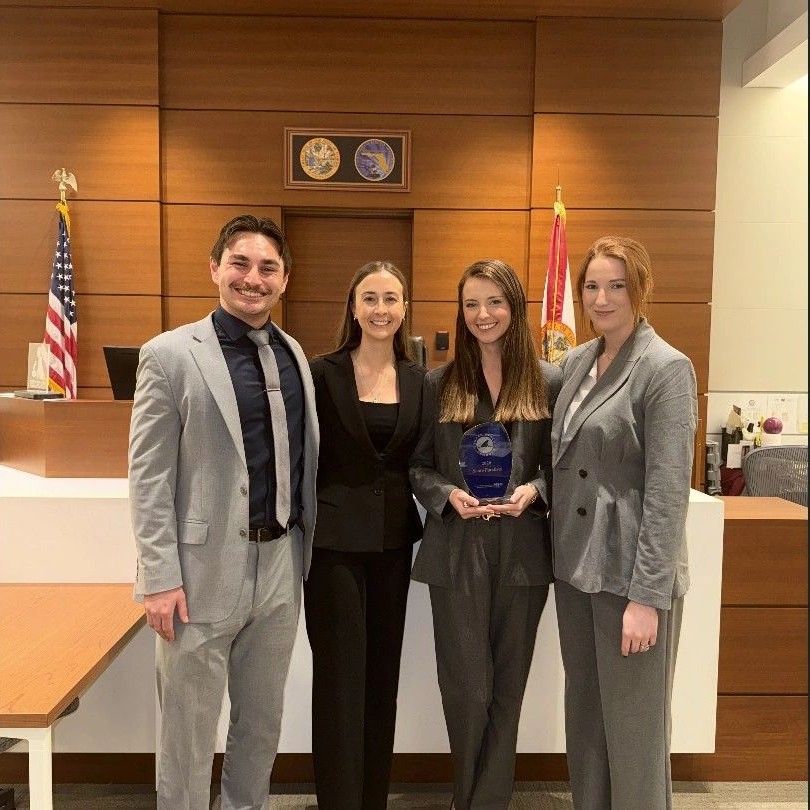
The Hon. Deborah Karalunas L’82, Administrative Judge, Fifth Judicial District, Supreme Court of New York, received the Betty D. Friedland Award for Trial Excellence in recognition of her contributions to the legal profession across New York state, excellence in legal education, courtroom practice, and ethics.
The Hon. Mae A. D’Agostino L’80, The Hon. Thérèse Wiley Dancks L’91, and The Hon. Deborah Karalunas L’82.
Several College of Law deans and professors were panelists, moderators, and discussants at the 2026 American Association of Law Schools Annual Meeting in January 2026.
Syracuse University Chancellor and Professor of Law Kent Syverud was a speaker on the Advanced Workshop for Experienced Deans – Post-Decanal Opportunities: Seeking a Presidency of a College of University program.
As the U.S. reflected on the 60th anniversary of the Voting Rights Act of 1965, Syracuse University College of Law marked the moment by bringing students to the heart of the conversation. The new Voting Rights and Policy residency, designed for hybrid online JDinteractive students and open to on-campus J.D. students, was held in Washington, D.C. for four days in December and was taught by Ryan Suto G’13 M.S. (NEW), G’13 M.S. (MAX), L’13, senior government affairs manager at FairVote.
The residency addressed the urgency surrounding voting rights in today’s political climate while also examining the law’s origins, impact, and the ongoing challenges related to protecting Americans’ right to vote throughout history.
Ryan Suto G’13 M.S. (NEW), G’13 M.S. (MAX), L’13 speaks in class with a student and guest speaker, Sara Rohani.
A Universal Right Not Stated in the Constitution
“There is actually no individual right to vote in the Constitution. Instead, it protects voting through a number of constitutional amendments. The history of voting rights is intertwined in our country’s history, and this residency was a good frame to understand the struggle for civil rights, disability rights, the rights of Black and Latino communities, and more,” says Suto. “Familiarity with voting rights helps our students understand the difference between equality and equity.”
In response to student interest, Syracuse Law reached out to Suto about creating this new residency. He designed the course to familiarize students with major federal and state court decisions and federal legislation, deepen their understanding of how federal and state governments interact with voting rights, and prepare them to critically assess and participate in future developments within the area of law.
JDi Students Found Topic Valuable in Wake of Current Events
Ryan Dudley L’26 enjoyed attending the residency. He currently works as the state policy manager for the Freedom from Religion Foundation.
“I chose this residency because I was very interested in this topic, especially given the current political climate around redistricting and the Supreme Court’s interest in taking a further look at the Voting Rights Act,” he says. “It gave me a clearer understanding of the Voting Rights Act, the history of the laws, and the threat to the law and voting rights in general.”
“One of the best parts, however, was the opportunity to have in-person interaction with others in my cohort,” he adds. “The JDi program is great because, although we are all participating from all over the country, there is a real sense of friendship and camaraderie within our group, and it’s great to connect with others at the residencies.”
Highlights of this residency included several prominent speakers: Sara Rohani, assistant counsel of the NAACP Legal Defense Fund; Fred McBride, Ph.D. senior advisor, voting rights, for the Southern Poverty Law Center; and Robert Weiner, director of the Voting Rights Project, The Lawyers’ Committee for Civil Rights Under the Law.
Sara Rohani, assistant counsel of the NAACP Legal Defense Fund, speaks with students at the Voting Rights and Policy residency.
Residency Brought Together Students with Diverse Expertise
Even though many of these students may not pursue careers specifically in voting rights, they wanted to understand how the law shapes and impacts communities. And because JDi students tend to be working professionals attending law school to advance or change their careers, they also brought real-life experiences to the topic. For example, one student was an elected official in Pennsylvania, another worked in state government, and another was a teacher, adding depth and practical relevance to the conversations in the room.
Michael Roach L’26 is the county judge of Stephens County, Texas.
“In my role as a county judge, I see firsthand how voting rules affect both election administrators and voters on the local level,” he explains. “I was particularly interested in getting a deeper understanding of how federal voting rights policy has developed, been interpreted, and implemented beyond the courtroom.”
“One of the most valuable aspects of the residency was exposure to practitioners working directly in the voting rights space, including our guest speakers who shared real perspectives for advocacy and enforcement,” Roach says. “And Professor Suto brought a unique level of insight, drawing on his experience at the forefront of drafting and advising on legislation designed to promote fairness, access, and integrity in the electoral process. All of the information throughout the residency helped connect legal theory to real policy outcomes.”
Fred McBride, Ph.D. senior advisor, voting rights, for the Southern Poverty Law Center, teaches students about Redistricting Principles as a guest speaker.
Students Tasked With Final Assessment of Writing Bill
According to Suto, the residency emphasized familiarity with voting rights and statutory drafting, instead of analyzing what someone else had already written.
“I like the exercise of saying, ‘This is the jurisprudential frame. What would you do in the middle of that?’ and asking students to see the gap between law and politics,” Suto explains, adding that the final assessment of the residency was to draft a bill.
The inaugural Voting Rights and Policy residency was a success. According to Suto, he received very positive, informal feedback from those who participated. Given the headlines voting rights have been making in today’s political climate, he hopes to present a similar residency to students in the future.
See here for more information on upcoming JDi residencies.
Joanne “Joanie” Mahoney ’87, L’90, President of the State University of New York College of Environmental Science and Forestry (SUNY ESF), will deliver the Commencement address at Syracuse University College of Law’s Class of 2026 Commencement on Friday, May 8, 2026, in the JMA Wireless Dome.
Mahoney was appointed SUNY ESF President in November 2020. She previously served as Onondaga County Executive for 11 years, during which she earned national recognition for her environmentally friendly stewardship. Before her elective office, she worked as an attorney both in private practice with the Harris Beach law firm and for five years as a criminal prosecutor in the Onondaga County District Attorney’s Office. Mahoney received her Juris Doctor from Syracuse University College of Law in 1990 and her Bachelor of Science from Syracuse University Whitman School of Management in 1987. She currently serves on the College of Law’s Board of Advisors.
As Onondaga County Executive (2008-2018), the first woman elected to this position, Mahoney created the nationally acclaimed Save the Rain green infrastructure program, transforming stormwater management. Her leadership helped restore Onondaga Lake from one of America’s most polluted lakes to swimming-quality water. She helped the county maintain the highest bond ratings among all New York State counties while championing the Say Yes to Education partnership. Governing Magazine named her Public Official of the Year in 2011.
As SUNY ESF’s fifth president and first woman to lead the institution in its 110-year history (2020-present), Mahoney has elevated SUNY ESF nationally in Princeton Review’s “Most Environmentally Conscious” ranking. She serves as Co-Chair of SUNY’s system-wide Sustainability Advisory Council. Her concurrent service as Chair of the New York State Thruway Authority (2015-2025) included overseeing completion of the $4 billion Governor Mario M. Cuomo Bridge, one of the nation’s largest infrastructure projects at the time.
Mahoney has sustained and strengthened the historic Syracuse University-SUNY ESF partnership, ensuring joint diplomas, shared opportunities for students, and collaborative academic programs. A Syracuse native from a family of nine children, she has championed regional development including helping to secure the $500 million CNY Rising award from the state.
“I am honored to give the commencement address to my alma mater’s 2026 graduating class,” said Mahoney. “I look forward to providing this next generation of leaders with insights into what awaits them as they start their careers.”
“I am pleased to welcome Mahoney back to the College of Law and am excited to stand with her as we welcome our most recent graduates into the powerful alumni network of Syracuse Law,” said College of Law Dean Terence Lau L’98.
Professor Keith Bybee, the Paul E. and Hon. Joanne F. Alper ’72 Judiciary Studies Professor, spoke with WUSF/NPR on the state of civility one year into the Trump presidency.
Bybee, author of How Civility Works, discussed the history of civility in society, the ways norms of civility were broken throughout American history, and the impact of the current climate on civility across the political spectrum.
“There is some sense that if they go low and you don’t go high, then you become reduced to the level of the person you are disagreeing with,” said Bybee. “I would suggest something different, which is to focus on the real stakes of what are the boundaries of polite society, who gets the benefit of decent treatment and behavior in our society, who is owed basic respect. If we focus on that as the goal, perhaps it will make it less imperative that we engage in tit-for-tat or f-bomb-for-f-bomb.”