
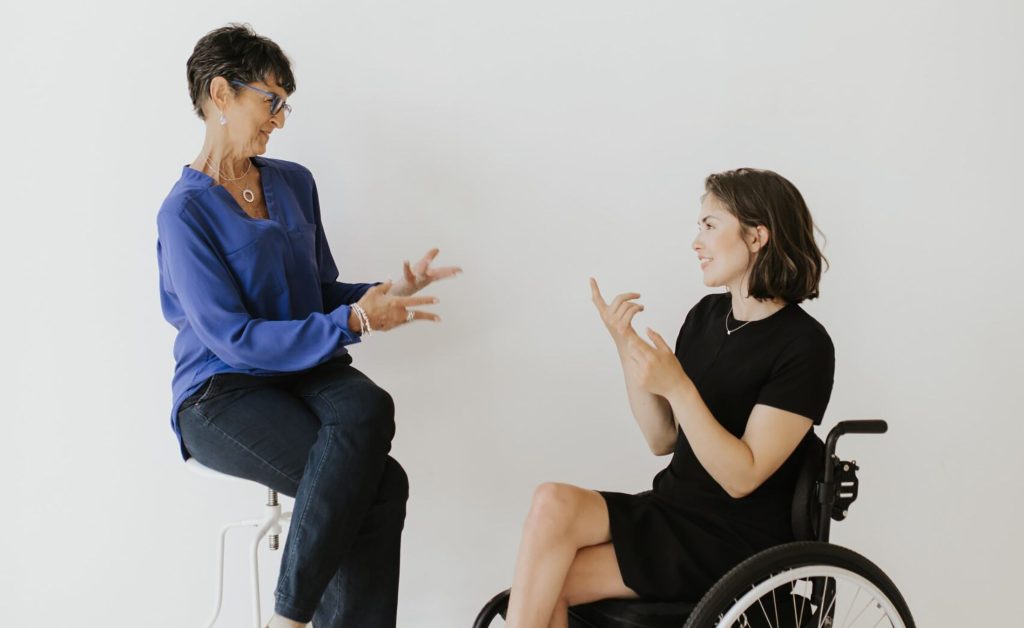
A 3L at Syracuse University College of Law, Kaitlin Sommer L’26 is always planning ahead. Throughout her life, she has continuously asked herself, “Is there a better or more efficient way to do this?”, “Am I advocating for what I need?”, “How can I figure this out by myself?” And, while this way of operating is a great skillset for any lawyer, Sommer has developed this method out of necessity and independence, as she navigates the world as a wheelchair user, as well as a child of Deaf adults (CODA).
Sommer attended Rochester Institute of Technology (RIT) as a political science major for her undergraduate degree as part of a 3+3 program with Syracuse Law, which allows students to transfer from RIT to the Law School after three years to finish their bachelor’s degree and at the same time start studying law.
As she prepares for her last year at Syracuse Law, Sommer has taken full advantage of many of the opportunities that come from being a law student—attending the Ms. JD Fall 2024 Leadership Academy Intensive hosted by the Harvard Women’s Law Association at Harvard Law School, and presenting at her alma mater’s third annual Together RIT: A Day of Dialogue centered on the theme of Deaf culture, disability and neurodiversity in her first ever public speaking appearance.
In January, Sommer added another responsibility to her already busy schedule: co-president of the Disability Law Society (DLS) at Syracuse Law, a position she shares with Emely Recinos L’26. The organization serves as a community for students with disabilities and their allies at Syracuse Law, while also raising awareness and providing related information across the greater University.
“This is a new venture that I’m really excited about. We are a small group of students at Syracuse Law, and it’s important that we have our voices heard,” she says, noting that only about 1.4% of lawyers in the U.S. self-identify as having a disability according to the American Bar Association. “Emely, who also has a disability, and I have a new take, which revolves around being more vocal about disabled students’ experiences and how the University can best support us. I want the Disability Law Society to see where we can set permanent roots and have a noticeable space to make our voices heard. And, of course, having this kind of community at the Law School has helped me to know that I’m not alone.”

When Sommer started at Syracuse Law, it seemed to make sense that she go into disability law, but some great advice from Professor of Law Katherine Macfarlane, a leading expert on civil rights litigation, disability law, and civil procedure, gave her the freedom to consider other areas, as well.
“Professor Macfarlane said that just because I’m a person with a disability doesn’t mean I have to go into disability law,” Sommer explains. “She made me see that being a disabled person in any legal space is also representative, and my personal experience will make me a better professional no matter which field of law I choose. She has been such a good mentor and support system for me and has encouraged me to advocate for what I want and need.”
Now, Sommer is very interested in pursuing national security law, while possibly finding a way to intersect that with disability law, too. She has since taken courses through Syracuse Law’s National Security Program and is working on her Certificate of Advanced Study in National Security and Counterterrorism.
Her hope is to live and work in Washington, D.C., in the future. As an undergraduate, she interned for Congressman Joe Morelle (D-NY) in the nation’s capital. Sommer recently completed an intern at the POPVOX Foundation, a nonpartisan organization that advocates for improvements in Congress. And, this summer, she is interning with The Spinal Cord Injury Law Firm, PLLC, in Washington, D.C. Despite these impressive opportunities, she is eager to learn more through her coursework and seek out other experiences to prepare to graduate from Syracuse Law in 2026.

“Having a disability does make things harder, but, at the end of the day, I’m so grateful. My own life experiences, along with lessons from the Law School, like critical thinking, have really helped me see how important it is to assess facts to see if what seems to be true really is true. This has made me a more open-minded person and will make me a better lawyer, too,” she says.
“After all, I never want people to make assumptions about me just because I use a wheelchair. I hope to be a positive example of a compassionate and knowledgeable disabled lawyer who can better connect with my work through my life experiences, and Syracuse Law is helping me get there.”