When studying Artificial Intelligence (AI) in the 1980s, I never thought it would become such a mainstream, hot topic as it is today. Its promising advances are being discussed everywhere, even at the kitchen table. The promotion of AI is important to our society, and such promotion is perhaps best accomplished by the U.S. patent system. This article discusses the case law governing the patentability of AI inventions. In short, AI inventions are patent eligible, but they must overcome several hurdles.
AI Definition
AI has been the focus of research since the 1950s.2 There are many definitions for AI, but most include simulating human activity (such as robotics) and providing decision support (such as suggesting an optimal network configuration based on network activity). This article focuses on the patentability of decision support systems, which include machine learning. Decision support systems usually analyze data, which could be a static data set or dynamically derived data, like network activity. They then provide recommendations by, for example, displaying them or even automatically implementing those changes. Neural networks are a common tool for use in such systems.
Patentable Subject Matter Overview
The statute governing patentable subject matter is very broad, for it states “Whoever invents or discovers any new and useful process, machine, manufacture, or composition of matter, or any new and useful improvement thereof, may obtain a patent therefor, subject to the conditions and requirements of this title.”3 The Supreme Court has recognized several judicial exceptions that limit patent eligibility: “Excluded from such patent protection are laws of nature, natural phenomena, and abstract ideas.”4 The rationale for these exclusions is that “these exceptions are ‘part of the storehouse of knowledge of all men … free to all men and reserved exclusively to none.’”5 When and how these exceptions are applied are perhaps the most challenging part of a § 101 analysis.
Patentability of Computer-Related Inventions
The Supreme Court first dealt with computer-related inventions in a trilogy of cases. First, in Benson, the Supreme Court struck down a binary-coded decimal to pure binary conversion program, leaving it up to Congress to decide whether to patent these inventions.6 Next, Flook dealt with a method for updating alarm limits using a mathematical formula and again struck down the invention because the only difference “between the conventional methods of changing alarm limits and that described in respondent’s application rests in the second step—the mathematical algorithm or formula.”7 In this “point-of-novelty” test, the formula (a law of nature) is ignored and the rest of the claim must be novel.8 The last in the trilogy of cases was Diehr, where the Court rejected the point-of-novelty test, stating that “The ‘novelty’ of any element or steps in a process, or even the process itself, is of no relevance” in a § 101 inquiry.9 Then, decades later, the Supreme Court in Mayo seemingly resurrected the point-of-novelty test but left Diehr intact.10 This is the cause of much difficulty today.11
The current § 101 analysis—as explained by the Supreme Court in Alice—is a two-part test: (1) determine if the claims are directed to one of the judicial exclusions, such as an abstract idea; and if so, (2) “consider the elements of each claim both individually and as an ordered combination to determine whether the additional elements transform the claim into a patent-eligible application” by reciting an inventive concept, which must be more than a generic computer.12 This test caused much concern for software patents because the novelty in those inventions is found in the processing of the software itself, rather than in the hardware. Luckily, in Enfish, the Federal Circuit clarified that software is not “inherently abstract” and can be patent eligible.13
Patent Eligibility of AI Inventions
As the Federal Circuit’s case law evolved after Alice, it generated yet another hurdle for decision support systems in the Electric Power Group line of cases.14 In Electric Power Group, the Federal Circuit held that collecting information, analyzing that information, and presenting the results is an abstract idea.15 This means that many decision support systems may fail step one in the § 101 analysis, requiring that such systems recite an inventive concept—more than a generic computer—to be patent eligible. Electric Power Group is therefore dangerous for AI inventions. Although this line of cases is evolving and expanding, other cases provide help.
The courts have found patent eligibility in a number of situations potentially applicable to AI inventions. First, both the Supreme Court and the Federal Circuit have found patent eligibility where the invention improves the functioning of the computer itself. 16 Second, the Federal Circuit has found patent eligibility when the claimed invention provides a technical improvement over the prior art.17 Third, the Federal Circuit has found patent eligibility where the claims recite a technical solution to a technical problem,18 and fourth, the Federal Circuit has found patent eligibility when conventional elements are arranged in a non-conventional way.19 Should an AI invention fit into one of these categories, it will likely be found patent eligible as long as those features are both described in the patent specification and claimed.
There are other concerns beyond the Electric Power Group line of cases for AI inventions. For example, the Federal Circuit is very willing to strike down functionally drafted claims regardless of their subject matter.20 Also, the Federal Circuit has found no business method patents after Alice satisfy § 101.
Empirical Summary of § 101 Cases
The Federal Circuit § 101 cases post Alice can be somewhat confusing to reconcile. However, when viewed based on claim analysis and the invention’s subject matter, a pattern emerges as shown in the following graph. The y-axis shows patent eligibility based on the patent’s claims, with those drafted functionally faring the worst, those drafted with technical details faring better, and those reciting a technological improvement faring the best. The x-axis shows patent eligibility based on the claim’s subject matter. Claims directed to business methods fare the worst, claims directed to user interfaces fare better, claims directed to applications fare better still, and claims directed to system hardware and software fare the best.
Conclusion
AI inventions may face more patent-eligibility difficulties than other technologies based on the Electric Power Group line of cases. But where the specification and claims describe the technological advantages and other features that the Federal Circuit equates with patent eligibility, AI inventions should pass § 101 muster.
U.S. Army Judge Advocate General (JAG) Corps Visits the College of Law
The Judge Advocate General of the U.S. Army, Lieutenant General Stuart Risch (left), along with members of his staff and the JAG Corps, visited the College of Law in February of 2023 to share insights and advice with students.
Lieutenant General Risch delivered an address to the College of Law community on “Lawyers as Leaders,” and discussed the modern challenges faced by today’s JAG Corps during a National Security Law Conversation with the Hon. James E. Baker, Director of the Institute for Security Policy and Law. Assistant Dean Lily Hughes also moderated a panel of Army JAG officers and civilian attorneys, who shared knowledge, advice, and perspectives on serving as an officer and lawyer.
The Army JAG Corps also held a recruitment fair for current Law students.
US Court of Appeals for Veterans Claims (CAVC) Holds Live Oral Arguments in Melanie Gray Memorial Courtroom
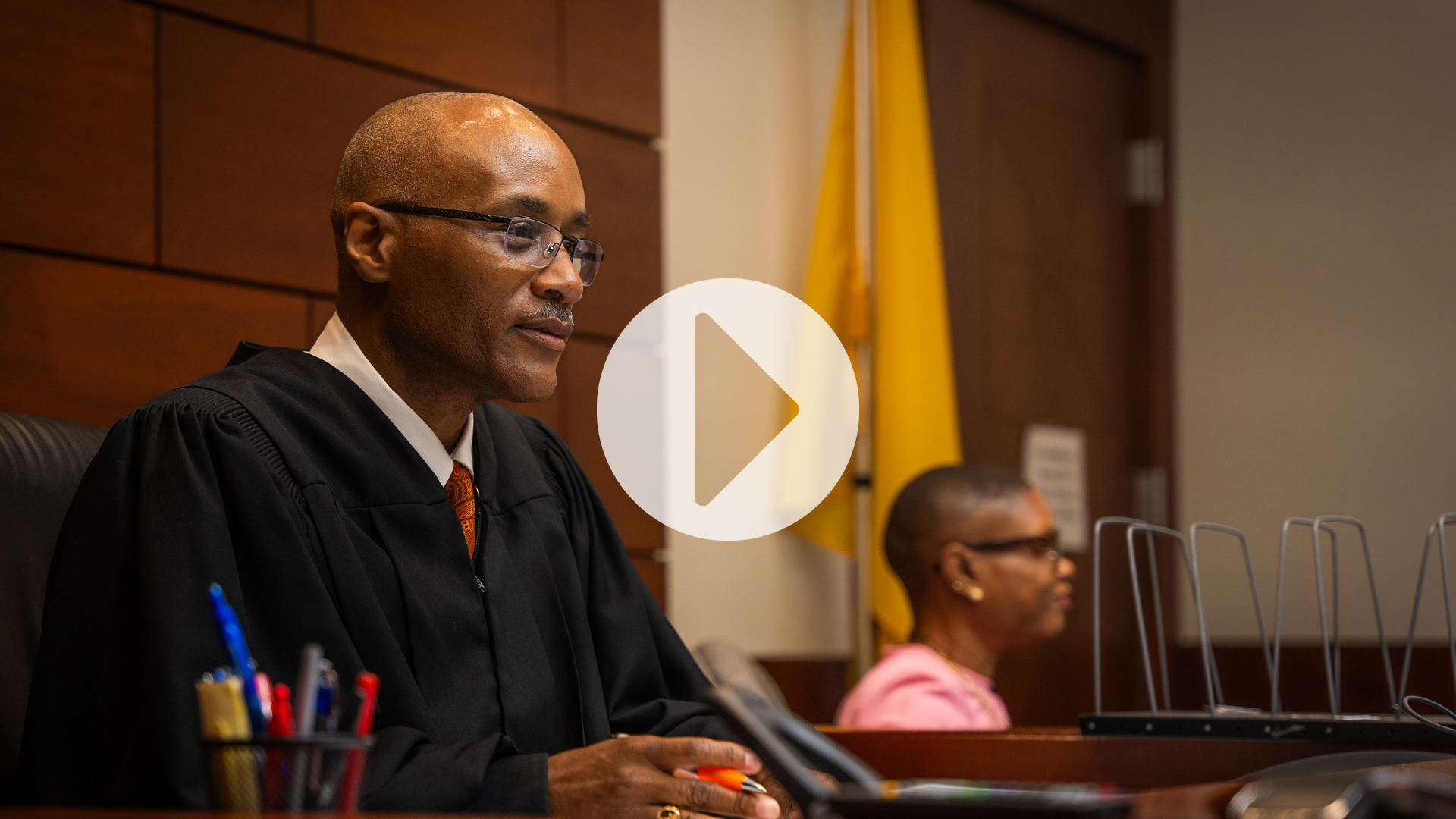
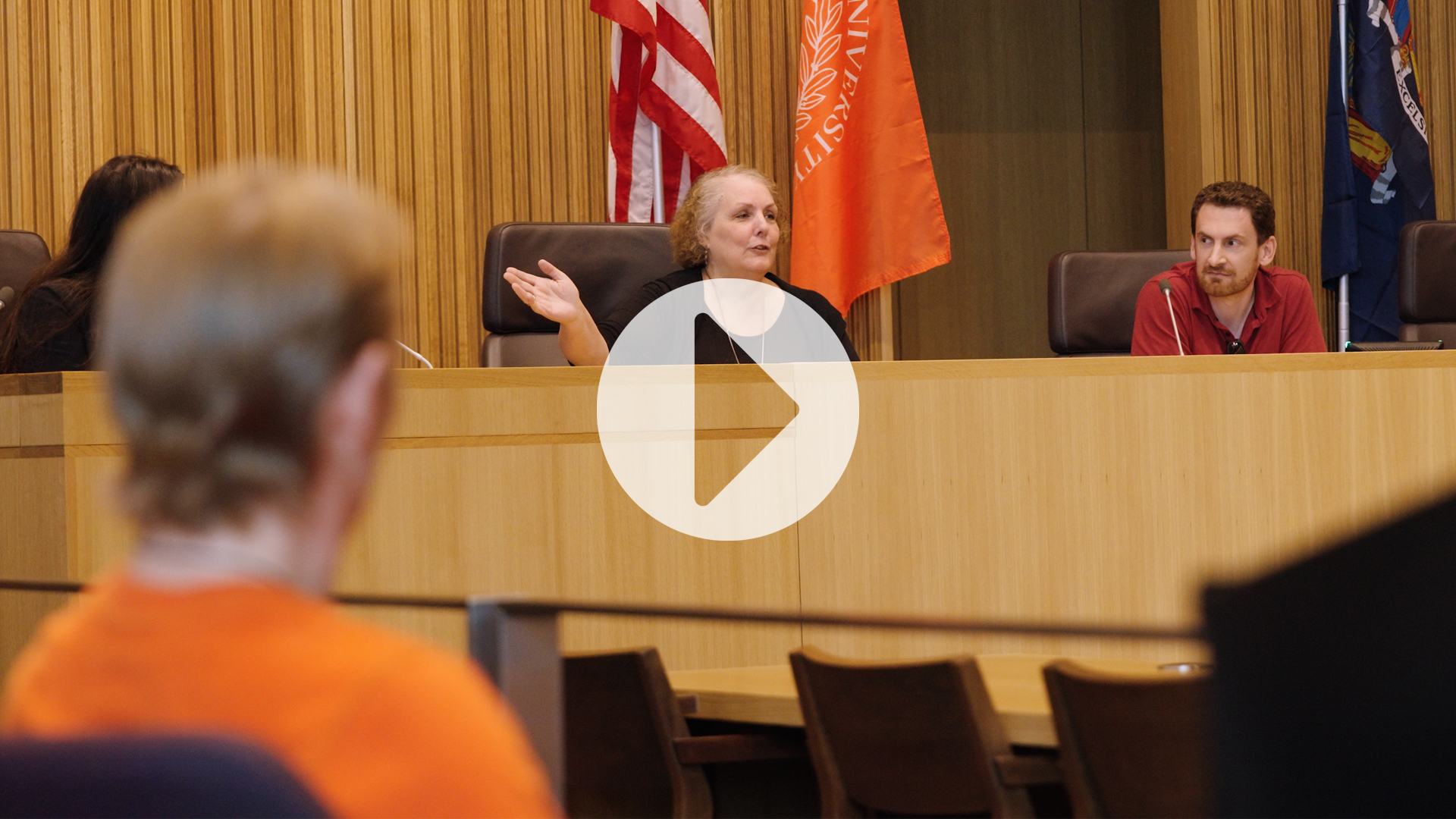
The College of Law hosted the US Court of Appeals for Veterans Claims (CAVC) in the Melanie Gray Memorial Courtroom for live oral arguments in the fall of 2022. The arguments provided students, faculty and staff, alumni, and the local legal community with an opportunity to learn about veterans’ benefits, federal practice, and administrative law.
As part of the CAVC visit, the Betty and Michael D. Wohl Veterans Legal Clinic also arranged two panels for students. Professor Andrew Greenberg L’89 moderated a panel of judges on the court who discussed judicial opinions and appellate advocacy. Following this event, Greg Block, the Clerk of Court, moderated a career panel including the attorneys from the VA’s Office of General Counsel, the attorneys representing the appellant, and the judicial law clerks at the Court.
Tracy Costanzo L’25 and Amanda Hepinger L’24 Win the ABA Section of Taxation 2022-2023 Law Student Tax Challenge
Tracy Costanzo L’25 (left) and Amanda Hepinger L’24 won the ABA Section of Taxation 2022-2023 Law Student Tax Challenge, held in person at the Section of Taxation’s 2023 Midyear Tax Meeting. Both are students in the JDinteractive program.
Costanzo and Hepinger were one of six semi-finalist teams invited to the national competition. Overall, 62 teams from approximately 48 law schools entered the Challenge. The team was coached by the Sherman F. Levey ’57, L’59 Low Income Taxpayer Clinic Director Robert Nassau.
VLC Students Deliver Oral Arguments Before U.S. Court of Appeals for the Federal Circuit
Ben Emmi L’23, Emily Pascale L’23, Professor Beth Kubala, 2L Milana Casillas, 2L Cody Nagel, and Bill Rielly L’23.
While many law school students learn about appellate advocacy in the classroom or on a mock trial competition team, seven College of Law students recently traveled to Washington, D.C., for an oral argument before a federal court. The students seized the opportunity to apply the skills they learned in their law school experience before a three-judge panel at the U.S. Court of Appeals for the Federal Circuit.
The Executive Director of the Betty and Michael D. Wohl Veterans Legal Clinic (VLC), Professor Beth Kubala, supervised the students along the way and applauded their efforts.
“Participating in a clinic during law school not only affords students an opportunity to work directly with actual clients on important issues, it also gives them invaluable real-world legal experience,” says Kubala, who served as principal counsel on the case. “The students learned how to navigate a complex appellate process and did so while zealously representing their client.”
Student attorneys in the VLC represented the widow of an Army veteran in her pursuit of survivor benefits. The students initially assisted the widow in appealing this matter through the Army’s administrative process, then through the federal court system.
As the students learned, effective appellate advocacy requires a cohesive litigation team to conduct legal analysis, writing, and advocacy simultaneously. Several students contributed to the litigation team through various roles and tasks.
Last summer, VLC student Mike Poggi L’22 took the lead in drafting the appellant’s opening brief. Bill Rielly L’23 and 2L Milana Casillas helped with research, responding to motions, and brief writing and editing. During the summer, as part of clinic case rounds, all students collaborated in reviewing the draft brief, providing feedback, and helping to shape the final submission. Leveraging clinic students for this purpose brought fresh perspectives, objectivity, and ideas for new approaches to challenging issues.
“Under the leadership of Professor Kubala, we cultivated a dynamic work environment that promoted collaboration and efficiency. Her guidance and support were instrumental in helping us navigate the complexities of our case, and she always went above and beyond to ensure that we had the resources and support we needed to succeed. It has been rewarding to work towards our goal with full confidence in one another and with the support of the Syracuse Law.”2L Milana Casillas
“In the Veterans Legal Clinic, I had the privilege to work with online JDinteractive and residential J.D. students from across the US, collaborating on research, editing, and motion filing for an important case on behalf of a veteran’s widow. This experience culminated in an awesome morning at the United States Appeals Court for the Federal Circuit in Washington D.C., where our lead Syracuse student attorney persuasively argued before the Court,” says Rielly.
In the fall, after receiving the government’s response brief, Ben Emmi L’23 volunteered to draft the appellant’s reply brief to counter matters raised by the Department of Justice. Again, the team mobilized to analyze the government’s approach, refute opposing arguments, and respond appropriately to convince the court that the law supported a finding for the client.
With more than 80 percent of federal appeals decided solely based on written briefs, it came as a bit of a surprise in the spring when the clinic received notice that the Federal Circuit requested an oral argument. Emmi rose to the challenge, narrowing the issues and determining the strongest arguments.
Syracuse Law community members mobilized to hold moot court proceedings to emulate the experience of arguing a case at the appellate level. Professors Shannon Gardner, Courtney Abbot Hill L’09, Kelly Curtis, and Adjunct Professor Dean DiPilato from Mackenzie Hughes donned judicial robes and held two separate moot court sessions where they replicated real court proceedings by asking numerous questions to force Emmi to think on his feet and practice engaging with the bench. During the first moot court session, the entire proceeding was filmed for later use in one of the College’s Appellate Advocacy classes.
Each moot court session helped Emmi refine his knowledge of the facts of the case, practice his opening statement, and expertly frame the issues consistently. The students provided feedback, discussed the strengths and weaknesses of the arguments, and continued to predict the questions the judges would pose.
In early April, a team of students gathered in Washington D.C. for the oral arguments before the U.S. Court of Appeals for the Federal Circuit. Prepared and composed, Emmi confidently appeared before the three-judge panel to emphasize arguments made in the briefs and respond to pointed questions from the judges. The oral argument represented the culmination of 24 months of effort from the entire clinic.
“We were able to put on two moot arguments with the help of Professors Abbott-Hill, Curtis, and Gardner, and Mackenzie Hughes partner, Dean Dipilato. I owe them a huge thank you. They were incredibly dedicated to learning the subject matter and providing me with the most realistic experience possible, not once but twice. As a testament to their judicial prowess, many of their questions during practice came up during the actual argument. I can sum up my argument in front of the Federal Circuit by saying that I wouldn’t have even had such an incredible experience without the support of my peers and Syracuse Law faculty,” says Emmi.
After an outstanding morning in federal court, the students enjoyed engaging with alumni and partners across the nation’s capital. The Marshal of the U.S. Supreme Court gave the students an insider’s view of the courtroom and other historic portions of the building. Bill Van Saun L’19 provided the students with current perspectives from the Senate Committee on Veterans Affairs, where he serves as Legal Counsel. The next day, 2L Cody Nagel hosted students for a tour of the White House, where she currently is interning with the Office of National Drug Control Policy.
Strengthening ties with the Georgian Bar Association (GBA) Through a Visit to Tbilisi and Hosting Judges in Dineen Hall
The Hon. James E. Baker (fourth from left) and Assistant Dean of International Programs Andrew Horsfall L’10 (third from right) meet with Chief General Prosecutor of Georgia (third from left).
Assistant Dean of International Programs Andrew Horsfall L’10 and Institute of Security Policy and Law Director the Hon. James E. Baker traveled to Tbilisi, Georgia this spring upon invitation from the Georgian Bar Association (GBA) in spirit of partnership and future collaboration with the College of Law.
The institutional partnership between the College of Law and the GBA originated during the 2021-22 academic year, when GBA President David Asatiani and Dean Craig M. Boise signed a Memorandum of Understanding (MOU) to promote scholarly exchange and cooperation between Syracuse Law, Syracuse University, and the GBA. Asatiani visited the College of Law with GBA Director of International Affairs Giorgi Tshekhani and Head of Analytical and Committee Affairs Tamta Devdariani to deepen their linkages and understanding about rule of law and civil society functions in the United States.
“The College of Law has, and continues to be, a rich academic destination for Georgia’s students, scholars, and academics seeking to pursue further study in the areas where it is facing its greatest political challenges—security law and policy, the spread of disinformation, and cyber security” Andrew Horsfall L’10
Syracuse Law also offered a five-part lecture series to members of the GBA in the spring of 2022, discussing a range of topics that covered foundational aspects of the U.S. legal system, and nuances of criminal procedure, commercial law, national security law, and intellectual property.
Continuing this collaboration, Horsfall and Baker visited Georgia this academic year with the objective to not only strengthen the relationship with the Georgian legal profession, but also to promote Syracuse Law and University as a destination for collaborations around security policy and law. Highlights of the visit included:
Meetings with the Chief Justice of the Supreme Court of Georgia, the Chief Prosecutor General of Georgia, and Georgia’s Deputy Minister of Defense to discuss current rule of law challenges and mutual cooperation in the training of its lawyers.
A lecture by Baker to members of the GBA on the challenges of serving as a national security lawyer.
A meeting with the Ministry of Education’s Center for International Education to discuss the launch of a tripartite scholarship program, in collaboration with the GBA, for Georgian lawyers, prosecutors, and judges.
Round-table discussions with the Deans and representatives of eight of Georgia’s law schools to expand the College’s network of academic partners in Georgia, and with representatives from various civil society organizations promoting grass-roots level rule of law initiatives.
Shortly after their return, the College of Law hosted 10 of Georgia’s civil and administrative judges in April as part of a jointly sponsored exchange program with the ABA Rule of Law Initiative (ABA ROLI) and USAID. For over 30 years, the initiative cultivates mutual understanding and capacity building through in-country visits, guest lectures, and engagement with various aspects of the U.S. judicial system.
Focusing on themes such as freedom of expression, jury selection, and court administration, the judges visited members of the judiciary from the United States’ Northern District of New York and New York State’s Fifth Judicial District to observe voire dire proceedings and share perspectives on jury selection. The College of Law also hosted a roundtable discussion with Vice Dean Keith Bybee and Professor Roy Gutterman L’00 to discuss freedom of expression and the media’s coverage of high-profile cases.
“This visit to Georgia and the College’s hosting of its judges has strengthened another crucial segment in the ‘Ring around Russia’ and our project’s present mission of cultivating a community of academics, military, government, and private-sector professionals committed to the rule of law. We were regularly reminded throughout our engagement with Georgia’s judges and advocates that 20% of Georgia is occupied by Russia and that threats to Georgia’s political and cultural sovereignty persist. Georgia’s relationship with the United States and other Western allies remains a priority to support the democratic values anchoring its institutions, and partnerships such as this further these important interests.” The Hon. James E. Baker
Judge Baker lectures members of the GBA on the challenges facing a national security lawyer.
by Shubha Ghosh, Crandall Melvin Professor of Law Director, Syracuse Intellectual Property Law Institute; Innovation Law Center
A contentious question in the field of intellectual property and technology commercialization is how broad a creator’s exclusive rights are in their work. Three current Supreme Court cases grapple with this issue in the fields of copyright, trademark, and patent.
In Warhol Foundation v. Goldsmith, the trustee of the late artist’s estate claims the right to make 12 silkscreens based on Lynn Goldsmith’s photograph of the late musical phenomenon Prince. Goldsmith had granted Vanity Fair the right to use her photograph of Prince, taken shortly after the release of his 1984 film Purple Rain, as part of a magazine article on the performer. Under the terms of the license from Goldsmith, Vanity Fair commissioned Andy Warhol to create artwork based on the photograph. Warhol copied the photograph as part of his silkscreen process to create Orange Prince, published in the 1984 Vanity Fair article. Warhol continued to make 12 more silkscreens from the photograph. These additional works came to light in 2016 after Prince’s death when Conde Nast, the publisher of Vanity Fair, released these twelve images in a tribute to the musician. Goldsmith complained to the publisher that these 12 silkscreens were unauthorized and infringed her copyright in the photograph. The Warhol Foundation initiated litigation to establish that Warhol’s creation of the 12 silkscreens was fair use and therefore allowed under copyright law. While the district court found in favor of Warhol’s Foundation, the appellate court disagreed, ruling that the silkscreens did not contain sufficient creativity to be a fair use of the copyrighted photograph. The Supreme Court heard oral arguments in October 2022, to resolve this dispute.
How broad are a copyright owner’s rights? Does Goldsmith’s copyright in her photograph allow her to prevent all copies or alterations of the image of Prince captured in her photograph? She authorized Warhol’s first silkscreen. Did the artist have to go back to Goldsmith to receive permission for each subsequent silkscreen? How about other artists who want to reproduce the Goldsmith photograph in their works or documentarians of Prince’s life who want to refer to the photograph in their movies? Does every conceivable use of the photograph have to be licensed or are there some uses that do not require a license because they are protected as fair use under the Copyright Act? The Supreme Court, as well as lower courts, have confronted questions like these for over one hundred and fifty years. Courts inform us that parody or other critical commentary are fair use. So are repurposing of copyrighted works to create new expressions, new uses, and new markets. For example, Google’s scanning of copyrighted books to allow a search that displays samples is fair use. In addition, copying of videogame software is allowed to create new platforms for playing games as is copying of smartphone software to allow new phone technologies, such as the Android. In Warhol, the Court seems poised to possibly expand fair use to encompass the creation of fine art that are not parodies or critical commentaries but embody original creative expression of an artist. How far the Court will go, we will see soon as its opinion should be out before June.
A portrait of Prince taken by Lynn Goldsmith (left) and 16 silk-screened images Andy Warhol created using the photo as a reference. Collection of the Supreme Court of the United States
Brands and trademarks are another set of legal rights whose boundaries are often tested. Jack Daniels found itself before the Supreme Court in March 2023, defending the use of its name and the design of its famed whiskey bottle against VIP, the manufacturer and distributor of dog toys. What caught the attention of Jack Daniels, particularly its trademark attorneys, was a squeeze toy marketed by VIP that mimicked a Jack Daniels bottle with the name Bad Spaniels on the label. Although the toy contained foam and no liquids of any kind, its label included statements about dog poop which some pet owners might find amusing. The district court found that the design of the bottle constituted trademark infringement as consumers might be confused into thinking that Jack Daniels had marketed the dog toy. The appellate court reversed, ruling that VIP’s toy was protected by the precedent of Rogers v. Grimaldi, a case from New York which allows the use of a trademark when the use does not denote authorship, sponsorship, or endorsement. The Rogers in this precedent was Ginger Rogers who sued Alberto Grimaldi, the producer of a movie called Fred and Ginger, a story of two dancers who emulated the famed duo. The New York federal appellate court ruled in favor of Grimaldi, and the court followed its own reasoning in ruling for VIP. The Supreme Court must decide whether to adopt the legal test in Rogers or adopt another approach to assess the uses of a company’s trademark in a humorous way on a product completely distinct from that of the trademark owner.
While my schedule conflicted with the oral argument for Warhol, I was able to attend the energetic oral argument in Jack Daniels. The Court rigorously grilled the advocates, who responded forcefully. The Justices, as a general impression, were concerned with the First Amendment problems in not allowing VIP to create its dog toy. Justice Kagan, however, questioned what VIP was trying to express by copying Jack Daniels’s trademark in this way. Acknowledging her recognized sense of humor, she questioned whether there was any parody here. Instead, she suggested the dog toy was just a knock-off (to use the vernacular, not her words) of the famed whiskey bottle. Justice Jackson, who asked the most persistent and penetrating questions, wondered if this was trademark infringement at all, as a matter of law, separate from any First Amendment concerns. After all, she pointed out, VIP was not branding its dog toys with Jack Daniels’ mark. The situation was different from the classic trademark case of someone selling a counterfeit Rolex watch. Finally, Justice Roberts, emphasizing the First Amendment concerns raised by his colleagues Justices Alito and Thomas, asked whether the Court needed to engage First Amendment law or work within the contours of trademark law to protect the speech interests of companies like VIP. The latter approach might entail adopting the lower court’s test from Rogers. Whatever approach the Justices take, the result, in my estimation, will not be unanimous and may well create an interesting opinion on how the First Amendment limits the scope of trademark rights.
Farther afield from photographs, fine art, whiskey bottles, and dog toys, is Amgen’s rights in the antibodies that constitute Repatha, the company’s patented cholesterol drug. The Supreme Court heard arguments a few days after the Jack Daniels dispute in a highly watched patent litigation between rival pharmaceutical companies Amgen and Sanofi. I was able to attend this oral argument as well and found the exchanges lively for what might appear to be a dry technical dispute. Once again at issue is how broad are the rights of the intellectual property owner.
Monoclonal antibodies, one particular type of antibody, are proteins that attach to cells and block them from invasion by pathogens, such as viruses or bacteria. Identifying antibodies and designing drugs around them are invaluable in treating diseases. Amgen identified 26 antibodies in its patent covering Repatha, an anti-cholesterol drug, but claims that this disclosure revealed 300 more antibodies. Therefore, the company argues, its patent covers a wide range of competing drugs, including Praluent discovered and manufactured by Sanofi. It may seem odd that Amgen is claiming rights not just in what it actually discovered but in other drugs that were made possible, or enabled, by its specific invention. At work is the patent doctrine of enablement which does allow a patent owner to claim a broad range of inventions beyond the specific discovery. A simple historical example illustrates this.
When Alexander Graham Bell made the first successful telephone call, it was to his assistant Thomas Watson in the next room. For patent law, a critical question is what specifically did Bell invent. It would be wrong to say that Bell invented an apparatus for speaking to someone in the next room. His invention encompassed more than that, allowing long distance communication. Specifically, Bell’s patent states that his invention consists of an “employment of a vibratory or undulatory current of electricity in contradistinction to a merely intermittent or pulsatory current, and of a method of, and apparatus for, producing electrical undulations upon the line-wire.” This technical language from the patent states what Bell invented. Anyone who makes or uses or sells a product containing this invention as described would be infringing Bell’s patent, which expired over a hundred years ago. This language shows what Bell’s invention enabled other inventors to do.
Patent law requires enablement for several reasons. Enablement provides notice to other inventors working in the field and to those who might want to license the patent. Enablement also makes sure that the inventor does not get more legal rights than is deserved. A patent rewards what an inventor has accomplished. An implication is that a patent owner might lose a patent if someone can show that the claimed invention has not actually been enabled. This is what happened in a famous Supreme Court case involving Thomas Edison.
Thomas Edison marketed a lightbulb using filament made from bamboo. A patent was issued to inventors William Sawyer and Albion Man covering light bulb filaments made of “carbonized fibrous materials.” The inventors sued Edison for patent infringement, claiming that the bamboo filament was an example of the carbonized fibrous materials. Edison successfully showed that Sawyer and Man had not actually invented a filament that could be made of any carbonized fibrous materials. Specifically, nothing in their work showed that bamboo, which Edison was able to make work after much effort, would serve as a light bulb filament. Therefore, Swayer and Man’s patent claim was found invalid and hence unenforceable.
Edison’s infringement woes are immortalized in the Incandescent Lamp Patent case, a Supreme Court precedent that is now being re-examined in Amgen v. Sanofi. Under this precedent, an inventor enables her patented invention if another inventor knowledgeable of the science can make the invention without too much experimentation. Edison had to work hard to show that bamboo would work as a light bulb filament contrary to Sawyer and Man’s claim that any carbonized fibrous material would work. Similarly, Sanofi is arguing that the antibodies that constitute its cholesterol-reducing drug were not enabled by Amgen. By contrast, Amgen is arguing that Sanofi’s antibodies would have been readily discovered without too much experimentation based on the antibodies that Amgen did discover. In other words, Amgen did enable Sanofi’s drug and therefore it infringes Amgen’s patent.
The dispute between Amgen and Sanofi has been proceeding for nearly a decade, with the lower courts ruling that Amgen had not enabled the antibodies in Sanofi’s drug. The Supreme Court will determine whether the lower courts reached the correct result. Readers may be justifiably skeptical that judges can work through such a technical dispute. Understandably, the Justices exhibited caution in questioning the attorneys arguing the various sides of the dispute. What informed the Justices was the policy over granting Amgen too broad a patent, one that would thwart a competitor, like Sanofi. Edison’s name was mentioned during the oral arguments. If Sawyer and Man had been successful in the patent suit, how would the light bulb have developed? If Amgen is successful now, what would be the impact on other inventors trying to compete in the pharmaceutical market? The Justices questioned Amgen to determine exactly how broad its patent might be. To be honest, in my opinion, Amgen’s attorney did not quell concerns that the patent might be too broad. At one point, he stated that Amgen may have enabled as many as 300 other antibodies and possibly even a million. Such a broad claim would have chilling effects on drug development. To be fair, perhaps Amgen has developed a blockbuster, game-changing drug, which would justify a broad patent. However, Amgen was not making a persuasive argument for how revolutionary its invention is, either in the lower courts or before the Supreme Court.
The trio of cases before the Court this term illustrates the importance of determining how broad intellectual property rights are for the commercialization of intellectual property and technology. How the Court decides these three cases will not settle long-standing and challenging legal problems but will fuel how attorneys work in the field. Recognizing these issues and keeping informed about how the law develops makes the practice of intellectual property and technology commercialization a constant source of excitement in guiding imaginative and entrepreneurial clients.
UPDATE
As this article went to press, the Supreme Court issued its opinions in the Warhol and Amgen cases on May 18, 2023 and in the Jack Daniels case on June 8, 2023. The Andy Warhol Foundation lost its appeal as the Court found that Orange Prince was very similar to Goldsmith’s Prince photograph and substituted for it in Vanity Fair Magazine. The Court split 7-2 with Justices Kagan and Roberts dissenting vehemently against the majority’s ruling that Warhol did not add creative transformation to Goldsmith’s photograph. Amgen also lost its appeal with the Court ruling that Amgen had failed to enable the antibodies that were the basis for Sanofi’s pharmaceutical. The ruling against Amgen ends that litigation. Finally, the Supreme Court unanimously ruled in favor of Jack Daniels, overturning the Second Circuit’s decision applying Rogers v Grimaldi to rule for VIP. Without much explanation, the Court held that Rogers, a case with applications to trademarks used in movie titles and song lyrics, had not application to VIP’s copying aspects of Jack Daniels’ trademark to brand dog toys. The dispute between the producer of whiskey and the purveyor of dog toys continues, perhaps to a settlement, perhaps to a trial.
Syracuse Law Review and the Institute for Security Policy and Law Host “Lessons Learned: Perspectives on Law and Policy from the War in Ukraine” Symposium
The Syracuse Law Review and the Institute for Security Policy and Law (SPL) hosted the “Lessons Learned: Perspectives on Law and Policy from the War in Ukraine” symposium during the 2022 Law Alumni Weekend. Beginning with an introduction from the Director of the SPL, the Hon. James E. Baker, panelists gathered for a roundtable discussion on topics related to the war in Ukraine, which included:
THE LAW OF ARMED CONFLICT
Beth Kubala, Professor, Executive Director of the Betty and Michael D. Wohl Veterans Legal Clinic (LTC U.S. Army Ret.)
Rachel VanLandingham, Irwin R. Buchalter Professor of Law, Southwestern Law School (Lt. Col. U.S. Air Force Ret.)
Major William Casey Biggerstaff, Military Professor at the Stockton Center for International Law at the U.S. Naval College
Major Jason Harrup, Chief of National Security Law, 10th Mountain Division, U.S. Army
INTELLIGENCE
Robert Murrett, Professor, Deputy Director of the Institute for Security Policy and Law (former Director NGA, Vice Admiral U.S. Navy Ret.)
Renn Gade, Deputy General Counsel/Intelligence, Department of Defense
Brian Taylor, Professor, Maxwell School of Citizenship and Public Affairs
Laurie Hobart, Professor, College of Law
SANCTIONS
Adam Smith, Partner Gibson Dunn (former Senior Advisor, Office of Foreign Assets Control, Director NSC staff)
Kristen Patel, Professor, Maxwell School of Citizenship and Public Affairs
The Syracuse Law Review recently published a special Symposium Journal edition that discusses ideas and topics deducted from the discussion. The symposium and accompanying journal focused on strategic and subject matter aspects of Russia’s war of aggression against Ukraine, starting with the question: why Ukraine matters to United States and NATO security.
This was the first symposium on the war in Ukraine held at a law school in the United States. While the in-person speakers were drawn from the United States, the special edition of the Law Review included comparative perspectives drawn from leading scholars in the “frontline states,” referencing the European states located on Russia’s border.
“An Introduction to Artificial Intelligence for Federal Judges” Published by the Federal Judicial Center
In February 2023, the Federal Judicial Center (FJC) published An Introduction to Artificial Intelligence for Federal Judges, written by James E. Baker, Professor Laurie Hobart and Research Fellow Matt Mittelsteadt during the 2021-22 academic year. The booklet addresses the role of judges as evidentiary gatekeepers, constitutional guardians, and potential consumers with respect to artificial intelligence (AI).
The FJC reports that the booklet has been one of their most downloaded and requested publications this spring. Hobart and Baker are currently revising and updating the booklet into a chapter for the National Academies of Sciences, Engineering, and Medicine and FJC’s Reference Manual on Scientific Evidence. The work supplements and supports SPL’s ongoing AI work to promote responsible AI regulation, including over 10 presentations to domestic and international legal and policymaking audiences.
Expanding the Reach of Ring Around Russia: A Partnership for Law and Policy
Expanding the reach of the Ring Around Russia: Partnership for Law and Policy was a key focus for the SPL this academic year. Led by the Hon. James E. Baker, the initiative involves a series of partnerships and exchange programs with universities and civil society organizations in countries along the eastern flank of NATO and the edge of Russia to reinforce the connection between law and security.
Through training, symposia, joint papers, and academic exchange at the professorial and Master of Laws (LL.M.) student level, SPL is working with regional partners to assist critical regional actors and thinkers to articulate and apply national security law and thus make the link between good faith adherence to law and process and security. Doing so will help provide for NATO’s physical and legal security while building trans-Atlantic academic bonds and, it is hoped, help democratic states, including Ukraine, resist aggression. The project draws on leading scholars in the Frontline States, including Professors Knut Einar Skodvin (University of Bergen), Izabela Kraśnicka (University of Bialystok), Martin Bulla (Trnava University), Volodymyr Turchynovskyy (Ukrainian Catholic University), and Charles Szymanski (University of Bialystok).
The Ring Around Russia partnership now stretches from the Arctic to the Black Sea with participants in Norway, Finland, Estonia, Latvia, Poland, Ukraine, Slovakia, Romania, Georgia, and Moldova. During the past year, the SPL team and its partners conducted more than a 100 meetings with government officials, Non-Governmental Organizations (NGO), and university officials in Europe and in the United States. In addition, SPL hosted and contributed to four seminars addressing Ukraine, including an online Symposium on the “Experience of the Frontline States” with the Ukrainian Catholic University and the University of Bialystok that drew scholars from throughout Eastern Europe, including Ukraine.
This significant outreach effort has produced a fruitful outcome. The project team has delivered well over 20 presentations and conducted training for domestic and international audiences on Ukraine, cybersecurity, disinformation, and emerging technologies. Baker and SPL consultant Lotta Lampela LL.M.’23 were also invited to publish the project’s first best practice paper, “A Combined Arms Response to Disinformation,” in the Journal of the Latvian Association of Political Scientists. The project’s value has been recognized by European cabinets, as the Chief of Staff to the President of Slovakia and Estonia’s Minister of Foreign Affairs have called it both vital and critical.
Several new Memorandums of Understanding (MOU) with universities abroad are also underway, including:
Ukrainian Catholic University (Ukraine)
Trnava University (Slovakia)
The University of Bialystok (Poland)
The University of Eastern Finland (Finland)
Tallinn Technical University (Estonia)
Alexandru loan Cuza University (Romania)
Carol I National Defense University (Romania)
Academy of Economic Studies of Moldova (Moldova)
Partnerships with universities such as the University of Eastern Finland (UEF) and Tallinn University of Technology (TalTech) in Estonia bring significant potential to Syracuse Law students aspiring to become leading experts in growing and vital areas of law. TalTech Law School is a top-tier regional research institution focused on cyber security and technology law, whereas international environmental law and international climate change law are among the specialty areas of UEF.
The MOUs serve as a mechanism for academic cooperation, including funding mechanisms, further enhancing the cultural and values ties between the United States and the Frontline States, and making Syracuse University a leader in international academic cooperation in the national security area, highlighting the College of Law’s outstanding LLM program and the Maxwell School’s world class policy research and programs. These MOUs will also allow the SPL to expand the reach of the Ring Around Russia partnership, thereby stimulating necessary changes in the Frontline States’ national security laws and policies and ultimately enhancing their overall security and thus the security of NATO and the United States. They also highlight SU’s outstanding LLM program and international programs generally.
1L D’Andre Gordon Named One of Eight Federal Magistrate Judges Association Fellows
1L D’Andre Gordon is one of eight law students nationwide to be named a Federal Magistrate Judges Association (FMJA) Fellow for the 2023-2024 academic year. Gordon will be interning for the Hon. Thérèse Wiley Dancks L’91, U.S. Magistrate Judge for the Northern District of New York.
The FMJA, in collaboration with Just the Beginning, created the fellowships to support and promote the placement of diverse and underrepresented law students in judicial internships with U.S. Magistrate Judges. Each FMJA Fellow will also have the opportunity to participate in FMJA programs advising students about the application process for federal clerkships and the various career pathways to the bench.
Gordon says, “As someone who identifies strongly with Black people’s struggle for liberation, the FMJA fellowship is necessary for increasing diversity in the judiciary. Because the intersection of race and class permeates every aspect of our lives, the federal judiciary must strive to reflect the demographic makeup of the U.S. population. Otherwise, there is a real risk that federal courts will cause more significant public harm, and public trust will erode. Working with a magistrate judge will allow me to better understand how federal judges decide cases of great importance while also learning about multiple areas of law. Using the skills I’ll gain working in a judge’s chambers, I hope to become a stronger and more effective advocate for individuals and groups lacking access to the legal system.”
Christopher (Martz) Arima L’22 Named a 2023 Law360 Distinguished Legal Writing Award Winner by the Burton Awards
Christopher (Martz) Arima L’22 was named a 2023 Law360 Distinguished Legal Writing Award winner by the Burton Awards. Sponsored by Law360 and co-sponsored by the American Bar Association, the Burton Awards were established to honor the finest accomplishments in law, including writing, reform, public service and interest, regulatory innovation, and lifetime achievements in the profession.
His note “Domestic Violence in Iraq: Legal Barriers to Survivors in Pursuit of Justice” was published in the Journal of Global Rights and Organizations Annual Review–Volume 12. Aliza Milner, Director of Legal Communication and Research, reviewed notes from the College’s academic journals to select one paper for submission.
Arima is currently a law clerk at Herbert Smith Freehills New York LLP, specializing in disputes, international arbitration, and international investment.
Kendall Anderson L’23 Featured in the ABA Journal
Kendall Anderson L’23 was featured in the article “ABA Partners with Law Schools to Advance New Approaches to Policing and Public Safety” in the spring ABA Journal.
Anderson is a fellow in the ABA’s Legal Education Police Practices Consortium, a collaboration between law schools and the ABA that is examining and addressing legal issues in policing and public safety. As a part of his research, he plans to collect local data on police stops that involve physical contact or altercations. This could include roadside sobriety tests and pat downs, he says, as well as further escalations.
As part of their work in the Legal Education Police Practices Consortium, law schools offer semester-long fellowships to students such as Anderson who are interested in studying policing and other criminal justice issues. In January, Anderson joined 40 law students from 28 law schools in the spring fellowship class.
Maureen Blennerhassett L’23 and Matthew Mayers L’23 Named 2023 Feinman Fellows
Maureen Blennerhassett L’23 and Matthew Mayers L’23 were named Feinman Fellows as Spring 2023 externs. Established by Martin Feinman L’86, the Feinman Fellows receive a financial gift to help defray expenses associated with taking on their spring externship in recognition of their commitment and dedication to public service. Feinman is the Director of Juvenile Justice Training at The Legal Aid Society of New York City.
Blennerhassett’s Spring 2023 externship was with the Federal Public Defender for the Western District of Texas, Capital Habeas Unit (CHU). CHU is a federal office tasked with representing indigent men and women on Texas’ death row in late-stage appeals of their death sentences, filing federal habeas corpus petitions, and applications for clemency.
Mayers’s Spring 2023 externship was with Legal Services of Central New York (LSCNY). LSCNY is a legal aid organization whose mission is to promote equity and justice through law and policy, and advocates for juveniles whose rights have been violated in the context of incarceration.
College of Law Tillman Scholars Run in Pat’s Run 2023 Fundraiser
College of Law Tillman Scholars and JDinteractive students (pictured left to right) Bill Rielly (Army), Amanda Higginson (Navy), and Natasha DeLeon (Marine Corps) joined leadership from the Syracuse University Office of Veteran and Military Affairs for Pat’s Run, the signature fundraiser for the Pat Tillman Foundation’s Scholar program.
Their shared commitment to service beyond self has led them to the College of Law. According to Rielly, “Justice in our country requires both accountability and redemption. We need to stop defining people by their mistakes and start focusing on their potential.”
Higginson is dedicated to promoting a positive growth experience in medicine and life by connecting people with support and resources. Meanwhile, DeLeon hopes to become part of the solution to the injustices she has seen in the legal system as a social worker.
In the Spring 2023 semester, the College of Law welcomed Professor of Practice and Faculty Director of Externships Kristin Walker L’09 to the faculty. Walker, who served as an adjunct for four years, returns to her alma mater in a full-time capacity to teach transactional drafting and advanced litigation among other courses and the externship seminar.
Starting in the Fall 2023 semester, leading expert on civil procedure, civil rights litigation and disability law Katherine A. Macfarlane will join the faculty as Associate Professor of Law and Director of the College’s Disability Law and Policy Program.
Meet the Professors
Kristin Walker L’09
Why did you go to law school?
As an undergraduate at Villanova University, I enrolled in a Business Law course taught by a practicing attorney. At the time, I was pursuing a career in journalism. However, due to market changes and this professor’s energetic, practical teaching style, my pursuits shifted in the direction of law.
What inspired you to progress from an Adjunct Professor to a Professor of Practice and Faculty Director of Externships?
Teaching allows me to channel my practical knowledge into the classroom to bring legal theory to life. Having taught as an adjunct professor for four years while practicing full-time, I knew that teaching was my passion. As I was already teaching courses and externship seminars as an adjunct professor, it was a rather seamless transition into my full-time faculty role as Professor of Practice and Faculty Director of Externships.
Did you ever envision yourself in front of the classroom while a student at the College of Law?
I have always had an inclination to teach, whether it was equestrian sports, fitness disciplines, or law. I believe my desire to teach my profession was inspired by my father, now a Professor Emeritus of his own profession. Despite my awareness of this inclination, however, I will always remember my first day of teaching a law school class.
What interests do you have outside of the classroom?
Outside the classroom, I am a certified fitness trainer in the disciplines of TRX and STOTT Pilates Reformer and am a student of classical piano. I am drawn to entrepreneurial pursuits, all things nature and animals, and entertaining family and friends.
Katherine A. Macfarlane
Why did you go to law school?
I always wanted to be a lawyer. As a young person, I was inspired by civil rights movements and wanted to fight for civil rights.
What is the most important aspect of the law that students should know?
You can both love the law and recognize (and try to change) the injustice in our legal systems.
What interests do you have outside of the classroom?
I love swimming, catching a matinee, and spending time with my dog Cooper. I lived in Italy as a kid and am very happy whenever a margherita pizza makes an appearance in my life.
What are you most looking forward to this fall as you join the College of Law?
I am thrilled to be joining a law school that is committed to supporting people with disabilities. And I can’t wait to meet our students!
Innovation Law Center Recognized by Bloomberg Law’s Law School Innovation Program
The ILC has been designated a top-scoring program in the Innovation and Experience category of Bloomberg Law’s inaugural Law School Innovation Program.
ILC students work with Syracuse University engineering and business school students, advise clients on their intellectual property, and deliver regulatory, patent, and market research to support the commercialization of new technologies. ILC faculty conduct classes on bringing technologies to market, and related legal fields. The program provides extensive hands-on learning opportunities for students to guide real clients on new technologies. ILC clients include both start-ups and established companies, as well as several university tech transfer offices.
This experiential, interdisciplinary education prepares College of Law students for careers in IP law, technology, and the innovation ecosystem. Recognized as the sole New York State Science & Technology Law Center, the ILC delivers critical economic development support across the State of New York.
“The College of Law is honored to be recognized by Bloomberg Law in the field of legal experiential education,” says College of Law Dean Craig M. Boise. “The Innovation Law Center pioneered the educational field of technology commercialization law 30 years ago and continues to expand educational options and opportunities for its students and deliver vital research to its clients.”
“What is special about the ILC is that the work conducted by the Center benefits so many people and organizations. Our students receive invaluable experience working with real clients that positively position them for success in the job market. Our clients benefit from important research that guides them through the commercialization process and mitigates risk during the critical early stages of funding. The ILC’s high placement rate, reflecting our track record of converting student experiences into employment successes, is one of our proudest measures.”Brian Gerling L’99, Executive Director of the ILC
First Cohort of Students Enrolled in Graduate Level Certificate of Advanced Study (CAS) in Technology Law and Entrepreneurship Graduate
Three of the first cohort of six students enrolled to receive the Certificate of Advanced Study in Technology Law & Entrepreneurship (CASTLE) graduated this May from the College of Law.
A new partnership between the College of Law and Martin J. Whitman School of Management, the program leverages areas of strength at each of the schools that equip students with an advanced, marketable designation as they seek careers at the intersection of law, business management, and technology.
“The CASTLE partnership has allowed me to gain broad exposure to innovative and unique topics,” said 2L Patrick Mullery. “It has been a great opportunity to learn from and expand my network of, peers and professors with a variety of backgrounds. I hope to engage with entrepreneurs in the future—and this partnership has pointed me in the right direction.”
2L Michael Ortizo explains, “Coming from a non-business and non-STEM undergraduate background, the CASTLE Program has allowed me to explore my recent interest in the intellectual property and business world. In addition, it has given me the opportunity to network at a deeper level with entrepreneurs at the Whitman School of Management.”
The ILC is seeking to expand this partnership program in the future to other graduate-level students across the Syracuse University campus.
Innovation Law Center Launches 4th Year Program Residency Position
New this year, the ILC launched a 4th-year Program Residency position available to recent College of Law graduates. This one-year, full-time position provides students with an opportunity to gain real-world experience that they can use as a springboard for future careers at a law firm, industry, start-up, or however they choose.
Positioning the ILC as a job incubator, this Program Residency position is mainly available to students who participate in the ILC during their time at the College of Law. The first graduate to hold the position is Penny Quinteros L’23.
“This is a phenomenal opportunity for law students to get experience after graduation. The intersection of technology and the law impacts so many industries and fields that the position really allows for wide-ranging opportunities. Intellectual property is very important to the national security realm which is a personal focus for me. This position offered me the flexibility to be able to research and write on that topic while getting the hands-on experience necessary to succeed in a technology-focused law practice.” Penny Quinteros L’23
With Quinteros on the team, the ILC is now nimbler and has expanded its offering to clients to provide reports in a much shorter timeframe than ever before. The goal of the job incubator is to broaden opportunities for students as well as generate additional revenues that can then be reinvested into the program for future growth.
A Class of 2023 law student draws on her undergraduate STEM degree to help entrepreneurs bring ideas to market as a legal professional.
Some people spend years deciding what to do with their lives. Cecily Capo L’23, knew in an instant.
It was the spring of 2021, and, like most college students at the time, Capo was trying to make the most of remote learning. Truth be told, she felt listless, disconnected from her law studies.
Salvation came in the form of a virtual open house for Syracuse’s Innovation Law Center (ILC), an experiential learning program for students interested in technology commercialization. One of the presenters was a silver-tongued attorney named Jack Rudnick L’73, the face of the 30-year-old center for more than a decade.
“Professor Rudnick talked about the kind of work that the ILC does—intellectual property as well as market and regulatory research for clients—and how it could propel my career in a new direction,” recalls the Cazenovia resident, who earned a bachelor’s degree in environmental science from the SUNY College of Environmental Science and Forestry (SUNY-ESF). “But what really surprised me was how many ILC students had science backgrounds. That flipped a switch in me.”
A respected startup consultant, Rudnick convinced Capo of her own potential. He told her that in addition to interfacing with new and emerging technologies, she could draw on her scientific knowledge to help ILC clients—from federal laboratories and other universities to tech startups and blue-chip companies.
Moreover, her undergraduate focus on health and the environment could pay off for her down the road, given that the legal profession and science and technology overlap more and more.
“I knew that the ILC was where I needed to be. I couldn’t wait to get started.”Cecily Capo L’23
Today’s Trend, Tomorrow’s Disruptor
In her third year, Capo was a senior research associate at the ILC, where she helped innovators and entrepreneurs bring ideas to market. Most of her work focused on the legal, business, and technical aspects of product development, all of which comprise the growing field of technology commercialization law.
Supervised by one or more faculty experts, Capo handled about a dozen ILC clients a year. Many of them were early-stage tech companies looking to capitalize on the post-pandemic job boom.
As the legal profession becomes more data- and tech-driven, students like Capo can benefit ILC clients and peers alike. “Cecily’s background and time in the ILC gives her a unique understanding of our clients’ technologies and their desire to monetize a particular technology,” says Brian J. Gerling L’99, who recently succeeded Rudnick as the ILC’s executive director. “Cecily also has learned valuable practical skills that she can carry forward in her practice.”
Capo believes that the pandemic has changed how people think about work and technology. “Even if a client isn’t at the forefront of their respective field, tech can play an important role in growing their company,” she says, adding that today’s small business trend can quickly become tomorrow’s disruptor.
She has lent her expertise to all kinds of projects, from a nonsurgical solution for sleep apnea patients to an eco-friendly water filtration system to an image-transfer device for smartphones and TVs.
Most of Capo’s jobs spanned several months and culminated with a detailed landscape report in which she and her peers made recommendations to the client about the technology in question. Incredibly, they could do this for little or no cost, due in part to the ILC’s designation—and funding—as the New York State Science and Technology Law Center.
“We help clients figure out the next steps,” says Rudnick, the ILC’s senior advisor and professor of practice. “If their technology makes sense, we advise them to contact a patent attorney. If it doesn’t, we encourage them to go back to the drawing board.”
A Seamless Transition
To keep pace with demand, ILC enrollment has more than doubled in the past year under Gerling’s vision and management. Capo was a part of a 24-person cohort made up mostly of law students, along with a few graduate students from the Martin J. Whitman School of Management and the College of Engineering and Computer Science.
“Our clients need people who can break down complex systems, recognize cause and effect relationships, and draw conclusions from research,” Capo says. “Oftentimes we tell them what they don’t want to hear.”
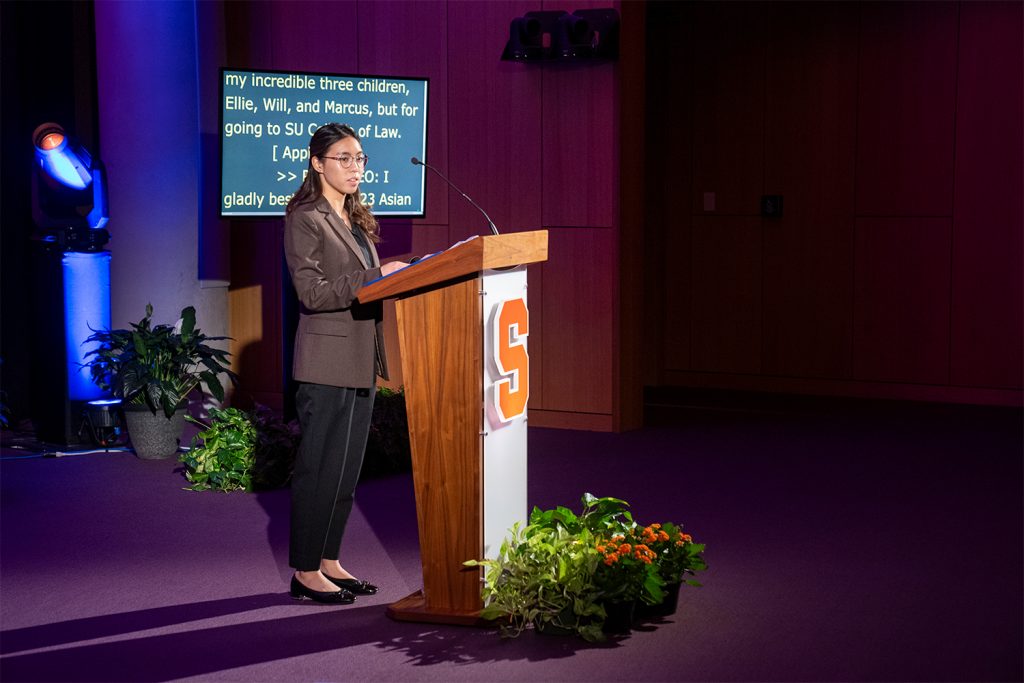
Lawyers at Bond, Schoeneck & King agree, as they have a job waiting for her after graduation. As a member of the firm’s intellectual property (IP) team, Capo will draw on her ILC experience to advise university spinouts, entrepreneurial start-ups, and blue-chip tech companies.
“Bond has an amazing track record of helping clients with patents and trademark registrations,” says Capo of the Syracuse-based law firm, which has offices up and down the East Coast. “My team also works high-profile cases involving patent and trademark infringement, unfair competition, and trade secrets.”
Capo will be in good company. Many of her future coworkers—patent attorneys and IP lawyers, mostly—have bachelors or advanced degrees in biology, chemistry, physics, and engineering.
“I anticipate a seamless transition,” says Capo, who currently spends one day a week at Bond in preparation for her new job. “Syracuse has prepared me well.”
Compassionate Professionalism
It was quite a leap from SUNY-ESF, where an elective in environmental law and policy forced Capo to rethink her career plans.
“Science can be black and white and have only one right answer. But with law, you can argue both sides. Sometimes the answer lies in how you present your case,” she continues.
It wasn’t until after SUNY-ESF, however, that Capo considered going to law school. A postgraduate internship with William Sawyer, a local forensic toxicologist who serves as an expert witness in the Monsanto Roundup lawsuits, helped her connect the dots between law and STEM (science, technology, engineering, and math).
Poring over Sawyer’s depositions, Capo was struck by their similarities with STEM research papers. She noticed that both followed the logic and structure of rules-driven writing.
“By then, the qualities of scientific writing had been drilled into me—clarity, cohesion, precision,” Capo continues. “Whether you’re a biologist or a lawyer, the rules of good writing apply.”
Case in point: Laura Lape and Rakesh Anand, who respectively teach IP law and constitutional law, are among Capo’s favorite professors. “They’ve taught me to think, read and write like an attorney—something I couldn’t have done without my STEM training,” admits Capo, who was the editor-in-chief of the Syracuse Journal of Science and Technology Law and secretary of the Intellectual Property Law Society.
Rudnick points to Capo’s involvement with the University’s Transactional Law Clinic, which provides legal services to small businesses, entrepreneurs, and startups, as proof of her compassionate professionalism, that she leads from her head and her heart.
“I’ve always been into giving back,” says Capo, who co-founded SUNY-ESF’s first food pantry and has volunteered for the Samaritan Center. “At Syracuse, I’m doing it on a bigger scale and, in the process, hopefully making a difference.”
It’s not just the law that draws students to the Innovation Law Center (ILC) at the College of Law. It’s the chance to apply the law to help others bring transformative ideas and inventions to life. “You’re working to create value for a company, for people, for yourself,” says Jack Rudnick L’73 who recently retired after directing the ILC for more than a decade.
Founded more than 30 years ago, the ILC was among the first experiential learning programs in the nation to teach intellectual property law by providing students opportunities to work with clients bringing a new technology to market. The commercialization process requires an innovation ecosystem, and students in the ILC become part of it, says Molly C. Zimmermann, managing director of the ILC-affiliated New York State Science & Technology Law Center.
“Technology commercialization takes a village. In addition to applying the law, you have to learn to make connections and access resources. Jack was all about that. He showed his students how to become part of the village to move a great idea from invention to innovation.”
“Innovation is not invention,” says Rudnick. “People misuse those terms all the time. Innovation is taking an invention and commercializing it, making money on it.” That process requires an understanding of the law and how to practice it in real life. And that’s what Jack Rudnick brought to the ILC when he started teaching and ultimately directing the program in 2013. “It was very academic at the time,” says Rudnick, who had taken his law degree from Syracuse in 1973 and spent four decades advising inventive companies like Welch Allyn and Blue Highway. When Rudnick signed on to teach at his alma mater, he became a most practical Professor of Practice.
The ILC program, which was first known as the Technology Commercialization Law Program, was founded in 1990 by Professor Ted Hagelin, a widely respected thought leader in the field. “Jack would say ‘Ted wrote the book, I lived the book,’” says Zimmermann. With decades of field experience under his belt, Rudnick shaped the ILC program to become a world-class resource for start-ups throughout the state of New York and beyond, with students helping hundreds of companies move through the commercialization process.
“We went from six projects to 60 projects that first year,” recalls Rudnick of the year he took the helm. “I wanted to show the students what it was really like in real life to multi-task and work hard and help people turn ideas into marketable and beneficial products.”
“Jack’s major contribution—and it’s a very significant one—was the change in the focus of the center,” says Christian “Chris” Day, professor of law emeritus. “He came with so much practical experience and it tremendously enhanced the student experience.”
Together, Day and Rudnick taught a first-of-its-kind general counsel course which was also steeped in practical learning. “We brought in a real galaxy of corporate attorneys to teach the course and challenge the students to come up with solutions to real-life problems faced by general counsels: employment problems, technology problems, intellectual property problems, and HR problems. The solutions are not just legal solutions.”
Similarly, Rudnick brought in an eclectic group of adjuncts to teach in the ILC, including scientists and engineers, a “wonderful mix of talent and a real gift to the law school,” says Day.
One of them is Dominick Danna ’67, ’71, who graduated from Syracuse University with degrees in chemistry and electrical engineering and brought decades of engineering experience in which he earned 36 patents to the classroom. Danna’s credentials are stellar and unique: He was a 1994 recipient of the prestigious Holley Medal from the American Society of Mechanical Engineers (ASME) awarded for “outstanding and unique act(s) of an engineering nature, accomplishing a noteworthy and timely public benefit.”
Danna and Rudnick met at Welch Allyn. Danna was in research and development. Rudnick was the corporate lawyer. They interfaced on lawsuits, taking on international companies to protect their inventions and figuring out creative ways to patent ideas for multiple uses and diverse industries. Today, Danna not only teaches in the law school; he teaches a course in the engineering school. “When I first started working as an engineer, I knew nothing about patents and contracts. I wish I did have that knowledge. It’s essential to know about ethics and contracts and patents and intellectual property.”
The interdisciplinary nature of the technology commercialization process is what attracts students from diverse backgrounds to the ILC. “Currently, one of our students is a French major; another is political science; they come from all over the country, and what they learn is to not be afraid of technology,” says Danna.
“The ILC worked for me because I was always a bit of a square peg in a round hole,” says Garin Murphy, who graduated in 2015 and is now Chief Business Officer and General Counsel at Orange Grove Bio, an early-stage biotech company creation and venture capital firm. “I grew up in an entrepreneurial family. My father was an engineer who became an entrepreneur, so I entered the law school with a business-focused lens, thinking I could focus on this skillset from the outset,” says Murphy. “Honestly, law school was initially disappointing because you were required to take a lot of courses as an entry point to the law, like torts and criminal law. During my 1L year, I questioned whether I should even be there. Then I met Jack and the light bulb went on. He changed the entire trajectory of my experience.”
Murphy says the normal course of law school studies can be a rather lonely experience for many students: “You’re very much on your own.” Zimmermann agrees: “A lot of law students find the experience isolating. Jack brought the ILC students on field trips, introduced them to experts, and organized social events which built connections. Learning from others—that’s Jack’s legacy. It was really energizing for them.”
Kaitlin Crobar L’21 recalls feeling bad for one of her law school peers who “just studied, studied, studied and didn’t even watch TV” whereas she, as an ILC student “worked with 20 different companies, engaging with other students and people outside the law school. We had so many more opportunities than other students because of Jack’s connections and approach.”
Rudnick truly took a personal interest in the success of his students and, for some, that was critical to building their confidence, a necessary quality for getting through law school and beyond.
“I was a non-traditional law student and had a rough time my first year,” says Heather Roark-Parker L’16, who came into law school with a background in biology and biotechnology. “Science came easy to me, but this was a whole new thing. Jack gave me the confidence that even though I might not excel in an academic area of the law, he knew what I needed to excel in the practical world. He basically convinced me that I wasn’t wasting three years of my life in law school!”
Though certainly the ILC students master the relevant legal knowledge governing patents and intellectual property, they also become incredibly proficient at researching, marketing, business writing, and communicating—factors critical to commercializing a product.
“You need that 360-degree approach in business, covering intellectual property, financing, market research, customer analysis,” says Murphy. “Ideas are a dime a dozen, but it’s the ability to execute on the idea that determines success. Many scientists and academics aren’t skilled at explaining exactly what they do. They like to live in that comfortable space in their head where the idea sits. That space between vision and reality is dangerous.”
Rudnick taught his students how to build that bridge between vision and reality for clients. They did the research and the work to determine if there was a market for their idea, what the competition was, how to explain it to potential funders in simple terms, and how to pivot from one idea to another if necessary.
“Nobody wants to hear their (tech) baby’s ugly or that their dog won’t hunt,” says Murphy, citing what his students call “Jackisms.”
“There was a lot of conversation when we had to tell clients their invention wasn’t likely to work, either because there were already active patents, or the regulatory requirements were prohibitive,” says Roark-Parker. “Jack encouraged us to confront the client with all the hurdles they would face, along with the opportunities.”
“When you deliver any message, it’s 10% the message, 50% body language, and the rest is in your tone,” says Murphy. “Jack taught us how to deliver a message in a palatable way.”
Rudnick says ILC graduates are “excellent communicators who form great interpersonal relationships. They can work with anybody and everybody. We had several individuals and companies come to us with a great idea. We showed them why it wouldn’t work, and how to pivot and move their invention forward in a different way.”
Crobar says she uses these skills daily as Innovation Commercialization Manager at the Zucker Institute for Innovation Commercialization in Charleston, SC. “We have researchers that do amazing work but if they publish early—and there’s intense pressure in academia to publish—they risk losing the chance to patent it. We help them figure out how to structure their research around ‘prior art,’ determine when to file for a patent, assist in obtaining monetary grants and investment to help pay for their research, and build a commercial plan that helps create value in their research innovations. And if we have to tell them ‘their baby is ugly,’ we explain the how, what, where, when, and why. Why there is no commercial path forward. How can we create value from where we are now? What can we find that they didn’t disclose in their published research or can we patent it for another disease or indication?”
ILC students are taught to figure out how to support inventors to succeed in the innovation ecosystem rather than “saying ‘no’.” “Jack was always client first,” says Roark-Parker. “He would go above and beyond for clients and remind us that no matter how much time it took, we should do it to benefit the clients.”
“A lawyer should avoid saying no,” says Danna. “In the engineering world, if you say you can’t do something, you won’t last long.” Rudnick taught his students how to “de-risk” ideas and be creative.
“You don’t do this alone. You do it together as a team with inventors, engineers, and others,” says Rudnick. “You will not be the sales prevention department. You’re not going to say ‘no.’ You’re going to say ‘how.’”
In cases where the students determined that a great idea just couldn’t be commercialized, Rudnick taught them how to help the clients “pivot and take inventions on a different path.” He recalls the case of an inventor who developed software for a drone to assess weather-related damage to roofing. The ILC students determined through a patent search that other companies had active patents and contracts with insurance companies to do the same thing. He recalled that when the students delivered the news, the client was bereft. But two weeks later, she came back with a new idea—to use the software for the placement of solar panels.
The invention became a successful innovation and spawned a company that is still in business today.
Rudnick’s kindness and generosity of time and spirit are cited by colleagues and students alike. “Commercialization can be cutthroat and competitive,” says Danna. “Under Jack’s leadership, I’ve never seen a dissatisfied client, even when we give them bad news.” “Jack is a very honest and honorable man,” says Day. “He’s a good model of what a good lawyer should be.”
“Not only did Jack help prepare students for the practice of law, but he mentored them to be good people,” says Brian Gerling L’99, who was invited by Rudnick to be an adjunct professor in the ILC and to succeed him as executive director in 2021. Gerling brought decades of experience in private practice in commercial and intellectual litigation to the classroom.
“Jack was a great steward of the program, particularly when it came to the resources provided to the program by New York State. I have big shoes to fill succeeding Jack, but he was a great mentor to me as well. Jack also taught that it wasn’t enough to be a good lawyer, and he gave his students advice on how to marry those two concepts—good lawyer and good people—imparting social and moral responsibilities to the students. They graduate inspired to make the world a better place.” Brian Gerling L’99
And they graduate with jobs—even before diplomas are in hand or the bar exam is passed. ILC students have a 100% job placement rate in the very careers they dreamed about. Sometimes career connections were made because of Rudnick’s vast network. Sometimes it was simply the reputation of the ILC. Danna recalls one student who was competing with students from Harvard and MIT for a job at a prominent Boston hospital. “The interviewer just wanted to know about the ILC coursework,” says Danna. The student got the job and started working before he took his bar exam.
“It’s a job course,” says Rudnick (another Jackism!). “When you come out of this course, you’re going to get a job. My students are really hard-working. They are smart, practical, and willing-to-dig-in-and-get-dirty-kids.”
And when they become successful, they pay it forward and reach back to help other students in the ILC. “I hire almost exclusively out of the program,” says Murphy. “I like to get interns or externs to engage with the management team, and I seek out the top students to work for my company. They’ve all been taught how to think differently, and that’s really important.”
Though retired as its director, Rudnick remains a senior advisor to the ILC, still connecting students to potential job opportunities, consulting with start-up companies, and contributing to the innovation ecosystem, ensuring that the “village that Jack built” is continuously expanding to help inventors, entrepreneurs, and companies turn ideas into solutions and accelerate innovation.
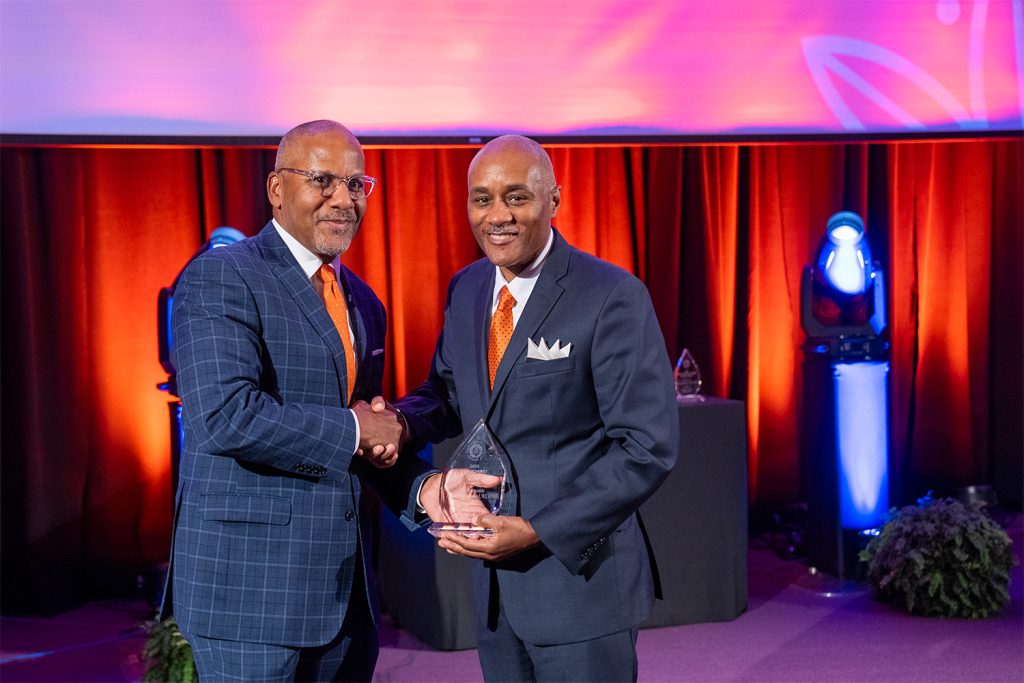
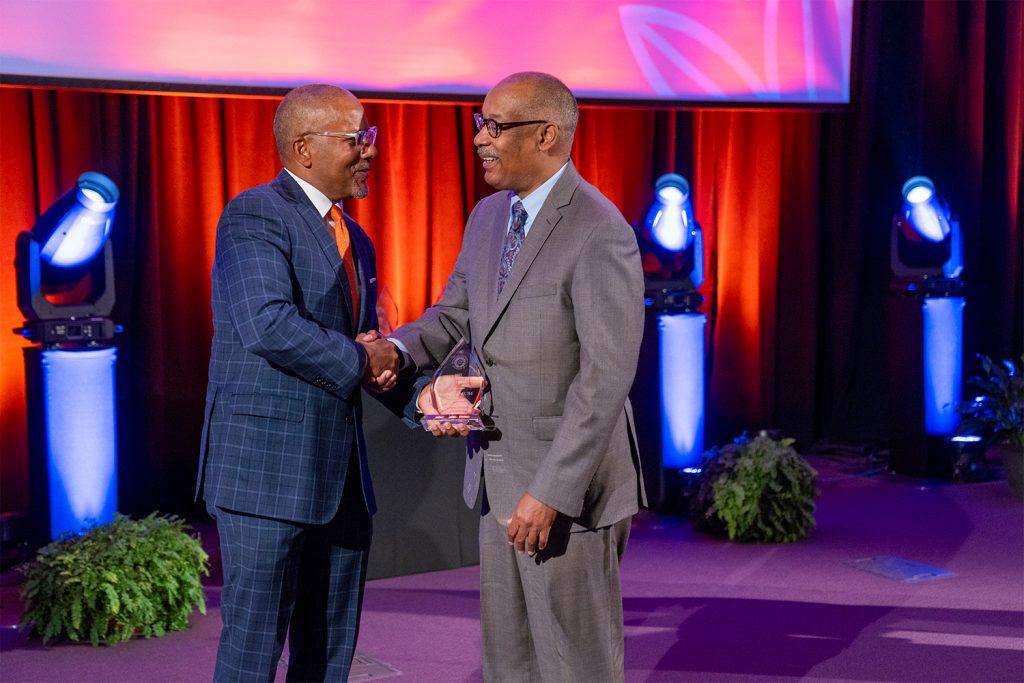
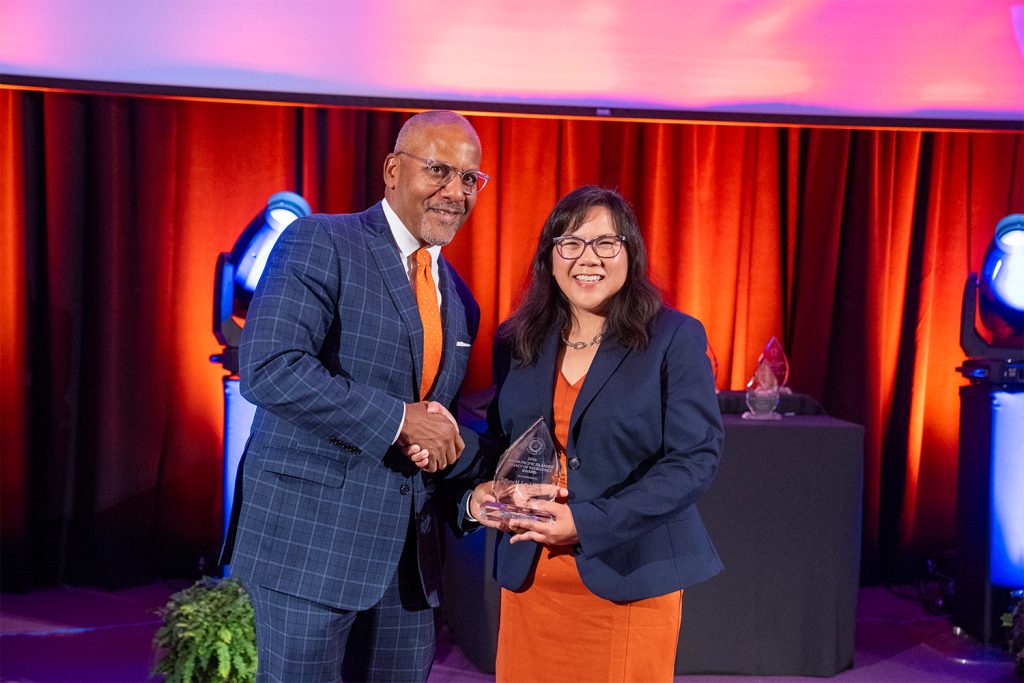
Jack Rudnick, left, received the George R. Burman Award for Entrepreneurial Leadership from the Whitman School of Management in 2016. Terry Brown, executive director of the Falcone Center for Entrepreneurship, presented him with the award.