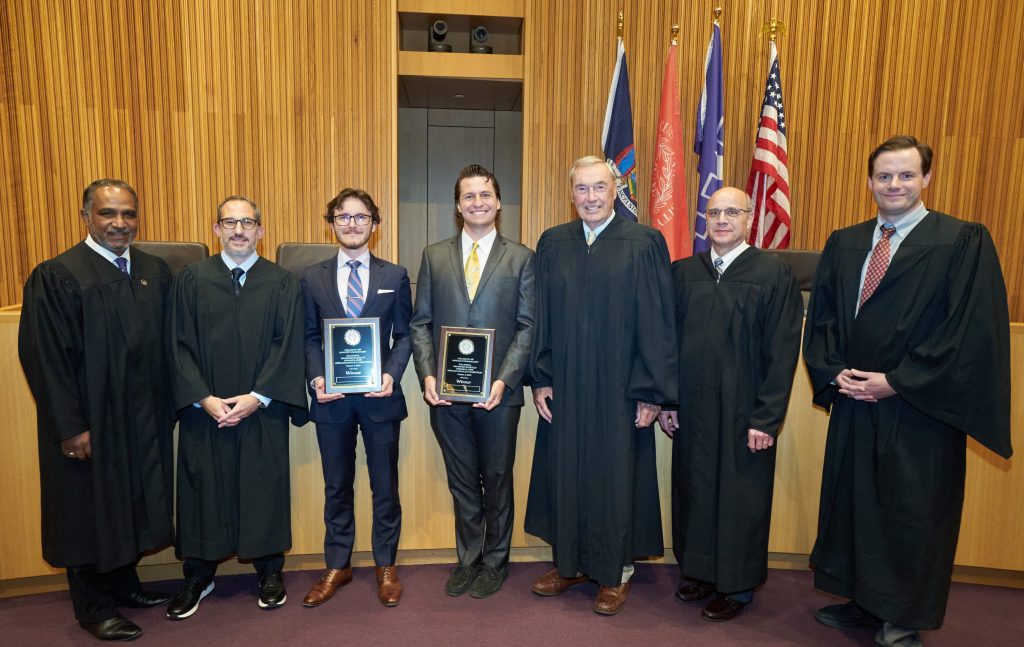
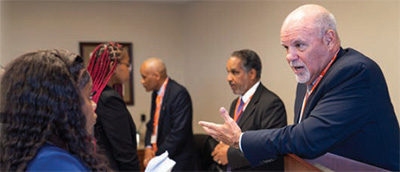
The team of 2Ls Nicholas Barrish and Nikolaus Merz prevailed over the team of 3L Christopher Beattie and 2L Katelin Koper in the final round of the Mackenzie Hughes LLP Edmund H. Lewis Appellate Advocacy Competition. Koper was selected Best Advocate and Beattie and Koper won Best Brief.
The final round was judged by the Hon. Frederick Scullin Jr. L’64, Senior U.S. District Judge Northern District of New York; the Hon. Andrew Baxter, U.S. Magistrate Judge for the Northern District of New York; the Hon. Ramon Rivera L’94, Court of Claims Judge, New York State Unified Court System; John Gilsenan, Assistant Federal Public Defender, Northern District of New York; and Professor Todd Berger, Director of Advocacy Programs at the College of Law.
Sponsored by Syracuse law firm Mackenzie Hughes LLP, this competition is open to two-person teams consisting of second and third-year Syracuse Law students. The competition is named for the Hon. Edmund H. Lewis L’1909, a distinguished alumnus of Syracuse University College of Law, a partner at Mackenzie Hughes, and a Chief Judge of the New York Court of Appeals. Each year, volunteer judges evaluate the teams’ written appellate briefs as well as oral argument performance through multiple rounds.
Overall, 10 teams of two students competed. Preliminary rounds were judged by Stephanie Hyde L’89, Nicole Macris L’18 Tom Taylor ’79, L’87, Neil Smith ’02, James Zino L’14, G’14, Laura Harshbarger L’97, Edwin (Pete) Frick L’13, Dean DiPilato, John Boyd II L’16, John Cirando, Judge Gerard Neri L’90, John Gilsenan, Judge Fred Scullin L’64, Judge Ramon Rivera L’94, and Judge Andrew Baxter.
David Katz L’17, John Boyd II L’16, and Professor Richard Risman graded the briefs.
The College of Law would like to thank all the judges and evaluators.
Judge Rivera, Professor Berger, Nikolaus Merz, Nicholas Barrish, Judge Scullin, Judge Baxter, John Gilsenan
The first recipient of a scholarship established in the honor of the Hon. Norman A. Mordue ’66, L’71 is 2L Tyriese Robinson.
The Northern District of New York (NDNY) Federal Court Bar Association (FCBA) Hon. Norman A. Mordue ’66, L’71 Law Scholarship provides a Syracuse University College of Law student with the means to pursue a legal education and follow in the footsteps of Judge Mordue, a decorated war hero who served as chief judge for the NDNY and taught trial practice at the College of Law as an adjunct professor. The NDNY FCBA established the scholarship after the passing of Judge Mordue in December 2022.
Robinson, a native of South Carolina, served in the U.S. Air Force. He was a GeoBase Engineering Technician and Lead Honor Guard Trainer at Joint Base Pearl Harbor-Hickam, Hawaii After the Air Force, Robinson completed his bachelor’s degree in psychology at Clemson University where he served as a U.S. Department of Veterans Affairs Federal Work-Study student, President of the Clemson Student Veterans Association, and in a number of volunteer roles across many campus initiatives.
After graduating from Clemson University, he selected Syracuse Law for his legal studies due to the University and College’s dedication to serving veterans.
“I decided to come to law school because I felt that there was tension between how my community viewed the law, and how the rest of the country viewed the law. I was already familiar with one aspect of the tension, so I decided to learn the other. I wanted to learn the law,” says Robinson.
At the College of Law, Robinson is a student attorney in the Betty and Michael D. Wohl Veterans Legal Clinic, a member of the Military and Veterans Law Society, and a volunteer with the Cold Case Justice Initiative.
Judge Mordue served as the senior U.S. District Judge for the Northern District of New York, where he was a judge from 1998 until his passing in December 2022. A 2022 recipient of the College’s Law Honors Award, Judge Mordue was awarded the Distinguished Service Cross for actions during the Vietnam War as a First Lieutenant in the U.S. Army.
When informed that he was receiving the Mordue Scholarship, Robinson reflected, “The astonishing things that Judge Mordue has done, both in uniform and on the bench, inspire humility. To me, being selected as the inaugural recipient of this scholarship means that I must continue to strive for excellence in honor of Judge Mordue’s legacy. Judge Mordue’s scholarship will serve as a valuable resource so that I can not only graduate but graduate in a manner that upholds the dignity and reputation of Syracuse Law,” says Robinson. Upon graduation, Robinson plans to become a prosecutor.
The scholarship will be awarded during a tailgate celebration held at the College of Law Saturday morning before the Syracuse Orange takes on the Army West Point Black Knights in football at the JMA Wireless Dome on September 23.
The ambition to make the world a better place is a common characteristic among Tillman Scholars. Some aim to have far-reaching global impact while others want to address problems in their local communities. For U.S. Army Captain Luis “Lu” Weierbach L’24, that ambition comes from experiencing poverty at a young age.
She is the administrative judge overseeing operations of trial courts in the six counties of the Fifth Judicial District: Herkimer, Jefferson, Lewis, Oneida, Onondaga, and Oswego counties. Judge Karalunas fills the vacancy left by Judge James P. Murphy L’84, who was recently named deputy chief administrative judge for courts outside of New York City.
In a statement, Judge Karalunas says, “I am humbled and honored that Chief Administrative Judge Zayas, together with Chief Judge Wilson and Presiding Justice Whalen have entrusted me to oversee the daily operations of the trial courts in the Fifth Judicial District. I look forward to supporting and collaborating with the dynamic leadership of the New York Courts, including First Deputy Chief Administrative Judge Norman St. George, Deputy Chief Administrative Judges James P. Murphy, Edwina Richardson-Mendelson, and Deborah Kaplan, and the entire court family to deliver equal and timely justice to our diverse constituents.”
Judge Karalunas was first elected to the Onondaga County Supreme Court bench in 2002. She was re-elected in 2016 and has served as the presiding justice of the county’s Supreme Court–Commercial Division since 2007.
Prior to becoming a judge, Judge Karalunas was a partner at Bond, Schoeneck & King. She began her legal career as a law clerk to Chief Judge Howard G. Munson of the U.S. District Court in the Northern District of New York.
She obtained a Bachelor of Arts degree from Cornell University in 1978 and graduated cum laude from Syracuse University College of Law in 1982. At the College of Law, Judge Karalunas was a member of the International Law Review, Moot Court, and Justinian Honor Society.
The College of Law recently held a virtual swearing-in ceremony for summer semester student attorneys in the Betty and Michael D. Wohl Veterans Legal Clinic (VLC) with U.S. Court of Appeals for Veterans Claims Judge Grant Jaquith.
“The College takes pride in its robust experiential education programs, which include clinics that allow students to practice in a wide variety of substantive areas of the law,” says Professor Beth Kubala, Executive Director of the VLC. Student attorneys apply complex legal doctrine to real-life matters while interviewing and counseling clients, drafting motions, briefs, contracts, and many other documents, and representing clients in court proceedings and in other transactional matters.
The VLC provides representation to veterans and their families who are seeking benefits from the U.S. Department of Veterans Affairs or upgrading an unfavorable discharge through the various military services. While representing real clients, student attorneys gain an understanding of military culture, interact with government agencies, develop case management skills, improve advocacy skills, and instill the value of pro bono service.
Before the oath, Judge Jaquith, an Army veteran, shared that veterans benefit from having the advice, assistance, and advocacy of a lawyer that nearly always sharpens the identification and presentation of relevant facts and applicable of law, hastens resolution, and increases the likelihood of an appropriate outcome.
Judge Jaquith said, “There is a real need for your help and a real opportunity for you to gain valuable experience and make a real difference for Soldiers, Sailors, Flyers, and Marines who have sacrificed their health in military service as well as the spouses and family members that have depended on them.”
The ceremony concluded with Judge Jaquith administering the oath in which the student attorneys promised to abide by the rules of professional responsibility and courageously represent their clients. All students are part of the JDinteractive program.
Clinic students discussed the summer clinic experience.
“I wish that I would have started with the clinic earlier. These veterans are so grateful for the assistance and have waited unacceptable amounts of time to be compensated for their sacrifices. This experience allows you to sharpen your research skills, advocacy skills, client counseling skills, and record maintenance skills. I am more confident and prepared for my future legal career because of my time spent in the clinic this semester.” 2L Joe Jasper.
“Although I entered the ceremony feeling somewhat unqualified to take the oath, after hearing Judge Jaquith speak passionately about the tremendous unmet need and potential impact we, in the Veteran’s Legal Clinic could make in the lives of our vets, I proudly spoke the words of the oath feeling honored to be given this opportunity to make a real difference.” 2L Gina Bilotti.
“It was an honor to have Judge Jaquith take the time to speak to our clinic and conduct the student swearing-in ceremony. His insights as to the role of the court in the overall process of a veteran’s claim will be valuable as we advocate for our clients. Those were remarks I won’t forget. Reciting the oath before him really highlighted the impact that we can have on a veteran’s future by helping them navigate the legal/administrative process.” 2L Seth Owens.
“This group of students tonight raised their right hand and swore to zealously represent our community’s veterans. Here at the College of Law, we are proudly training the next generation of veteran advocates,” says Kubala. “These students are directly impacting the way we treat our veterans, and programs like this reflect the College of Law’s commitment in making Syracuse University the Best Place for Veterans.”
The Pat Tillman Foundation has announced its scholars for 2023, including College of Law student 2L Luis Weierbach.
Prior to enrolling at the College of Law, Weierbach attended West Point and was later commissioned as an active-duty infantry officer, became airborne qualified, led a light infantry platoon in Thailand and Korea, and served as a company executive officer and battalion logistics officer.
A New York State wrestling champion in high school, Weierbach seeks to bring his passion for his fellow soldiers and young athletes to his future career in law. He plans to continue his life of service as an advocate in the courtroom for soldiers and an ambassador of healthy outlets like wrestling to underserved youth, encouraging participation in non-profits such as “Beat the Streets” to prevent them from entering the justice system and staying on the right path.
“I believe that we are as strong as our weakest moment and the grit we summon to wrestle through it,” Weierbach states.
As a Pat Tillman Foundation University Partner for the last five years, Syracuse University proudly supports its Tillman Scholars. The Program unites and empowers remarkable military veterans and spouses as the next generation of public and private sector leaders committed to service beyond self.
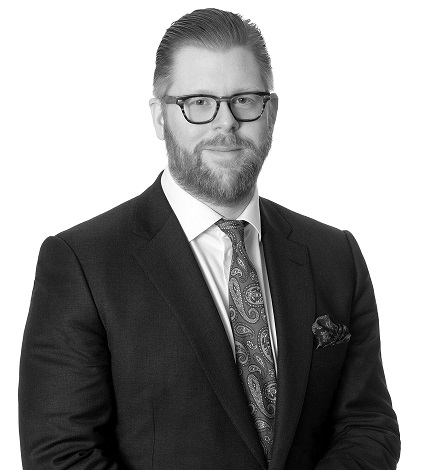
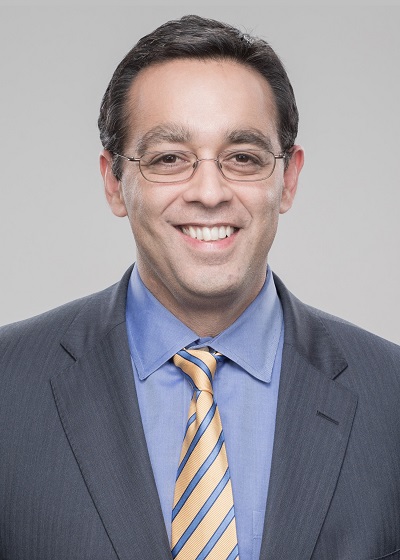
Syracuse University College of Law has added James L. Kelly L’99, Partner and Chair, New York Private Equity at DLA Piper, and Sandeep (Sandy) Qusba L’94, Partner and Head of the Restructuring Practice at Simpson Thatcher & Bartlett LLP, to its Board of Advisors. Kelly and Qusba will strengthen the College’s Board with their extensive legal and leadership experiences.
“James and Sandy are highly accomplished attorneys who bring to our Board deep knowledge of the legal industry and an understanding of the skills that new attorneys need to achieve their goals,” says Dean Craig M. Boise. “I look forward to working with them. Their insights into the profession will help steer our academic programs in support of our mission.”
“On behalf of the Board, I want to welcome James and Sandy,” says College of Law Board of Advisors Chair Melanie Gray L’81. “As lawyers and leaders at two of the world’s largest and most respected law firms, James and Sandy are shining examples of the heights that Orange lawyers reach and serve as inspiration for our students.”
James Kelly
James Kelly focuses his practice on representing private equity funds in all aspects of their investment activities. He is recognized by The Legal 500 US in Private Equity Buyouts and has been recognized for numerous consecutive years by Chambers in New York M&A. Kelly graduated from Syracuse University College of Law magna cum laude where he was Lead Articles Editor for Syracuse LawReview and received the Order of the Coif. He received his B.A. from the University of Washington.
Sandeep (Sandy) Qusba
Sandeep (Sandy) Qusba focuses on restructurings, bankruptcies, acquisition of distressed companies, and bank financings. He has represented private equity sponsors, special committees of boards and portfolio companies, agent banks, steering committees, and official and ad hoc committees and creditors in some of the largest Chapter 11 proceedings and out-of-court restructurings in recent years across a wide range of sectors, among them media, real estate, healthcare, energy, automotive, manufacturing, and telecommunications.
Qusba was recently named an “Outstanding Restructuring Lawyer” by Turnarounds & Workouts and has also been inducted as a Fellow of the American College of Bankruptcy.
Qusba received his J.D. cum laude from Syracuse University College of Law and his B.A. from Tufts University. He served as a law clerk for Chief Judge Stephen D. Gerling in the U.S. Bankruptcy Court of the Northern District of New York.
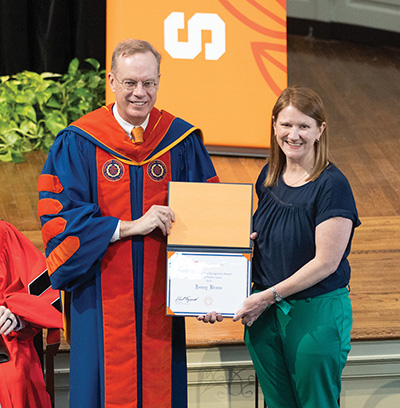
Associate Professor Jennifer Breen Recognized by Syracuse University with a Laura J. and L. Douglas Meredith Teaching Recognition Award
Associate Professor Jennifer Breen received a 2022-23 Laura J. and L. Douglas Meredith Teaching Recognition Award for Early Performance in recognition of her excellence in teaching. The awards were created in 1995 to recognize and reward outstanding teaching among faculty in two categories: Early Performance and Continuing Excellence. Breen was selected for this award upon the recommendation of a committee of Meredith Professors, Teaching Recognition Awardees, and student representatives.
Breen teaches Constitutional law, administrative law, and labor law. Her interdisciplinary scholarship is centrally concerned with democratic governance in the United States and pays particular attention to the roles of gender and labor politics.
She has recently completed or is working on several new articles including “Democratic Erosion and the United States Supreme Court” (forthcoming Utah Law Review, spring 2024), “Democracy, Republicanism, and the Roberts Court” (work in progress), and “Labor Unions and Public Health Outreach” (with Gretchen Purser, Syracuse University Associate Professor of Sociology).
Professor Arlene Kanter Receives a Chai Feldblum Award from the AALS Section on Law Professors with Disabilities and Allies‘
Professor Arlene Kanter, Director of the Disability Law and Policy Program, received a Chai Feldblum Award from the AALS Section on Law Professors with Disabilities and Allies at the American Association of Law Schools (AALS) 2023 Annual Meeting.
The award is named after Chai Feldblum J.D., an EEO and DEI consultant, Partner and Director of Workplace Culture Consulting at Morgan Lewis, and former Commissioner of the U.S. Equal Employment Opportunity Commission. This is the third year the award has been given.
Kanter’s nomination letters note that she is “an influential scholar, innovator, and leader,” and that students and colleagues often conveyed their personal thanks for her advocacy on their behalf.
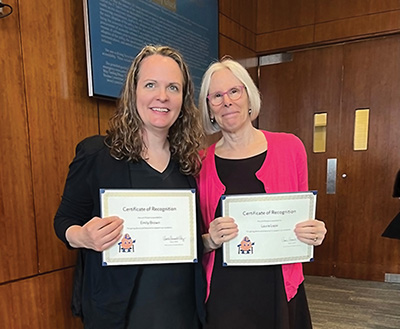
Professors Emily Brown L’09 and Laura Lape Honored at the Center for Disability Resource’s Faculty and Staff Recognition Ceremony
Professors Emily Brown L’09 (pictured left) and Laura Lape both received honors at the 9th Annual Faculty and Staff Recognition Ceremony. Hosted by the Center for Disability Resources, the awards are presented to individuals who have exceeded expectations and embrace a culture of empowering students, inclusion, and celebrating disability as diversity.
Brown, nominated by 2L Elle Borgdorff, and Lape, nominated by Jessica Senzer L’23, said they found it moving to attend the ceremony and see how much inclusive practices mean to students across campus.
Professor Mary Helen McNeal Retires after Over 30 Years of Teaching
Professor Mary Helen McNeal taught her last class for the College of Law on Thursday, April 20, capping more than 30 years as a professor with the last 18 years at Syracuse Law. She founded the Elder and (later the Elder and Health Law Clinic) Law Clinic in 2008 and served as the Director of the Office of Clinical Legal Education from 2005 until 2011. Most recently, she served as the LondonEx Program Director and taught professional responsibility.
Her research and writing focus on elder law, with a particular emphasis on Medicare, clients with diminished capacity, restorative justice and elder abuse; culture and lawyering; and clinical teaching.
McNeal participates in the Syracuse area Elder Justice Task Force and the CNY Restorative Practices Working Group and was Chair of the Aging and the Law Section of the Association of American Law Schools (AALS) in 2021. She previously served on the AALS Clinical Section’s Task Force on the Status of Clinicians in the Academy, on the AALS Equal Justice Task Force, and as Chair of the Clinical Section. She also has worked extensively on equal justice issues and served as Chair of the Montana Supreme Court’s Equal Justice Task Force and as a member of the Montana State Bar’s Access to Justice Committee. McNeal also has participated as an ABA site inspection team member.
The College of Law offers a sincere thank you to Professor McNeal for her service over the years and the spectacular impact she has made on countless students for their professional lives and individuals who may otherwise not be able to obtain critical legal services.
Her well-earned retirement will enable her to pursue her many other interests, including traveling, hiking, and spending time with her family and her beloved dog Rosie.
Professor Kathleen (KC) O’Connor Retires After Over 20 Years at the College of Law
Professor Kathleen (KC) O’Connor retired from the College of Law after more than 20 years of teaching and mentoring Syracuse Law students.
O’Connor joined the College of Law faculty as a Legal Writing Professor in 2002. She came to the College with solid practical experience in private practice and at the U.S. Attorney’s office. In 2008, she was recognized by the University with the Meredith Teaching Recognition Award for excellence in classroom teaching.
In addition to her classroom assignments, O’Connor played many leadership roles at the College of Law. She served as interim director of the Legal Communications and Research program and, from 2015 to 2018, as the faculty director of the Moot Court Honor Society. In that role, O’Connor was instrumental in reshaping the advocacy program into the Travis H.D. Lewin Advocacy Honor Society.
Her most lasting accomplishment at the College was in launching and piloting JDinteractive, first as Executive Director of Online Education alongside Professor Nina Kohn and then as Associate Dean of Online Education. With her guidance, the College of Law successfully established the program as the leading online JD program in the United States.
Professor of Law, Associate Dean for Clinical and Experiential Education Syracuse University College of Law
Our College of Law Community mourns the passing of Professor Deborah Kenn on April 20, 2023. Professor Kenn served as the Associate Dean for Clinical and Experiential Education and the Director of the Community Development Law Clinic for many years. She will be remembered as a passionate educator and mentor to hundreds of students and a relentless advocate for our community.
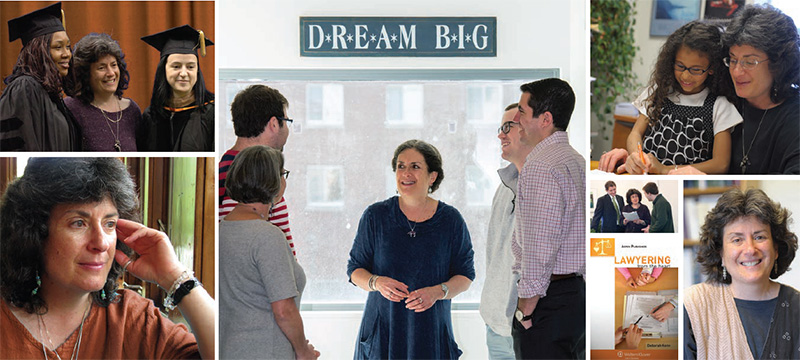
Deborah (Orah) Kenn, 67, of Nelson, NY died at home in the presence of family and friends on April 20, after a courageous seven-year journey with leukemia. Born in NYC and raised in Fort Lee NJ, she spent her adult life in Syracuse and Nelson. She obtained a B.A. from Eisenhower College, and a J.D. degree from SUNY Buffalo. Initially practicing environmental and animal rights law in NYC, she then worked in poverty law with Legal Services in Syracuse. Subsequently, Deborah was employed at Syracuse University starting in 1989, initially as a law professor to direct the Community Develop Law Clinic. She was then appointed as Director of Clinical Legal Education Office, and most recently served as Associate Dean of Clinical and Experiential Education at the Law School. She also led three student trips to South Africa to study the post-Apartheid legal system in that country. Throughout her legal and academic career, Deborah was a passionate advocate for social, environmental and economic justice, for animal rights, and for compassionate lawyering. She is the author of Lawyering from the Heart, and co-author of Community Economic Development Law. Deborah also served the Nelson community as a member of the Town of Nelson Town Board.
Her energy and dedication for living was shared with her family, a wide circle of friends, her animals, her students and her colleagues. Her interests included gardening, word puzzles, hiking, traveling, reading, cooking and dining out. She also found comfort, wisdom and strength from the natural world.
College of Law Holds Commencement for Class of 2023
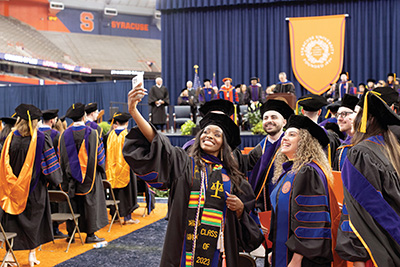
On Friday, May 5, the College of Law held Commencement for its 182 J.D. and 22 LL.M. Class of 2023 graduates.
Senior Vice President, General Counsel and Corporate Secretary at Micron Technology Rob Beard delivered the 2023 commencement address. Class President Ryan Ockenden offered remarks to the Class of 2023, followed by Ludmilla Evelin de Faria Sant’Ana Cardoso as the LL.M. SBA representative.
Professor Todd Berger received this year’s Res Ipsa Loquitur Award, given to a faculty member for “service, scholarship, and stewardship” to the students. Professor Antonio Gidi was voted by the LL.M. class of 2023 as the recipient of the Lucet Lex Mundum Award for his significant impact on the successes and experiences of the LL.M. students during their studies.
Beard offered words of advice and wisdom to graduates, inspiring them to make their own luck and be the best and most genuine version of themselves. He emphasized the importance of teamwork and relationships as a key component of a successful career, explaining, “Relationships have been central to each major step in my career. They were the introductions to new opportunities that broadened and shaped my path. And many times, these people were great coaches — they emphasized and highlighted qualities I had and encouraged me to have the confidence to step into the next role. Relationships are central to everything in life.”
College of Law Advocacy Program’s National Trial League Recognized by Bloomberg Law’s Law School Innovation Program
The College of Law proudly celebrates its Advocacy Program’s National Trial League (NTL) as among the top-scoring entries in the Student Development category of Bloomberg Law’s Law School Innovation Program.
The College of Law created and launched the NTL in 2021 as a new trial competition that brings together 12 top national law school trial teams to compete in a season-long format resembling a traditional sports league. The bi-weekly matches are conducted virtually using short fact patterns.
The NTL is composed of two conferences of six teams. The teams compete in bi-weekly matches through seven rounds in their conference and in one cross-conference match. The top two teams from each conference advance to the playoffs. This year, the championship match was held in person at Syracuse University College of Law.
“The College of Law is honored to be recognized by Bloomberg Law in the Student Development category for our nationally ranked Advocacy Program’s National Trial League,” says Dean Craig M. Boise. “At its heart, the NTL is a dynamic experiential opportunity for aspiring trial lawyers across the country to hone their advocacy skills in the courtroom, under conditions that simulate the pressure of appearing before a bench of judges.”
Explains NTL organizer Professor Todd Berger, Director of Advocacy Programs, “Before the NTL, inter-collegiate trial competitions occurred over the course of a few days and featured long, complex fact patterns. Most real-world trials involve much shorter fact patterns and are conducted over a few hours, particularly bench trials.”
The College of Law’s Innovation Law Center also received recognition from Bloomberg Law as a high-scoring program in the Innovation and Experience category (see article on page 14.)
Bloomberg Law’s Law School Innovation Program identifies, recognizes, and connects law school faculty, staff, and administrators who are pioneering educational innovations that benefit their students, their schools, and the legal field. Through the Law School Innovation Program, Bloomberg Law seeks to acknowledge these innovators while raising overall awareness of innovation in legal education.
Orange Advance Summer Residency Program
The College of Law welcomed a cohort of undergraduate students from the Atlanta University Consortium Center (AUC) for the Orange Advance Summer Residency program in May. These students interested in pursuing a law degree spent the week learning about the legal profession and how to prepare for law school with a full slate of academic, social, and cultural events.
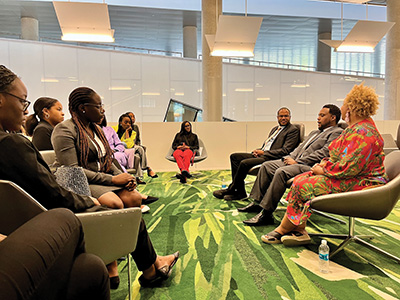
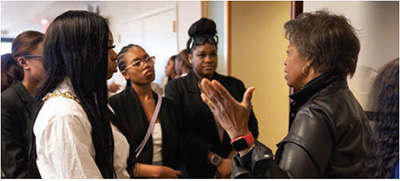
Benita Miller L’96, Executive Director Powerful Families, Powerful Communities NJ, (pictured on the right, closest to the camera) held a discussion with the Orange Advance students about different career paths you can take with a J.D.The Hon. Vanessa Bogan, Syracuse City Court Judge, speaks with Orange Advance students at a networking event at Bond, Schoeneck & King PLLC.The Hon. Rodney Thompson G’93, L’93 (pictured top left), New Jersey Family Court Presiding Judge for Mercer County, NJ, the Hon. Ramon E. Rivera L’94, Court of Claims Judge, New York State Unified Court System, and the Hon. Glenn T. Suddaby L’85, United States District Judge for the Northern District of New York provided students with college, career, and life wisdom and lessons.