Around Syracuse Law

College of Law Welcomes Seven LL.M. Students in Spring 2022 Cohort

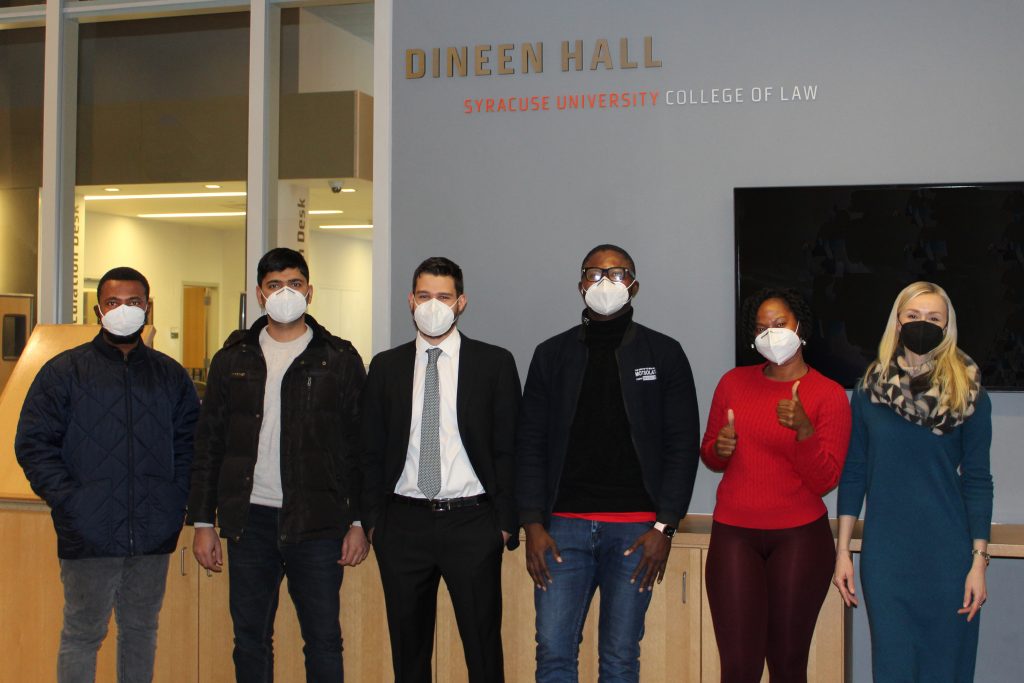
Christian Oko, Ahmad Riaz, Francisco De la Parra Villanueva,
Noel Omeji, Dessi-Ann Yetman, Lotta Lampela

In January 2022, the College of Law welcomed a new cohort of seven international students enrolled in the Master of Laws (LL.M.) program.

“Despite the continued barriers and uncertainties caused by the coronavirus pandemic, this new spring cohort includes foreign lawyers representing the legal systems of six countries,” says Assistant Dean of International Programs Andrew S. Horsfall L’10. “These students come from very diverse backgrounds and expanses and have wide-ranging professional interests.”

The LL.M. cohort will maintain its wide reach across time zones and locations with students from Ethiopia, Finland, Jamaica, Mexico, Nigeria, and Pakistan. These new students will join the 34 returning LL.M. students who began their studies this past fall and spring along with four

S.J.D. students, and five Visiting Scholars.

In addition, the LL.M. students and visiting scholars will receive advising support from International Programs Academic Coordinator Kate Shannon and LL.M. student mentors Marisol Estrada Cruz, Mazaher Kaila, Anthony Levitskiy, Carlos Negron, and Tia Thevenin.

LL.M. Spring 2022 Cohort

Francisco De la Parra Villanueva (Mexico): De la Parra completed his LL.B. at the Instituto Tecnológico Autónomo de México (ITAM) in 2021. As an undergraduate, he participated in two clinics: the Sustainable Development and Environmental Law Clinic, and the Clinic for the Improvement of Labor Justice. De la Parra also held several internships that focused on corporate and banking law.

Lotta Lampela (Finland): Lampela holds both a Bachelor’s and Master of Arts in History from Oulu University in Finland. She also holds an LL.M. in International Law from Helsinki University. She was the chief superintendent of the Finnish Security Intelligence Service and an intelligence advisor for the EU Intelligence Analysis Centre. Before recently moving to the U.S., Lampela served as a policy advisor for the Delegation of the European Union to the International Organizations in Vienna where she represented the EU and its member states at the UN Office of Drugs and Crime and the Commission on Narcotic Drugs. She plans to enroll in courses that will prepare her for the New York Bar Exam.

Christian Oko (Nigeria): Oko received an LL.B. from the University of Nigeria Nsukka in 2019. Since graduating, he has worked as a legal consultant for the Sunset Football Club and an intern at the Nigerian Football Association where he focused on alternative dispute resolution. Oko plans to enroll in courses that will prepare him for the New York Bar Exam.

Noel Omeji (Nigeria): Omeji completed his LL.B. at Kogi State University in 2014 and graduated from the Nigerian Law School in 2016. He also completed an LL.M. in Private and Commercial Law at Bayero University. He has been a prosecutor with the Nigerian Police Force since 2017. Omeji will study tax law, ADR, and coursework that will prepare him for the New York State Bar Exam.

 Ahmad Riaz (Pakistan): Riaz holds an LL.B. from the University of Punjab, Lahore. Since graduating in 2015, he has worked as a legal associate at a private law firm. He intends to study family law, criminal procedure, and civil procedure.

Savior Welu (Ethiopia): Welu holds an LL.B. from Mekelle University and an LL.M. in Public International Law from Addis Ababa University. As an undergraduate, he interned at the Mekelle University Legal Aid Center where he drafted pleadings on criminal and civil cases. Most recently, Welu has served as a law lecturer at Aksum University in Ethiopia where he teaches international law, refugee law, African Union and human rights law, and business law.

Dessi-Ann Yetman (Jamaica): Yetman obtained her LL.B. from the University of the West Indies in 2018. She plans to study family law and immigration law.

Spring 2022 Visiting Researchers

Carlos Higino Ribeiro de Alencar (Brazi): Professor de Alencar works as a Tax Auditor for Brazil’s Internal Revenue Service under its Ministry of Economics. He is also pursuing a Ph.D. through a joint degree program with the University of Brasilia and the University of Paris, Paris 1, at the Sorbonne. During his visit, he is pursuing comparative research on the evolution of anti- corruption legislation using the American model and other sources, under the guidance of Professor Antonio Gidi.

Natalia Chernicharo Guimaraes (Brazil): Professor Guimaraes teaches civil procedure at University of Juiz de Fora. She is researching comparative civil procedure and class actions, under the guidance of Professor Antonio Gidi.

Satoshi Kawashima (Japan): Professor Kawashima teaches at Okayama University of Science and Kanagawa University’s Graduate School of Law. During his visit, he will pursue the study and research of U.S. disability rights laws, including the Americans with Disabilities Act, Section 504 of the Rehabilitation Act, and the Individuals with Disabilities in Education Act under the supervision of Professor Arlene Kanter.

Kihan Lee (South Korea): Professor Lee teaches at Dankook University’s Faculty of Law. He is also Chair of the Korea Social Service Policy Institute. He will engage in the study and research of comparative environmental regulation, with specific focus on the United States and South Korea, and economic and legal efforts to combat climate change under the guidance of Professor David Driesen.

Levan Nanobashvili (Georgia): Nanobashvili is a Fulbright Teaching Scholar and a practicing intellectual property lawyer in Georgia. He plans to engage in the study and research of intellectual property law, internet law, and the teaching methods and pedagogy of these subjects under the guidance of Professor Shubha Ghosh.

Patricia Pizzol (Brazil): Professor Pizzol teaches class actions and civil procedure at Pontificia Universidade Catolica de São Paulo. She will undertake a comparative study of class actions and methods of standardizing judicial decisions, under the guidance of Professor Antonio Gidi.
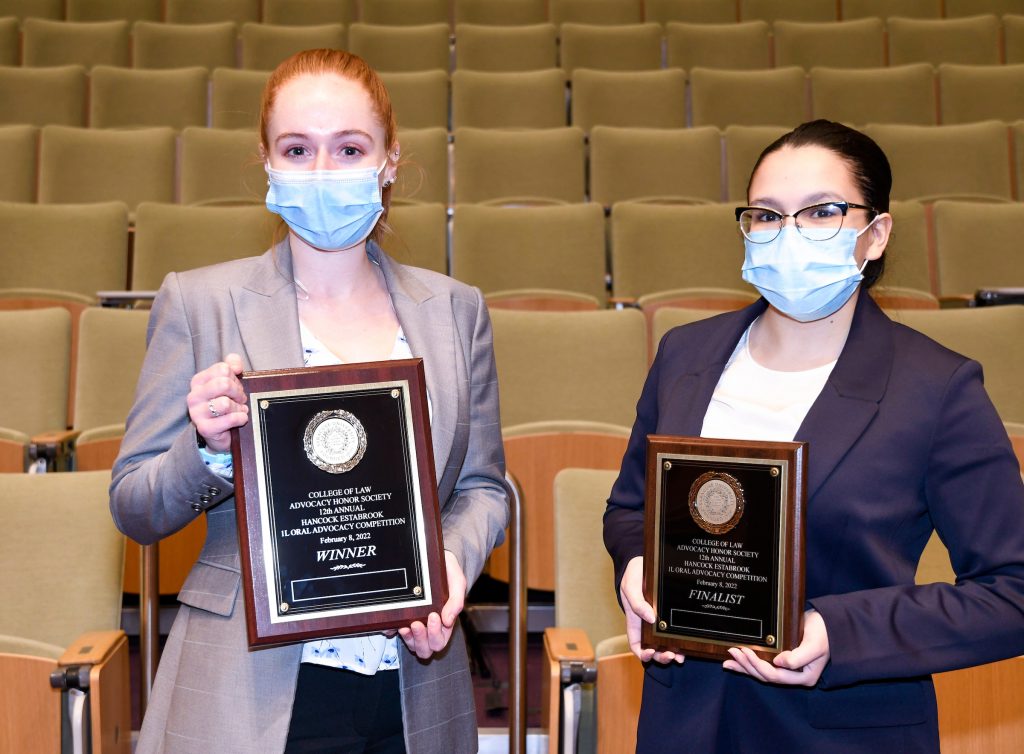
Mikayla Barrett wins 12th Annual Hancock Estabrook LLP 1L Oral Advocacy Competition

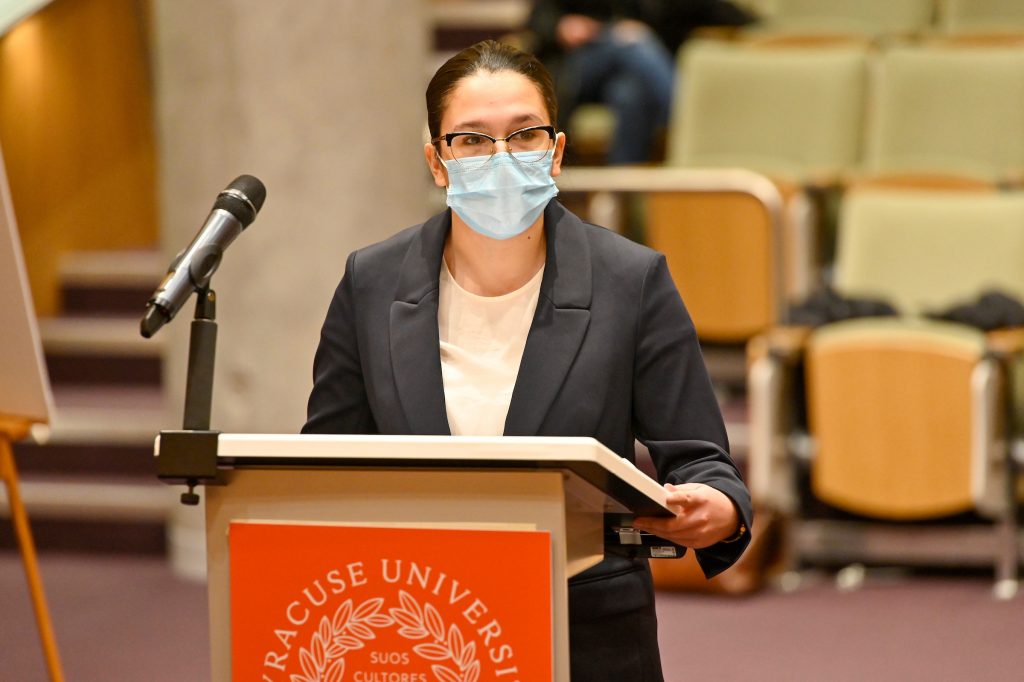
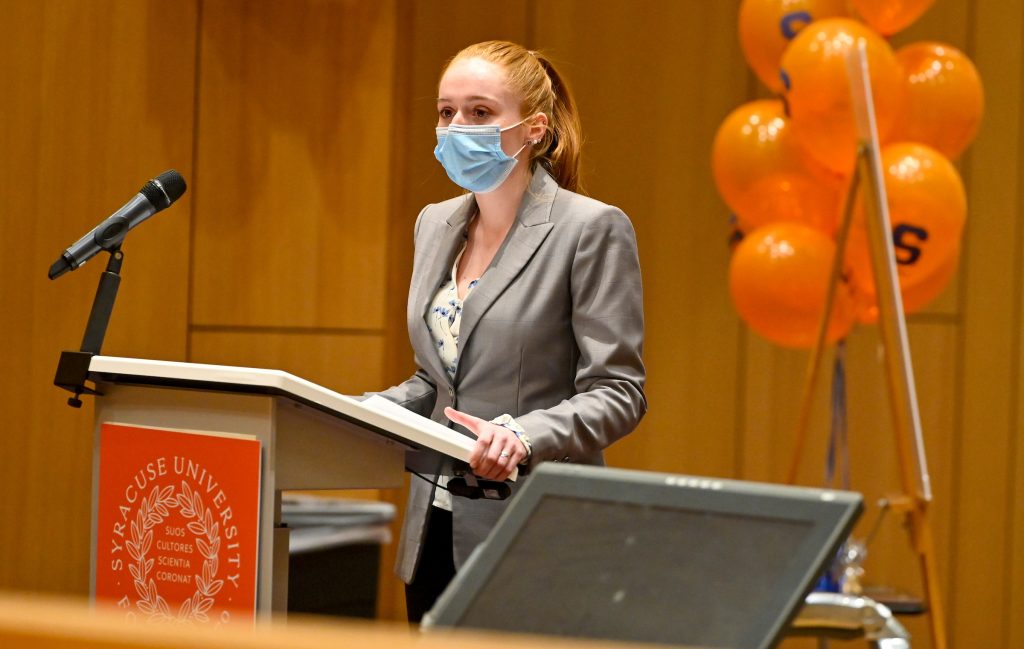
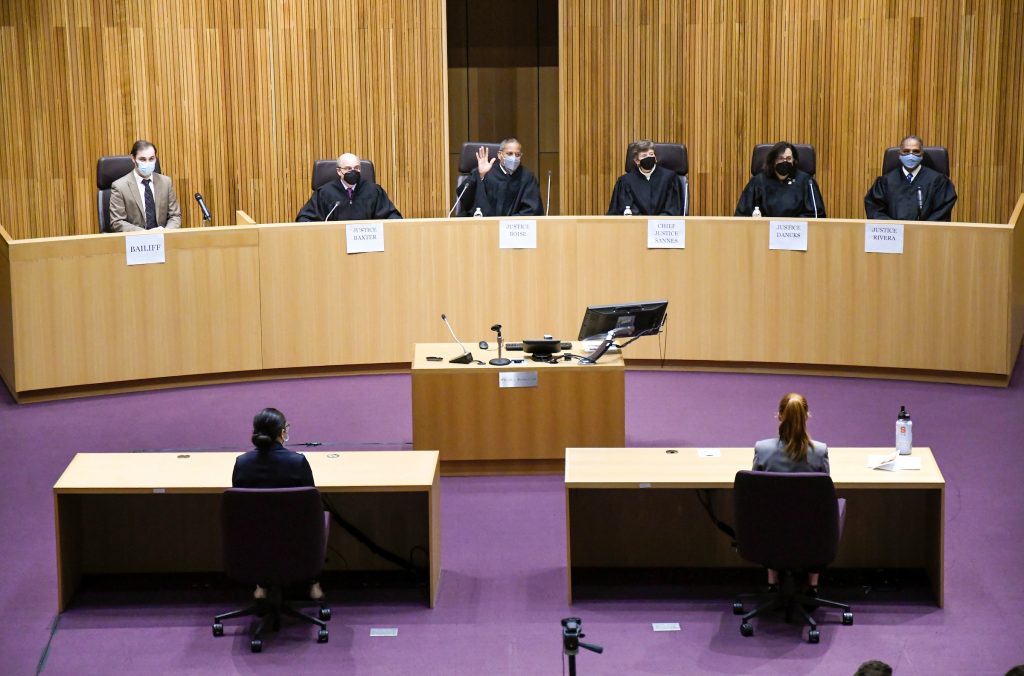
Congratulations to Mikayla Barrett who won the 12th Annual Hancock Estabrook LLP 1L Oral Advocacy Competition! She triumphed over finalist Nikita Norman in the final round on Feb. 8, 2022. Overall, 38 1L students competed.

Barrett is from Rotterdam Junction, NY, and has a B.S. in Political Science from SUNY Plattsburgh. Although she hasn’t finalized her career path, Barrett is interested in criminal justice and medical/health law.

Norman is from Eagle Bridge, NY, and has a B.S. in Criminal Justice from SUNY Oneonta. She is a Law Ambassador for the Office of Admissions and a member of the First Generation Law Students Association.  Norman is interested in civil litigation and family law.

Barrett argued for the Petitioner and Norman for the Respondent in Theresa Vanderpump v. Bravo Quick Care, Inc. The case problem concerned Vanderpump losing her job after receiving a text message from the medical clinic Bravo Quick Care that revealed her failure to comply with pandemic-related policies. Competition Director 3L Gabriella Kielbasinski introduced this state law tort claim for invasion of privacy and statutory claim under the Telephone Consumer Protection Act case problem.

The final round was judged by Hon. Andrew T. Baxter, US Magistrate Judge for the Northern District of New York; Hon. Thérèse Wiley Dancks L’91, US Magistrate Judge for the Northern District of New York; Hon. Ramón E. Rivera L’94, New York State Court of Claims Judge; Hon, Brenda K. Sannes, US District Judge for the Northern District of New York; and College of Law Dean Craig M. Boise.

The College of Law thanks Hancock Estabrook LLP, who since 2013 has generously sponsored this important opportunity to introduce basic oral argument skills and the art of preparing and delivering an argument.

All photos by Mike Roy Media.

Syrian Accountability Project Releases “The 2022 Winter Olympics and Genocide: A History of Enabling”

The Syrian Accountability Project (SAP) has released the white paper, “The 2022 Winter Olympics and Genocide: A History of Enabling Atrocities and the Path Forward.” The paper recognizes the genocide occurring in the Xinjiang Uyghur Autonomous Region against the Uyghur people, documents the history of the International Olympic Committee (IOC) enabling the violation of human rights and the perpetuating of genocide, tracks the legal framework for holding complicit parties accountable, and identifies possible actions states and private entities may take to avoid complicity.

In summary, the paper indicates that “Most directly, the People’s Republic of China (PRC) is responsible for the genocide of the Uyghur people. Forced concentration camps, disappearances, and slave labor put the responsibility squarely on the shoulders of the PRC. However, the PRC does not shoulder responsibility for this atrocity alone.”

The 2022 Winter Olympics and Genocide: A History of Enabling Atrocities and the Path Forward can be downloaded from https://syrianaccountabilityproject.syr.edu/publications

The paper was researched and written by 11 Syracuse University College of Law students along with students from the University of Michigan School of Law, Suffolk University, and the University of Washington in St. Louis under the direction of SAP founder and project leader David M. Crane L’80, Former Chief Prosecutor, Special Court of Sierra Leone and professor at the College of Law. 

The Syrian Accountability Project (SAP) is a student organization founded at Syracuse University College of Law and expanded to the University of Michigan College of Law. SAP is affiliated with the Global Accountability Network (GAN). The entirety of the report is that of SAP alone, and is not reflective of the views of Syracuse University or its College of Law. For more information, visit https://syrianaccountabilityproject.syr.edu/.

Syracuse University College of Law taps Alumnus and Entrepreneur Luke Cooper L’01 as 2022 Commencement Speaker

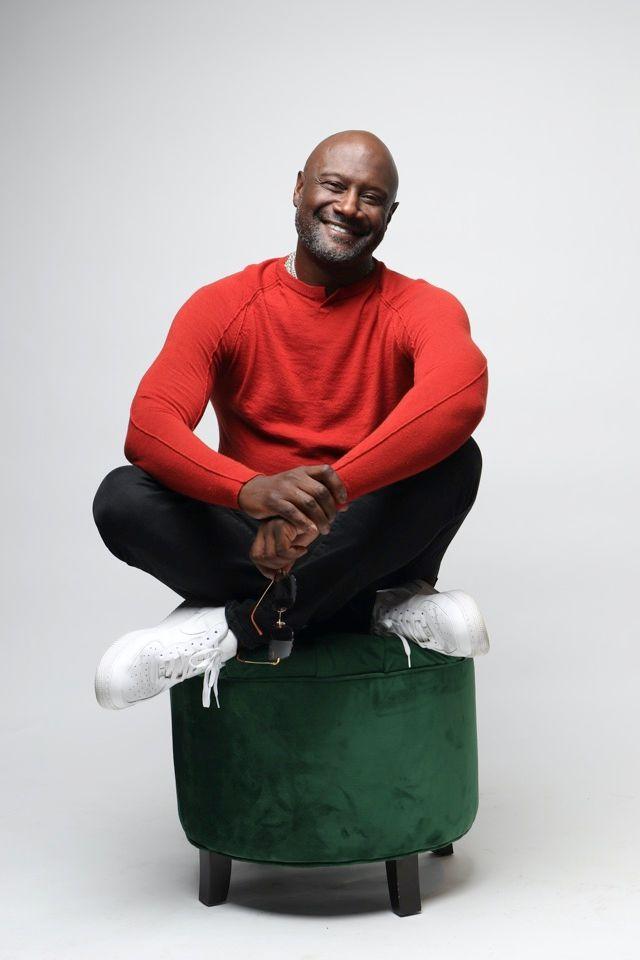
Luke Cooper L’01

Syracuse University College of Law has announced that College of Law alumnus and Fixt Founder and corporate executive Luke Cooper L’01 will serve as its Commencement Speaker on May 6, 2022. Cooper is presently CEO of Latimer Ventures, a Partner at San Francisco-based Preface Ventures, and 2022 Visiting Scholar at the University of Maryland Baltimore, which encompasses Maryland’s Law School, Medical School, and other graduate programs.

“Luke has been a strategic planner, technology innovator, and product developer for more than 20 years,” says Dean Craig M. Boise. “We are honored to welcome him back to Syracuse University and look forward to hearing about his entrepreneurial successes and how his law degree from the College of Law and personal life experiences have shaped his leadership style and professional pursuits.”

In a 2020 Stories Book article, Cooper credits Syracuse Law with developing skills in critical thinking, analytical reasoning, and advocacy that have fueled his successes. Importantly, Cooper is passionate about building diverse and inclusive work cultures and lifting up Black entrepreneurs. 

Cooper, who built and sold his first cyber startup to CACI in 2011, founded the device support platform Fixt, which he sold to Assurant in 2020. He is only the second Black tech entrepreneur to see a company through to a successful exit in Baltimore, MD. He serves on the Board of Trustees of the University of Maryland Baltimore Foundation and has been appointed by Gov. Larry Hogan to serve on the Board of Directors of Maryland’s TEDCO

Cooper’s upcoming memoir—Mud to Magic: A Black Tech Entrepreneur’s Inspiring Journey (2022)—will tell his life story and share his powerful message, that showing up as your most authentic self will drive the best outcomes. 

Renci “Mercy” Xie LL.M. ’20 Speaks with National Public Radio on Disabled Chinese Citizens’ Fight for Disability Access

Mercy Xie LL.M. ’20

National Public Radio recently interviewed Renci “Mercy” Xie LL.M. ‘20 and currently a doctoral candidate in the S.J.D. program for the story, “China excels at the Paralympics, but its disabled citizens are fighting for access.” Xie, who is focusing her degree on disability law, recounts the hurdles she faced growing up with a disability in China.

Lawyers in Love: Andrew Wright L’10 & Stacy Wright L’10 

The Wright Family
The Wright Family

A strong relationship can be defined in a variety of ways. For Stacy Wright L’10 and Andrew Wright L’10, studying for the bar exam together was just a confirmation that the two of them can make it through anything together. 

After receiving rankings for their first semester at the College of Law, Stacy was on a mission to find the number one ranked student, but little did she know that the mysterious student was her future husband.

“When we got back to school after our 1L first semester, and we got our rankings and I jokingly said to some of my friends ‘I want to meet whoever was number one in the class because I could use some work,’ and they told me I wouldn’t know him since he never goes out because he’s always studying,” Stacy said.

Stacy was not deterred by Andrew’s mysteriousness, and they finally met during their first summer. Andrew and Stacy began to spend a lot of time together inside and outside of school.

By their third year, they were practically living together, despite renting separate places. They appreciated the balance they provided each other, and as they spent more and more time together, both realized how much they valued the other’s presence as they challenged each other to grow into different and better people.

“I think we’re similar in lots of ways, but we’re opposites in lots of good ways, too. I think that the more time we spent together in my second and third years of law school, the more I came to appreciate those things and I think she helped me grow into a different person than I was during the first year of law school,” Andrew said.

As law school ended, Andrew was planning to move to Buffalo, N.Y. after accepting a position with Hodgson Russ LLP, but realized he desperately wanted Stacy to join him. In April of 2010, Andrew asked Stacy to marry him and move to Buffalo together, and despite being from Miami, FL., Stacy said yes to both proposals.

“I knew he was the one when I said yes, but it was reaffirmed when we survived studying for the bar together,” Stacy said. “We could make it through anything after that.”

Today, Andrew is still with Hodgson Russ LLP working as a partner in the state and local tax group and Stacy is in-house counsel for the London Stock Exchange Group. They have three children and will be forever grateful for the College of Law, as it changed their lives in the best possible way. 

“I met Mr. ‘Right’ and the rest was history,” Stacy said. “We fell in love.”

Lawyers in Love: Nichole Thompson L’95 & Troy Thompson L’96 

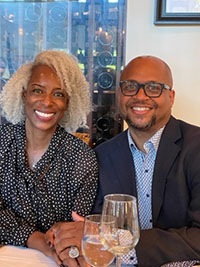
Nichole Thompson L'95 and Troy Thompson L’96

Nichole Thompson L’95 met the man of her dreams at her undergraduate college, Clark Atlanta University, and thought she had to say goodbye to him for three years when she came to Syracuse in 1992 for law school. Little did she know that in 1993 the man of her dreams, Troy Thompson L’96, would follow her to Syracuse and join her at the College of Law. 

Growing up in New York City, Nichole knew that she wanted to go to Syracuse for law school, as she wanted to pursue a degree in communications as well. Her initial goal was to enter the field of entertainment law, but she also knew that she wanted to return to Atlanta after law school.

During her undergraduate experience, Nichole was a part of the Divine Nine Panhellenic Council, where she met Troy and the two immediately hit it off. Both held leadership positions and their friendship quickly kindled into a romance. 

“There was a spark that just drove me towards his connection because of his intellectual probe and his ability to not just look at me as a beautiful woman, but as a beautiful mind, and we were connected in that space,” Nichole says.

After separating post-graduation so Nichole could follow her dreams of pursuing entertainment law, the two talked every night on the phone, with Nichole telling Troy about all of her coursework and exciting College of Law opportunities that she was experiencing.

“He said ‘you know what, I think I’m going to apply’ and I couldn’t believe it,” Nichole says. “And low and behold, he joined me the next year as a law student.”

In 1994, Nichole and Troy were married and welcomed their first child while still vigorously pursuing their law degrees. Despite the obvious challenges of raising a child while simultaneously seeking a law degree, Nichole and Troy flourished and had what they believe to be their most successful semester.

After graduation, the couple moved back to Atlanta, with three daughters eventually joining their family. Their son is a lieutenant in the Navy, their oldest daughter is an accountant, their middle daughter is finishing her undergraduate experience with the hopes of being a psychiatrist, and their youngest daughter is heading off to high school soon.

Although Nichole expected to pursue entertainment law, she quickly learned that she had a knack for Human Resources (HR). Over the last 25 years, Nichole has worked in an HR capacity at Target and at Union Pacific Railroads, which helped pave the way for other senior-level HR positions. Today Nichole is the Senior Vice President of HR and the Chief People Officer at FLS Transport. Since Troy’s time at Clark Atlanta, his passion has always centered around technology. As President of Business Development and Government Relations at Judicial Innovations, Troy can blend his passion for technology and law together.

“I certainly can only speak to what I know and what I know is that Syracuse forged an indelible relationship between my husband and me, and the start of our family,” Nichole says. “The fact that we were married there, matriculated through the law school, and then had our first child there, those are memories and those are lasting impressions that are very favorable for us. It delved into a love of the institution that you can’t get in any other way.”

From the Playing Field to the Courtroom or the Boardroom

What Turns a Great Athlete Into a Great Lawyer?

In the last two Stories Books, we examined the intersection of law, creative pursuits, and other disciplines not often associated with the practice of law: fiction and non-fiction writing (2020) and music (2021). This year, we turn our attention to athletics.

How does one transition from the playing field to the courtroom or the boardroom? What are the connections between such physical and intellectual pursuits? What are the transferable skills and lessons, from sports practice and play to law school and the practice of law? We spoke with College of Law alumni and a current student who have competed in sports at the highest levels in both team and individual disciplines to learn how their experiences as athletes have informed their careers.

On Humility

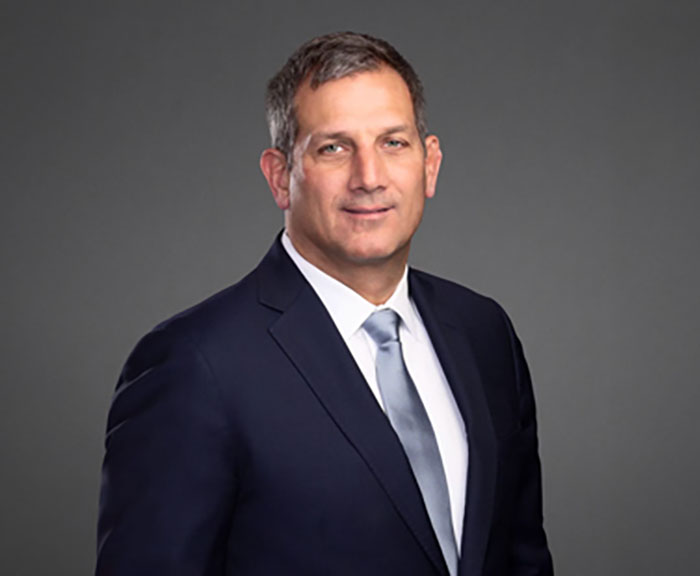
Frank Ryan Headshot wearing a blue suit standing in front of a grey background

Frank W. Ryan IV ’90, L’94 (Syracuse University Wrestling 1987-1990) Americas Chair, Global Co-Chair, and Global Co-CEO, DLA Piper 

Wrestling teaches you humility. Mistakes on the mat lead to embarrassment. You must prepare to be humbled. You see your teammates struggle, press, and find out who they really are when the storm hits.

David Moffitt L’96 (Professional hockey 1984-1986, Erie Golden Blades, Mohawk Valley Comets, Flint Spirit, 1996 Binghamton Whalers) Co-Head of US Credit Management, Investcorp

What hockey or any sport teaches you is a sense of selflessness and that you succeed as a team. You know there’s a time when you will sacrifice for the team without a quid pro quo, and if you do the right thing, you hope the right thing happens to you. It’s a nice intellectual approach but doesn’t always work out that way…

Headshot Tia Thevenin L'18

3L Tia Thevenin ’18 (Syracuse University Women’s Track & Field, 2014-2018; Canadian National Track & Field team, 2013-2020) Syracuse Law Student, 3L

All athletes should go to law school! I say that to my friends who are still competing. The determination and discipline are the same in both. You are used to being knocked down as an athlete. First-year law school will humble you, and you need the will to wake up the next day and get it done. There’s a quote from the track, “success is going from failure to failure without a loss of enthusiasm.” That is exactly what law school is. You are going to fail and fail and win and fail, and you have to have that spark and enthusiasm.

On Teamwork

Matthew J. Moore ’91, L’95 (Syracuse University Men’s Lacrosse, 1988-1991, three-time National Champion; Professional lacrosse, Philadelphia Wings 1992-1993) Partner, Latham & Watkins LLP, Global Vice Chair of the Technology Industry Group, and a former Global Co-Chair of Latham & Watkins’ Intellectual Property Litigation Practice.

I learned so much from being on the SU Lacrosse team, such as the importance of preparation and how to prepare; how to support your teammates, and how to be a leader. Sports are all about competition and getting the best out of you and your team, and we learned how to get the best from ourselves, our teammates, and our team. When you were on that team, one of the fun yet challenging things is that every game you play is the biggest game on your opponent’s schedule. Our ability to be mentally and physically prepared for every game was special. It was expected that you would bring 100% every day; otherwise, you would be letting the team down. This work ethic was critical to the next-man-up philosophy that helped those teams win game after game. That work ethic – if you can take that experience and translate it to any job-you’ll be successful.

A trial is also a team sport. I might do the opening and the closing, but if the documents are not ready when I reach for them, the team is not positioned for success. You need the mouthpiece, the people that understand the technology, the people that help with the examination outlines, the people who know the record, the logistics of getting the witnesses at the right time, and so much more. You must value all the people who put it all together with you equally because you would not succeed without them.

Ryan: Student-athletes can be powerful lawyers. Great athletes learn the selflessness critical to being an effective teammate, which translates well in the legal industry. Teamwork, equality, and hard work all equal success in sports and law.

Thevenin: I use the lessons learned through my athletic experiences every single day in law school, and this was true especially during my first year. Things come at you fast in the 1L year.

My classmates are my teammates. True, we are ranked, and that’s a mechanism that can divide us, so some people fear it in law school. But I remember sitting in class one day in my first year, as my classmates were speaking, they were offering perspectives that I didn’t consider, and that made me better. It’s like how teammates with different talents helped make me better. I realized I needed them to make me better. You put in work to see incremental changes. In law, when you are trying to grasp a concept there’s always room for improvement, so it reminds me of hurdles.

I contrast the hurdles to life. You have obstacles you have to tackle and keep going. Track and field allowed me to stay sharp. I’m a high-energy person, so hurdles were a good way to express who I am. The relay allows you to work with a team for a common goal. That’s transferable to any place in life as teamwork.

On Competition

Moffitt: Law school is almost the antithesis of playing a team sport. There’s a lot of competitiveness in any forced ranking system that mitigates against being a team player. Because it is a forced-ranked competitive environment, many don’t know how to handle the competition. The one thing that helped me in law school was that I was a competitive athlete, and I knew how to handle one-on-one competition.

You would watch people melt down in ways that were modestly embarrassing like a teacher giving you a facial in class because you said something stupid, and I would just laugh. I had this great professor that I was terrified of but learned a lot from in my first year property Professor Laura Lape. She terrified everybody. She was so tough in the Socratic dialog that if you said something ridiculous, she would pause, and you knew it would be five minutes of torture. She is a genuinely nice person but takes her job seriously and the level of intellectual rigor you needed to bring to that class was probably the most I had to bring to any class. I’ve been yelled at by coaches, had things thrown at me, and been verbally humiliated… the level of mental toughness coming out of a professional sport, knowing what it is like to spend three days on a bus you are sleeping on, play three games in three days and have your “A-game,” prepares you for law school.

Moore: A trial is just like a game. You use individual skills, work ethic, and preparation. What great athletes and trial lawyers learn to do is overcome the fear and anxiety of competition. So many people never get over the fear of public speaking much less speaking in front of a jury. One of the things about being a trial lawyer is that it is the opposing counsel’s job to make you look bad. You are in that arena every day. You, and everyone on the team, must prepare enough so that your case comes through to the jury. Whether it’s the National Championship game or in a trial, you need to prepare and execute so you deserve victory. One of the things that gravitated me to this job is I can continue to compete and get the thrill I did with Syracuse winning national championships.

On Leadership

Moffit: When you are a leader on a sports team, you need to lead from the front, make the sacrifices and be the one willing to give up the most. By doing that, others will emulate the behavior, and if you have a good team they will do even more. It’s something I learned from sports and it’s something I do to this day.

I recently read a quote from Napoleon: “leaders transact in hope.” And that’s the difference between leadership and management. Managers will tell you what to do, how to do it, and when to get it done. Leaders create a vision and communicate it to internal and external stakeholders. They don’t tell you how to get there, they lead you there. If you go off the track, they’ll go back and bump you back on the track. Leaders never tell you how to do things. They give you a vision of what it will look like when it’s done and leave it to your creativity to get it done.

Moore: We had some great leaders. I can see why Gary Gait is so successful. He led by example. He never acted like he was the best player on the team. Same with Paul [Gait]. They were just always working on the game. They did not think of themselves as the best or most important players. They were very humble, nice, and respectful to everyone. When you are that good, sometimes those lead players can put themselves before the team – not the Gaits.

They acted like they were any other player. They valued and appreciated everyone on the team; the walk-ons, the trainers, the backups, they made everyone feel just as important as they were. That’s not easy to do at that age, getting all that attention and having all the success they did. But they demonstrated leadership by example, working hard to get the most out of themselves and supporting everyone around them to get the most out of the team.

Thevenin: The best way to lead in sports is by how you carry yourself, through example and learning as a servant leader. I learned in law school, it doesn’t have to be just one way. Leadership plays into how you affect changes.

The Final Word 

What are the ties that bind athletes and lawyers? The competitive spirit, strategic and tactical thinking, the willingness to sacrifice for the team and the greater good, the ability to perform under pressure, the desire to excel, and the determination to stay fit (physically, mentally, and emotionally). Moore sums it up: Successful athletes can be good at anything if they learn how to transfer their work ethic and leadership on the field into their work ethic and leadership off the field. Some get it and some don’t. If you can transfer what you learn from sports into being a lawyer, you will be successful.

Sustained Support: LL.M. Program Provides Knowledge Needed to Succeed 

Lawyers from more than 40 countries have earned their degrees from the College of Law LL.M. program during its 10 years of existence. Seeking to study and further their knowledge in the theory and practice of law in the U.S., LL.M. students are international lawyers who already possess a degree in law from their respective countries. These students come to the U.S. to learn and for a one-year program (or more if they would like to extend), and make the transition to practicing law in the U.S.

One of these students, Daria Ivasiuk LL.M. ’20, found her experience at the College of Law to be particularly beneficial in preparing her for future success.

Headshot Daria Ivasiuk LL.M. ’20
Daria Ivasiuk LL.M. ’20

​Path to America

Ivasiuk is originally from Ukraine. She graduated from Ukrainian University with bachelor’s and master’s degrees in law. After working in Information Technology (IT) briefly after graduating, Ivasiuk’s family decided to move to the U.S. where they had family in the Syracuse area. Relocating to another country introduced a major professional transition for Ivasiuk, and she found herself on the fence about whether she should pursue a career in law or computer science.

Curious about the U.S. legal system, Ivasiuk ultimately chose to pursue law. She was pleased to discover that Syracuse Law offered a one-year LL.M. program that she was eligible to enroll in to practice law in her new home.

“When I was accepted into the program, my happiness was beyond any measure,” Ivasiuk explained. “Syracuse Law school is a nice place to study, in all terms, and was very helpful and welcoming to me in my journey. No matter your background, Syracuse will help you pursue your legal dream.”

Embracing Diversity

Ivasiuk quickly found that what makes the College of Law unique is how it embraces diversity, helping students of all different backgrounds and nationalities feel welcome and supported. She specifically remembers a meeting of LL.M. students held on the first day of orientation week.

Ivasiuk painted the scene, saying, “when I entered, I saw maybe 30 or more people from all around the world. Each brought their own background, history, cultures, and food preferences—and all were different. I was impressed by this diversity and that Syracuse welcomes everyone. It made me feel that I’m not a stranger here.”

The College of Law provides all LL.M. students with peer mentors to ease the transition in the social aspects of law school and living abroad. Embracing cultural differences and learning from each other is a mutually beneficial experience for both the mentors and students. The social aspect of this experience is also key, as students are immersing themselves not only in the study of U.S. law but also in the whole experience of what it means to be a law student in the U.S.

The U.S. Law School Experience

As she began taking courses at the College of Law, Ivasiuk learned how the U.S. legal system and standards differ from that of Ukraine. She recalls the American Legal Systems course taught by Professor Shannon Gardner where she and her fellow classmates learned about constitutional law in the U.S. piece-by-piece, with a focus on the differences between law at the federal and state levels. 

Legal Writing for International Students is another course specifically designed for LL.M. students. This course focused on legal research, essential knowledge for all legal careers. Preparing for her legal memorandum assignment, Ivasiuk researched many facts and cases, piecing her case together to articulate her position. These types of legal writing skills have been very helpful to Ivasiuk in providing background and understanding of what her legal career in the U.S. would soon entail. 

Keeping classes small and providing access to professors sets LL.M. students up for success, enabling them to have enriching discussions around the subjects that they are seeking to master. “Professor Deborah O’Malley took the time to review every question we had until we had no more,” Ivasiuk was happy to find. “It was very helpful to me.”

Preparing for the Future

The main takeaway Ivasiuk learned from law school is that you must work for your results.

“You gain determination and become disciplined while at law school, which greatly prepares you to be a hardworking attorney,” Ivasiuk said. “I also learned communication skills at Syracuse that I use in my career now, mainly in how to pitch my own ideas.”

After graduation from Syracuse, Ivasiuk worked at a six-month internship focused on immigration law and asylum cases at the Law Offices of Jose Perez L’07. That fall, Ivasiuk received the good news that she passed the New York Bar exam. She then accepted an offer to join the Olinsky Law Group, focusing on disability law, and recently transferred to a nonprofit, Hiscock Legal Aid Society, as a staff attorney.

In the Next Five Years…

Ivasiuk’s favorite component of her current position is the fact that she can help underrepresented people and those with low incomes.

“I want to serve our community and help as many people as I can,” Ivasiuk explained, “because I believe that justice should be provided to everyone. Over the next five years, I want to deepen my knowledge of divorce law and be able to say I am a specialist. I’d like to advise people on every step of their divorce, and to make the process as amicable as possible so people won’t be traumatized, especially when there are children involved.”

Taking on Justice Causes in Pursuit of Truly Meaningful Representation

J. David Hammond L’07 and Melissa Swartz L’14

“I kept fighting for the court to do the right thing.” The words of a man who spent 16 years in prison and decades professing his innocence. The words of a man who sought help from the Innocence Project, the infamous Johnnie Cochran, and multiple attorneys including one who took his money, all his files and did nothing. The words of a man who finally succeeded in getting his conviction overturned in court because he never gave up, and because of the two tenacious graduates of the College of Law who have made justice causes their life’s work.

J. David Hammond L’07 and Melissa Swartz L’14 in library
J. David Hammond L’07 and Melissa Swartz L’14

J. David Hammond L’07 and Melissa Swartz L’14 work for different law firms in Syracuse, but they have forged a formidable team in confronting injustice and incompetence in pursuit of what Hammond describes as “meaningful representation” for the client. Last fall, they succeeded in winning exoneration for Anthony Broadwater who was imprisoned in 1983 after being wrongfully convicted of raping Alice Sebold, a Syracuse University student who later detailed the rape in her memoir Lucky. Though released from prison in 1999, Broadwater was further “sentenced” to life as a registered violent sex offender, severely limiting his ability to work and build a future. He waited forty years to be declared a truly free man after Hammond and Swartz produced evidence that led a judge to vacate the conviction.

“No lawyer is perfect. But when you have a case that involves another attorney’s mistakes or misconduct, it’s vital that you place yourself in the shoes of a client and appreciate what they went through with that lawyer,” says Hammond. “The legal concept of ‘meaningful representation’ defines what a lawyer must do in terms of strategy and diligence in providing assistance to the client. If you are operating in a system that is patently unfair, you can’t just go in there kicking and screaming. Coming into a courtroom and expressing outrage is kind of a JV approach to lawyering. You have to know when it’s appropriate to challenge the system or just preserve an appellate issue.”

And you need to know when to call upon colleagues for specialized help. That’s why Hammond contacted his friend Swartz at Cambareri & Brenneck Attorneys at Law and asked her to join him on the Broadwater case after he was approached by a film producer and private investigator who was doing research related to a movie adaptation of Sebold’s memoir. The case raised alarming questions about misidentification in a police line-up and microscopic hair analysis that allegedly linked Broadwater to the rape. Hammond knew he would need the help of an attorney who specialized in forensic analysis.

“Melissa is a phenomenal lawyer, and probably among the best in this area,” says Hammond. “I’ve never met any lawyer better in forensics—blood spatter, DNA—she just eats it up! For every case with a forensic aspect, there’s nothing better than a lawyer who could moonlight as a forensic expert. Most lawyers can’t do that. And it’s good to have a teammate to plan with.”

Hammond says his methodical approach to developing and presenting a case was forged by his experiences in law school, followed by nearly ten years of military service. “Law school essentially reprograms your brain to think in a different way. Through the process of a good legal education, you can look at things less subjectively. It also takes tremendous self-discipline, and that was really strengthened for me during my time in the military.”

Hammond served in the military first as a Judge Advocate in the U.S. Army, prosecuting court-martial cases, and conducting training on the military justice system for the Army’s police academy. Eventually, he became a Battalion Judge Advocate for the Airborne Special Forces at Joint Base Lewis-McChord (WA) where he served as the primary legal advisor to all levels of command on military justice, operational law, international law, domestic and foreign policy, fiscal law, administrative law, and legal assistance. He provided training to service members in the Law of Armed Conflict (LOAC) and Rules of Engagement (ROE). He finished his military career on the defense side, representing soldiers convicted at courts-martial on appeal before the U.S. Army Court of Criminal Appeals and the U.S. Court of Appeals for the Armed Forces.

“As a military officer you’re programmed to think strategically: every action has a consequence which produces another consequence, and so on. Whether you’re in a courtroom or preparing for the appellate argument, you have to plan for those third and fourth order effects,” says Hammond. “There’s an amazing quote attributed to former President Dwight D. Eisenhower when he was overall Commander of the Allied Forces in World War II. He famously said, ‘Plans are useless, but planning is indispensable.’ In my view, it’s also the lawyer’s motto. There are lawyers who wing it and take things as they come, and they usually aren’t the best. It’s that methodical approach to every case that sets lawyers apart, and I think that’s what law school begins to teach and the military reinforced for me.”

The practice of law demands the same kind of discipline and focus that Hammond employed in military service. “I’ve dealt with the stress of military leaders relying on me for split-second decisions: Can I drop this munition on this target? If you can learn to deal with that sort of scenario, there aren’t a lot of situations in the civilian legal world that can shake you up. It’s about planning within the bounds of the law and ethical considerations. You have to continually ask yourself ‘What’s your desired end state and what plans can be put into place to achieve that desired end state?’ Thinking through all the possible courses of action. It’s the process that allows you to come as close to perfection as possible, to apply a method to the madness.” 

Hammond now works for Syracuse-based CDH Law, a veteran-owned legal defense firm, which states on its website: “We achieve results because we are disciplined. Our military, police, and prosecutorial backgrounds forged unmatched self-discipline into our character.” Certainly, that disciplined process has defined Hammond’s career and continues to impact the cases he takes on. He served as the only military-appointed lawyer on Chelsea Manning’s appeal, following her conviction and court-martial for leaking classified information (Manning was granted clemency in 2017 by President Barack Obama and her appeal continued for several years after). Manning’s trial record consisted of nearly 50,000 pages, one of the largest files in military history.

Hammond defines the Manning case as another “justice cause” involving government overreach and an unjust sentence by the court.

“Even though I am methodical and strategic in my approach, these justice cases also involve a personal element,” says Hammond. “I can’t help but become personally invested in the outcome. A lot of people get jaded and keep their personal feelings out of the equation. But it should matter to you.”

Swartz agrees that justice cases demand discipline and passion for the law and the client. “To be an effective attorney you really need to know your area of practice. You don’t just dabble, especially in criminal law, where lives hang in the balance,” says Swartz. “You can be a great orator, but that’s not enough.” In the Broadwater case, Swartz says her years of working “on the other side” in the Onondaga County district attorney’s office honed her appreciation for forensic evidence (or the lack thereof). The Broadwater conviction, largely based on microscopic hair analysis that has proven to be suspect, represented prosecutorial misconduct in her view.

“The system didn’t work for Anthony Broadwater,” says Swartz. “I’ve never had a case keep me up at night, until this one. The idea is that he lost 40 years of his life. I want to do everything I can so that he is able to move forward.” She and Hammond are part of the legal team that recently filed a lawsuit in the New York State Court of Claims, working toward getting the state to compensate Broadwater for the years of life lost to the unjust conviction. “In law school, they teach you about making people whole again,” says Swartz. “In reality, in cases like this one, you can never really achieve wholeness. We will fight the state of New York and pursue other avenues for relief, so he can be financially compensated.”

Swartz’s passion for justice and criminal law developed long before law school. “I was in fourth grade when my math teacher allowed us to watch the OJ Simpson trial on television. It was obviously completely inappropriate,” she recalls. “I remember coming home one day and telling my parents I wanted to be Johnnie Cochran.” The irony of that is not lost on Swartz, given that Cochran turned down a request by Broadwater to take up his case.

Swartz grew up with what she terms an obsession with the criminal mind. “One of my beloved books was Helter Skelter,” she says. She approached law school with that same obsession, tailoring her courses to her passion. “I didn’t take a lot of bar courses to get ready for the bar, I didn’t care about law review or moot court. I took a seminar on the death penalty because I knew exactly what I wanted to do.” Most valuable to her were the experiences she gained externing in the district attorney’s office and the classes taught by working attorneys. “One of my bosses now, Steve Cambareri L’89, was my trial practice professor. I remember him telling me that I was sometimes dangerously close to being overly dramatic. And I was over the top. I’ve toned myself down,” she adds with a laugh.

Swartz still loves legal drama, real and fictional. With both sincerity and humor, she easily shares a long-time dream—to play a character in a two-part episodic Law & Order, starting off as the victim who eventually unveils herself as the murderous perpetrator of the crime. Art imitating life? Life imitating art? The fact is, Swartz loves and lives her work.

“To be good at what you do, you need to love what you do,” says Swartz. “To be effective at it, you need to love your area of practice. I’m obsessed with it.”

Swartz says she and Hammond make a good pair because they are similarly passionate about criminal defense, and similarly hard-working, but bring very different viewpoints to each case. They argue. They debate. They trust each other. And, ultimately, they give to each client the best possible representation.

“We treat every case and every client as if it’s the case or the client of the century,” says Hammond. Because it just might be.