

Law Events Calendar
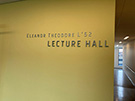
As he prepared to deliver this year’s annual State of the College Address, Syracuse University College of Law Dean Craig Boise was thinking about both place and time. Moments before, he had officially dedicated the lecture hall where he was standing in the name of Eleanor Theodore L’52. He was thinking about her legacy and gift to future generations of law students who would study there.
“Today, we honor a woman who graduated more than a half-century ago, the only woman in the Class of 1952,” said Boise. Eleanor Theodore, who also earned her undergraduate degree from Syracuse University in 1949, passed away last year at the age of 92. Her estate gift to the College of Law will create the Eleanor Theodore Memorial Law Scholarship Fund to support scholarships for deserving and promising students.
The amount of the gift was not revealed, reflecting the wishes of the donor, her lifelong modesty, and her desire to serve others without fanfare. “Eleanor was an introvert,” says Mike Bandoblu L’11, Theodore’s close friend, accountant, and executor of her estate. “She was a private person, but she always put others first. The first word that comes to mind in describing Eleanor is ‘selflessness.’”
During the dedication ceremony, Boise recalled Theodore’s career of service over nearly four decades in the Department of Law for the City of Syracuse. As assistant corporation counsel, she provided legal advice to mayors, city departments, the council, the planning commission, and others.
“You name it—whatever happened in Syracuse, Eleanor probably had a hand in it, working through multiple administrations and transitions, and helping to build and protect the city she loved,” said Boise. According to a profile of Theodore published in Syracuse Law Magazine (Fall 2007), she was the first woman in the history of the city’s law department and its only female attorney during her first decade there. She served for 37 years, under 5 mayors and 11 corporation counsels.
“Her education at the College of Law was important to her. She often told people that. What she learned here built a future for her and allowed her to live a life of service,” said Boise. “By putting her name on this lecture hall, we hope our students will remember the woman who was modest in demeanor but fierce in her commitment to serving others and the College of Law.”
In opening the program, J.D. Candidate, Class of 2024, and President of the College’s Women’s Law Students Association Julie Yang said “The Women’s Law Students Association is committed to empowering women and advancing women in legal education and the legal profession. Our mission is to advocate for gender equity and women’s causes while creating lasting relationships with our mentors and alumnae. It is fitting therefore that we should join in this morning’s unveiling, in celebration of a woman who was truly a trailblazer. I know I speak for all of my colleagues when I say that we will remember this day with great admiration and inspiration.”
In the State of the College address following the dedication, Boise noted that the College remains strong, in large part due to the generosity of alumni and friends. In 2021-22, the College exceeded fundraising goals by 40%, with $6 million raised from 1600 donors, allowing the College “to attract the best and brightest and offer them appropriate financial aid to help make their career dreams a reality.”
The College of Law’s Criminal Defense Clinic has been helping students gain practical experience in the courtroom and hone their craft since 1971.
The CDC represents low-income individuals pro bono throughout Onondaga County, working mainly on civil matters such as shoplifting, vandalism, and traffic violations. Students involved in the clinic said the experience has made them realize the impact of their work. Always under faculty supervision, they learn how to negotiate plea agreements, conduct legal research, and analyze the criminal justice system as a whole.
Members of the clinic typically discuss their cases with Gary Pieples, the director of the CDC and a teaching professor at SU. They then travel to one of several courts to meet with their clients prior to appearing before the judge.
Read on for student stories from the CDC in the Daily Orange.
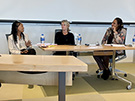
As a part of Orange Central 2022, Staci Dennis-Taylor L’14, Senior Assistant District Attorney at the Chief of Municipal Courts Bureau, and Lisa Peebles L’92, Federal Public Defender at the Northern District of New York, returned to the College of Law for a panel on “the Challenges Facing Criminal Justice.”
An audience of alumni and students gathered to hear from Dennis-Taylor and Peebles about the challenges facing criminal justice practitioners from their work experiences and perspectives over the years. College of Law Professor Paula Johnson moderated the discussion.
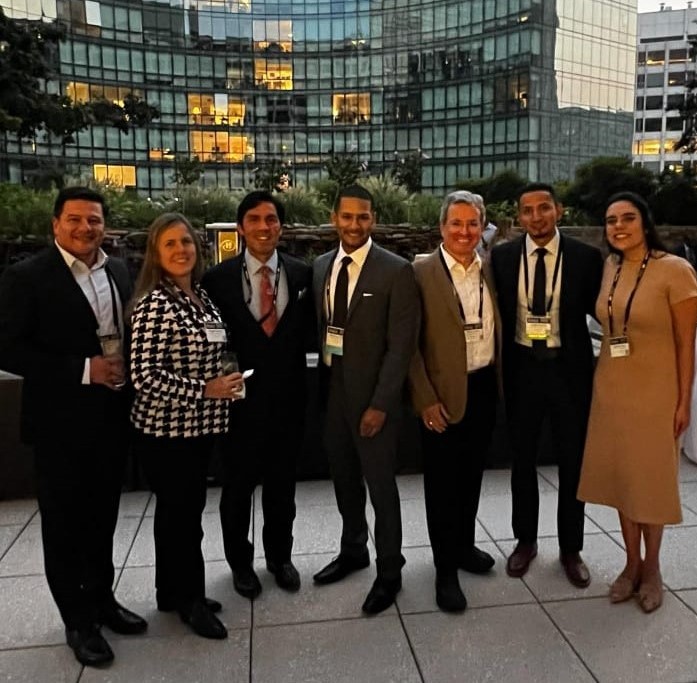
3L Jorge Estacio recently met with senior government officials, big law partners, and judges from around the world at the ABA Business Law Section’s Annual Meeting in Washington, D.C. Estacio works at the Innovation Law Center as a Special Projects Consultant researching and writing reports covering intellectual property, freedom to operate, and marketing information for clients. He is also a student attorney in the Transactional Law Clinic.
Thank you to alums and friends who took time out of their schedules to participate in our August Orientation and JDi Residency programs. The line-up included:
“Only once in American history has one school had its graduates serving simultaneously as the local mayor, the state’s governor, its member of Congress, and as President of the United States. That school is Syracuse University in 2022.”
Chancellor Syverud
On Aug. 15, 2022, Syracuse University College of Law welcomed 241 new students at its Opening Convocation ceremony held at the National Veterans Resource Center on the Syracuse University campus. The NVRC represents SU’s steadfast and long-standing commitment to cultivate and lead innovative academic, government, and community collaborations positioned to empower those who have served in defense of the United States.
The new student body includes 144 students in the residential juris doctor program (Class of 2025); 95 students in the online JDinteractive program (Class of 2026); 22 LL.M. students from eight different countries (Class of 2023), three S.J.D. students from Brazil and India (Class of 2025), four visiting scholars, three-semester exchange students, and three international students in the two-year J.D. program.
The students heard from Syracuse University Chancellor and President Kent Syverud, College of Law Dean Craig M. Boise, and the Honorable Nazak Nikakhtar L’02, G’02, Partner at Wiley Rein LLP, Chair of the firm’s National Security practice, and Co-Chair of the Foreign Investment practice (CFIUS/Committee on Foreign Investment in the United States). Nikakhtar specializes in international trade national security law, global competition policy, and supply chain resilience.
As we emerge from the global pandemic, returning to old norms and learning to live with new ones, Chancellor Syverud highlighted the historical fact that “only once in American history has one school had its graduates serving simultaneously as the local mayor, the state’s governor, its member of Congress, and as President of the United States. That school is Syracuse University in 2022. And, for the first time, this University is simultaneously welcoming four new Tillman Scholars – three of them College of Law students. The Tillman Scholarship is the most prestigious scholarship award for US service members, veterans, and military spouses. Our large number of Tillman Scholars, like our large enrollment of veterans in this college, reflects our University’s tradition and mission to be the best University in the nation for veterans and military-connected students.”
Addressing the students, Dean Boise advised, “Now is an appropriate space to reflect on your ’future moment.’ For there are many unprecedented challenges — and opportunities — that await your bright minds, sharp skills, and a deep sense of justice: climate change and human security, threats to public health and community wellness, justice for communities of color, and the rights of vulnerable populations, the largest armed conflict in Europe since World War II, and its impact on our planet and our nation, supply chain challenges and global trade imbalances, and the respect for the rule of law and democracy abroad and here at home. And, of course, the challenges and opportunities that come with economic prosperity, innovation, and technological advances, such as artificial intelligence and drones.
“Our faculty are leading experts in these topics … and more! They, and the laws that impact them, will come alive for you in the classroom. I know, that at Syracuse Law, we will inspire you, prepare you, and help you gather and hone the tools to shape lives and change the world. That is our commitment to you because we know that’s why you are here.”
The class of incoming J.D. students has an undergraduate Grade Point Average (GPA) of 3.55 for the 50th percentile, which is the highest seen at the College of Law in over 10 years. The 75th percentile GPA of 3.75 and 25th percentile GPA of 3.21 are also higher than the incoming class of 2021. The incoming class is comprised of 25 veterans/active duty military members, 10 more than the incoming class of 2021.
Nikakhtar offered words of encouragement from the perspective of a graduate, saying, “Syracuse will give you a wonderful, top-notch education. It will train you to master the law, it will teach you how to write persuasively, think analytically, and it will teach you grit. Embrace it. You will have good days and challenging days and they will all pass. Learn, learn as much as you can, because one day you will draw from the information you’ve acquired over these few years.
“Whether you want to be law partners, professors, judges, politicians, career diplomats, business executives, stay-at-home parents, or part-time anything. Whatever you want to be, you will develop important building blocks here. The foundation of modern democracy is based on the American legal system, and it is the greatest legal system in the world. It may not be perfect, but when you learn it, you can fix it. Fundamentally, the knowledge of the law is one of many things that will enrich you as a person. And it’s something that will stay with you forever.”
Overview of Incoming J.D. Students*
Class size: 241
LSAT Scores
Undergraduate GPA (uGPA)**
Higher Degrees
Diversity
Military-Affiliated
Geography
Overview of Incoming LL.M. and S.J.D Students
*Statistics are as of August 17, 2022
**The Undergraduate GPA numbers are all higher in 2022 compared to 2021 numbers
***A median GPA of 3.55 is the highest average in over 10 years
****10 more Veterans than the incoming class of 2021
Alumni who have passed between July 1,2021— June 30, 2022
| 1940s | 1970s |
| Norman S. Fenton 1947 | David A. Weinstein 1972 |
| 1950s | F. Evan Black 1973 |
| Michael A. Brumer 1951 | Michael G. Donnelly 1974 |
| Eleanor Theodore 1952 | Edward C. Hooks 1974 |
| Leonard Ware 1952 | Robert L. Tisdell Sr. 1974 |
| Ernest Ginsberg 1955 | Richard A. Welder 1974 |
| Walter R. Christy 1956 | Edward Z. Menkin 1976 |
| John M. Thomas 1958 | Nancy J. Mierzwa 1976 |
| Thomas A. Vitanza 1958 | Frederick H. Monroe 1976 |
| Leslie H. Cohen 1959 | Lyn H. Simon 1976 |
| John E. Crowe 1959 | Kathleen C. Boyle 1977 |
| 1960s | Leann Kowalski 1979 |
| Gerald A. Goldberg 1962 | 1980s |
| Gerald Stern 1963 | Alan S. Drohan 1980 |
| Kevin E. Whelan 1963 | Francis E. Hunt Jr. 1980 |
| Robert E. Meshel 1964 | Vincent J. Cole 1981 |
| Joel J. Goldman 1965 | Charles Zolot 1981 |
| Edward Chertowsky 1966 | James D. Dimassimo 1982 |
| William H. Miller Jr. 1966 | Susan V. John 1983 |
| Arthur R. Gaudio 1967 | Edward J. McQuat 1984 |
| Richard J. Keough 1967 | Kathryn K. Hoskins 1985 |
| Kevin B. Blaney 1968 | Ronald A. Szot 1986 |
| David V. DeLuca 1968 | James V. Parravani 1989 |
| John E. Watkins Jr. 1968 | 1990s |
| Laurence H. Woodward 1968 | Janice R. Robinson 1991 |
| Francis T. Cuda 1969 | Jose Bahamonde-Gonzalez 1992 |
| 1970s | Lisa P. Sucy 1996 |
| James F. Mock Sr. 1971 | Alycia A. Ziarno 1996 |
| John F. Triggs III 1971 | 2000s |
| John P. DiLauro 1972 | David B. Jones 2003 |
| Samuel J. Levine 1972 | Samantha L. Kurkjy 2008 |
| John J. Rizzo 1972 | 2010s |
| Paul V. Webb Jr. 1972 | Lindsay H. Roufa 2019 |
The generosity of our alumni family remains second to none. Your philanthropic support drives our success, enabling us to continue to offer a forward-leaning 21st Century legal education, recruit and retain the best and brightest students, and employ a world-class faculty that is leading the discussion on the most important legal issues of our time.
In short, we couldn’t do it without our alumni’s support. In Fiscal Year 2022:
We raised more than $6 million, exceeding our overall fundraising goal by more than $1.5 million and setting a new high mark in giving to the Law Annual Fund and the Scholarship and Financial Aid Fund.
We endowed new scholarships in the name of extraordinary alumni, including in honor of the
Hon. Theodore A. McKee L’75 and in memory of the formidable Eleanor Theodore L’52.
Our alumni continued to lead the University in donor retention and giving participation.
Nearly one in three College of Law alumni have now supported the Forever Orange Campaign, which has set a benchmark in participation for the University at large! If you have not yet made your campaign gift, it’s not too late! Call or email Sophie Dagenais at
315.443.4536.
Each year, we highlight and honor the top 10 classes for giving participation, and the top classes for giving participation by each decade. Congratulations to these classes and thank you!
Passing through the doors of the Eleanor Theodore Lecture Hall in Dineen Hall, a law student might just wonder about the woman behind the name. A simple Google search would turn up an obituary (she died at the age of 92 on January 15, 2021), but even that would not reveal the answer. The student would have to dig deeper and conduct research (primary and secondary) to uncover details about Theodore and her impact on the city of Syracuse, her profession, and the world at large. And that would have suited Theodore just fine. Because she liked to work quietly, diligently, over decades, surrounded by books, records, and historical artifacts.
Theodore was a woman who may not have made headlines, but she nonetheless made a huge impact on countless lives.
After earning her undergraduate degree in 1949 from Syracuse University in just three years, Theodore enrolled in the College of Law, fulfilling a childhood dream to become a lawyer. She would be the only woman to graduate in the Class of 1952.
“Eleanor was very smart,” says Steve Nicolaos, who was close to Theodore throughout his life, even helping to take care of her during her last year of life. “She would tell me that the law was a male-dominated field back in the ‘50s and that she experienced a good deal of resentment. She said she had to work twice as hard to succeed.” And succeed she surely did.
For eight years, Theodore practiced general law in a small Syracuse law firm and in 1960, she was appointed assistant corporation counsel for the City of Syracuse, becoming the first woman in the history of the city’s law department and the only woman attorney during her first decade on the job. A trailblazer of her time, Theodore provided legal advice to mayors, city departments, and the council. She was also the assigned attorney to the Syracuse Planning Commission and the Board of Zoning Appeals, defending them in any litigation.
Theodore was a woman who was passionate about her work, putting her whole self into her professional life. In a short profile piece published in the Syracuse Law Magazine (Fall 2007), Theodore said, “I intended to remain in the law department for four years and ended up staying 37 years, serving under five mayors and 11 corporate counsels.”
Theodore worked with both Republican and Democratic administrations throughout the span of her career. “That was highly unusual,” one of Theodore’s long-time friends, Dean Assimon, explains, “because often you see politicians cleaning house after an election. But she got things done and earned universal respect and trust. We need more Eleanors these days.”
“You name it—whatever happened in Syracuse, Eleanor probably had a hand in it, working through multiple administrations and transitions, and helping to build and protect the city she loved,” said College of Law Dean Craig Boise during a ceremony to dedicate the lecture hall in Theodore’s name.
Through multiple administrations and major political transitions, Theodore kept her head down and remained steadfast in her commitment to her work. In a major accomplishment for her profession, she compiled all laws and statutes of the City of Syracuse into a publication that was easy to access by members of the law department and the local bar. While this effort may seem insignificant at face value, it assisted members of the law department and the local bar in improving the way things were always done. “Previously there were statutes you might not be aware of unless someone called it to your attention,” Theodore said. “It was frustrating.”
Taking what she learned in her law career and applying it to other aspects of her life, Theodore was also a very passionate member of her church community. She was a member of St. Sophia’s Greek Orthodox Church since childhood, attending Sunday school and Greek school, along with religious services. As an adult, she brought her legal mind and dedication to her faith by serving on the Parish Council for more than 30 years, including four times as its president. She was widely considered the church historian and is credited with putting together a book on the Church’s history.
History in all its forms was important to Theodore, along with understanding the rules, regulations and doctrines that governed the church.
“Eleanor actually read through the uniform parish regulations of the Greek Orthodox Archdiocese to ensure that our church bylaws were in compliance,” recalls Assimon, with a bit of humor. “When we had a general assembly meeting, we would invariably do something wrong, and Eleanor would take me aside and quietly whisper, ‘Now, Dean, you know you’re supposed to do this and this and this.’”
“Eleanor was very much a follower of rules and regulations,” Mary Assimon, Dean’s wife and Theodore’s close friend remembers. “Whatever Eleanor did, whether it was law or church-related, it had to be a certain way. What’s right was right. What’s wrong was wrong.” St. Sophia’s priest, Fr. David Smith, says Theodore “was clearly not a push-over, but everything she did was gentle and peacemaking. I think she’d like to be remembered for her humility, which was rather robust.”
That was the Eleanor Theodore way. With quiet determination and humility, she ensured the rules and regulations governing the church—and the City of Syracuse—were followed without
fanfare. And with a deep respect for history and those who helped make history. Theodore was interviewed in a video to celebrate St. Sophia’s centennial in 2021. She opens the film by paying tribute to the first Parish Council that had served a century before.
“I admire those people,” said Theodore on video. “They must have faced difficult times. Remember in this country, when you were foreign-born, even though you might be a citizen, you were considered a foreigner. And they built that church and maintained that church. They went through a Depression and they still survived. And we are the beneficiaries of their endeavors.”
Members of St. Sophia’s are beneficiaries of Theodore’s endeavors, too. She was on the building committee (as the only woman, of course!) that oversaw the construction of the new church in Dewitt when St. Sophia’s moved from downtown Syracuse in 1973. It was important to her to keep costs in line. “We endeavored to build a church at a
reasonable cost so we would not—not—encumber future generations with a tremendous mortgage,” Theodore said in her recorded video interview. “I have seen mortgages in other churches that go on forever; we didn’t wish to do that.”
Church members are beneficiaries of both her prudence and her generosity. She helped raise thousands of dollars— and donated thousands of her own—to support the stunning stained glass windows and iconography throughout the church. “When I look at our iconography project, I always hear Eleanor’s gentle voice and sense her support,” says Fr. David.
Her sister died the year before Theodore passed away. Neither married nor had children. Mike Bandoblu L’11, her friend and attorney, said: “Eleanor was introverted, but also very nurturing and selfless. When we talked about my 2-year-old daughter, she would just light up. It seemed to me that she would have wanted to be a mother. Now, through her estate gift, she sort of is—a mother to many.”
Theodore amassed a large estate, working hard, and living with her only sister, Dorothy, in a house filled with art, literature, and collectibles. Jim Bandoblu, Theodore’s accountant, believes the legacy that Eleanor left in her gifts to the Church and the College of Law reflects her deep love for both.
“The Church and the law school both defined her,” says Jim Bandoblu. “They drove her faith and they drove her culture—her desire to give back to the communities she loved.”
Her estate gift to the College of Law creates the Eleanor Theodore Memorial Law Scholarship Fund to support scholarships for deserving and promising students. The amount of the gift was not revealed, reflecting the wishes of the donor, her lifelong modesty and her desire to serve others without fanfare.
“Eleanor often told people that this law school was important to her,” says Dean Boise. “What she learned here built a future for her and allowed her to live a life of service. By putting her name on the lecture hall, we hope our students will remember the woman who was modest in demeanor, but fierce in her commitment to public service. A woman who loved history, tradition, and building for the future.”
As he prepared to deliver this year’s annual State of the College Address, Dean Craig Boise was thinking about both place and time. Moments before, he had officially dedicated the lecture hall where he was standing in the name of Eleanor Theodore L’52. He was thinking about her legacy and gift to future generations of law students who would study there.
“Today, we honor a woman who graduated more than a half-century ago, the only woman in the Class of 1952,” said Boise. “Eleanor Theodore, who also earned her undergraduate degree from Syracuse University in 1949, passed away last year at the age of 92. Her estate gift to the College of Law will create the Eleanor Theodore Memorial Law Scholarship Fund to support scholarships for deserving and promising students.”
The amount of the gift was not revealed, reflecting the wishes of the donor, her lifelong modesty, and her desire to serve others without fanfare. “Eleanor was an introvert,” says Mike Bandoblu L’11, Theodore’s close friend, accountant, and executor of her estate. “She was a private person, but she always put others first. The first word that comes to mind in describing Eleanor is ‘selflessness.’”
During the dedication ceremony, Boise recalled Theodore’s career of service over nearly four decades in the Department of Law for the City of Syracuse. As assistant corporation counsel, she provided legal advice to mayors, city departments, the Common Council, planning commission and others.
“You name it—whatever happened in Syracuse, Eleanor probably had a hand in it, working through multiple administrations and transitions, and helping to build and protect the city she loved,” said Boise. According to a profile of Theodore published in Syracuse Law Magazine (Fall 2007), she was the first woman in the history of the city’s law department and its only female attorney during her first decade there. She served for 37 years, under 5 mayors and 11 corporation counsels.
“Her education at the College of Law was important to her. She often told people that. What she learned here built a future for her and allowed her to live a life of service,” said Boise. “By putting her name on this lecture hall, we hope our students will remember the woman who was modest in demeanor but fierce in her commitment to serving others and the College of Law.”
In opening the program, J.D. Candidate, Class of 2024, and President of the College’s Women’s Law Students Association Julie Yang said, “The Women’s Law Students Association is committed to empowering women and advancing women in legal education and the legal profession. Our mission is to advocate for gender equity and women’s causes while creating lasting relationships with our mentors and alumnae. It is fitting therefore that we should join in this morning’s unveiling, in celebration of a woman who was truly a trailblazer. I know I speak for all my colleagues when I say that we will remember this day with great admiration and inspiration.”