Our alumni’s generosity underwrites the College of Law’s success.
For many alumni, a tradition of lifelong giving is often tied to personal stories and fond memories of their alma mater. And what better time to reflect on their College of Law days than on the occasion of a class anniversary! Here, alums celebrating years ending in zero share their philanthropic journeys. Tell us yours by emailing us at su-law@law.syr.edu.
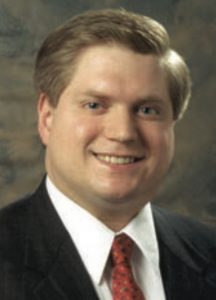
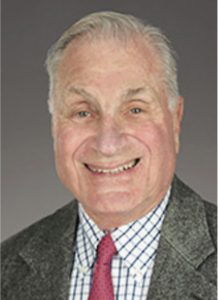
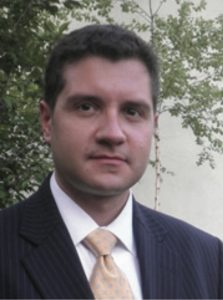
James Domagalski L’90
A Partner at Barclay Damon LLP, Jim Domagalski is Chair of the firm’s Construction and Surety Practice Area. He also practices in the Commercial Litigation and Labor and Employment practices, and he serves as the firm’s co-marketing partner.
What brought you to the College of Law as a student? Two things. First, after spending four years at the University of Notre Dame in northern Indiana, I wanted to return to New York State. Second, the College’s Advocacy Program attracted me, and eventually I became a member of the College’s National Trial team.
What law school memories stand out for you? The Class of 1990 was a collection of terrific people. We socialized together and created great memories outside of the classroom. I made lifelong friendships at the College of Law.
When and why did you start to give back to the College of Law? I started giving back soon after graduation because of my very positive experiences and my desire to help make the College stronger.
In what ways have you given back? Over the years I have supported the Law Annual Fund, and more recently, I have supported the College through the University’s Hill Society. I also serve as Chair of the Syracuse University Law Alumni Association Giving Committee.
Why is philanthropy important to you? I strongly believe in the responsibility of citizens to give back to the cultural, civic, religious, and educational institutions that comprise the core of American life.
Do you have a message to recent graduates about giving back to their alma mater? Some people might think that donating is only for more senior alumni, but a recent graduate should know that a donation of any size can make a difference as we pursue our fundraising goals.
Our alumni’s generosity underwrites the College of Law’s success.
For many alumni, a tradition of lifelong giving is often tied to personal stories and fond memories of their alma mater. And what better time to reflect on their College of Law days than on the occasion of a class anniversary! Here, alums celebrating years ending in zero share their philanthropic journeys. Tell us yours by emailing us at su-law@law.syr.edu.
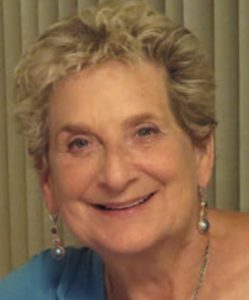
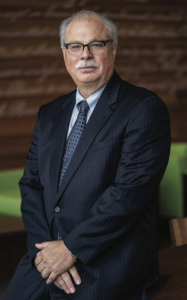
Golda Zimmerman L’80
Golda Zimmerman is an internationally recognized expert and frequent speaker and lecturer on adoption law and family formation. She is currently retired from the active practice of law, but she continues to serve as an expert witness and consults on difficult cases nationally and internationally …
My story starts at the end of the 19th century. It begins with two left shoes. A young man is so poor that he could only afford two left shoes. He journeyed alone in steerage on a boat from his homeland. He came in search of freedoms, to worship as he desired, to have economic opportunity, and to be safe from the ongoing threat of attack and death.
He was a butcher and worked in New York City. He visited Syracuse to see some friends from his village. While in Syracuse he saw a beautiful young woman hanging clothes in her yard. So taken, he immediately asked her father if he could marry her. Her father said “no” as she was only 14 years old. He told the young butcher to come back in two years when she was 16. He did come back, and he married her. That young butcher and the beautiful young woman were my grandparents.
Perhaps this family story has been embellished over the years, but every new year for as long as I can remember we all were bought a new pair of shoes: one right and one left. The purpose of those shoes was to remind us of the wonderful opportunity and life we were blessed to have; to not forget where we came from; and most importantly to remember others and help them if we were able.
My family’s values and lifestyle have always encouraged philanthropy at whatever level is appropriate. My husband and I started to give back to the College of Law once we were somewhat established and knew that our family was secure. We began our efforts in the 1980s. (As an aside, one of my grandparent’s children and three of their grandchildren are graduates of the College of Law.)
I have always felt that my professional success started with the foundation I received at the College. Law school taught me how to ask the right questions and gave me the skills to seek out the answers. I have used these skills in my international and domestic practice.
My entire professional life has centered on children, especially international and domestic family formation. It was natural for us to support law students who were interested in pursuing the area of law most important to me.
Many of my closest friends are classmates from law school. Jeri D’Lugin L’80 and I have kept a close and important friendship these past 40 years. As we were not able to convene the celebration of our 40th reunion in person, we felt that a giving challenge might encourage our fellow classmates to remember that during these difficult times, the law school is especially in need of our financial support.
My advice to recent graduates starting their law career is simple. When the door of opportunity presents itself, have the courage to walk through it. The College of Law has well prepared you to be successful. Use what you have learned, remember your moral compass and life experiences, and be secure that you have the skills to succeed.
Our alumni’s generosity underwrites the College of Law’s success.
For many alumni, a tradition of lifelong giving is often tied to personal stories and fond memories of their alma mater. And what better time to reflect on their College of Law days than on the occasion of a class anniversary! Here, alums celebrating years ending in zero share their philanthropic journeys. Tell us yours by emailing us at su-law@law.syr.edu.
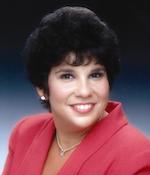
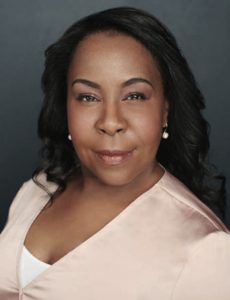
Jeri D’Lugin operates her own retirement planning practice in Greensboro, NC as the owner of a wealth management company. After beginning her law career at a large law firm in Miami, FL, she returned to North Carolina where she headed the tax division of a bank’s trust department and eventually became a regional trust officer …
D’Lugin counts herself as one of the many College of Law graduates whose law degree helped propel her career in different and unexpected ways. “A law degree is great for anything you do in life, as it provides you with a broad background of knowledge and skills. You understand liabilities, where you can make mistakes, and it provides you with the intellect to avoid making those mistakes. Being an attorney has helped me with every career move I’ve made.
It was her first position out of law school, at a large Miami law firm, that set in motion D’Lugin’s continued engagement with the College of Law in many ways. “I felt fortunate to have the position at the firm, and the blend of my College of Law, Syracuse Law Review, and Maxwell School of Citizenship and Public Policy experiences played a big role in getting that position. As soon as I could, I started giving back to the law school,” explains D’Lugin.
D’Lugin is a consistent supporter of the Law Annual Fund, a fund that gives the law school maximum flexibility in addressing its most pressing needs. She’s also made a gift to dedicate a room in honor of her parents in MacNaughton and White halls.
Giving back to the law school encompasses more than monetary donations for D’Lugin. She welcomes any prospective or current College of Law student in her offices for discussions about law school and legal careers. She also served on the College’s Board of Visitors (now the Board of Advisors) during Dean Daan Braveman’s tenure.
To D’Lugin, giving back is an obligation to make the world a better place, if you are fortunate enough to be in a place to give back to your community and beyond. “I’ve heard a local gentleman put it best: ‘You need to put more wood on the pile than you have taken off the pile.’”
D’Lugin believes that recent graduates should begin to give back to the College as soon as they are able. “Recent graduates have benefitted from the alumni who preceded them and have given to the College, so they could get a good education at Syracuse with the best in technology and classrooms. Continuing that cycle is critical for those who will come after you,” she says. “And all alumni have a stake in the College of Law remaining a top law school because the reputation of the school reflects on all of us.”
When thinking about the challenges recent graduates face as they begin to make career decisions, D’Lugin looks to her career and the careers of her classmates for direction. “If you start in an area of law and feel that you haven’t found your niche, don’t give up,” she observes. “There are so many opportunities in front of you because of your law degree. A law degree is a door opener, whether it’s to leadership positions in non-profits, or financial services, or whatever.”
Her classmates and their diverse career paths continue to be an inspiration and point of pride for D’Lugin. “We have alumni who have gone on to be successful in real estate and financial services, a leading adoption law expert [that is, her dear friend Golda Zimmerman L’80] to a judge on the US Court of Appeals for the Fifth Circuit. There is no onesize-fits-all career path.”
To celebrate everything the Class of 1980 has accomplished and to help the next generation of Orange law students make their mark, D’Lugin and Zimmerman announced a Class of 1980 Challenge shortly after their 40th anniversary reunion over Law Alumni Weekend.
Adds D’Lugin, “After issuing the challenge in October, we quickly heard from classmates that our message encouraged them to give back to the College. I really believe we’ll have a great showing by the end of the campaign, and I thank all who give to the College.”
Our alumni’s generosity underwrites the College of Law’s success.
For many alumni, a tradition of lifelong giving is often tied to personal stories and fond memories of their alma mater. And what better time to reflect on their College of Law days than on the occasion of a class anniversary! Here, alums celebrating years ending in zero share their philanthropic journeys. Tell us yours by emailing us at su-law@law.syr.edu.
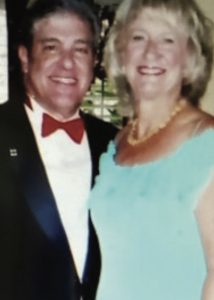
Giuseppe Vincenzo ”Joe” Vumbacco L’70
Joe Vumbacco stood down as CEO, President, Vice Chairman of Health Management Associates Inc.—a $4 billion revenue organization managing more than 60 hospitals in the southeast and southwest—in 2008. “But I don’t consider myself retired.” Since 2008, Vumbacco has learned to speak and write Italian; gained a Certificate of Finance from Harvard Business School to manage his own investment portfolio; and has turned his hand to writing novels. The Ghost of Bowdoin College was published to acclaim in 2018, and Vumbacco has completed the manuscript for his follow story of “money, murder, and the mob:” The Return of the Ghost of Bowdoin College.
What was your favorite class and professor at the College of Law? More than one person gave me a break over the years, but I’ll never forget what Dean Robert Miller did for me. I was married in my senior year at Bowdoin and my wife, Lee, and I had our first child in 1966. I wanted to go to law school, but coming from a factory background in Meriden, CT, I had little money, just enough to get through the first year and pay rent on married student housing.
But I felt responsible for my family, so I walked into Dean Miller’s office in the summer of 1968 and asked him to save my place, so I could work to raise more funds. I thought he wouldn’t know who I was, but he said he had reviewed class grades, saw I was near the top, and offered me a full scholarship. Not only that, he called his friend Gary Axenfeld in Syracuse and I went to work as a clerk at Axenfeld, Webb, Marshall, Bersani and Scolaro. From there I became Research Editor at Syracuse Law Review and was elected to Honor Court and the Order of the Coif.
My first year at Syracuse was also Professor Emeritus Travis H.D. Lewin’s first year. He went on to have a brilliant career, and he is an outstanding teacher.
How did your SU College of Law degree help you reach your career goals? I wanted to be one of those people who broke the ceiling of non-Ivy League law graduates getting a job with a Wall Street corporation. After graduating, I practiced law in Manhattan with Mudge Rose Guthrie & Alexander before joining the “tough and tumble” world of beer and bread as a senior vice president of the F. & M. Schaefer Corporation. I then became the Executive Vice President of the Turner Corporation—the largest general contractor in the US—before leading Health Management Associates.
When and why did you start to give back to the College of Law? When Lee and I got to the point when we weren’t poor, we started to give to certain causes, and top of the list was Syracuse. Later, I was asked to serve on the Board of Advisors during the period when Dean Hannah Arterian was raising money for Dineen Hall.
In what other ways do you practice philanthropy? After leaving Health Management Associates, I became a Master Mason, and I helped to revive a scholarship program here in Maine. Plus, my wife and I helped to found a non-denominational “church without walls” in southwest Florida, the Jubilee Fellowship of Naples. I also try to do a lot of counseling with high school and college students. I have a cardinal rule for them: don’t strive to be the smartest person, be the most organized. Work first, then play.
What advice can you share with recent graduates just starting their law careers? I learned the following from Gary Axenfeld. If you want to be a successful lawyer or businessperson, there are four things you have to do—answer mail, return calls, have big ears, and a small mouth. I’ve practiced that for 50 years. I worked very hard on listening, for instance, not just listening to important things, but everything. An example of having a “small mouth” is from my Turner days when we managed top secret government contracts. I had a reputation for never breaching confidence, which goes back to growing up in a rough place.
Our alumni’s generosity underwrites the College of Law’s success.
For many alumni, a tradition of lifelong giving is often tied to personal stories and fond memories of their alma mater. And what better time to reflect on their College of Law days than on the occasion of a class anniversary! Here, alums celebrating years ending in zero share their philanthropic journeys. Tell us yours by emailing us at su-law@law.syr.edu.
Stephen Davis L’60
After many years of experience in Real Property Litigation, Steve Davis concentrates his practice in Hudson Valley tax certioraris. He leads the Tax Certiorari and Condemnation group at McCarthy Fingar LLP, a leading White Plains law firm which inter alia represents owners of income producing and development property at redressing their valuation grievances and other abuses by municipalities. Davis still plays baseball, primarily in the Men’s Senior Baseball League (MSBL), offering local league play over the summer and weekend tournaments across the country over the fall and winter, including in Phoenix, Palm Springs, and Las Vegas. He has supported the College’s Annual Fund for more than 50 years!
What brought you to the College of Law? After graduating from Queens College and living at home for those four years, I wanted to try living away for a few years. Since Harvard didn’t seem the right spot for me, I chose Syracuse. After my time at Syracuse, I concluded that Harvard would not have been any more difficult. I noticed that ease or difficulty at school seems directly related to inclination. I find competition and its rewards fascinating.
Any law school memories that stand out? I enjoyed everything about the law school. In particular, I remember a Real Property test Dean Ralph Kharas sprung on us in the middle of the semester. It was the only Law School test on which I attained the highest grade in the class. By happenstance, I read about the topic the night before: equitable adjustment. Most of the class had no idea of the subject, and consequently failed!
My most cherished memory though, is meeting Sandra Rosenberg, the girl who ultimately became my wife for 50 years until she passed.
When and why did you start to give back to the College of Law? For the same reason I love America—the pride of a first generation American in a leading American institution. The College of Law makes us better. I began giving back financially about four years out of school.
In what ways have you given back? I make an annual gift to the Annual Fund. I also sponsored a seat in the Melanie Gray L’81 Ceremonial Courtroom in memory of Sandra. I also give back to Queens College in the same manner.
Why is philanthropy important to you? At the time I attended law school, compared to today, it was a bargain. Consequently, I felt the need to give back to ensure it remained attainable. Although the cost of graduate school today spirals higher, the need remains for keeping legal education costs within reach. The College of Law prepared me well for the rest of my life in general, and the ability to give back, in particular.
Do you have a message to recent graduates about giving back? For law school graduates, I would say that law school is the vehicle that provides you with the tools you need to have a successful future. The law school requires funds to survive and to attract the best professors and student.
This year, 2020, marks the 125th anniversary of the founding of the College of Law. Today, as in a number of those prior years, the College faces global, societal, demographic, and technological challenges, which the coronavirus pandemic has brought into sharper focus and accelerated.
Yet, in the face of these challenges, the College has not only persevered but has grown in stature and relevance because of its pioneering efforts and a culture of innovation. The 2020 Yearbook highlights a number of innovations that have occurred over the rich history of the College, as well as the remarkable contributions alumni, faculty, and students have made to the legal profession and beyond. I would like to underscore two.
Syracuse University, through the work of disability rights pioneer Dr. Burton Blatt, has been a leader in humanizing services for people with disabilities. Today, the College of Law, thanks to work of the Burton Blatt Institute and Director and University Professor Peter Blanck—as well as the scholarship of professors Arlene Kanter and Robin Paul Malloy, among others continues to pioneer research and scholarship regarding not only how persons with disabilities are viewed and treated by society but also how laws, such as the American with Disabilities Act, can function as a force for change.
Research by BBI has been instrumental in helping to shape policy for the promotion of inclusion opportunities. Similarly, Professor Kanter’s Disability Law and Policy Program and the Disability Law Clinic provide hands-on experience for students, here and abroad, while Professor Malloy has written extensively on the intersection of disability law and land use, as a way to ensure greater accessibility within our communities. The importance of these efforts to provide a more inclusive and accessible society cannot be understated.
“JDi has enabled our faculty to develop a deeper understanding of the multiple dimensions for effective online learning, far in advance of other institutions.”
Among the communities that are facing dramatic challenges due to the pandemic are institutes of higher education in general, and legal education in particular. In fact, their challenges began well before the pandemic. Traditional job opportunities for law school graduates have been reduced as firms downsize, leading in part to a reduction in the number of applicants to law schools. The landscape is ever changing.
The shifting landscaping creates pressure on all law schools to find innovative ways to compete. Our JDinteractive program—developed before the pandemic—has placed us at the forefront of online legal education now that it is experiencing a paradigm shift. JDi has enabled our faculty to develop a deeper understanding of the multiple dimensions for effective online learning, far in advance of other institutions. That effort, along with the immediate success of the program, has made the College a much sought-after resource for other institutions across the country as they try to grapple with the pivot toward remote learning.
These and our other extraordinary achievements over the past 125 years could not have come about without the dedication and persistence of the College community of alumni, faculty, students, and friends over these years. Your unwavering commitment to the College, especially in these challenging and difficult times, is a testament to the role the College has fulfilled and will continue to fulfill in preparing generations of thoughtful, articulate, passionate, and compassionate leaders both within and outside our profession.
On behalf of the Board of Advisors and the faculty and students at the College today—and all those who will follow—I want to thank you for your generosity and support.
In Fall 2015, then-J.D. Class President Dustin Osborne L’16 and the Class of 2016 launched the College of Law’s first-ever Class Act! campaign, buoyed by the support of College of Law Board of Advisors Member Alan Epstein L’74.
A University-wide senior class giving campaign, Class Act! encourages students to make their first-ever gift to the University a symbolic amount in honor of their class year—$20.21, for the Class of 2021. We hope these gifts will be the first of many more as our students graduate, join our alumni family, and build their careers.
Five years later, the tradition continues, and—as with other aspects of the student experience at the College of Law—it grows in innovative ways.
A Historic Class Gift, and a New Participation Record for LL.M. Students
In spring 2020, the University suspended the Class Act! Campaign, in deference to students and in recognition that they were facing unforeseen financial and personal challenges due to the COVID-19 pandemic. By that point, led by then-3L Class President Aubre Dean L’20 and the Class Act! Giving Committee, J.D. students had achieved a 32% giving participation rate.
Monetary gifts by students to any law fund of their choosing qualify for their Class Act! participation. Usually, most students elect to designate their gifts to the Law Annual Fund or the Scholarship and Financial Aid Fund. But this year—making the best of an unusual situation— students voted to pivot their focus from a campaign of individual gifts to a class gift using funds raised collectively by the class earlier that year.
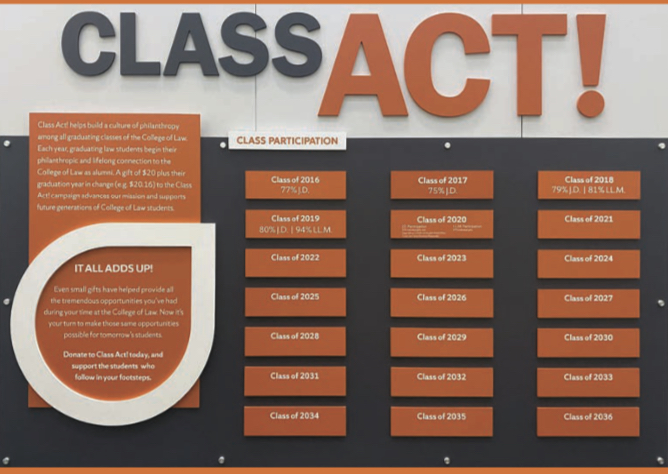
This new gift was earmarked for ’Cuse Law Cares, an emergency fund for College of Law students adversely impacted by the pandemic. For their part, the LL.M. Class of 2020, led by Betania Allo LL.M.’20, had already achieved a record breaking individual Class Act! giving participation rate of 97%.
All these achievements have been recognized on the Class Act Giving Wall in the Travis H.D. Lewin Advocacy Commons in Dineen Hall. We are grateful for the generosity and philanthropic leadership of both the J.D. and LL.M. classes.
Class of 2021: A Tradition Reimagined
As of November 2020, the Class of 2021’s campaign is already well underway. The class voted to expand the scope of its campaign by adding new options for giving: donations of basic needs items to Hendricks Chapel and/or donations of casebooks to the Law Library for use by future law students, along with the traditional monetary gift.
The class will recognize these new giving options along with the traditional philanthropic gifts in its Class Act! participation rates. This is new territory for Class Act!, driven by students’ desire to leave a unique and meaningful legacy.
Best wishes to the Class of 2021 for a successful campaign!
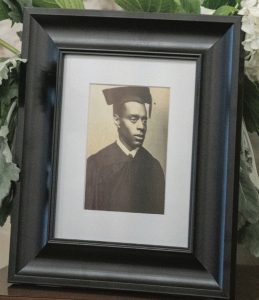
Felicia Collins Ocumarez L’98, G’98—who received the 2020 Black Law Students Association (BLSA) Legacy Award at the Alumni of Color Award Ceremony during Law Alumni Weekend (LAW)—has generously spearheaded an effort to establish a new scholarship to expand diversity at the College of Law.
This scholarship initiative honors William Herbert Johnson L’1903. Johnson was the first African American to graduate from the College of Law. With a steady call for action during LAW, College of Law alumni and friends have reached their first fundraising target of $150,000.
“I thank Felicia Collins Ocumarez for her extraordinary leadership and generosity in spearheading this scholarship at the College of Law. This is a transformative investment in diversity and equity whose benefits will ripple out into the legal profession and society at large,” says Dean Craig M. Boise.
Syracuse University Trustee and College of Law Board of Advisors Member Vincent Cohen Jr. L’95 says, “I am proud of the role my father, Vincent Cohen L’60, played in the diversification of ‘Big Law’ back in the early 1970s and I continue to build on his belief that the legal profession needs to reflect the people it serves,” says Cohen Jr. “With this new scholarship, the College of Law is set to further expand the diversity in the profession by attracting the best and brightest aspiring Black attorneys. I am proud to be a part of this urgent equal access to justice movement.”
“Felicia Collins Ocumarez is the epitome of a trailblazer who advocates for the Black community and does so with tenacity and excellence. I am grateful for her support of the Black Law Student Association,” says 2L Mazaher Kaila, President of the Black Law Student Association.
To support this scholarship, contact Assistant Dean for Advancement and External Affairs Sophie Dagenais at 315.560.2530 or sdagenai@law.syr.edu.
The Attorney Who Represented the Ukrainian Whistleblower Describes His Path from Syracuse to the Impeachment of a President
In August 2019 a government whistleblower made a formal complaint alleging that President Donald J. Trump had asked Ukrainian President Volodymyr Zelensky to investigate former Vice President Joseph R. Biden L’68, Trump’s political opponent in the 2020 presidential election. That official complaint set off a series of events that led to Trump’s impeachment in the House of Representatives in January 2020 and to his Senate trial and eventual acquittal a month later.
Many Americans followed only the third impeachment trial of a president intently, but perhaps none more so than Andrew Bakaj L’06, the Ukrainian whistleblower’s lead counsel. Bakaj was a student of Professor Emeritus William C. Banks in the early days of the Institute for National Security and Counterterrorism (INSCT), now the Institute for Security Policy and Law. That’s where he learned the laws that would inform his subsequent work on whistleblower law and policy in the Intelligence Community.
As an intelligence officer and criminal investigator, Bakaj also represented state department officials impacted by “Havana Syndrome.” Today, as Founding and Managing Partner of Compass Rose Legal Group PLLC, he is a leading expert in security clearance matters and has advised and counseled numerous senior US government officials in a variety of legal and investigative areas. In this interview, Banks and Bakaj catch up to discuss Bakaj’s fascinating career, including his public service, the importance of strong whistleblower laws, what happened when Bakaj was himself the subject of retaliation, the founding of Compass Rose, and the impeachment of a president.
Professor Emeritus William C. Banks: Tell us what brought you to Syracuse and how your legal education prepared you for your career.
Andrew Bakaj L’06: When researching law schools, what genuinely stood out about Syracuse was INSCT. The more I researched the program and looked at the school as a whole, the more I felt that Syracuse was the perfect fit for me. I knew that Syracuse was going to prepare me to be a lawyer, and I knew that the Institute’s professors would have an impact on me for years to come. However, what has surprised me is how my education had such a direct, positive impact on my career.
Obviously, law schools typically don’t have courses on “whistleblower law,” but the legal concepts we study prepare us to work as advocates and advisors. The Institute offered an opportunity to delve deeper into real-world issues impacting our nation’s security.
WCB: What national security path did you take after graduation?
AB: My education and training resulted in me being hired as an investigator with the US Department of Defense (DOD) Office of the Inspector General (OIG). My OIG leadership was looking to create a program to protect DOD civilian whistleblowers, particularly those within the defense intelligence community. After conducting a number of investigations, I was tasked with developing the legal and investigative framework to protect whistleblowers within and outside that community who hold security clearances.
Additionally, I worked closely with the National Security Agency (NSA), overseeing its internal whistleblower protection program. Our program became the model for President Barack Obama to expand whistleblower protections to members of the larger Intelligence Community and those who hold security clearances.
WCB: Tell me more about your time at the CIA Office of Inspector General and the path toward founding your own firm …
AB: When I joined CIA OIG in 2012, I was directed by Inspector General David Buckley to lean forward and develop a program to comply with the presidential directive. What’s more, not only did he want me to lead at CIA, he wanted me to lead and coordinate within the greater Intelligence Community. This led me to work with the recently established Office of the Intelligence Community Inspector General (OIC IG).
While successfully creating the program at CIA, my colleagues disclosed to me that senior CIA OIG officers were manipulating evidence in order to obtain a false prosecution, which resulted in someone pleading guilty.
After attempting to resolve the issue at the lowest level, CIA OIG leadership was not taking any action, and it was, in fact, targeting colleagues for raising concerns. Unable to merely sit on evidence that CIA leadership was violating the law, I coordinated with the OIC IG to have independent eyes look at the matter.
The matter was immediately referred to the FBI for investigation, and the case where the individual pleaded guilty was reversed. Moreover, the CIA IG and Deputy IG began targeting me and my colleagues. In 2014, David Buckley suspended my security clearance and placed me under investigation because of my communication with the OIC IG, which is protected whistleblower activity.
Over a year later, I resigned from CIA and filed a whistleblower reprisal complaint against the CIA OIG, using the rules and regulations I developed.
Shortly thereafter I began working as Special Of Counsel for Mark Zaid— who happens to be my attorney—and I eventually went on to found Compass Rose Legal Group.
WCB: How did you become involved as counsel for the Ukrainian whistleblower in 2019?
AB: Quite simply, the client was a referral from a trusted friend.
WCB: Were you surprised that the whistleblower’s claims would lead to impeachment?
AB: Candidly, I was surprised that the claims resulted in impeachment. When I first learned about the underlying issues back in early August 2019, I suspected that the matter would have legs because it involved the President. I certainly expected a congressional investigation. Impeachment isn’t something I considered would happen.
WCB: Based on your experience with the Ukraine case and others in recent years, what changes, if any, would you like to see in laws protecting whistleblowers?
AB: First, I would like to see it codified that the identity of whistleblowers are protected from public disclosure, and that this extends to members of Congress and other US government officials, including the President.
Second, given the complexity of the issues involved, I think it would be wise to create an Intelligence Community administrative court to ensure consistency in the agency application of laws and regulations protecting whistleblowers.
WCB: What advice do you have for law students aspiring to a career in national security law?
AB: While it’s important to have overarching career goals, it’s important to be flexible and to keep options open. As you can see from my own story, there is no way I could have predicted the twists and turns my life took. Opportunities come around when you least expect them, and there are times when something relatively minor can have significant meaning down the road.
As a White House Intern, Sergio Rumayor Had a Front-Row Seat to History
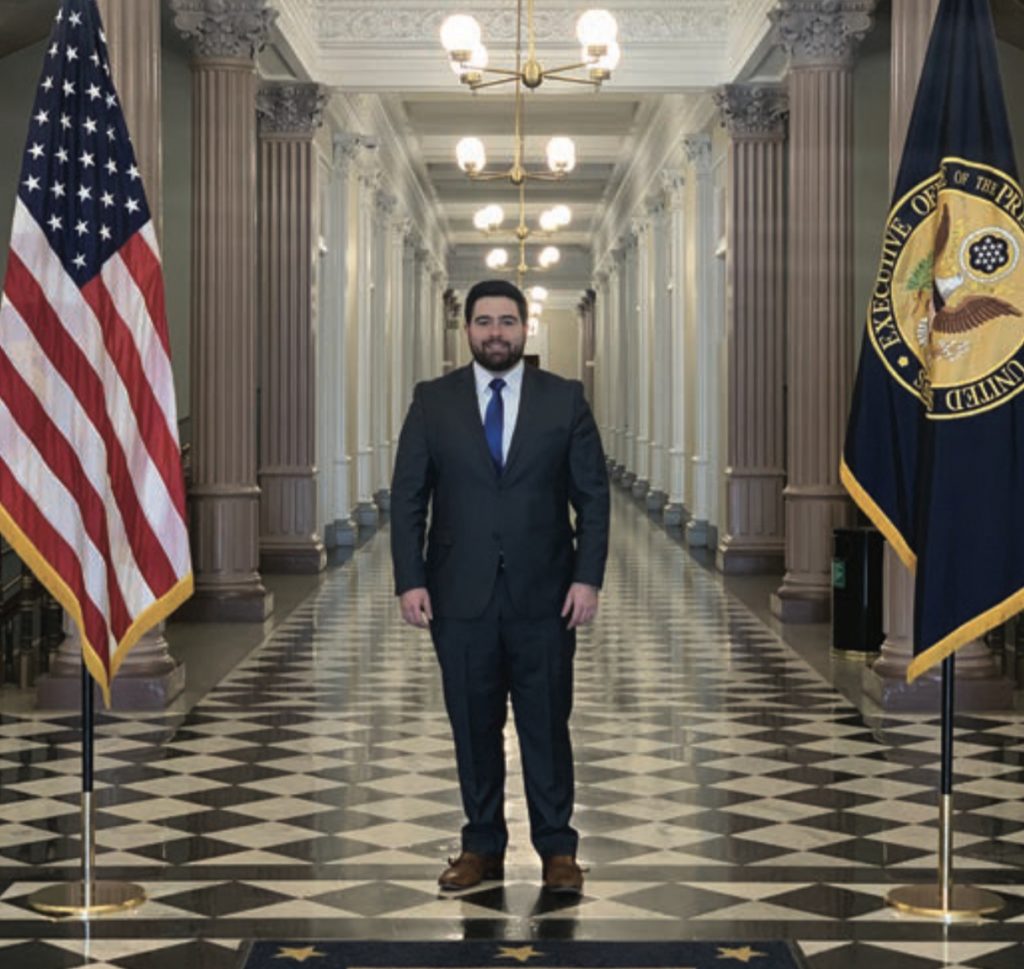
Rising 3L Sergio Rumayor stands in the entrance lobby of the Eisenhower Executive Office Building in Washington, DC.
Impeachment. Flood. Pandemic. Rising 3L Sergio Rumayor’s spring 2020 externship in the Office of White House Counsel did not lack for excitement. Then again, as Rumayor explains, when it comes to the highly competitive White House Internship Program (WHIP), only students prepared for hard work and challenges will do. “I believe White House interns are students and professionals who are team players: outgoing, articulate, and capable,” he says.
All that drama was still to come when Rumayor, a native of Staten Island, NY, was assessing his externship options as a 1L. “My interest in an externship at the White House happened on a whim,” he says. “Originally, I wanted to work in the private sector, but I thought it would be cool to get out of New York City.”
Rumayor learned that the White House was on the list of DCEx choices, and specifically the Office of White House Counsel, where Rodney Dorilas L’19 worked the year before. “I later found out that Rod was well-liked in that office, and the image of a Syracuse intern he left behind set a high standard.”
Offering honest advice, Dorilas explained to Rumayor that WHIP and the Office of White House Council were difficult to get into. Rumayor was up for that challenge. After a rigorous application process, he learned he had been accepted around Thanksgiving 2019. In January 2020, he moved into a short-lease DC apartment along with rising 3L AnoopKahlon—who was externing at DC firm Sanford Heisler Sharp LLP—and reported to the Eisenhower Executive Office Building.
Rumayor joined the Executive Branch team during the third-ever impeachment of a US president in American history.
“From a law student’s perspective that was amazing,” says Rumayor. “I was able to observe and appreciate the extensive hours of research on constitutional and American history necessary to perform everyday duties at the Office of White House Counsel, as well as the professionalism required to succeed in such an environment.”
Working under “some of the most brilliant legal minds and scholars in the country,” notes Rumayor, “made it an unforgettable experience that I will carry with me forever. I feel extremely blessed to have served in the Executive Branch during this time in history.”
“There was rarely a dull moment,” Rumayor adds. “I woke up every morning eager to get to work and see what was in store.”
Often what was in store were critical Executive Branch tasks, such as researching and writing memoranda on constitutional issues and federal statutory law, tracking Freedom of Information Act litigation, assisting with Presidential Records Act compliance and federal judiciary nominations, and helping with government oversight requests, questions of executive authority, and government ethics. “I applied skills I learned in the classroom— such as in constitutional law, legal communications and research, and professional responsibility—in a high-stakes and demanding, practical environment,” he notes.
Despite being an intern in such a high-level Executive Branch office, Rumayor says that he and his two fellow interns were treated exceptionally well. “The interns are treated like part of the team. It was an incredible experience that has made not only an impact on my career as a law student but also on my future career as a Syracuse lawyer.”
Unfortunately, Rumayor’s externship was cut short by the COVID-19 health crisis in March. And that wasn’t the only adjustment he had to make that month. “March 10 was my last week at the White House. That same week, my apartment was flooded, so I had to live in a hotel for a month!” Ever resourceful, Rumayor applied for another externship to fulfill his curriculum requirements. “This summer I am working remotely for HBW Resources, a DC energy lobbying firm, as well as for the Office of the Richmond County District Attorney in Staten Island in the Criminal Court Bureau.”
Thanks to his work at the White House and the Richmond County DA, Rumayor says he is now considering a public service career.
“I am very grateful for the time I spent at the Office of White House Counsel and the relationships and bonds I made there,” Rumayor says. “My experience gave me a clearer understanding of how the law operates in the three separate branches of government. There is simply no other place in the world that you can do work like that.”