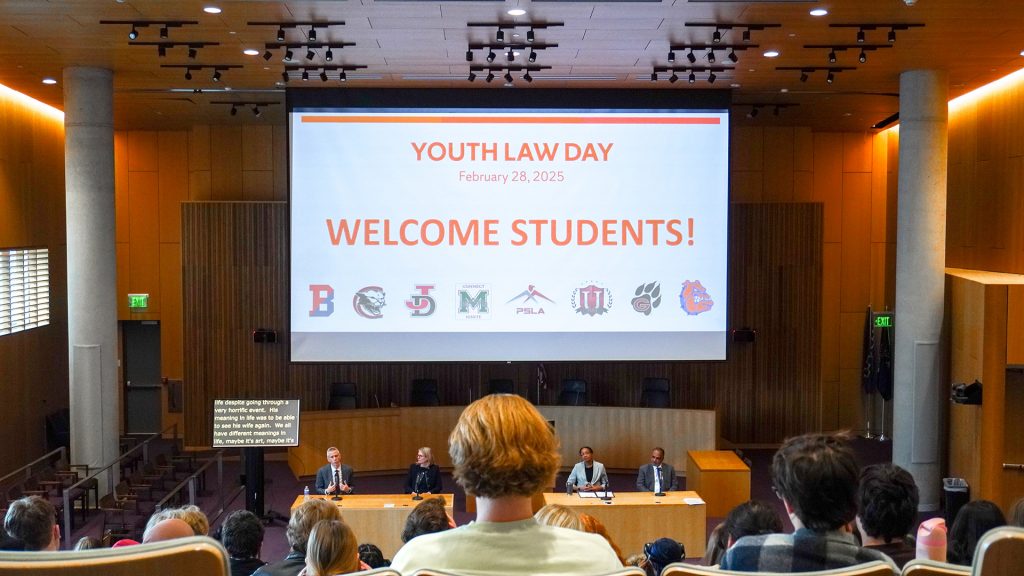
The College of Law’s annual Youth Law Day event recently brought more than 200 high school students from schools across Central New York to Dineen Hall for an introduction to the legal profession, learning about the role of attorneys in society, and how to chart a path to law school. The theme of the day was “Science and Technology in Law.”
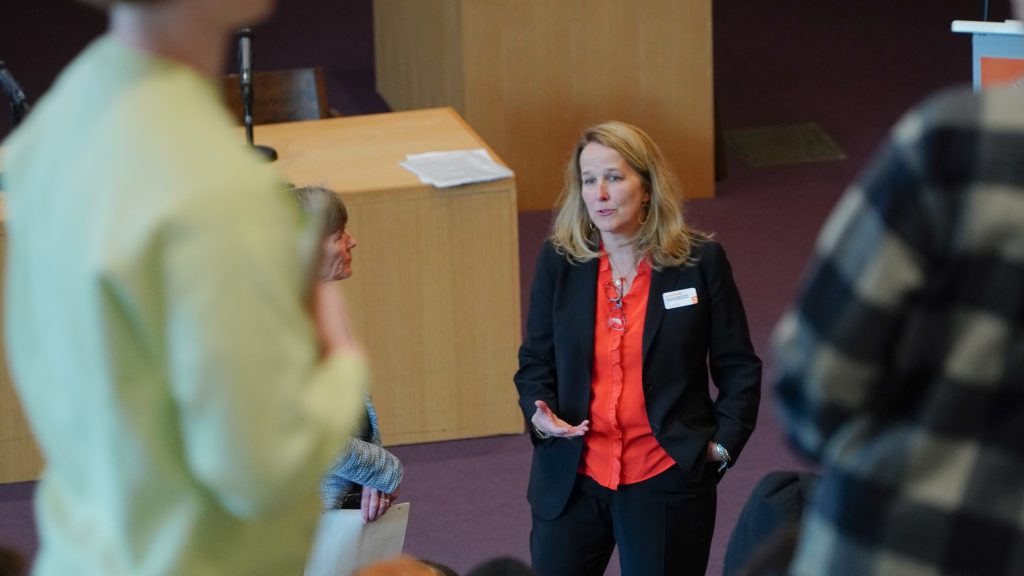
Participating schools were Binghamton High School, Corcoran High School, the Public Service Leadership Academy at Fowler High School, Geneva High School, Jamesville-DeWitt High School, Marcellus High School, Nottingham High School, and Utica Proctor High School. This year’s program was coordinated by Professor Lauryn Gouldin, co-founder of the Syracuse Civics Initiative.
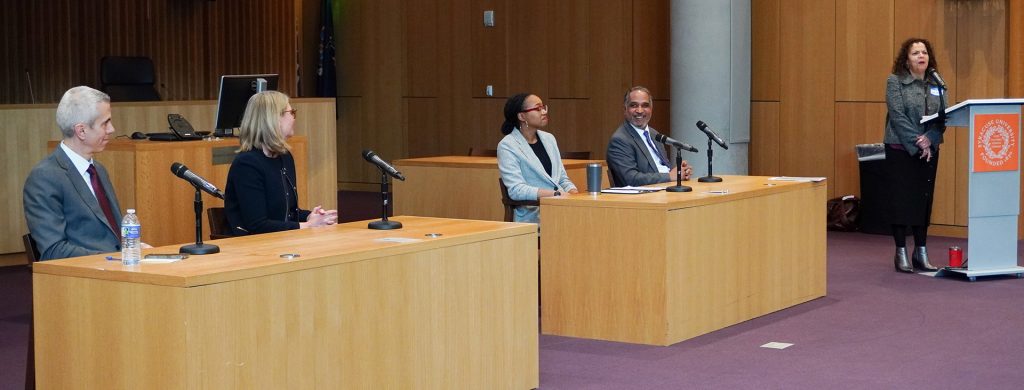
The welcome address of the day was delivered by the Hon. Brenda K. Sannes, Chief United States District Judge for the Northern District of New York. Students then heard from a panel of judges that featured the Hon. Anthony Brindisi, the Hon. Beth Coombe, the Hon. Ramón E. Rivera L’94, and the Hon. Staci Dennis Taylor L’14. Professor Nina Brown of the Newhouse School of Public Communications then lectured on Ownership and AI.
From left, the Hon. Anthony Brindisi, the Hon. Beth Coombe, the Hon. Staci Dennis Taylor L’14, the Hon. Ramón E. Rivera L’94, and Professor Suzette Melendez.
Before lunch, the students broke into groups to tackle a mock oral argument activity. This activity was led by current law students who gave them advice and feedback about oral argument and modeled the activity for them. While at lunch, students were able to network with faculty, alumni, and current law students.
Students then heard from a college admissions counselor who answered their questions about applying to law school, followed by a lecture called “The Life of a Criminal Case” by Gabriela Girona Wolfe L’16, Assistant Public Defender from the Northern District of New York.
Professor Lauryn Gouldin
The visiting students were then able to ask a panel of current Syracuse Law students about their path to law school, how to prepare for the LSAT, good study and test-taking habits, and more. The panel was moderated by 3L Jesse Elmer and featured 2L Jocelyn Anctil, 3L James Cameron, and 2L Jared Park.
Kimberly Wolf Price L’03, Chief Strategy & Diversity Officer at Bond, Schoeneck & King PLLC, provided closing remarks.
Event sponsors were:
Syracuse University College of Law
Barclay Damon
Bond, Schoeneck & King, PLLC Law Firm
Bousquet Holstein
The Hon. Robert A. Katzmann Justice for All: Courts and the Community Initiative
Lexis Nexis
New York State Bar Association
The Onondaga County Bar Association
Syracuse Civics Initiative
Syracuse Student Bar Association
The Wladis Law Firm
Travis H.D. Lewin Advocacy Honor Society
United States District Court for the Northern District of New York
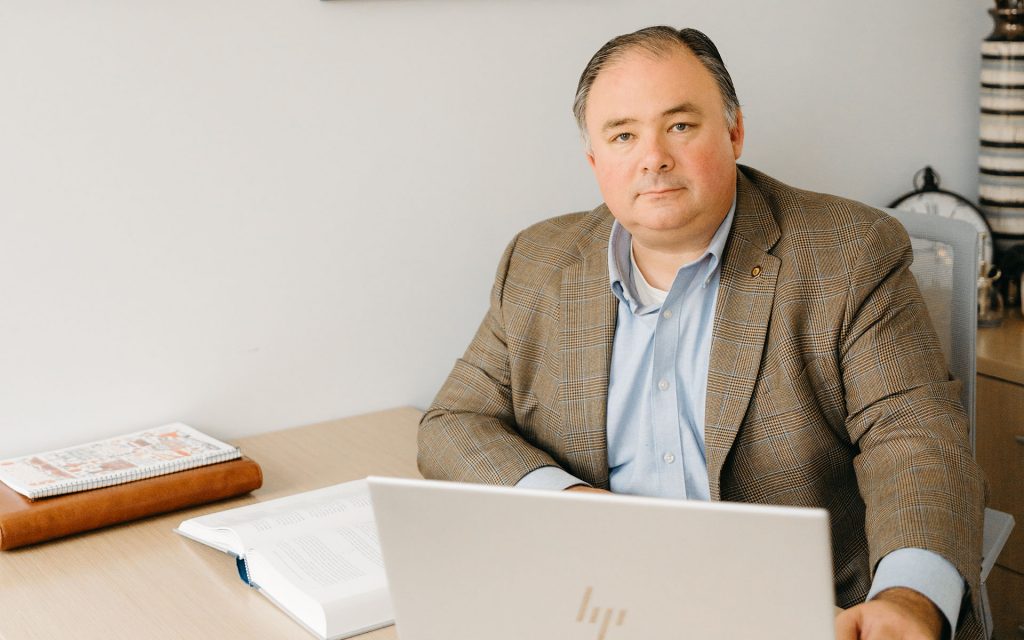
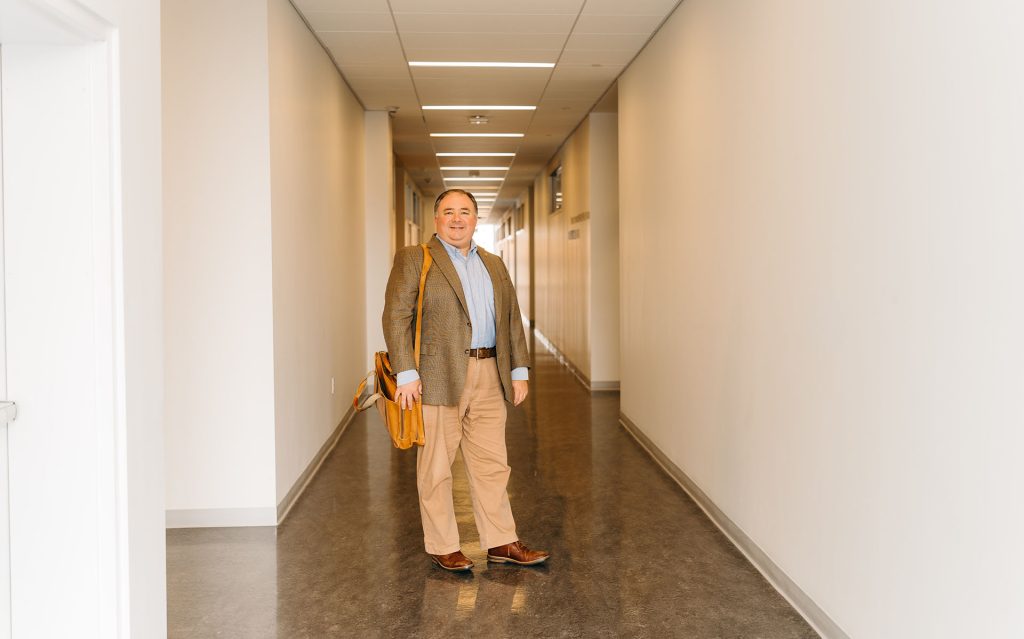
“The stakes are never higher than when someone’s liberty hangs in the balance,” says John J. Dowling III L’20 of why he chose to become a criminal defense attorney.
Dowling started his criminal defense practice, Dowling Defense Group LLC, in 2021 in Charlotte, North Carolina. After graduating from Syracuse University College of Law, he had opportunities to join larger organizations that would have initially been more lucrative, but he decided to blaze his own trail to gain trial experience as quickly as possible.
“It’s difficult to generate trial experience right out of law school. If you work for a big firm, it’s going to be a long time before you get to try a case in front of a jury,” he explains. “So I went another way and opened a law firm by myself, and it’s amazing. I’m so glad I did it, as I’ve already tried a number of cases and argued two cases in the U.S. Court of Appeals.”
Dowling believes that the advent of the plea bargain—which didn’t always exist—has resulted in less trial experience for attorneys. “Trial by jury pre-dates the American Revolution, and I don’t think plea deals are how the framers of the Constitution thought this is how it would go,” he says. “A jury trial is the spinal column of the criminal justice system, but it’s used less and less because the risks of going before a jury can be higher.”
His focus on federal criminal law is not often a common choice, but he likes the challenge of going up against the federal government, including the FBI, Secret Service, or IRS.
“It’s a huge process when the federal government comes at you with all its forces,” he says. “But, Syracuse Law set me up to be an effective criminal lawyer, and now I’m using those skills to help others.”
Dowling is thankful for the education he received at Syracuse Law, calling it “one of the best in the country” and noting the experience he gained in various legal externships, as well as Trial Practice, Trial Advocacy and Moot Court. He points to Associate Dean for Online Education and Teaching Professor Shannon Gardner as someone who had a big impact on him as she demonstrated excellence and professionalism within the law.
His law school education also cemented his beliefs that criminal defense attorneys are an essential function of the law. “Everyone deserves a defense,” Dowling says. “Whether someone is guilty or innocent, things need to be handled the right way, and rules need to be abided by in order for a fair system to exist.”
Many of his cases are considered white collar crimes, which come with complex questions and interpretations of the law. “Clients can get themselves into situations that weren’t nefarious, but the consequences can be devastating to their lives, marriages, finances, etc. And, whether or not the government can show proof beyond a reasonable doubt is not as cut and dried as people think,” Dowling says.
“White collar crimes can often be harder to figure out and more nuanced than violent crimes, but they still have devastating penalties,” he adds. “There are many people who are falsely accused or overcharged, not because prosecutors are corrupt but because a witness might be lying, evidence is presented in a certain way, or the government has taken shortcuts. Often, it’s the consequences of misunderstandings that put people in prison.”
He is pleased with the path he chose and finds his job as a defense attorney fascinating, interviewing witnesses, doing research, and demonstrating his knowledge of the law in front of juries, all in an effort to make sure his clients get a fair trial.
Dowling acknowledges there are a few cases he won’t take, but, he says, “I don’t struggle with what clients are accused of doing because I recognize that all people have rights. I’m not here to agree or disagree. I’m here to serve an essential function of the American legal system.”
(Syracuse, NY – March 24, 2025) The United States Court of Appeals for the Second Circuit will hold oral arguments at Syracuse University College of Law on March 28 from 10 to 11:30 a.m. The oral arguments are free and open to the public. Seating is limited.
The court session will be held in the Melanie Gray Ceremonial Courtroom in Dineen Hall, 950 Irving Avenue, Syracuse, NY 13244.
The cases to be argued are Keri Spring, et al v. Allegany-Limestone, et al and United States of America v. Allen R. Clark.
In addition, Director of Legal Communication & Research and Teaching Professor Aliza Milner will hold a lecture on the appellate process on March 28 at 9:30 a.m. in Dineen Hall. The lecture is open to all.
No cell phones, laptops, cameras, or video recording devices will be permitted in the courtroom during arguments. The College of Law will not be able to store any items.
About the U.S. Court of Appeals for the Second Circuit
The United States Court of Appeals for the Second Circuit is one of the thirteen United States Courts of Appeals. Its territory covers the states of Connecticut, New York, and Vermont, and it has appellate jurisdiction over the U.S. district courts in the following federal judicial districts: District of Connecticut. Eastern District of New York. Northern District of New York. Southern District of New York, Western District of New York, and District of Vermont.
The U.S. Court of Appeals sits just below the Supreme Court of the United States in the judicial branch of the federal government.
Glenda Criss L’28 and Sarah Peck L’28 recently placed second in the Northeast Regional of the National Patent Application Drafting Competition. The competition is hosted by the United States Patent and Trademark Office. Criss and Peck, students in Syracuse Law’s JDinteractive online J.D. program, were coached by George McGuire ‘91 L’96, a Member of Bond, Schoeneck, and King, and an Adjunct Faculty member at Syracuse Law since 1998.
The competition involves taking an invention statement and conducting a prior art search, developing a search strategy, drafting a complete patent application, and drafting a summary of the search strategy and the claim drafting strategy. The competition also had the students write an information disclosure statement (a statement under 37 CFR 1.56 required by patent applicants to disclose material prior art), prepare a slide presentation, and give an oral presentation and Q&A session before a panel of judges.
“The competition is, in essence, a 2 to 3 credit course on patent preparation/prosecution that Glenda and Sarah took on at the end of the fall semester of their first year of law school and worked on diligently over break and subsequently competed against other northeast law schools in February,” explains McGuire.
Following the oral presentations, the top three rated schools out of the nine in the region advanced to the regional finals where they were required to conduct a second round of presentations before a larger panel of judges. The College of Law was amongst the top three scorers from the opening round and advanced to the Regional Finals where Syracuse Law finished second.
“Needless to say, Glenda and Sarah did a tremendous job. Their determination, unbelievable work ethic, and brilliant legal work reflect very positively on Syracuse Law. Neither of these students had any prior experience with intellectual property law, let alone patents and patent application preparation and prosecution. They studied, learned, and remarkably applied their skills. They are both destined for great legal careers!” says McGuire.
Criss and Peck are very grateful for McGuire’s coaching. McGuire is a registered patent attorney and member of Bond’s intellectual property and technology practice. “We competed against teams of 2L and 3L students who have a more solid grounding in patent work and were able to finish in 2nd place. The judges indicated that one of our claims was so well drafted that it could likely be approved right away! This is largely due to George’s guidance and support. We have learned so much through this process, and we cannot express our gratitude enough.”
Dean Terence Lau L’98 was impressed by the students’ strong results. “Your dedication to mastering complex patent application concepts in such a short timeframe is truly impressive. Taking on this challenge during the end of the fall semester and over break demonstrates exceptional commitment to your legal education. The judges’ comments about your draft claims being potentially approval-ready speak volumes about the quality of your work. You took the initiative, you learned a great deal, and you demonstrated how powerful Syracuse Law can be on the national stage.”
Lau was also thankful for McGuire’s mentorship. “I cannot thank you enough for volunteering your time and expertise to coach our students. Your approach of guiding rather than doing the work for them exemplifies the best of legal education. The weekly meetings and patient mentorship made a tremendous difference in helping Glenda and Sarah navigate unfamiliar legal territory. This achievement highlights the caliber of our students and faculty at Syracuse Law.”
Growing up in southeastern Pennsylvania as the son of a small-business owner, John Lawrence saw first-hand some of the challenges faced by family-run businesses. Later on, he didn’t agree with some of the decisions coming out of Pennsylvania’s capital in Harrisburg, so in 2010 he decided he could best serve his community by throwing his hat into the ring to run for the House of Representatives as a Reformer. In 2011, Lawrence was sworn in to serve the 13th Legislative District, located in Chester County, and he hasn’t looked back.
“Serving as an elected official is humbling and a great honor,” says Lawrence, who is now in his eighth term.
A graduate of Penn State University with a degree in business, Lawrence has built a reputation for bringing a common sense approach to state government. He has authored bills to consolidate redundant government services, reform budgeting practices and even require state legislators to submit to drug tests. Putting his words into action, Lawrence refuses to take a state pension, per diems, drive a state vehicle or take advantage of other perks that come with the job.
This past session, Lawrence authored floor amendments to be sure citizens are aware of their right to counsel, that disabled veterans receive constitutionally mandated property tax relief and that police officers working in some of the most challenging areas in the state are rewarded. He has also had legislation signed into law to ensure victims of domestic violence are not required to financially support their convicted abusers during an ongoing divorce.
Outside of work, Lawrence is active in his church and community, and he and his wife are heavily involved in their two children’s high school activities.
With all of that going on, how is Lawrence possibly going to law school? Through the JDinteractive program at Syracuse University College of Law.
After college, Lawrence went to work at J.P. Morgan Chase as an account officer. Pursuing law was in the back of his mind, and he knew a legal background would be helpful in his line of work. After transitioning to politics, he considered part-time traditional law programs, but they were either too far away from his family and community or conflicted with his other obligations. So, when he discovered Syracuse Law’s hybrid JDi program, Lawrence thought it just might work.
“I did a lot of research before applying and visited the campus several times,” he says. “Before making the commitment to law school, I wanted to make sure I could make it work with my schedule. The JDi program gave me the flexibility to make it happen.”
Today, he is taking asynchronous classes and completing other tasks and activities online around his busy schedule through Syracuse Law’s JDi. He notes that one of the best things about the program has been the other students in his cohort.
“The caliber of others in my cohort is remarkable,” he says. “It’s such a diverse group with very different life experiences—a doctor, a dentist, several working on Wall Street. These people have great perspectives and bring some interesting experiences to the program. Most tend to be a little older than those in traditional law school, and, in a way, it’s helpful that we’re all dealing with the pressures of career, family, community and more. I think I’ve learned as much in law school through the others in my cohort as I have from my professors.”
Living about five hours from Syracuse University, Lawrence has attended several residencies on campus, including one on cryptocurrency just a few months ago. Now a 2L, he is preparing for higher level classes, and while he intends to keep serving the people of Pennsylvania, Lawrence also knows that a degree from Syracuse Law will allow him to expand his work and make him a better policymaker.
“Enrolling in the Syracuse Law JDi program was a great decision,” Lawrence says. “People might wonder if a hybrid online program can be engaging and rigorous, I can assure you that the program at Syracuse Law is both. I know that my experiences during the program and attaining a law degree will help me in ways that would not otherwise have been possible.”
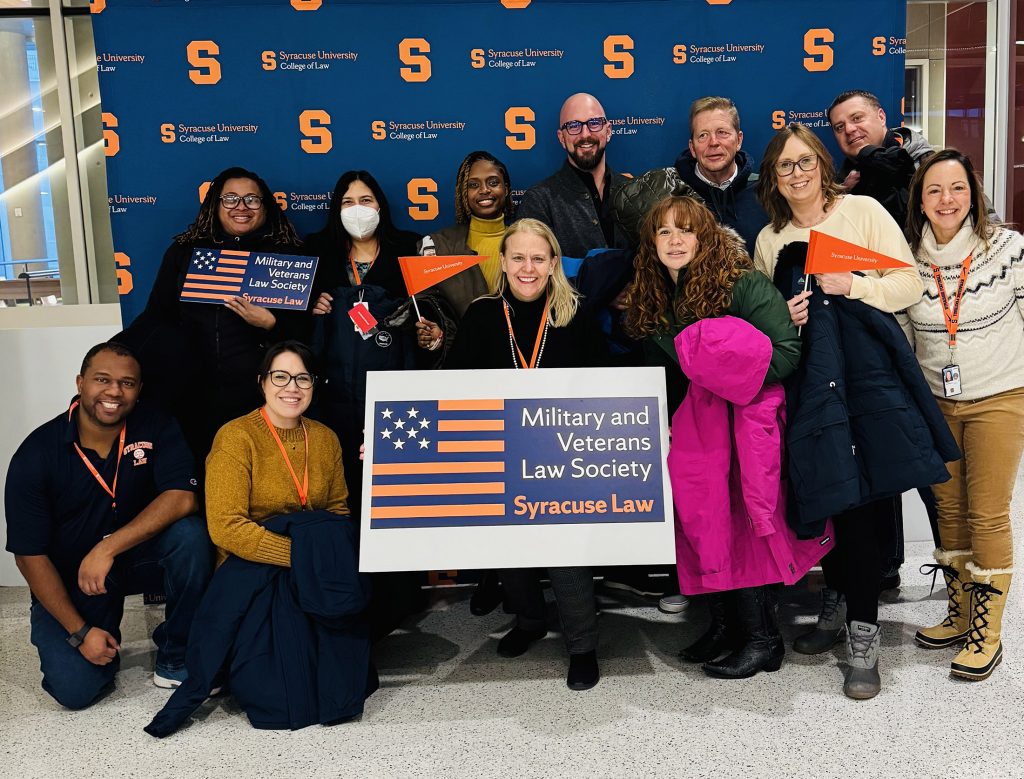
In January, JDinteractive (JDi) students came to the Syracuse University College of Law for several in-person residencies. Many brought heavy winter coats, hats, mittens and scarves, not just to endure the snowy Syracuse weather themselves but, more importantly, to donate to military veterans in need.
Operation Veteran Warm-Up was the idea of Inge Gedo L’25, a 3L in the JDi program who wanted to create a way for the JDi students to feel more connected to Syracuse Law by participating in a service project similar to what some of the Law School’s residential students do throughout the academic year.
A retired U.S. Air Force officer who lives in Virginia, Gedo bounced the idea off a few others during a residency on mediation held in Miami in December. It was well received, so she approached the Syracuse Law Military and Veterans Law Society (MVLS) and its faculty advisor Teaching Professor Elizabeth Kubala, who is also the director of veteran and military affairs; the executive director of the Betty and Michael D. Wohl Veterans Legal Clinic (VLC); and the director of clinical legal education at Syracuse Law.
The MVLS agreed to facilitate the project and decided that this year’s Operation Veteran Warm-Up would support an initiative that the VLC was already involved with in the greater Syracuse community. In partnership with the Syracuse VA Medical Center, The Altamont Program operates a transitional housing facility with 55 beds for unhoused veterans, both male and female, and provides case management, therapy and other services with the intention of finding veterans permanent housing and helping them get back on their feet. Operation Veteran Warm-Up complemented the efforts that the wider University holds each winter to assist students in need through its Operation Orange Warm-Up, as well as Syracuse Law and the entire University’s long-standing commitment to veterans in the community.
With only a few weeks until the on-campus residency, Gedo sprang into action to get the word out to the JDi students from the classes of 2025 to 2028 who planned to come to the Law School in January. She even set up a way for students to purchase through Amazon, so they wouldn’t have to pack items in their luggage. Delivery to Dineen Hall was difficult at this time of year, however, as the building was closed prior to the residency for the University’s annual winter break Orange Appreciation Days. Thankfully, Kubala stepped up and volunteered her home address for package delivery, and soon the items started rolling in. Donations even came from JDi students who were not attending the January residency.
Another wave of donations arrived when the residency began on campus, as JDi students brought winter clothing with them or purchased items locally when they arrived and heard about the service project. At the end of the residency week, some students from warmer parts of the country even donated the gently used coats, hats and scarves they had bought for themselves specifically for the trip to chilly Syracuse. In the end, more than 100 items were donated to Operation Veteran Warm-Up and distributed to those in the transitional housing program.
“Inge is the kind of person who gets behind something and makes it happen,” says Kubala, who got to know Gedo when she worked as her research assistant. “The participation and generosity of our JDi students and the willingness of the MLVS to facilitate Operation Veteran Warm-Up was simply amazing. Our residency programs are always a way for our JDi students to connect on a more personal level and get acquainted with the Syracuse Law campus, but this time it was even more special as the service project gave so many of the students an added sense of belonging by working together to meet a real need in the local veteran community.”
Gedo, who currently works as a legal intern at the Fairfax County General District Court in Virginia, will complete her degree in August 2025, but she is hopeful that the MLVS will continue to facilitate Operation Veteran Warm-Up with the JDi program annually and expand it, possibly including residential students, too.
“We intended to just start small this year, and we weren’t sure what the response would be,” says Gedo. “But, we were thrilled with the donations, and the feedback from the JDi students has been so encouraging. Not only did we assist veterans, which is, of course, very near to my heart as a veteran myself, but we also added another level of camaraderie to the JDi program. It turned out to be a very special project that I hope will continue in the years ahead.”
Rebeca Puente Chavar L’27 prevailed over Nicholas R. Hardy IV L’27 in the 15th Annual Hancock Estabrook First Year Oral Advocacy Competition.
The competition was judged by the Hon. Thérèse Wiley Dancks L’91, U.S. Magistrate Judge for the Northern District of New York; S. Alexander Berlucchi L’18, an associate at Hancock Estabrook; Michelle Whitton Cowan L’07, Managing Attorney, AmTrust Financial Services Inc.; and Gabriela Groman L’23, an associate at Hancock Estabrook.
Thirty-three first year students participated in the competition.
We are honored to have Frank Ryan IV ’90, L’94, Americas Chair, Global Co-Chair, and Co-CEO of DLA Piper and a Member of our Board of Advisors, as our Commencement speaker!
Ryan leads one of the world’s largest law firms, with lawyers in more than 40 countries throughout the Americas, Europe, the Middle East, Africa, and Asia Pacific. Throughout his legal career, Ryan has handled numerous high-profile matters in various areas and is known as a go-to strategist for some of the world’s most sophisticated media and sports corporations.
He is a member of the Legal Service Corporation’s Leaders Council, the nation’s largest funder of civil legal aid programs for low-income people, and sits on the Board of Directors for Beat the Streets NYC, an organization dedicated to mentoring NYC student wrestlers (Ryan was a member of Syracuse University’s Wrestling team as an undergraduate.) Ryan is a Founding Partner of the Legal Elite Athlete Pipeline Scholarship Program (LEAP), a DLA Piper initiative aimed at supporting student-athletes in their pursuit of legal careers through scholarship aid and educational guidance.
“New lawyers are joining the practice of law at an exciting time, with technology enabling lawyers to work smarter and faster, and clients relying on their lawyers more than ever for strategic advice at the highest levels of business,” Ryan said. “At the same time, there are important legal questions yet to be explored about how our government functions, where the boundaries of individual rights lie, and how our laws will adapt to changing technologies such as AI. I look forward to speaking with Syracuse Law grads about all that awaits as they embark on their legal careers.”
It is an honor to welcome Ryan back to the College of Law, and we are excited to hear his inspirational message in the JMA Wireless Dome on Friday, May 9.
Mercy Renci Xie LL.M.’20, who is currently pursuing an S.J.D. at the College of Law, recently had papers selected to be presented at Stanford’s Law & Humanities Workshop and the 2025 Law & Society Annual Meeting.
She will present her paper “Guanxi Paradox in Chinese Relational Legal Consciousness” at the Law & Humanities Workshop at Stanford University on June 9-10.
Her paper “Navigating Power Dynamics: Contingent Second-Order Legal Consciousness of Chinese Disabled People,” was selected to be presented at the 2025 Law & Society Annual Meeting in Chicago May 22-25.
Alex Styrt ’22, L’25 (left) with Premier client Jacory Croskey-Merritt (2025 NFL Draft Prospect) and agent/general counsel at Premier, Wyatt Mumfrey.
Alex Styrt ’22, L’25, is on the fast track. A 3L at Syracuse University College of Law, he is also founder and CEO of Premier Athlete Agency, a full-service sports agency representing elite athletes. The business is based in San Diego, California, and, thanks to Syracuse Law’s Orange Flex program, Styrt is able to live on the West Coast while finishing his law degree.
Styrt always wanted to be a sports agent, so he decided a degree in business followed by law school was the way to go. Typically, it would take seven years of school to get his career started, but then he found Syracuse University offered one of the country’s only 3+3 BS/JD programs. This accelerated program allows qualified students to earn a bachelor’s degree at the Martin J. Whitman School of Management in only three years and then, upon acceptance, get a jump start at Syracuse Law.
“The opportunities to get an undergraduate degree in three years and go right into Syracuse Law, along with the Orange Flex program, have let me accelerate my dream career, grow my agency and become a lawyer—all by age 24.”
—Alex Styrt ’22, L’25
At Whitman, Styrt majored in entrepreneurship and emerging enterprises (EEE). He was encouraged by his professors to take the plunge and start his own business in the developing area of NIL (name, image and likeness), which allows NCAA athletes to be paid for endorsements, appearances and other opportunities. He says the support system from the school “played a big part in his success,” even allowing him to use the work he was doing to establish the agency to fulfill course credit requirements.
“Getting the business running before starting law school made all the difference. Once I was a 1L, I don’t think I would have had the time to get it done,” Styrt says.
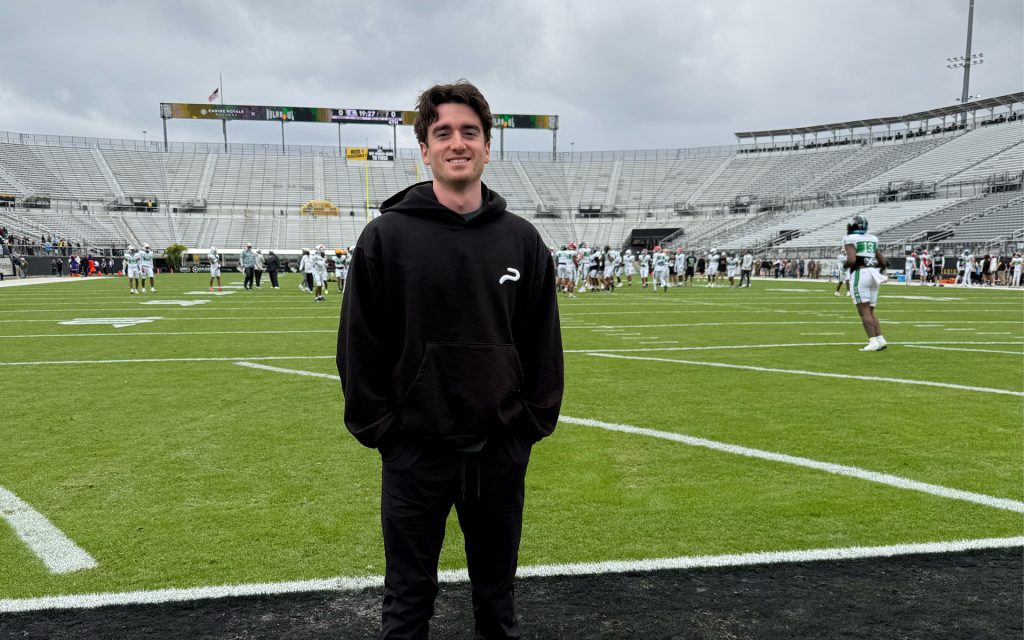
Alex on the field at the Hula Bowl in Orlando, Florida.
In 2022, he graduated from Whitman after just three years and started at Syracuse Law that fall with a focus on sports, entertainment and intellectual property. Styrt went to law school with the intention of building skills like negotiating, client advocacy and an overall knowledge of the law to help him better represent athletes for everything from endorsement deals to player contracts.
Styrt spent his first two years at Syracuse Law juggling classes while keeping his business growing over calls, texts and Zoom. But in 2L, Barry Weiss, special advisor to the Office of Career Services, suggested he look into Syracuse Law’s Orange Flex program, which allows qualified 3Ls to take their last year of classes online through the School’s JDInteractive program.
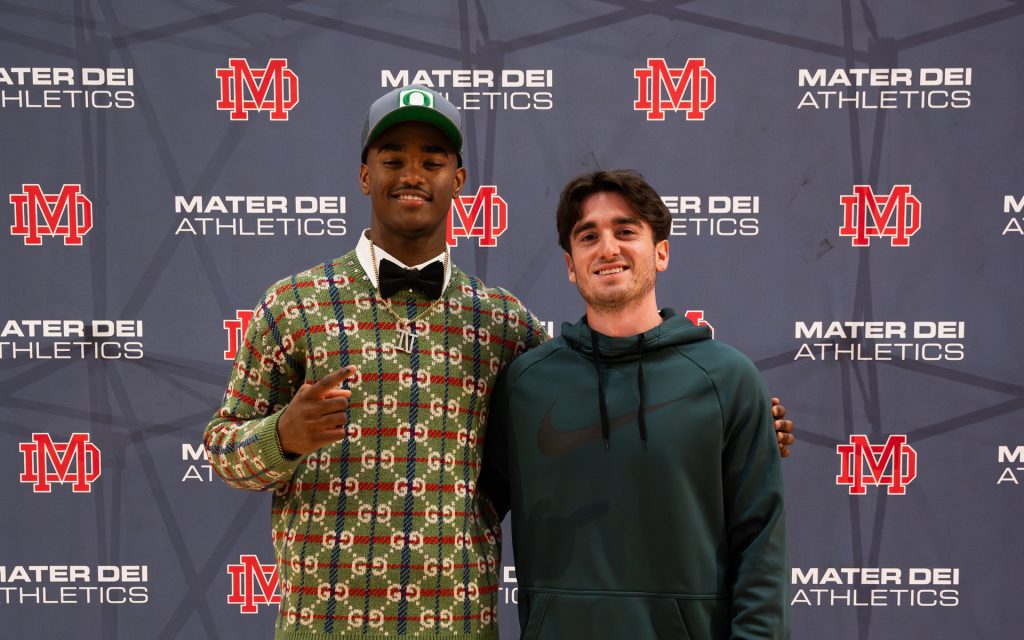
Alex with with Premier client, Nasir Wyatt (University of Oregon) at Mater Dei signing day in Santa Ana, CA
“Orange Flex was perfect for me,” he says. “I’m spending my 3L year in San Diego taking my courses online, while running my business full time. I’ve made a lot of sacrifices and put in plenty of 14 hour days jumping from classes to client calls, but the progress growing the company in just the past six months has been worth it. It’s my passion.”
His first client was signed by the San Francisco 49ers three years ago, when Styrt was only 21. Since then, the agency has expanded its client base to players drafted by more than a dozen NFL teams, as well as made inroads into women’s college basketball, beach volleyball and soccer. Styrt has worked with NFL athletes such as Jared Goff and Kerby Joseph, as well as artists such as Wiz Khalifa and Heembeezy. Most of Styrt’s time is spent working with his team at the agency, as well as representing athletes and their families in off-field business and marketing opportunities. He has negotiated endorsement deals with brands like Oakley, Alo, Bose, Fiji Water and Bulgari.
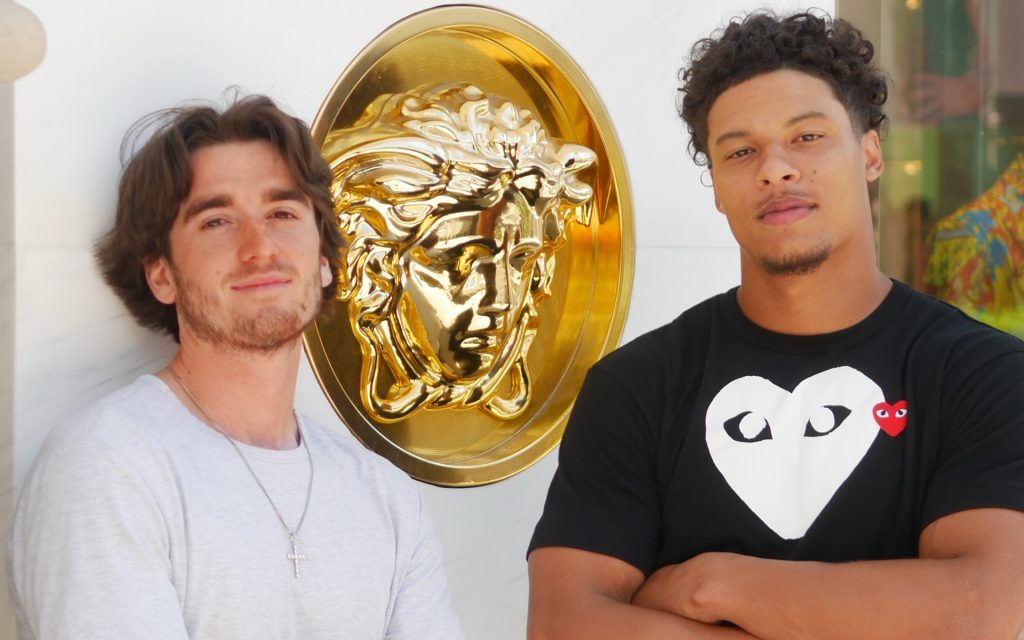
Alex with Tayler Hawkins (San Francisco 49ers) at the Versace Store in San Diego.
When Styrt graduates in Spring 2025, he will focus solely on the agency, but, to him, it’s become about so much more than just business. Styrt has become close with his clients and their families and says he “feels blessed to have developed great relationships that will last beyond football. They are family now.” He also credits his friends and own family who have been there since the beginning.
As his agency succeeds, giving back is important to Styrt, and he encourages his clients to give back, as well. Annually, Premier’s college athlete clients partner with Oakley to support the Boys and Girls Club through a holiday event where athletes sign autographs, take pictures and wrap gifts. Styrt assisted his client Cameron Young of the Seattle Seahawks with creating a bike drive where he gave away over 100 bikes to kids from his community in Crosby, Mississippi. And, currently, Premier is supporting client Josh Karty of the Los Angeles Rams, in his chosen charity for the NFL’s My Cause My Cleats—The American Cancer Society—by matching donations made in his name.
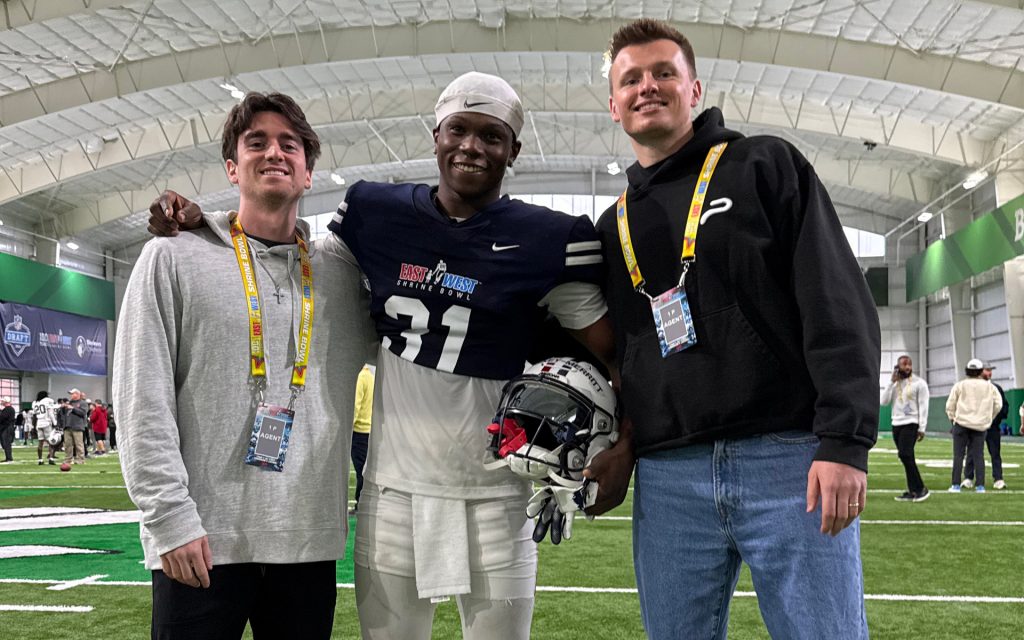
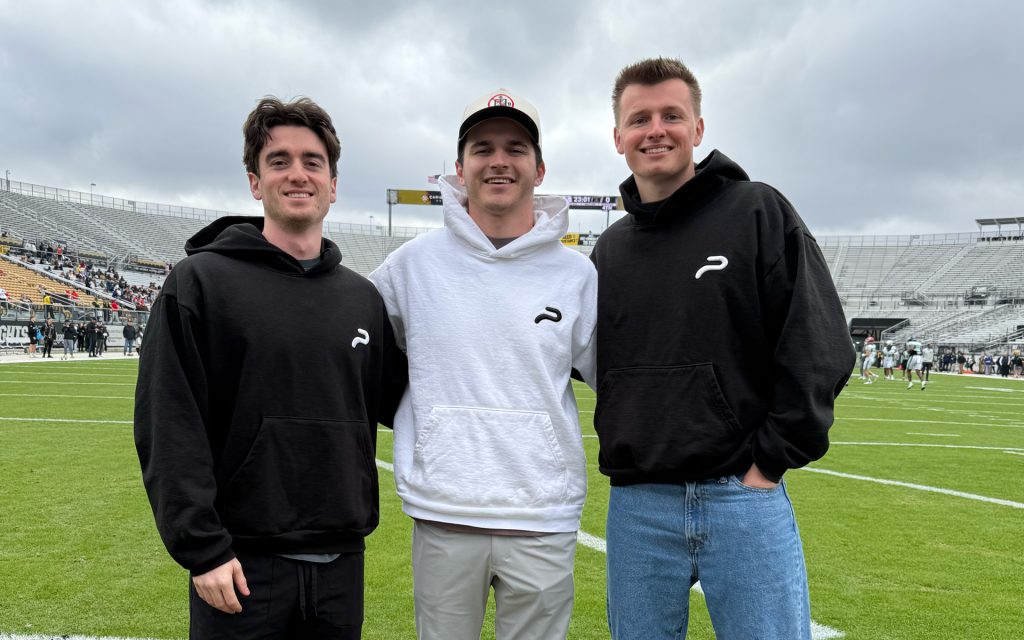
Alex (left) with Cole Singer (agent at Premier), Wyatt Mumfrey (agent and general counsel at Premier) at the Hula Bowl in Orlando, Florida.
Today, Premier is a full-service sports agency operating remotely with more than 30 team members, including in-house legal counsel and some employees recruited from Syracuse University. As of December 2024, Premier is providing legal services and business and marketing representation to over 40 clients across the NFL, NCAA and Ultimate Fighting Championship (UFC).
“Of course, I want to continue scaling the agency, but, the more I do this, the more it’s important to build a reputation as a person of character who cares about the athletes I work with and their families,” he says, noting that he specializes in setting up clients for their lives after football, something often overlooked with NFL players.
While Styrt acknowledges that becoming a sports agent is very competitive, he believes he has found his niche and is eager to see where it takes him.
“The opportunities to get an undergraduate degree in three years and go right into Syracuse Law, along with the Orange Flex program, have let me accelerate my dream career, grow my agency and become a lawyer—all by age 24,” he adds. “The whole experience at Syracuse has definitely been a win for me!”
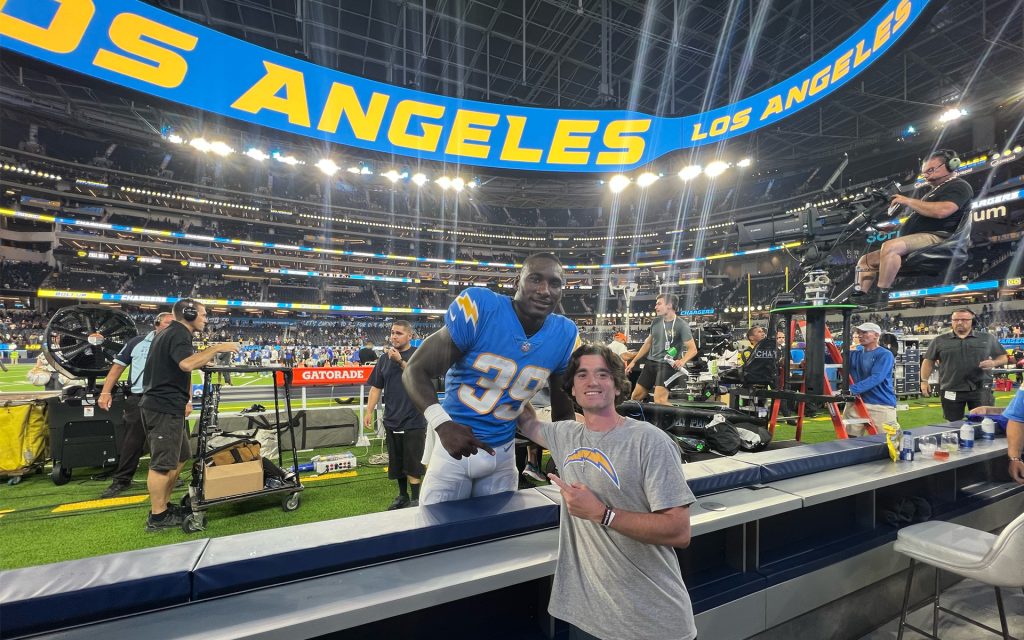
Postgame pic with Premier client Kevin Marks Jr. (Los Angeles Chargers) at Sofi Stadium in Los Angeles, California.