Our alumni family’s generosity continues to drive Syracuse Law’s success, enabling us to offer a forward-leaning legal education, recruit and retain the best and brightest students and an outstanding faculty, and build upon our traditions and strengths.
We couldn’t do it without you. Thanks to your gifts, each year we have new philanthropic successes to report:
During a global pandemic that tested us all, we exceeded our overall fundraising goal by more than $1 million, and we saw increased giving to our priority funds: the Law Annual Fund and the Scholarship and Financial Aid Fund.
We also successfully endowed new scholarship funds, including the Syracuse Black Law Alumni Collective William H. Johnson L’1903 Endowed Scholarship—named in honor of the College’s first African American graduate—and the Deborah and Sherman F. Levey ’57, L’59 Endowed Scholarship. These two new funds represent a landmark step in our continued efforts toward increased diversity, for our law school and the legal profession at large.
Moreover, our alumni consistently lead the University in giving participation when compared to their Orange peers and continue to lead the University in Forever Orange campaign participation. Our alumni family has much to be proud of!
In this chart, we highlight the top 10 classes by giving participation for the Fiscal Year 2021, as well as the top classes by giving participation for each decade. Congratulations and thanks to these classes for their outstanding contributions!
Our alumni’s generosity underwrites the College of Law’s success. For many alumni, a tradition of lifelong giving is often tied to personal stories and fond memories of their alma mater. And what better time to reflect on their College of Law days than on the occasion of a class anniversary!
Here, alums celebrating years ending in one share their philanthropic journeys. Tell us yours by emailing us at SULaw@syr.edu.
Barry Slotnick is a partner and Chair of the Intellectual Property and Entertainment Practice Group at New York City-based Loeb & Loeb LLP. His areas of focus include copyright, rights of privacy, and publicity and entertainment law. He is also a member of the board of the Volunteer Lawyers for the Arts.
What inspired you to study law?
As a kid, I had a propensity and a talent for arguing with people. I was also terrible in math and science, so med school was out of the question!
What brought you to Syracuse Law?
I chose to attend SU because of the quality of education it offered. I also had friends who were at or were going to the College of Law, which was a draw, and I received a scholarship.
What law school memories stand out?
I recall feeling totally lost and overwhelmed during the first few weeks of law school. That feeling eventually went away. Now, if I have such feelings—and they still do come back on occasion—I just ask an associate to give me the answer I am looking for!
Did you attend the most recent reunion?
I did not get to attend the 50th reunion because of COVID-19. I’m really not sure I wanted to see how old everyone else got! I find it hard to imagine it’s been 50 years. The time went by so quickly, but time flies when you are having fun.
Did a particular law professor have a lasting impact?
Professor Thomas Maroney L’63 seemed to really love what he was doing. He taught at the school for 43 years.
Why is philanthropy important to you personally?
I started giving to the school a few years after graduation. It would have been difficult for me to attend law school without the financial assistance I was given. I also try to give my time, because of the mentoring I received both at school and once I began practicing. How could I not do the same for the next generation?
Do you have a message to recent graduates about giving back?
My advice is to do what you can. Make an effort and stay involved.
Our alumni’s generosity underwrites the College of Law’s success. For many alumni, a tradition of lifelong giving is often tied to personal stories and fond memories of their alma mater. And what better time to reflect on their College of Law days than on the occasion of a class anniversary!
Here, alums celebrating years ending in one share their philanthropic journeys. Tell us yours by emailing us at SULaw@syr.edu.
The Hon. Carl J. Mugglin practiced general law and served as a confidential law secretary to a judge and one term as Delaware County District Attorney. In 1985, he was elected a Supreme Court Justice for the Sixth Judicial District and was re-elected in 1999. He retired from the bench in 2007.
What inspired you to study law?
From 1954 to 1958 I was enrolled in the Syracuse University School of Business Administration. During this time, I took several courses in political science at the Maxwell School, and as a result of these studies, I was inspired to apply to law school. I scored well on the law aptitude exam and was accepted at the University of Chicago Law School.
Then why study at the College of Law?
When I found out that my wife, who was entering her senior year at SU, could only transfer enough credits to be a second-semester freshman at Chicago, I went to visit Syracuse’s law school dean. This was about two weeks prior to the fall semester. He accepted my verbal application, and he enrolled me that day.
What part of law school made a lasting impact?
My memories of law school revolve around long hours of studying, which I came to see as good preparation for private practice, and the different methods of instruction used by the professors. This ranges from the instillation of fear of failure to friendly helpfulness, which was good preparation for trial practice.
Looking back, what are some career highlights?
After graduation, I worked for a firm in Endicott, NY, for about one year. I then returned to my hometown of Walton, NY, where I engaged in general practice until January 1986. During this time, I held two part-time positions. I was the District Attorney of Delaware County from 1965 to 1967, and I was a law clerk for a Supreme Court Justice from 1973 to 1979. In November 1985, I was elected as a Justice of the Supreme Court for the State of New York. I served on the trial bench for 13 and a half years and on the Appellate Division, Third Department, for eight and a half years, retiring at the end of 2007 at the age of 70.
Why is giving back important to you?
Philanthropy has always been an important part of my life, particularly when it comes to supporting those institutions or organizations that are not supported by tax dollars and that have been helpful or meaningful to me. Thus, I have been generous in my support of my church, the Boy Scouts, the local hospital, the Memorial Sloan Kettering Cancer Center, and the College of Law.
Do you have a message to recent graduates about giving back?
Obviously, I could not have had the very enjoyable career that I did have without the education provided by Syracuse. I encourage all Syracuse Law graduates to remember their own careers and to give as generously as possible on an annual basis.
You don’t need me to tell you that so much has changed in legal education during the last year, let alone the last five years that Dean Boise has been at the helm of our College of Law.
When I think about the adaptation that law schools and other institutions of higher learning have had to make during the pandemic, I cannot help but take pride in knowing many of them turned to Syracuse as a leader in that realm.
Frankly, it’s easy to see why. For one, JDinteractive has set the bar for the future of legal education. The growth of our online option for a J.D. has been phenomenal, from hosting 32 students in the first cohort in 2019—who will graduate this coming spring!—to 97 students this year.
Witness also the continued expansion of international programs, which under the stewardship of Assistant Dean of International Programs Andrew Horsfall L’10 saw the largest matriculating LL.M. class in 2021, along with the development of groundbreaking partnerships such as the 3+3 Program with Historically Black Colleges and Universities in Atlanta.
“How can you help young alumni land that first job or make the transition to a more meaningful career path?”
Additionally, Dean Boise’s promotion of Professor Suzette Meléndez as the law school’s first-ever Associate Dean for Equity and Inclusion speaks to the College’s commitment to equity and inclusion. So does the College of Law’s agreement with AccessLex Institute to offer a robust bar preparation program free of charge and ensure that all students have the tools they need to pass the bar exam upon graduation.
I am delighted to see the expansion of these and other opportunities for our current and future students. The growth of opportunities is so critical not only for their success but also for ours as an institution. The Syracuse University Law Alumni Association has been busy, too. See how you can help:
In April, outraged by the torrent of anti-Asian racism and acts of violence around the country, SULAA issued a statement in solidarity to stop Asian hate and called on all alumni to condemn the discrimination and xenophobia.
My question to our alumni family is: How can we use our influence to take a stand for justice and healing?
In May, SULAA welcomed the Class of 2021 to our alumni family. Like the Class of 2020, these graduates faced remarkable circumstances, including the inability to celebrate together in person their hard-earned accomplishment of graduating from law school and having to take socially distanced remote bar exams. We are proud of their accomplishments and look forward to their impacts on the legal profession, their communities, and our law school. We also recognize the challenge of launching a career is far from over.
How can you help young alumni land that first job or make the transition to a more meaningful career path?
In June, SULAA hosted “Tips for Tackling a Remote Bar Exam,” a special panel discussion for the Class of 2021 featuring Aubre Dean L’20, Natalie Switzer Maier L’20, and Delaney Rose Moore L’20, organized and moderated by Lauren Blau L’17.
What experiences can you share with fellow alumni to help smooth the path for those who follow in your footsteps?
Also in June, SULAA welcomed six accomplished alumni to its Board of Directors: Sonia Worrell Asare L’06, BreAnna Avery L’17, Brittany Jones L’14, Benita Miller L’96, Sean Palmer L’01, and Kathleen Turland L’95. Additionally, throughout the year, we have welcomed alumni participation across our many committees and initiatives.
There are many ways to get involved in our alumni network—how will you participate?
In September, SULAA, the SULAA Inclusion Network, and the College honored eight distinguished alumni and faculty during the annual Syracuse Law Honors and Alumni of Color awards ceremonies during Law Alumni Weekend. They included Seuk Joon Lee L’99as the inaugural recipient of the Asian Pacific Island Legacy of Excellence Award. This award would not have been possible without the vision and leadership of SULAA Board Members Kimberly Lau L’06 and Astrid Quiñones L’18, Professor Mary Szto, and the student leaders of the Asian Pacific American Law Students Association, the Korean Law Students Association, and the South Asian Law Students Association. Nominations for next year’s recipients are already being received (email Director of Alumni Relations Melissa Cassidy at mpcassid@syr.edu to learn more).
How will you reconnect and reengage with the law school and your former classmates?
In October, building on the success of our partnership in 2020, SULAA and the College of Law Board of Advisors launched another dollar-for-dollar fundraising challenge, to match the first $10,000 donated by law alumni during Boost the ’Cuse.
Which College of Law programs or initiatives will you support through your financial generosity?
SULAA is committed to engaging and empowering our alumni through communication, knowledge, and resources. How would you like to see SULAA advance our mission of linking the past, present, and future of our College of Law family? I don’t ask these questions rhetorically. On the contrary, I welcome your input and participation. SULAA is your law alumni association (remember, all alumni become members upon graduation).
If you have not done so already, please join the conversation on our LinkedIn page (search for Syracuse University Law Alumni Association), and please don’t hesitate to reach out to any Board member at any time. We would love to hear from you.
Go Orange,
Mark O’Brien L’14 President, Syracuse University Law Alumni Association
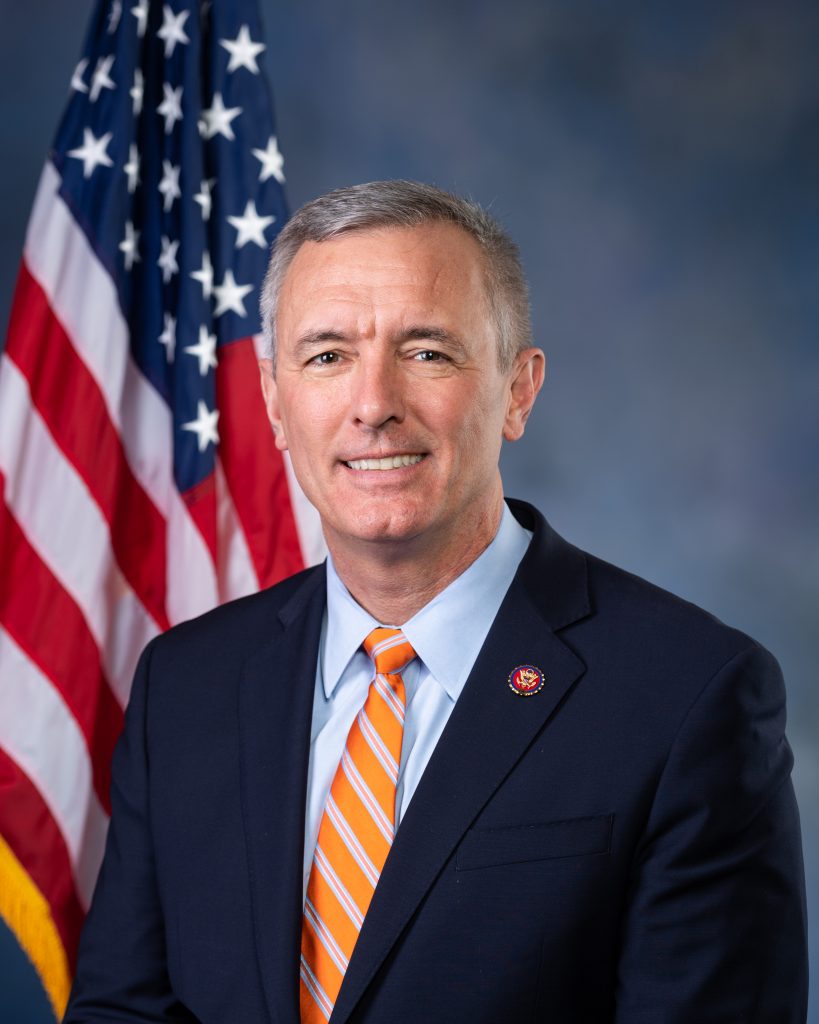
Elected for a fourth term in the US House of Representatives in November 2020, Rep. John Katko L’88 serves New York’s 24th Congressional District, which includes all of Onondaga, Cayuga, and Wayne counties, as well as the western portion of Oswego County in Central New York.
Currently, Congressman Katko is Ranking Member on the House Committee on Homeland Security—leveraging his years as a federal prosecutor litigating narcotics and gang cases—as well as a member of the House Committee on Transportation and Infrastructure.
Serving as a Congressman is the latest position in a distinguished public service career for the Central New York native. Today, Congressman Katko resides in Camillus with his wife, Robin, a registered nurse, and is the proud father of Sean (currently a second lieutenant in the US Army), Logan, and Liam.
After earning degrees from Niagara University and the College of Law, Congressman Katko began his career at Washington, DC, firm Howrey & Simon. He then worked at the US Securities and Exchange Commission before becoming an Assistant US Attorney for the US Department of Justice, serving as Special Assistant US Attorney in the Eastern District of Virginia and with the DOJ’s Criminal Division, Narcotics and Dangerous Drug Section. In this capacity, he served as a Senior Trial Attorney on the US-Mexico border in El Paso, TX, and in San Juan, PR.
“It’s clear that the College provided both President Biden and me with a high-quality education that we’ve relied on for our successes.”
Later, Congressman Katko returned to Central New York as a federal organized crime prosecutor in Syracuse for the US Attorney’s Office in the Northern District of New York, spearheading high-level narcotics prosecutions.
Throughout his 20 year career as a federal prosecutor, Congressman Katko was repeatedly tapped to train prosecutors in Central and South America, Eastern Europe, and Russia. He also was selected to serve as the only foreign prosecutor to lead an investigation and prosecution of government troops in Albania who shot and killed numerous protestors. He was awarded top prosecutor awards by three different Attorney Generals.
Notably, in the mid-2000s, Congressman Katko led the Syracuse Gang Violence Task Force, which employed the Racketeer Influenced Corrupt Organizations Act, along with other federal statutes, to prosecute gang-related crime in the city. Between 2003 and 2012, the Task Force prosecuted 90 suspected members of six Syracuse street gangs.
While first running for Congress in 2014, Congressman Katko referred to his work breaking up Syracuse gang violence in a Syracuse Post-Standard interview: “If I can get gang bangers to cooperate, I can certainly work with the knuckleheads in Washington and help them straighten things out.”
We recently caught up with Congressman Katko to ask him about his service to his community and the nation, how Syracuse Law prepared him for life as a prosecutor and Congressman, and what it takes to lead in Washington, DC, in the midst of a highly partisan atmosphere.
What led you to pursue a law degree at Syracuse Law? As a student, I quickly developed an interest in public service and found that I enjoyed working on issues that supported my community and our nation. That, combined with the appreciation I always had for Syracuse University growing up, sort of instinctively led me back to the College of Law after my undergraduate degree, and that turned out to be a great decision.
When did you know you wanted to be a federal prosecutor and later seek public office? I still remember the first time I was at the podium while serving at the US Securities and Exchange Commission and was introduced as “John Katko on behalf of the United States of America.” That was the moment where everything clicked for me, and I knew what I wanted to do.
How did Syracuse Law prepare you to become a federal prosecutor? I remember how fired up I would get for trial practice classes, and how much that feeling stuck with me. Those classes really prepared me to pursue a career as a prosecutor.
Why is public service important to you, and what should the public understand about the role of public servants in a democracy? As a federal prosecutor, it was drilled into your head to always be non-political and to only look at the facts. Integrity and ethics always came first and foremost, and it was important to remember that I was in that role to seek justice, not just to win cases.
Those principles date back to my earliest classes at Syracuse Law. It was hammered into our heads as students that upholding the law is a tremendous responsibility to be entrusted with, and therefore we have to be as objective as possible in every decision we make.
Now, as a member of Congress, I still make every decision by analyzing the facts and assessing the evidence in front of me. Sometimes, that leads to a choice that’s not popular with everyone, but ultimately, I’m here to do what’s right.
Many alumni serve the public—from your perspective, is that a coincidence or the result of a Syracuse Law education? Syracuse provides a lot of opportunities to serve our communities, such as the legal clinics and other chances to deliver pro bono service to give back and make a difference. I learned very quickly that there was a lot of good that someone could do with a law degree, and you could tell the College of Law deliberately worked to instill this lesson in us.
All Syracuse Law students should know that it’s a distinct honor to serve the public and to realize our ability to have a positive impact on society. There’s no better reward than being able to help people and feel good about the work done along the way.
In your opinion, what makes a good leader? How do these skills relate to your work as a Congressman? People have to recognize when they don’t have all the answers and learn to value other sides of an argument. In Congress, I interact with a lot of different opinions on just about every issue imaginable. Whether I’m listening to constituents or working on a bill with members of Congress representing different districts across the country, I always want to keep an open mind and find ways to make compromises.
I’ve been fortunate enough to be elected to Washington, DC, and to advocate for policies that help my district. It turns out that writing off half your colleagues as enemies isn’t the most effective strategy to get this done, so I’ve been willing to work with anyone, regardless of party, who shares my concern for an issue.
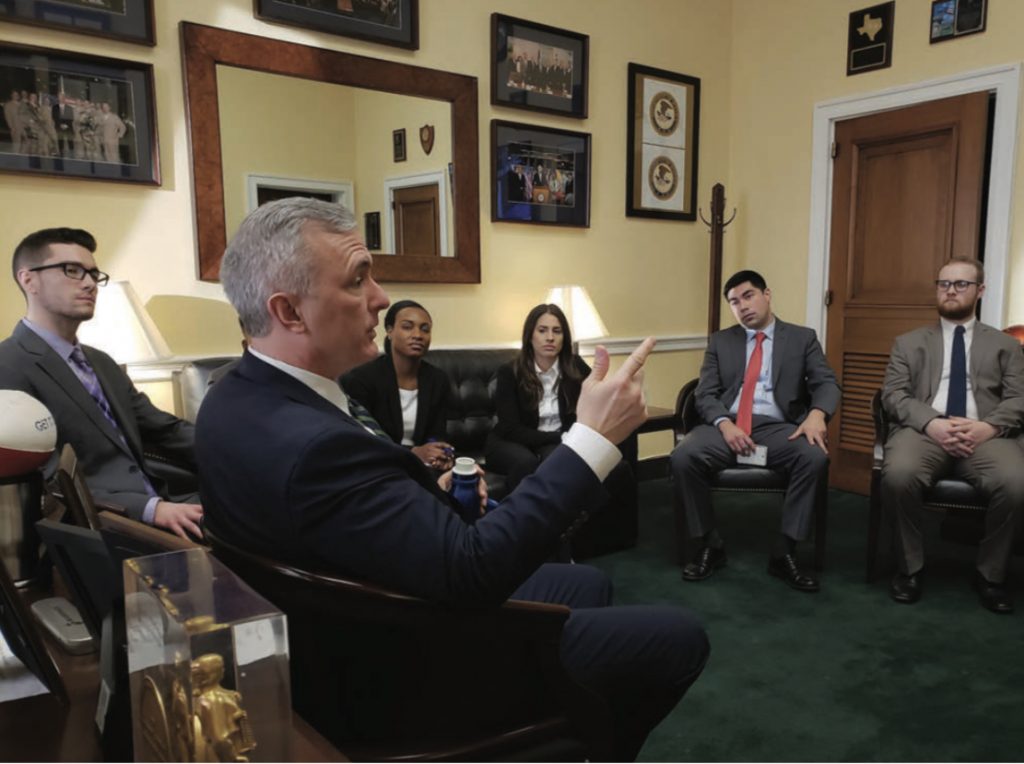
Rep. John Katko L’88 meets with Washington, DC, externs in November 2019.
What are your thoughts on a fellow alum being elected President while you are serving in Congress? I’m proud of our school. It’s clear that the College provided both President Biden and me with a high-quality education that we’ve relied on for our successes. It’s exciting to see that we’re just two of the many distinguished alumni who have come out of Syracuse Law, and I hope the school continues the tradition of providing a superb education that helps students do good in the world.
How would you define your legacy in public service? I’m a normal guy who’s been granted some extraordinary responsibilities in my life. I guess I want to be remembered as someone who never let these get to his head and as someone who used his good fortune to give back to the community he grew up in and loved.
Last year, we celebrated the 125th anniversary of the founding of the College of Law. Although we all had the opportunity to celebrate and recognize the many achievements of the College over those 125 years, for many it remained a time of anxiety, stress, and uncertainty.
While much has changed over the past year, issues that challenged us then continue to evolve even as new issues have arisen. Not surprisingly, the College has met them head-on.
For example, historical shortcomings in diversity, equity, and inclusion (DEI) among our political, civic, legal, and other institutions are in sharper focus. Recognizing the impact a more diverse, equitable, and inclusive environment can have, the College launched a cultural competency curriculum this Fall. Residential and online students will be required to take a cultural-competency course as a requirement for graduation. This effort will expand and deepen as the College community works to better understand the role of DEI in legal education and beyond.
Artificial intelligence (AI) has been the stuff of science fiction for many years. More recently, it has become a focus of the College’s Institute for Security Policy and Law (SPL). National security decision-making long has been the province of human effort. Increasingly, however, AI not merely supports those efforts but, in fact, it may supplant those efforts. SPL explores the legal and policy boundaries between the benefits provided by AI and the need for human (ethical) control.
“I am especially proud that the College is now ranked #11 nationally in Trial Advocacy by U.S. News and World Report.”
As the College continues to rise to meet existing and new challenges, it continues to deliver high-quality legal education. Faculty are always advancing their knowledge in their respective fields through teaching and writing, generating an extraordinary number of scholarly books and other publications.
Bolstered by externship opportunities, the College’s clinics offer proving grounds for our students who deliver much needed representation across the disciplines of bankruptcy law, criminal defense law, disability law, tax law, transactional law, and veterans law—and who gain meaningful practical skills as student attorneys.
Finally, the Advocacy Program provides extensive and rigorous opportunities for students to develop their trial, appellate, and negotiation skills. I am especially proud that the College is now ranked #11 nationally in Trial Advocacy by U.S. News and World Report.
What the College is today and where it will go in the future is in no small measure driven by the engagement and support of the alumni and friends of the College. Your generosity enables us to lean into the challenges that lie ahead. On behalf of the Board of Advisors, faculty, and students, I thank you for your support and hope that you’ll remain engaged with your alma mater well into the future.
Thank you for making Law Alumni Weekend 2021 a tremendous success. After last year’s 100% online gathering, this year’s event returned to Dineen Hall, with most events also available online.
Across the weekend, more than 400 attended 19 events, featuring dozens of alumni and guest presenters, 10 honorees, and nine student organizations. “It was a joy to reconnect with so many of you in Dineen Hall after such a long absence, and from my perspective, the energy, enthusiasm, and sense of renewal were palpable,” says Dean Boise.
Of course, we couldn’t have done it without you. Thank you to all who attended an event or get-together in person or online, moderated or served on a panel, engaged with students and fellow alums, or worked with us behind the scenes.
Many thanks also to our sponsors, including Lowenstein Sandler LLP (title sponsor); Bond, Schoeneck & King PLLC; the Institute for the Study of the Judiciary, Politics, and the Media; Mackenzie Hughes LLP; the Northern District of New York Federal Court Bar Association; the Syracuse Civics Project; The Tully Center for Free Speech; and Wladis Law Firm.
If you missed any of the programs, videos of Dean Boise’s State of the College Address, the annual United States Supreme Court Preview, and the Law Honors Awards and Alumni of Color Awards ceremonies are posted at alumniweekend.law.syr.edu.
And it’s not too early to start planning for LAW 2022. Be sure to visit law.syr.edu/honorsaward to submit candidates for the next Law Honors and Alumni of Color awards.
LAW 2021 featured the final round of the 50th anniversary of the Mackenzie Hughes LLP Edmund H. Lewis Appellate Advocacy Competition. Pictured (L to R): The Hon. David E. Peebles L’75, US Magistrate Judge, US District Court of the Northern District of New York (NDNY); Hon. Brenda K. Sannes, US District Judge, US District Court of NDNY; 3Ls Cierra Thomas and Gabriella Kielbasinski (winners); the Hon. Frederick J. Scullin Jr. L’64, Senior US District Judge, US District Court of NDNY; Hon. Thérèse Wiley Dancks L’91, US Magistrate Judge, US District Court of NDNY; and Hon. Ramón E. Rivera L’94, Judge, NY Court of Claims.
The Corporate Law Society’s“Inside the Minds of Inside Counsel” panel featured (L to R) Scott P. Boylan L’85, Partner, StoneTurn Group LLP; Lisa K. Levine L’96, General Counsel, National Women’s Soccer League; Aaron M. Tidman L’07, Global Compliance Counsel, Pinterest; and Assistant Dean of Career Services Lily Yan Hughes. Neena M. Patil, Chief Legal Officer and Senior Vice President, Jazz Pharmaceuticals, joined via video.
Michael Kaplan L’11 (far right), Partner at Lowenstein Sandler LLP, hosted a timely CLE presentation on “Virtually Litigating: Pros and Cons of Litigation Practices Developed During COVID-19.” Other panelists were (L to R) Kara Krueger L’11, Senior Counsel, National Grid; Allison B. Fiut L’11, Partner, Harris Beach PLLC; and the Hon. Mae A. D’Agostino L’80, US District Judge, US District Court of NDNY.
The Hon. James P. Murphy L’84, NYS Administrative Judge, Fifth Judicial District, delivered the keynote address at the annual Lunch with Judiciary and Alumni.
The College of Law’s fifth annual United States Supreme Court Preview featured a keynote address from David G. Savage, Supreme Court Correspondent, The Los Angeles Times. The keynote was followed by a panel discussion that featured (L to R): Savage; Professor Gary Kelder; Bond, Schoeneck & King Distinguished Professor Cora True-Frost L’01; the Hon. Glenn T. Suddaby L’85, Chief US District Judge, US District Court of NDNY; Jesse Feitel L’16, Media Associate, Davis Wright Tremaine LLP; Associate Dean for Faculty Research Kristen Barnes; and Vice Dean Keith Bybee.
The 2021 Law Honors Award Ceremony honored five recipients. Seated in the front row are: Professor and Director of the Cold Case Justice Initiative Paula Johnson; Carey Ng L’02, Assistant District Attorney, Suffolk County District Attorney’s Office; Laurence Bousquet L’80, Partner, Bousquet Holstein PLLC; and Melanie Gray L’81, Partner (Ret.), Winston & Strawn LLP. On the screen is recipient Joanna Geraghty L’97, President and Chief Operating Officer of JetBlue, who could not attend the ceremony. Standing at back are Mark O’Brien L’14, SULAA President; Richard Levy Jr. L’77, Co-Chair, SULAA Syracuse Law Honors Committee; Director of Alumni Relations Kristen Duggleby; and Dean Boise.
The Law Honors Award reception is always a time to reconnect with old friends and make new ones, including this group of current students pictured with Law Honors recipient Melanie Gray L’81 (center right).
Alums, faculty, staff, and students convened at SU’s new National Veterans Resource Center for the event “Supporting Veterans in Our Community.” Attendees met student attorneys and learned about the work of the Betty and Michael D. Wohl Veterans Legal Clinic (VLC). Also—in a special ceremony—Robert J. Gang L’42, the College’s oldest living alum, was honored with a proclamation from Rep. John Katko L’88 recognizing his Army service in World War II and the Korean War and his long dedication to the legal profession. He is pictured with VLC Executive Director Elizabeth Kubala and Holly Gang.
LL.M. alums from across the years and around the globe reconnected with each other at the annual LL.M. Reunion and heard program updates from Assistant Dean of International Programs Andrew Horsfall L’10.
Members of the classes of 2020 and 2021 got back together for a casual afternoon lunch reunion.
LAW 2021 concluded with the Fourth Annual Alumni of Color Awards Ceremony. The Hon. Ramon Rivera L’94, second from left), New York State Court of Claims, received the LALSA Legacy Award, and standing next to him is the Hon. Rodney Thompson L’93, Presiding Judge, Family Division, Superior Court of New Jersey, BLSA William Herbert Johnson Legacy Award. On the screen is Seuk Joon Lee L’99, Senior Foreign Counsel, Yulchon, the recipient of the inaugural Asian Pacific Islander Legacy of Excellence Award. Award. Standing next to Rivera is SULAA Board member and Inclusion Network chair Astrid Quiñones L’18 and next to Thompson is SULAA Board member Betina R. Miller L’96.
Recent graduates returned to Dineen Hall to celebrate at the Fourth Annual Alumni of Color Awards Reception.
ANNOUNCING THE DEBORAH AND SHERMAN F. LEVEY ’57, L’59 ENDOWED SCHOLARSHIP
Sherman F. Levey L’59
“Sherm was passionate about his alma mater, and throughout his career, as a lawyer, a teacher, and a philanthropic leader and volunteer, he was a strong believer in lifting up his communities,” says Deborah Ronnen, the wife of alumnus and former College of Law adjunct professor Sherman F. Levey ’57, L’59, who passed away in April 2018.
To honor the many contributions that Levey made to his alma mater, his community, and the legal profession—and to encourage diversity across the law, a cause close to his heart—Syracuse Law and Ronnen has created the Deborah and Sherman F. Levey ’57, L’59 Endowed Scholarship.
“Sherm’s spirit is embedded in this endowed scholarship,” observes Ronnen. “It exemplifies all that is great about him: his keen intellect, his kindness and grace, his enduring commitment to his profession, and his open heart and generosity in support of countless generations of students.”
“Sherm’s spirit is embedded in this endowed scholarship.”
Deborah Ronnen
As Dean Boise explains, “This scholarship will enable our students to achieve their dream of a career in law and advance diversity and inclusion in our profession. Levey Scholars will bring wide-ranging perspectives to our classrooms, continuing Syracuse Law’s firm commitment to diversifying legal education and the legal profession, just as Sherm imagined it should be.”
Boise continues, “Deborah Ronnen’s vision and generosity—in Sherm’s memory—will not only help ensure that law school is accessible to brilliant minds among the broadest possible group of students, it will actively encourage them to select Syracuse Law as their law school of choice.”
The inaugural Levey Scholar is 2L Kerstein Camilien. “As a Syracuse law student, there is no greater feeling than knowing that our alumni and their families keep us in mind. It’s a reminder that the rigors of law school need not be dealt with alone and some of them can be soothed,” he says. “Law school is stressful, and this scholarship has eased that stress by giving me one less thing to worry about. It’s made my career goals more achievable.”
Camilien adds, “I am deeply grateful for this opportunity and Sherman Levey’s inspiring legacy, and am very proud to be a Levey Scholar.”
Sherman F. Levey ’57, L’59 and Deborah Ronnen.
An Exceptional Lawyer
Born in Rochester, NY, on July 4, 1935, Levey earned a full scholarship to Syracuse University. After graduating in 1957, he enrolled in the College of Law, where he graduated with honors in 1959. He also was active on Syracuse Law Review; the Fall 1958 (Vol. 10, No. 1) masthead lists Levey as an associate editor.
After graduating from law school, he formed the tax law firm of Rubin and Levey in Rochester, with Sydney R. Rubin. The firm eventually merged with Harris, Beach and Wilcox to form Harris, Beach, Wilcox, Rubin and Levey.
“What I like about practicing law is dealing with real people and real problems,” Levey once told Syracuse Law magazine. “I never quite believed in the grandeur of the law. But I do believe in the rule of law trying to solve problems in a civilized way by an orderly process. The law is basically a framework by which society attempts to solve, or hopefully avoid, problems among people.”
Later in his distinguished career in tax law and estate planning, Levey joined the Rochester firm Boylan Code as Counsel. In his passing, his friends and colleagues at the firm remembered Levey as “an exceptional lawyer and a great man who will be missed by so many.”
Proudest Accomplishment
Levey was also passionate about teaching the law, serving as an adjunct professor at Cornell University Law School, the Simon Business School of the University of Rochester, and Syracuse University College of Law.
He noted in a Syracuse Law feature that—as a teacher—his proudest accomplishment was establishing and co-directing the College’s Low-Income Taxpayer Clinic, which continues its work to this day. Levey helped to secure the clinic’s original funding through a Congressional program.
Levey’s daughter—Lynn Levey L’94—followed her father to the College and then on to the faculty roster in 2006. She taught legal writing until 2017, when she joined Clark University in Worcester, MA, as its Title IX Coordinator and Assistant Dean for Wellness.
Another important contribution to his alma mater saw Levey establish a lecture series in his name in 1999. The Levey Lecture Series brings distinguished practitioners to Syracuse, including former American Bar Association president Robert MacCrate, the inaugural lecturer, and William E. Kennard, former Chair of the Federal Communications Commission.
The Class of 1959 poses together during its 25th anniversaryin 1984. Sherman Levey is back row, fourth from left.
A Great Friend
Lifelong supporters of music and dance, Levey’s and Ronnen’s philanthropy has enhanced multiple artistic projects in their hometown, where Ronnen is the proprietor of Deborah Ronnen Fine Art.
Among the Rochester organizations that have benefitted from the couple’s generosity are the George Eastman Museum, the Memorial Art Gallery, the Rochester Philharmonic Orchestra, the Eastman School of Music, and Garth Fagan Dance.
Levey was generous with his time, serving as Chair of the Jewish Home Board of Trustees and Vice Chair of the George Eastman Museum. He also worked with the Rochester Area Community Foundation, and he was on the board of Rochester public media company WXXI.
Class of 1959 graduates George Bruckman, Art Sherman, and Alan Herman remember their classmate as “an exceptional student and a great friend.”
“He was a proud alum and very generous to the College, including as an investor in the Class of ’59 Endowed Scholarship,” say the classmates, in union. “Deborah’s extraordinary contribution in Sherm’s memory is not only fitting of his lifelong record of generosity and excellence, but it also will complement the endowed scholarship we established together.”
CLEE MALFITANO’S L’21 MENTORSHIP INITIATIVE INSPIRES NEW PROGRAM
Clee Malfitano L’21 with her uncle, Marc Malfitano L’78
Clee Malfitano L’21 experienced the importance of mentorships and making lasting professional connections early in her collegiate career.
While an undergraduate at Vanderbilt University, she founded Women in Business, a student organization focused on empowering women. Through its Mentorship Program, Women in Business connected undergraduates with Nashville businesswomen, who helped guide the undergraduates’ educational and career decisions.
When Malfitano arrived at the College of Law in 2018, she realized the doctrinal 1L courses were not structured to provide exposure to different legal career paths. “Not all students know during their 1L year what direction they want their careers to go,” she says.
Seeing a gap in providing first-year law students with more insight into what they could do with their law degree, Malfitano approached Assistant Dean of Advancement and External Affairs Sophie Dagenais and the Office of Career Services staff with an idea to apply her Women in Business model to the law school’s Corporate Law Society (CLS).
“As with all relationships, some pairings were deeper than others, but I know some students who are still in contact with their alumni mentor on a weekly basis.”
Clee Malfitano L’21
“When I met with Dean Dagenais and the career services team, they were enthusiastic and supportive in getting the initiative started,” relates Malfitano, who was initially able to match 17 alumni with CLS members based on responses to a survey.
“The survey helped pair students with the right alum based on the knowledge and connections of Dean Dagenais,” Malfitano says. “As with all relationships, some pairings were deeper than others, but I know some students who are still in contact with their alumni mentor on a weekly basis.”
The small-scale CLS mentorship pilot helped jump-start the College’s Mentoring in Action Program, which began in the fall of 2020 by matching participating 1L students first with Syracuse Law faculty. Once 1Ls become 2Ls, they are matched with alumni mentors.
Malfitano, now a Corporate and Commercial Litigation Associate at Morris, Nichols, Arsht & Tunnell LLP in Wilmington, DE, is excited to see that—thanks in part to her CLS initiative—all Syracuse Law students have the opportunity to work with faculty and alumni mentors.
“I am looking forward to contributing to the initiative in any way I can,” she notes. So far, Malfitano happily joined the orientation program of Mentoring in Action as a panelist to help the participating students prepare for their introduction to alumni mentors.
One Leader to Another
Clee Malfitano’s L’21 success at the College of Law comes as no surprise to one of her biggest fans, her uncle, Marc Malfitano L’78
The former Board of Advisors Chair and catalyst behind the Dineen Hall building project says, “Clee is a leader and she’s exhibited that since high school, through team sports, high school trial teams, and at Vanderbilt where she established with five other students the Women in Business program that has continued beyond her tenure. I’m not surprised at all she’s been a leader and am proud of what she’s accomplished.”
Further cementing their bond was a gift that Clee gave Marc after she graduated. “She was able to get a print of my class picture and combined it with her class picture in a frame with our class years. She is my legacy, and that gift is a daily reminder. The gesture moved me and my wife, Jeanette a lot, as does the knowledge that she was able to accomplish so much at the College of Law.”
Marc is fully supportive of the mentorship initiatives at the College of Law. “Many students have not had the benefit of having a lawyer in their family to give guidance, so the more we can connect students who have experienced the same thing as they have is a great thing. It develops a legacy, and it offers perspective and a comfort level.”
A long-time adjunct professor who teaches a course in advanced real estate law each spring, Marc Malfitano was back in the classroom a semester early this year. He was invited by Chancellor Kent Syverud to co-teach the Chancellor’s popular seminar on negotiation.
“I was honored to be asked by the Chancellor based on my business and teaching and life experience background to co-teach negotiation during the first weekend of law school classes,” Marc observes. “It was a great opportunity, a lot of fun, and many of my experiences and thought processes dovetailed into what the Chancellor teaches. We plan to co-teach next year, and I am committed to doing so.”
When Irving S. Devorsetz L’1924 graduated from the College of Law, little did he know how his career in law and service to the Syracuse community would resonate for generations.
Born in Brooklyn, NY, in 1900, Devorsetz moved with his family to Syracuse as a teen. After serving in World War I, he attended Syracuse University for his undergraduate and law degrees.
After graduation, he established his solo private practice in Syracuse and provided general legal services—from family law to criminal defense work—for clients from all walks of life.
In addition to his solo practice, Devorsetz was deeply committed to public service. He was an examiner for the Public Service Commission, a member of the Syracuse Housing Authority, Secretary of the Citizens Committee of the Board of Supervisors, which recommended state acquisition of the Onondaga Sanatorium, and on the board of the Onondaga Bar Association.
“It’s always heartening to hear from a student and how the scholarship has helped in their studies.”
Sidney Devorsetz
“He became close friends with many of his clients, including African Americans. He took me with him on many occasions when he visited with them in their homes,” remembers his son, Sidney Devorsetz. “He was supportive and sympathetic with their fight against discrimination.”
Irving and Ruth Devorsetz with
Recognizing a need to diversify the legal profession to serve all constituents, Irving established the Irving S. Devorsetz Scholarship in 1960 to provide legal education funding to a student from an underserved population. The scholarship was fully endowed after his death in 1963.
“My father foresaw that to pursue justice for all people, there needed to be more attorneys from underrepresented populations, and he knew that the cost of legal education would be a barrier. Therefore, he was determined to start a scholarship fund to help pay tuition for underrepresented law students,” says Amy Eliezer, Irving Devorsetz’ daughter.
Since that time, the Scholarship has met Devorsetz’s desire to diversify the legal profession with students receiving financial awards for nearly 50 years.
In a letter to the Devorsetz family, Kenneth Knight L’21, a recipient of the Scholarship, stated, “Thank you for your pledge to the College of Law and the leaders of the future. I hope this is only the introduction to a life-long bond that will continue well beyond my time at the College.”
“He was always a champion of inclusivity and very assertive in that regard,” says Sidney. “It’s always heartening to hear from a student and how the Scholarship has helped in their studies. The family is happy that the Scholarship is doing good in our father’s memory.”