Syracuse University College of Law has launched the Innovation in Advocacy Education Award, a first-of-its-kind award to encourage, support, and celebrate innovation in the field of advocacy education. The winner will receive $5,000 to create, support, or sustain their award-winning advocacy education innovation.
“The advocacy community, perhaps more than any other segment of legal education, is defined by innovation in action. Syracuse Law established this award to recognize those programs that keep adding to that tradition,” said Professor Todd Berger, Director of Advocacy Programs at Syracuse Law.
Below is the process of applying for the award:
*Any American law school may apply for the award (Syracuse is not eligible to receive the award). Schools that collaborate on joint initiatives may jointly apply for the award. The award and the award money will be given to the winning law school (not an individual).
*The award may be given to an existing innovation implemented in the past five years in the field of advocacy education, or a proposed innovation. Advocacy education encompasses the fields of trial advocacy, appellate advocacy, and alternative dispute resolution.
*The award will be selected by a committee composed of members of the broader advocacy education community.
*The application deadline is February 20th, 2026.
*The award application will consist of a description of an existing or proposed innovation in the field of advocacy education. The award application should total no more than 3,000 words and may include demonstrative exhibits. The application should describe how the innovation represents new ways of thinking and enhances the quality of advocacy education or otherwise benefits the larger advocacy education community. While not required, the application may describe how the award money will be used to support the innovation.
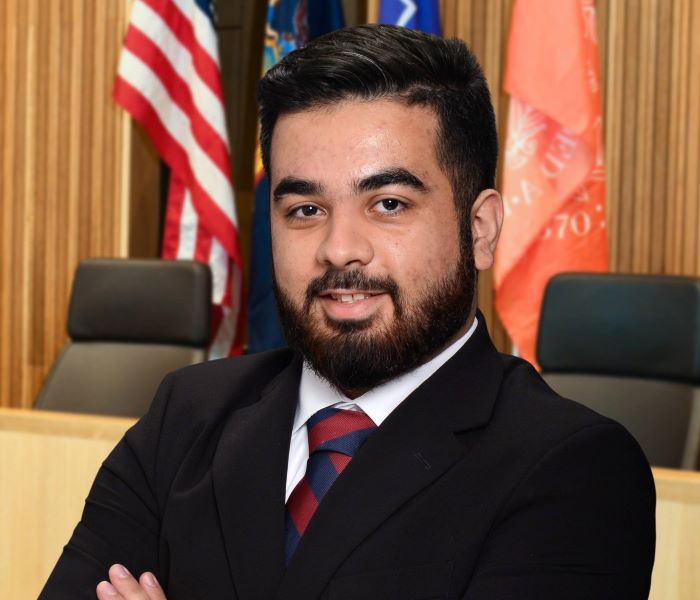
Syracuse University College of Law’s Mohammad Amer L’26 is the co-MVP/Best Advocate of the 2025 National Trial League (NTL) competition. The MVP award is given to the student who received the highest number of best advocate votes during the regular season.
The NTL is a competition format that provides multiple chances for students to hone their trial skills in a competitive, fast-paced, online setting throughout the Fall academic semester, creating opportunities for schools to compete outside the traditional weekend tournament structure. NTL features 14 trial teams competing against each other in a season format that resembles a traditional sports league with two conferences made up of seven teams each.
“Through seven rounds of brutal competition from August to November, against some of the best advocacy programs in the country, Mohammad tied for the most best advocate votes,” said Professor Todd Berger, director of Syracuse University College of Law’s Advocacy Program. “Without a doubt, because of the number of rounds, pace, and quality of teams, this competition is one of the hardest in the country. Winning the MVP in that context is truly an impressive accomplishment. Congratulations to Mohammad once again on this important achievement.”
Crandall Melvin Professor of Law Shubha Ghosh spoke with Law 360 on the recent ruling that Meta does not have a monopoly on social media.
Ghosh suggested that Judge Boasberg focused too much on the convergence of the apps and not enough on whether they are actually coming up with something new.
“There’s no discussion about how this particular set of social media is innovating,” Ghosh said. Instead of competition, he mostly just sees imitation.
Ghosh also noted that Judge Boasberg never considers what the market would have looked like had Instagram remained an independent competitor, rendering the opinion “kind of shortsighted.”
Jocelyn Anctil G’26, L’26 was named the recipient of the Rhoda S. and Albert M. Alexander Memorial Scholarship for the 2025-2026 academic year. The Alexander Memorial Scholarship Committee selected Anctil after a competitive application process to receive this significant scholarship in recognition of her commitment and dedication to public service.
Anctil is a joint J.D./M.P.A. candidate at Syracuse University College of Law and the Maxwell School of Citizenship and Public Affairs who has dedicated her legal education to public interest work. She has gained diverse experience through internships at Community Legal Aid, Hiscock Legal Aid, and the Volunteer Lawyers’ Project, and previously served as a paralegal with the Capital Area Immigrants’ Rights Coalition in Washington, D.C.
At Syracuse Law, Anctil serves as President of the Syracuse Public Interest Network and is an active member of the Travis H.D. Lewin Advocacy Honor Society. Her background in social work, combined with her extensive legal advocacy experience spanning housing rights, criminal justice, consumer protection, and immigration law, reflects her deep dedication to serving vulnerable and underrepresented communities. After graduation, Anctil plans to work as a staff attorney at a legal aid organization or non-profit focusing on criminal defense.
“I am deeply honored and grateful to be selected as the Rhoda S. and Albert M. Alexander Memorial Scholarship recipient for the 2025–26 academic year. This support brings me one step closer to pursuing my commitment to a career in public service,” says Anctil.
The Rhoda S. and Albert M. Alexander Memorial Scholarship was established by College of Law Board of Advisors Chair and Syracuse University Trustee Richard M. Alexander L’82, Partner at Arnold & Porter, and his wife Emily Alexander.
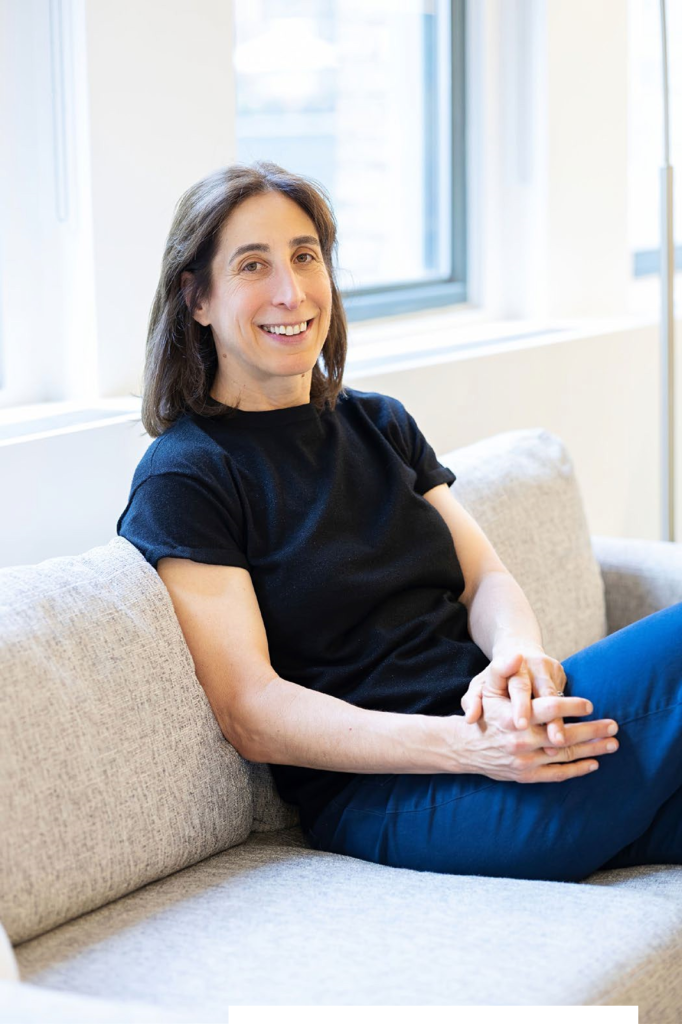
Jen Berrent, CEO of Covenant, led a conversation on how artificial intelligence is transforming legal practice and reshaping the future of law firms. Berrent, drawing from her experience as both a lawyer and CEO, provided insights into the evolving AI landscape and discussed its implications for lawyers, clients, and the delivery of legal services in the coming years.
Berrent discussed the progression of AI tools and how machine-learning systems are helping lawyers analyze large datasets faster and, at times, more accurately than ever before. She also addressed the shifting role of an attorney as work moves from document review to higher-level strategic advising and client counseling. Berrent highlighted the growing need for tech-literate lawyers who can collaborate with AI ethically and effectively.
A significant portion of the discussion focused on how Berrent’s firm, Covenant, is restructuring around AI-driven workflows, including smaller teams, the use of integrated AI tools, and more affordable and flexible billing models. Berrent also predicted a major rise in the role and strategic importance of in-house counsel as companies adopt AI more deeply.
Berrent emphasized that, even as AI grows more powerful, it remains essential to develop human-centric legal skills that technology cannot replace. The next generation of lawyers will need to bridge the gap between legal reasoning and data-driven insight, combining technological fluency with judgment, empathy, and communication.
The overarching takeaway of the session was that AI is not a threat but a catalyst for transformation in the legal profession.
Professor of Law Gregory Germain spoke with the Sydney Morning Herald on President Donald Trump’s threat to sue the BBC for $5 billion over how a video was edited.
The president would need to prove that the BBC acted with “actual malice.” “They’ve got to meet the actual malice standard with New York Times versus Sullivan, which is a very tough standard,” said Germain.
The case, if filed, would also have to surmount another legal standard that protected publications that were “substantially true”, Germain said. The remarks that were spliced together were both things Trump said, even if the edit was poorly done, he said.
“I don’t think they should win a Pulitzer Prize for the editing, but it’s not defamatory,” Germain said. “What he’s alleging is that he doesn’t like the way they edited the video, he’s not alleging that they posted a deep fake or something.”
The article surveys the rules that states have developed about when and what their intermediate appellate courts write. It also considers why states limit the writing of their intermediate appellate courts.
The article highlights why rules about appellate court writing matter, how AI may influence those choices, and what writing means for accuracy, transparency, and the future of state court appellate justice.
Aliza Milner, Written Opinions in State Intermediate Appellate Courts: Current Landscapes and the AI Horizon, 38 Geo. J. Legal Ethics 273 (2025).
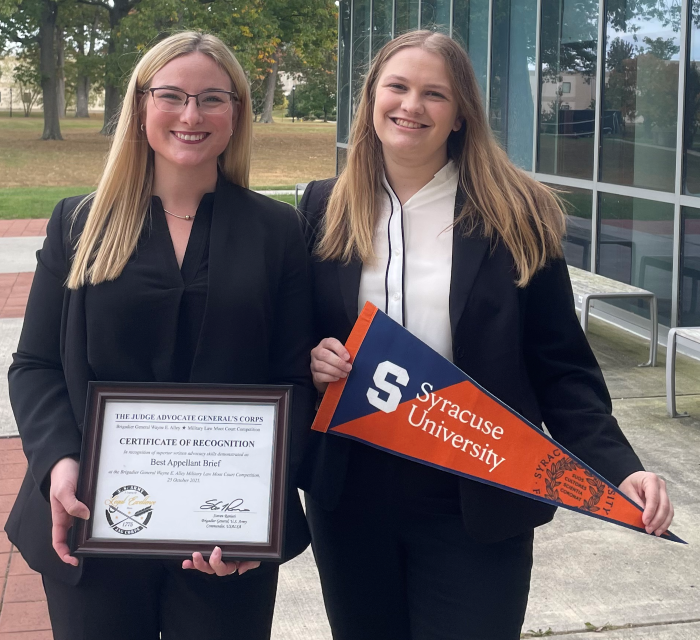
Emma Bissell L’27 and Elyse Maniccia L’26 tied for the Best Overall Brief award at the 2025 Brigadier General Wayne E. Alley Military Law Moot Court Competition. The team also finished third overall. The team was coached by U.S. Army Captain Nick Van Erp.
“I want to congratulate Emma and Elyse for their double accomplishments at this prestigious competition. I also want to thank Captain Van Erp, who has expertly coached numerous Syracuse Law appellate teams, generously and graciously volunteering his time,” said Professor Todd Berger, director of Advocacy Programs at Syracuse Law.
“It was a pleasure working with Emma, Elyse, and Captain Van Erp. Their professionalism and enthusiasm made a strong impression, and we were honored to host them,” said Captain Shannon K. Lorant L’22, Army JAG Field Screening Recruiting Officer.
This year marked the first time Syracuse University College of Law competed in the Brigadier General Wayne E. Alley Military Law Moot Court Competition, the most prestigious military appellate advocacy tournament hosted by the U.S. Army Judge Advocate General’s Corps. Syracuse Law’s participation underscores its long-standing national excellence in advocacy and its historic leadership in preparing advocates for military service in the legal profession.
The Brigadier General Wayne E. Alley Military Law Moot Court Competition recognizes the written and oral appellate advocacy skills of law students and showcases the Army Judge Advocate General’s Corps and its vast opportunities for litigation to law students, law schools, and the public. The tournament is hosted at the United States Army Advocacy Center on Fort Belvoir, VA and the competitors argue a mock case before the United States Army Court of Criminal Appeals. Past final round judges were current and former judges on the United States Court of Appeals for the Armed Forces, the United States Army Court of Criminal Appeals, and senior trial judges and members of academia.
Shaking hands with a Supreme Court justice is a dream come true for anyone in the legal profession, but that dream became a reality for three Syracuse University College of Law students who participated last summer in The Sonia & Celina Sotomayor Judicial Internship Program.
Syracuse Law students Imari Roque L’27, Rebeca Chavar L’27, and Emma Bissell L’27 participated in The Sotomayor Program, which aims to “cultivate and develop future leaders from underserved communities” through judicial internships, educational experiences, and other resources to help achieve professional goals.
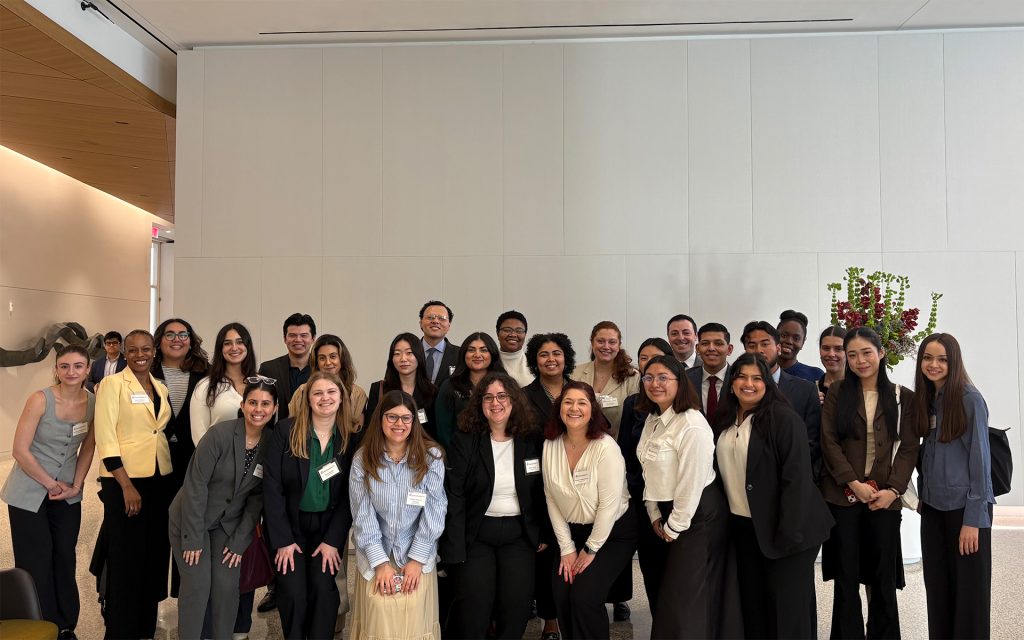
The full group of Judicial Interns participating in The Sotomayor Program in summer of 2025.
Justice Sonia Sotomayor is the first Latina and third woman to serve on the U.S. Supreme Court, appointed by President Barack Obama in 2009. Growing up in public housing in the Bronx, Sotomayor is known for her respect for the judicial process and passionate approach to the law, particularly in regard to civil liberties and the rights of those from marginalized communities. She is also committed to the judicial process, as well as supporting those impacted by systemic inequities.
For two months this past summer, Roque, Chavar, and Bissell participated in The Sotomayor Program, working full-time for judges, while also participating in professional development training and networking. Each worked in a different judicial environment, but all three gained invaluable insight and experience working in courtrooms under the direct supervision of a judge.
Roque has been interested in The Sotomayor Program since she was 14 years old, but it wasn’t until she was a 1L at Syracuse Law that she applied to the program’s law school division.
“I’ve always been drawn to being a lawyer, and Justice Sotomayor is the first person who comes to mind,” she explains. “No one in my family is a lawyer, so Sonia Sotomayor—a Puerto Rican woman from the Bronx like me—has been my role model.”
Roque was matched with the Hon. Bryant Tovar, a judge of the Housing Part of Civil Court of the City of New York, dealing with landlord-tenant matters, civil litigation and immigration law. The work focused on the Small Property Part of the court, which handles housing issues before trial, particularly cases where landlords are suing tenants.
“I became really familiar with what city court looks like, developed a rapport with the judge, clerk, and others, and learned a lot about negotiations and alternate dispute resolution, as well as what everyday law looks like,” says Roque. “It was interesting because Judge Tovar leads with understanding and empathy on the bench, which gave me a different perspective on the law.”
Chavar worked for the Hon. Javier Vargas in New York State Court of Claims in Manhattan, where she gained hands-on experience observing three major trials. Judge Vargas encouraged his interns to engage deeply in their work, often discussing with her issues brought against the state of New York, involving issues such as car accidents and claims of excessive force by law enforcement.
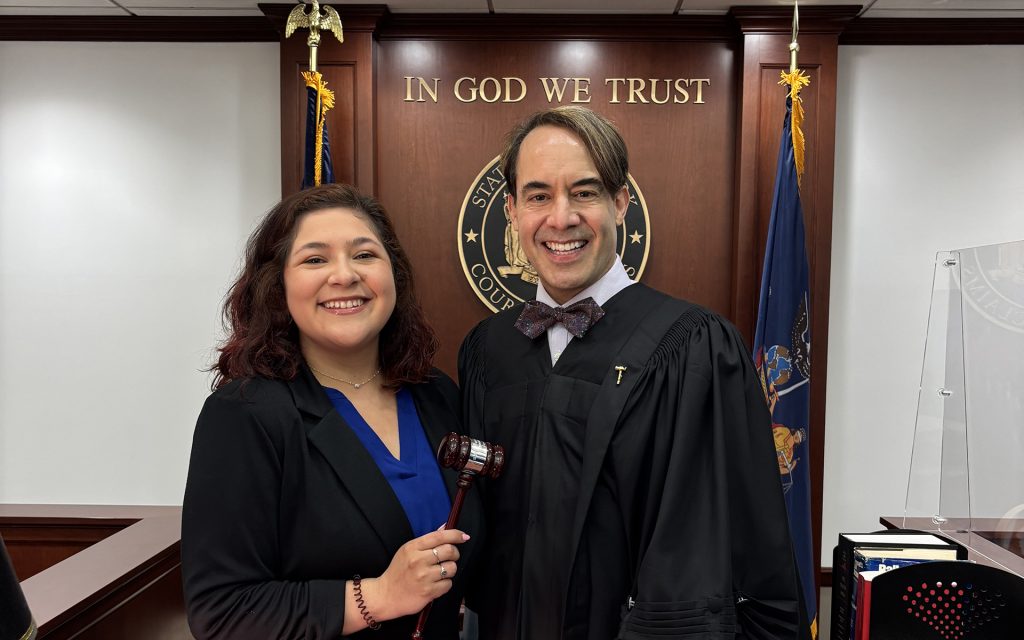
Rebeca Puente Chavar L’27 pictured with the Honorable Javier E. Vargas at the New York State Court of Claims in Manhattan, NY.
“I was thrilled when Judge Vargas asked me to help draft a memo recommending how to decide on a motion, and that set the tone for the kind of work he expected,” she says. “I also helped draft a decision for one of the trials, did research on pending trials, and my final project was a case where I wrote a decision by myself for review by the clerk and the judge.”
Bissell discovered The Sotomayor Program through an email Mary Kate Tramontano L’26 sent to the Women’s Law Student Association listserv, an opportunity that ultimately led her to work with district civil and criminal court judges in the Eastern District of New York in Brooklyn.
“It was awesome because I was able to observe a lot of different types of trials,” Bissell says. “I was assigned to a judicial clerk who helped me with whatever I needed. Getting to the end of my internship and seeing that I could write a full legal opinion was the best feeling ever.”
Meeting a Legal Legend
After a summer of learning the ins-and-outs of the courtroom, students were invited to an event highlighted by a visit from Sotomayor herself. Not only did the interns get to hear the Supreme Court justice speak, but they also had the chance to talk with Sotomayor and take photos with her.
“It was a full circle moment for 14-year-old Imari,” says Roque. “I shook hands and said hello to someone I’ve admired most of my life. It’s funny because she looked like someone who could be in my family. The experience really helped me understand that that could be me.”
Chavar was also awe struck by Sotomayor. “We took a group photo, and I was lucky enough to be placed right next to her! She asked me where I went to law school,” Chavar says. “The reason I’m in law school is largely inspired by Justice Sotomayor. When she went to the bench, I was in middle school, and I have a distinct memory that inspired me to go to law school. So it was a big deal to hear her wisdom. A majority of the students there were from underrepresented backgrounds in the legal field, and Justice Sotomayor was a beacon of hope and encouraged us to trust in the legal system despite all that’s going on in the world.”
“You read her opinions, and you know that she is incredible, but then you see her in action, and she is so eloquent,” says Bissell. “When I started law school, I was questioning my decision, and I think The Sotomayor Program helped reinforce that those in the legal field are making decisions that are impacting people’s lives. I know I want to be a part of that type of work.”
Professor Katherine Macfarlane’s essay Self-Accommodation has been published in the University of California Health Humanities Press collection “Legal Determinants of Health: From Incarceration to Accessibility,” edited by Brian Dolan and Juliet McMullin. The online, open-access version of the book is available here.
The “Legal Determinants of Health: From Incarceration to Accessibility” brings together six cutting-edge essays that expose how legal systems—through incarceration, detention, disability law, tort doctrine, and human subjects research—profoundly shape health outcomes and perpetuate structural inequality.
Professor Macfarlane serves as Director of the College of Law’s Disability Law & Policy Program and is a leading expert in reasonable accommodations.