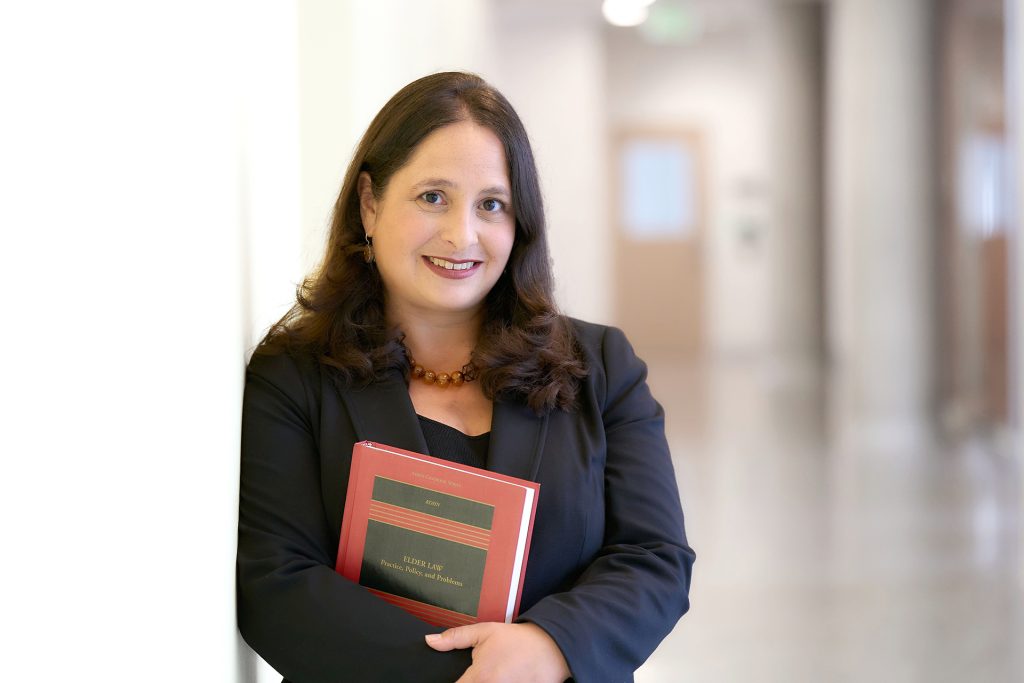
Syracuse University College of Law’s Distinguished Professor Nina Kohn is helping to create “gold standard” legislation on some of the most important issues facing older adults and individuals with cognitive disabilities.. Based on her legal expertise, including in the area of elder law, Kohn, the David M. Levy L’48 Professor of Law and newly named Distinguished Professor, has worked closely with the Uniform Law Commission (ULC) to create model legislation for the states.
Kohn has been selected not once, but twice, to serve as a reporter for the ULC. The first act she worked on with the ULC was the Uniform Guardianship, Conservatorship, and Other Protective Arrangements Act (UGCOPPA), which the ULC describes as a “comprehensive guardianship statute for the 21st century” that encourages person-centered guardianship reform, including promoting less restrictive alternatives to guardianship. The second act was the Uniform Health-Care Decision Act (UHCDA), a model law governing advance directives and healthcare decision-making for patients without surrogates.
Since joining the College of Law faculty in 2005, Kohn has been an active teacher and prolific scholar. Her research addresses a variety of legal topics associated with elder law, including age discrimination, family caregiving, elder abuse, and supported and surrogate decision making. She is also the author of the leading casebook on elder law. In addition, Kohn has taught on elder law, family law, trusts and estates, torts, and an interdisciplinary gerontology course. She has also served in a variety of public service roles for organizations such as the American Bar Association, the American Law Institute, and the Association of American Law Schools.
However, one of the highlights of her impressive career to date is being selected twice to be a reporter for the ULC, something she calls “the biggest compliment.”
“It’s hard to say ‘no’ when legislators are saying, ‘We’re interested in making our laws better. Can you help us?” she states. “It’s incredibly satisfying to be able to make a difference and see states improve their laws to make life better for families, patients, and health care providers.
“Being a reporter is part mediator and part editor, as you listen to and try to align the interests of diverse groups and commissioners,” says Kohn, noting that most states do not have the bandwidth to write this type of model law on their own. “Your function as a reporter is to enable a very deliberative, expert-informed, non-partisan approach that integrates various viewpoints and experiences into a model law that is as good as it can be.”
According to Kohn, the ULC model laws give states a solid, consistent starting point, which they may modify to suit their specific needs, budgets, or priorities. The details of the final laws are up to the individual state legislatures.
Kohn finds satisfaction in some recent successes in enacting the acts she has worked on. Consistent with the bipartisan nature of the acts, the UHCDA has been adopted into law in Delaware, a blue state, and Utah, a red state, in partisan efforts that will be beneficial to many. In addition, the UGCOPPA has been adopted in Maine, a blue state; the state of Washington, also a blue state; and Kansas, a red state.
She also believes that her expertise as a reporter has made her a better professor, as she is able to share with her students first-hand knowledge of cutting-edge legal debates and how the law is progressing on a state-by-state basis. Kohn reports that this work has also made her more sensitive about statutory drafting issues, and she has consequently spent more time in the classroom helping her students interpret, critique, and draft statutory language. She also says it has encouraged her to help students appreciate that even when people initially come at an issue from opposite viewpoints, there is often plenty of common ground to be discovered.
The work of a reporter can go on for years, but Kohn is prepared to stick with it in the hopes of seeing the two model laws enacted in as many states as possible.
“It’s hard to say ‘no’ when legislators are saying, ‘We’re interested in making our laws better. Can you help us?” she states. “It’s incredibly satisfying to be able to make a difference and see states improve their laws to make life better for families, patients, and health care providers. This process is an example of how we can work together in a partisan age, and it’s a source of pride to know that my work is helping to bridge differences and improve the law.”
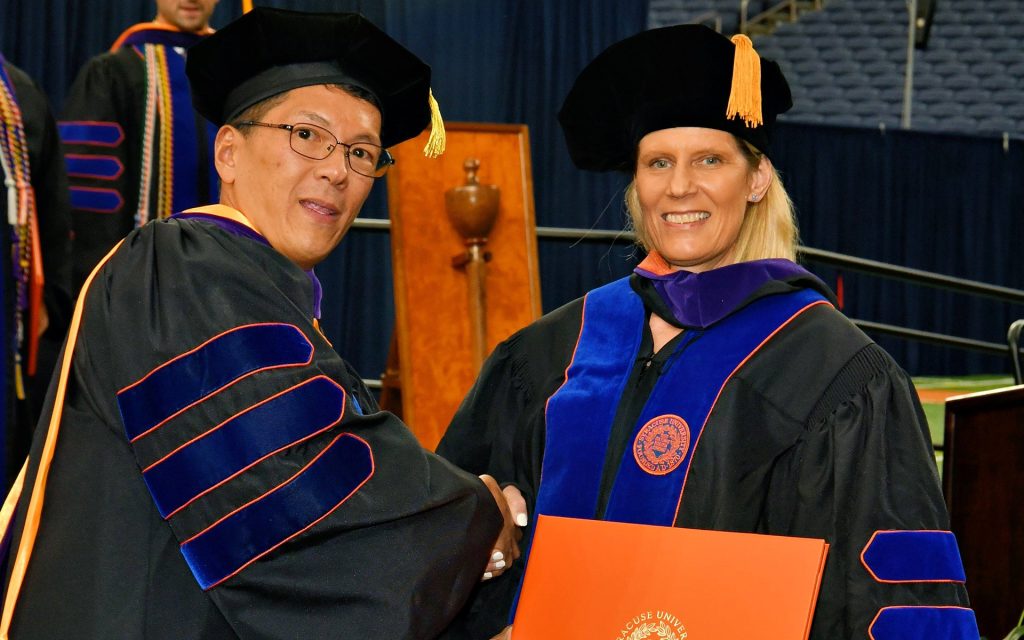
A runner for most of her life, Marla Runyan L’25 crossed yet another finish line when she walked the stage in May to accept her diploma from the Syracuse University College of Law. While this was quite an achievement, she is no stranger to hard work and success. Legally blind, Runyan has literally crossed hundreds of finish lines while competing in the Olympic and Paralympic Games in track and field. This month (July 2025), she will be inducted into the U.S. Olympic and Paralympic Committee (USOPC) Hall of Fame alongside such other greats as tennis phenom Serena Williams, gymnast Gabby Douglas, skier Bode Miller and basketball coach Mike Krzyzewski.
At age 9, Runyan lost much of her vision to Stargardt’s disease, but this never stopped her from participating in athletics, eventually competing in track and field at San Diego State University, where she received her undergraduate degree in education of the deaf and a master’s degree in education of deaf/blind children. (She also earned a second master’s degree from the University of Northern Colorado in special education, vision impairment.) Runyan competed in the 1992 Barcelona and the 1996 Atlanta Paralympic Games, winning five gold medals and one silver. After setting world records in the T13 classification in every event from the 100-meters to the marathon, Runyan stepped away from para athletics and set her sights on making the U.S. Olympic Team.
“After 1996, for me it was the Olympics or nothing,” Runyan explains, noting that she did not require a guide runner when racing. “I needed to compete in an environment where the expectation was that I was just like anyone else, competing and training with the best athletes in the world.”
And she did just that. The only legally blind U.S. athlete to qualify and compete in both the Paralympic and Olympic Games, Runyan represented the U.S. in the 2000 Olympics in Sydney in the women’s 1,500 meters and in the 2004 Olympics in Athens in the women’s 5,000 meters.
“For much of my life, I felt I had to prove a point— that disability does not preclude excellence.” she explains. “Earning a spot on two U.S. Olympic teams was the realization of a lifelong dream, but it also gave me a platform to change perceptions and attitudes about what is possible.”
In addition to her Olympic success, Runyan also was the top American female finisher in the New York City (2002), Boston (2003) and Chicago (2004) marathons finishing fourth, fifth, and seventh in the professional women’s field for those events, respectively. She was also the National Champion at 5000-meters from 2001- 2003.
Marla Runyan at the 2000 USATF Olympic Trials in Sacramento,CA Photo: Victah@Photo Run
Runyan retired as a professional athlete in 2008, but her passion for equity and access carried through to her next chapter, which included working in digital accessibility at the Perkins School for the Blind in Boston; as a para athlete and accessibility manager for the Boston Athletic Association, where she created a new competitive division for para athletes in the Boston Marathon, as assistant director of digital accessibility at Syracuse University; and in her current role as accessibility policy and procurement strategist in the Executive Office of Technology Services and Security, for the Commonwealth of Massachusetts.
Her impetus to go to law school stemmed from her advocacy work for individuals with disabilities and her passion for sport equity. “Despite what I have accomplished in my lifetime, as a woman and a woman with a disability, I have felt underestimated in the work force, and for me to get things done I knew I had to be over-accomplished just to have the same opportunities, so I decided a law degree would support me in that endeavor,” she explains.
While Runyan was accepted at another law school in the Boston area where she lives, it was a full-time residential program that would have forced her to give up her job and sacrifice time with family. Syracuse’s JDinteractive (JDi) program was a much better fit for her, as its year-round hybrid program allowed her to spread out the online coursework and balance her career and time with her daughter.
And while law school came with challenges, this Olympian made it work.
“When you are a person with a disability, you become a constant problem solver because no environment you’re operating in is designed for you,” she says. “You have to have strategies in how to negotiate and not only participate but excel in life. There’s a difference between showing up and being excellent in what you do. I had no plans to just show up!”
Tackling law school as someone with vision loss meant having a deeper understanding of the materials than her sighted classmates, who could quickly refer to their notes.
“I had to know facts and holdings backwards and forwards and not be dependent on visuals, and that’s a very tall order when you’ve got 15 case briefs to remember for each class,” Runyan explains, “but I created my own short hand, key words and prompts to spur memories of the case or the main takeaways. I thought of every case as a story, and I’ve applied what I’ve done throughout my life in terms of persevering and problem solving to make it through.”
Runyan especially enjoyed the JDi program’s residencies, where she was able to meet faculty and members of her cohort in person. When she attended the Foundation Skills residency on the Syracuse Law campus, she got to know Associate Dean for Academic Programs and Teaching Professor Shannon Gardner, whose “style of interaction was really respectful of all students,” Runyan says. “I felt she was a very important part of my law school experience and that she deeply cared for us and wanted us to do well.”
Runyan started using what she learned in law school in her own work right away, drafting policy and contract language to support digital access for users of assistive technology across the Commonwealth of Massachusetts.
While she’s not currently practicing law, she is “leaving the door wide open.”
“Don’t count me out,” says Runyan, who will be taking the Massachusetts Bar Exam next February. “The J.D. degree has opened up so many opportunities. Anything is possible.”
Crandall Melvin Professor of Law Shubha Ghosh is conducting research on artificial intelligence (AI) agents as a visiting scholar at Bucerius Law School in Hamburg, Germany.
The research, Legal Principles for Artificial Agents, is being conducted in collaboration with the Bucerius IP Center.
Ghosh, Director of the Syracuse Intellectual Property Law Institute, gave a lecture to students on the research. “The common understanding is that AI is a tool to satisfy certain tasks. But more than metaphorically, we also use AI much like we hire a human employee. The discussion will examine the analytical strengths and weaknesses of thinking about AI as an employee, drawing on a branch of law called agency law. One main conclusion is that introducing agency law into the AI discussion supports bringing fiduciary principles as a possible guardrail on AI technologies.”
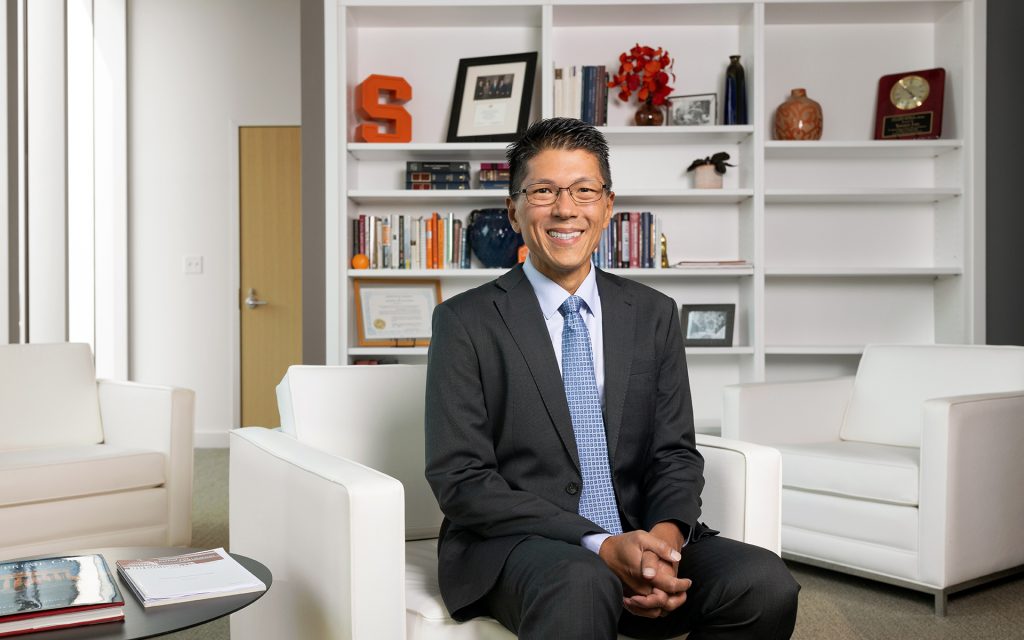
Three decades ago, Terence J. Lau L’98 walked the corridors as an eager student at the Syracuse University College of Law, then located in White Hall. He knew he had been given a rare chance—and a full scholarship—to be a part of Syracuse Law, and the opportunities ahead were endless. Today, his eagerness and enthusiasm are stronger than ever as he again walks through the halls of the Law School with the same sense that a rare opportunity has come his way. In August 2024, Lau began his role as the 13th dean of the Syracuse University College of Law — and the first alumnus to lead the Law School in its 130-year history.
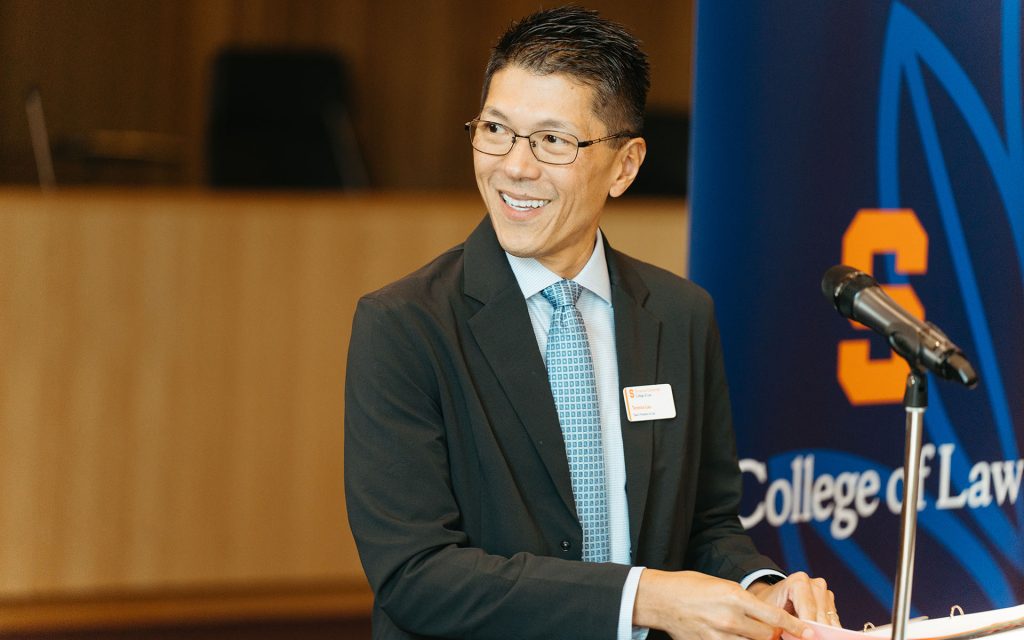
Terence J. Lau L’98 has been named the 13th dean of Syracuse University’s College of Law.
The Foundations for a Career
Prior to applying to law schools, Lau was training to be a commercial airline pilot, but without the funds to continue, he needed a new plan. So Lau set his sights on the law. Syracuse Law not only offered him a scholarship but gave him the foundations for a successful career in law and higher education.
“Attending Syracuse Law changed the trajectory of my life,” says Lau. “I enrolled sight unseen, and it became my home for the next three years. I’m eternally grateful for the education and career opportunities the law school gave me. Returning to serve as dean is a true full circle moment.”
Lau stands out not only as an alumnus, but also for his unconventional path to becoming a law school dean. While he was a practicing attorney early on, much of his career has been in higher education, particularly in the business school space, giving him a distinct perspective in his new role.
Pivoting to Business in Academia
After receiving his J.D., Lau joined Ford Motor Corp. as an attorney, working in transactional, distribution, and international trade practice. In 2006, he became a fellow for the U.S. Supreme Court assigned to the Office of the Administrative Assistant to Chief Justice John Roberts.
Lau’s career quickly pivoted to a more business-oriented path when he joined the University of Dayton’s School of Business Administration, first as a professor of business law and then as director of international business programs, department chair of management and marketing, and, eventually, associate dean of undergraduate programs. In 2017, he spent a year in China serving as executive director of academic and corporate relations for the University of Dayton China Institute.
The following year, he returned to the United States to take on the role of dean of the College of Business at California State University Chico, a position he stepped down from just before coming to Syracuse.
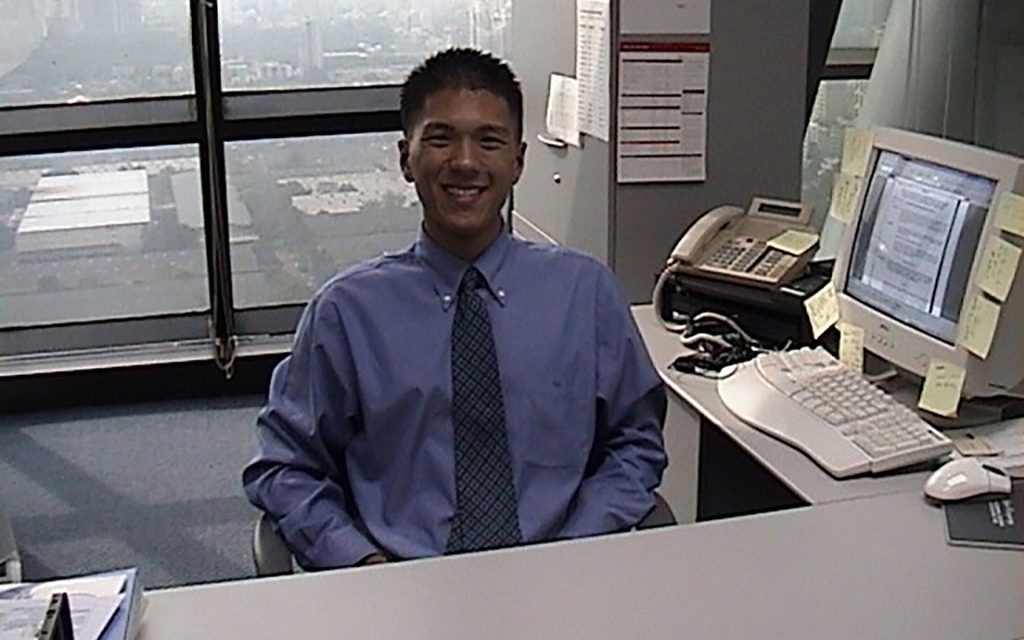
Dean Lau at his desk at Ford’s offices in Bangkok, Thailand.
Building a Long-Lasting Foundation
Taking on the role of dean at Syracuse Law has given Lau a chance to reflect on where he started and the path he took to get here today.
“I have great memories of law school, and I was also fortunate to experience the campus life of the greater University because, as part of my scholarship, I lived in the dorms as an employee of the Office of Residential Life for undergraduates,” he explains.
He says many of the best moments from law school revolve around the faculty. “When I run into other alumni, it seems everyone will talk about a specific faculty member who had a lasting impact on them,” Lau says. “And it’s that incredibly student-focused faculty who are a very integral part of what makes Syracuse Law much different from what you get elsewhere. They are practical and solution-oriented individuals who come to us having had a tremendous impact on the law through their scholarship and work experiences.”
Lau has his own list of faculty who made a lasting impression, including Professor of Law Emeritus Travis H.D. Lewin and former Dean Daan Braveman, now a distinguished lecturer in Syracuse Law’s JDinteractive (JDi) program.
“I was Professor Lewin’s research assistant, and he also coached me on the trial team. When we went into competitions, he would say, ‘Go to war; return in peace,’” says Lau. “Dean Braveman taught Civil Procedures my first year and told us, ‘You have to pass the “look yourself in the mirror every morning” test,’ referring to conducting yourself within the ethical and legal limits of the law. Both of these lessons have stuck with me as I navigated my career.”
A Personal Desire to Give Back
“Coming to Syracuse Law as a student is the center of all good things that have happened to me professionally, so I never lost touch with the law school,” says Lau, who has been an active alumnus since graduating. “I’ve been a donor for a long time because I wanted to pay forward what Syracuse Law gave to me, and, in 2022, I was honored to be asked to join the Board of Advisors and lend my experience to the law school and its future generations of lawyers.”
When Lau heard that Dean Craig Boise was stepping down, he offered his insights as a board member to the search committee, helping to shape the qualities they should seek in the next dean. His passion for Syracuse Law and his thoughts on new leadership clearly made an impression, as not long after, the search committee approached Lau to see if he was interested in the position.
The timing seemed right, as Lau was looking for another opportunity. Where better to further his career than his alma mater?
“Terence has a passion for the Law School and credits this place for a lot of his success,” says Professor of Law Todd Berger, co-chair of the Dean’s Search Committee. “For him, joining us as dean didn’t seem to be just the next step in his career. It was a very personal desire to give back to a place that truly impacted his life and his profession.”
According to Berger, the search committee was impressed by Lau’s background in higher education, particularly in a business school environment, as well as his foundation as a lawyer. “It gave an insider-outsider quality that made him a very intriguing candidate,” Berger says.
Nina A. Kohn, the David M. Levy Professor of Law, also co-chaired the search committee. “I think Terence brought a really sophisticated understanding of higher education and a sense of his vision of how the law school fits into the big picture of a research university,” she says. “And he has an outstanding ability to connect with a very broad and diverse group of stakeholders here, which is so important to our success.”
“I think it’s wonderful that he comes to us as an alumnus with a deep history of the College of Law,” Kohn adds. “He cares about the school in a very personal way, and I think it says a lot about how we value our students and about our confidence in the education we provide.”
Richard Alexander L’82, chair of the Syracuse Law Board of Advisors and partner and chair emeritus at Arnold & Porter, also admires the qualities Lau offered to the college.
“During the search process, Terence demonstrated a sophisticated understanding of the opportunities and challenges facing the Law School in the current environment,” says Alexander. “He impressed us with his enthusiasm and energy, as well as his commitment to driving success at the Syracuse University College of Law.”
From First-Year Student to First-Year Dean
Now that Lau has settled into his position as dean, he is solidifying his goals to retain the history and excellence of the school, while also working to see Syracuse Law reach its full potential.
“A lot has changed since I went to school here. The University as a whole has grown, climbed in the rankings and become more nationally and internationally known as the Orange brand has expanded. This has benefitted the Law School, as well,” he says. “But I’m proud to see that the values that I remember most — the role Syracuse University and the College of Law play in the greater community and the generosity to the region — have never wavered.”
Lau acknowledges that going from the dean of a business school to that of a law school is not the most common path. “Being a dean is largely the same skillset, but being a dean of a business school is not a natural step for a lawyer,” he explains. “However, this dual path has allowed me to become familiar with the study and operations of business such as management and budgeting, which are as necessary to running a law school as knowing the law. And it has allowed me to make decisions from both perspectives, which I believe will be a real benefit.”
Goals: The Roadmap to Tomorrow
Lau is solidifying his goals to continue the growth of Syracuse Law. While he has many ideas, some of his priorities focus on growing the JDi program, increasing the number of full scholarships the College of Law gives, creating an even richer campus culture by attracting more students to the international Master of Laws (LL.M.) program, and taking a careful look at what improvements might be made to the existing on-campus J.D. program.
According to Lau, one of the biggest strengths at Syracuse Law is its JDi program, which allows non-traditional students to become lawyers through a hybrid courseload.
“Business schools have had an online component for a while—but not so much law schools,” he explains. “Our JDi program started in 2019 and was the first program in the nation to be accredited by the American Bar Association (ABA). Today, almost half of our students are part of the JDi program, and it has become a legitimate alternative for working adults, those raising kids, and others who want a Syracuse Law education but can’t be on campus every day. That was simply never an option when I was in school. Only those who had the financial resources to take time off to be a full-time student could go to law school, which was very limiting.”
Lau believes the JDi program has expanded that level of opportunity and says the ABA has become more flexible about the rules for operating a hybrid program. (Students in Syracuse’s JDi program take classes and participate in activities online, but are required to attend several in-person residencies on campus or in a variety of other cities throughout the program.)
“Today, we have a whole group of students, from those on active duty in the military to retirees starting their next chapter. Many of these JDi students would not otherwise have had the opportunity to earn their law degrees,” he says.
Syracuse Law’s JDi program is currently limited by the ABA to 125 students, but Lau is determined to increase its capacity of qualified students “slowly and by demand.”
“Right now, we turn away a lot of qualified people, but by growing the program in an intentional, measured way, we can offer a quality legal education to a lot more people,” he explains.
Lau also intends to examine the existing on-campus J.D. program, which has not seen significant changes in years, to “offer different flavors, so students can become experts in a greater variety of areas of the law as they prepare to enter the professional legal arena.”
As someone who relied on a scholarship to attend Syracuse Law, he also hopes to increase the number of full scholarships the Law School provides. “I wouldn’t be here today if I hadn’t received a three-year scholarship,” he says. “The truth is we don’t give out many full-rides, and we need to take a closer look at improving on that in order to make Syracuse Law financially accessible to more people.”
Another important focus is the LL.M. program for international legal professionals. “There are some very accomplished people already working in the legal field as lawyers and judges from around the world who come here because they want a degree with a U.S. perspective,” says Lau. “We have the opportunity to expand this program, particularly in the area of tech transfer and technology, which is a growing need for foreign lawyers. Those enrolled in the LL.M. program add a richness to our campus community, and I’d like to see more of that in the future.”
One additional goal is continuing to strengthen ties across the greater University with more cross-disciplinary opportunities and initiatives.
“We know that there are many areas of interest across campus that pair nicely with the study of law, and I’d like to see us leverage more of that,” says Lau. “We already have a 3+3 program with the Whitman School of Management that allows qualified students to start law school after only three years of undergraduate work. And, we have several joint degree and certificate programs with the Maxwell School of Citizenship and Public Affairs, as well as our new center in Washington, D.C., which should allow us to maximize that relationship and provide a greater focus on public affairs and public policy laws.”
But it doesn’t end there. “We know there are other interests across campus like entertainment and sports management, and I’d like to see us do more with places like the Falk School of Sport and Human Dynamics or the Newhouse School of Public Communications, for example, to create mutual opportunities and greater options,” Lau says.
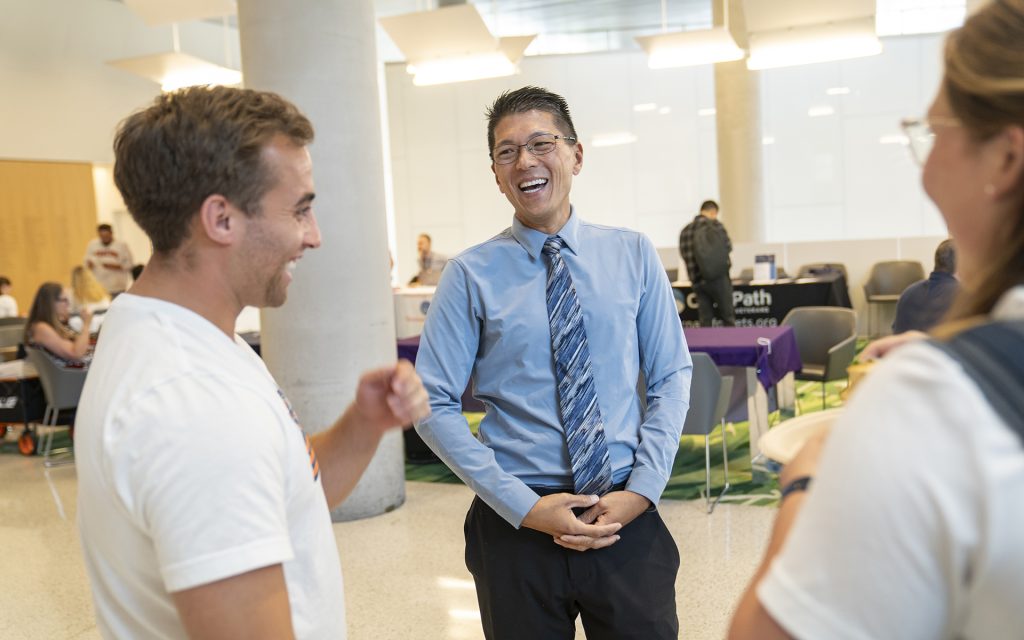
Dean Lau and Professor Elizabeth Kubala, Director of the Betty and Michael D. Wohl Veterans Legal Clinic, speak with a visitor to the 2024 Vet Fest held in Dineen Hall.
Faculty Is Heart of the College of Law
One thing Lau is certain of is the excellence of the current faculty, and he intends to work to further support their areas of interest as an important part of keeping Syracuse Law going strong.
“The long-standing and incredibly student-focused faculty we have here is the heart of the College of Law,” he says, noting they are one of the primary differentiators from the experience one might get at another law school. “The level of accomplishment in the legal field and their interest in transferring that knowledge to our students is extraordinary here.”
Lau believes that the best way he can support faculty is by encouraging their ideas and helping to find ways to fund them — “and then get out of the way!”
“We want to create a culture here where the faculty have the ability to try new things, get the funding they need and hopefully succeed, but also not be afraid to fail,” he explains. “I’d like to see a culture that rewards faculty for asking questions, taking risks and innovating. And having the resources to support these innovators and risk takers is absolutely critical and a benefit to us all.”
Solidifying Network of Alumni Support
As a graduate himself, Lau certainly recognizes the importance of solid relationships with Syracuse Law’s alumni. He intends to further increase alumni support and involvement to ensure that current students are entering the legal profession with the most current skillsets, legal experience, and access to a network of more than 11,000 willing to help them succeed.
“Syracuse Law alumni are found in the world’s largest law firms, in startups, government, as CEOs, judges, and in the public sector working for the common good,” he says, noting that the Law School is among the select few law schools that count a U.S. president, former President Joseph R. Biden L’68, among their alumni.
“Our alumni are known for their willingness to roll up their sleeves, and I hope to reach out even further into this network, listen to their ideas and rely on their support. I encourage any alumnus who would like to become more closely involved in the law school to reach out to me personally,” he adds.
Today, with a full academic year under his belt, Lau walks through Dineen Hall with a trifecta that truly no one else has — experience as a student, alumnus, and dean.
“I have always taken great pride in the College of Law and the various perspectives I have been fortunate to have here,” he says. “Certainly, being a graduate of Syracuse Law adds an additional layer of responsibility to lead with those students, faculty, former deans and other supporters who have come before me, but it is also a privilege to keep Syracuse Law on an upward trajectory creating the lawyers of tomorrow. And I am up for the challenge!”
The DANCING Project investigates the extent to which the protection of the right to participate in culture of people with disabilities and the promotion of cultural diversity intersect and complement each other in the European Union (EU) legal order.
True-Frost will speak on the June 19 panel “DANCING Contribution to Advance the Human Rights Model of Disability” at Maynooth University.
The College of Law recently held a virtual swearing-in ceremony for summer semester student attorneys in the Betty and Michael D. Wohl Veterans Legal Clinic (VLC). U.S. Court of Appeals for Veterans Claims Judge Grant Jaquith performed the swearing-in of the students.
“The swearing-in ceremony is an important part of the clinic experience as it reinforces the professional nature of the work they are going to be doing on behalf of their clients,” says Professor Beth Kubala, director of the VLC and executive director of Clinical Legal Education. “Having Judge Jaquith perform the ceremony means a lot to the students as he is a federal judge, former U.S. Attorney for the Northern District of NY, and retired Army J.A.G. officer.”
The VLC provides representation to veterans and their families who are seeking benefits from the U.S. Department of Veterans Affairs or upgrading an unfavorable discharge through the various military services. While representing real clients, student attorneys gain an understanding of military culture, interact with government agencies, develop case management skills, improve advocacy skills, and instill the value of pro bono service.
There are 18 students in the clinic – four are veterans, two are active-duty service members, one is a National Guardman, and four are military spouses.
The oath concludes with the student attorneys promising to abide by the New York State Rules of Professional Conduct.
“The swearing-in was a unique experience that underscored the fact that we as student attorneys get to do actual legal work, representing real-life people with real-world problems. The JDi program allows me to do this important work while still maintaining full-time employment, and from over 700 miles away. Having no military background has not impeded me from feeling like I’m contributing usefully to the lives of our veterans, and getting to help those who have served our country has already been the most rewarding experience of my law school career.”
Reid Surles L’26
“Taking the oath was surreal. Knowing I will have real clients with real problems—the realization that I am out of the academic and into “the grey” of actual practice—makes me both anxious and excited.”
Joe Creager L’25
“The VLC swearing-in ceremony marked a turning point in my legal education—it symbolized not just readiness, but responsibility. As a retired Navy officer, it was deeply personal and an honor to stand before a Federal judge and be formally entrusted to advocate for fellow veterans. The ability to participate in the VLC remotely has made my legal education more meaningful, showing me firsthand how the law can serve those who have sacrificed so much. It reaffirms that distance does not limit our ability to make a real impact in people’s lives.”
Professor of Law Emeritus William C. Banks and Professor of Law Mark Nevitt of Emory University School of Law have co-authored “The Mounting Crisis of Militarizing Immigration Enforcement” at Just Security.
The article covers the historical, political, and legal aspects of the recent deployment of the military to Los Angeles for immigration enforcement. This includes the Insurrection Act and the Posse Comitatus Act, among other statutes.
In summary, the writers state, “The United States has historically been widely respected for its tradition of entrusting law enforcement to civilians–federal agents, local and state police, sheriffs, constables. By contrast, the uniformed military fights wars and keeps Americans safe from foreign adversaries and it is only episodically needed for domestic assignment. American traditions are reflected in the Constitution and are explained in part by antipathy to the English Crown and the heavy-handed use of the British military in the colonies. Although the Constitution enabled Congress to Call Forth the Militia (today’s National Guard) to “repel invasions,” the grant of authority was understood to anticipate the possibility of war being brought to the United States, not to facilitate reaching arbitrarily assigned deportation quotas.”
Professor Gregory Germain spoke with Bloomberg on the president’s recent court hearing to have the New York jury verdict in the hush money case dismissed. Trump’s goal has been to get the case out of state court and into federal court.
“That’s clearly what he’s trying to do, but the question is whether they’re going to let him do it,” said Germain. “He wants to get it out of the state system, that’s his goal.”
Crandall Melvin Professor of Law Shubha Ghosh spoke with the BBC about the lawsuit brought by Disney and Universal against artificial intelligence (AI) company Midjourney.
“A lot of the images that Midjourney produces just seem to be copies of copyrighted characters that might be in new locations or with a new background,” says Ghosh, director of the Syracuse Intellectual Property Law Institute.
“It doesn’t seem like they’re being transformed in a creative or imaginative way.”
He added that there is a recognition in copyright law that creativity can build on other works as long as it adds something new.
Visiting Assistant Professor Maria Cudowska has published the article “Negotiating Food Security” in the Journal of Food Law & Policy. The article is in Volume 21, Number 1 (2025).
From the abstract: “This Article examines how national security impacts food security in the United States. It explores conflicts and synergies between municipal, state, and federal law developments related to the right to food and investigates recent developments in how those commitments have been negotiated.”