Professor Gregory Germain spoke with the New York Law Journal about a recently introduced New York State bill that would ensure the state wouldn’t recognize pro bono work “resulting from the Trump Administration’s unlawful extortion of private law firms and attack on the practice of law.”
“The bill does not restrict the provision of pro bono work. It only restricts using the hours spent on pro bono work directed by the federal government for pro bono bar credit,” Germain said. “It’s very hard to know what pro bono work the federal government will direct law firms to perform. It’s very possible that some of the pro bono work directed by the federal government would be traditional pro bono work on behalf of the poor, for example. So the legislation might be over-inclusive.”
She provided guidance on taxes, where to retire, how to pursue a new career, and the VA healthcare system.
When discussing new career opportunities for military retirees, Kubala noted, “Many military retirees I know seek careers that continue to provide meaningful opportunities for public service and personal satisfaction like state or local government, the non-profit sector, and even entrepreneurial endeavors.”
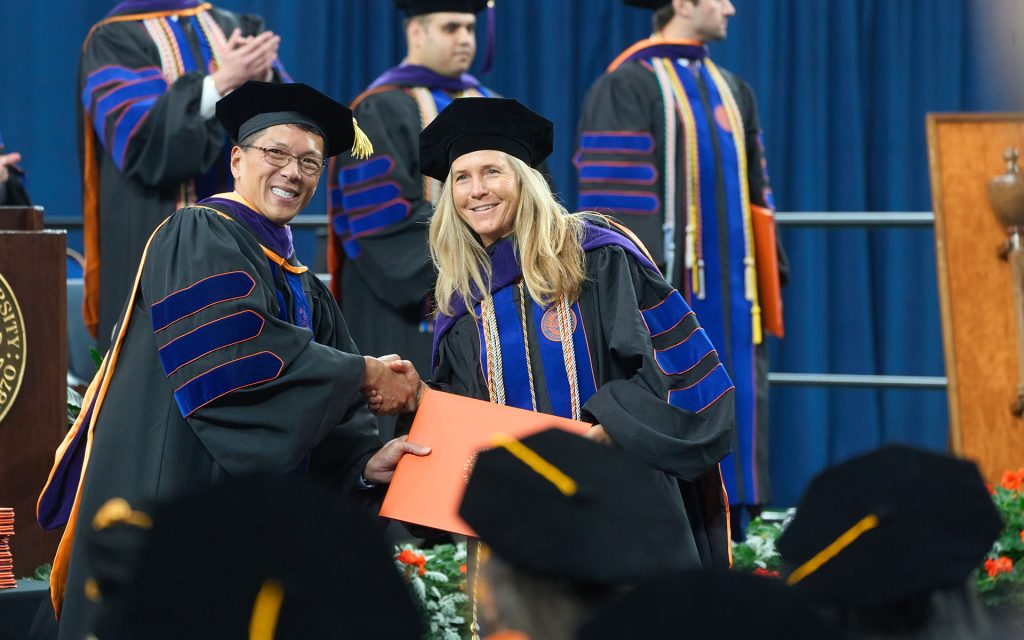
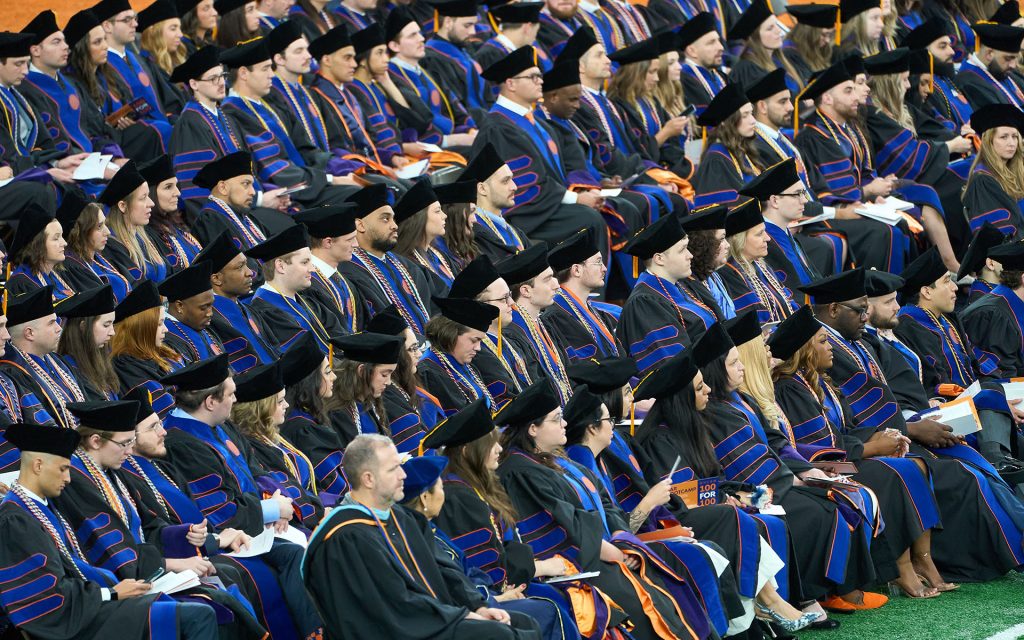
Syracuse University College of Law recently held Commencement exercises for the Class of 2025. The Class of 2025 includes 208 recipients of the J.D. degree and 24 LL.M. graduates.
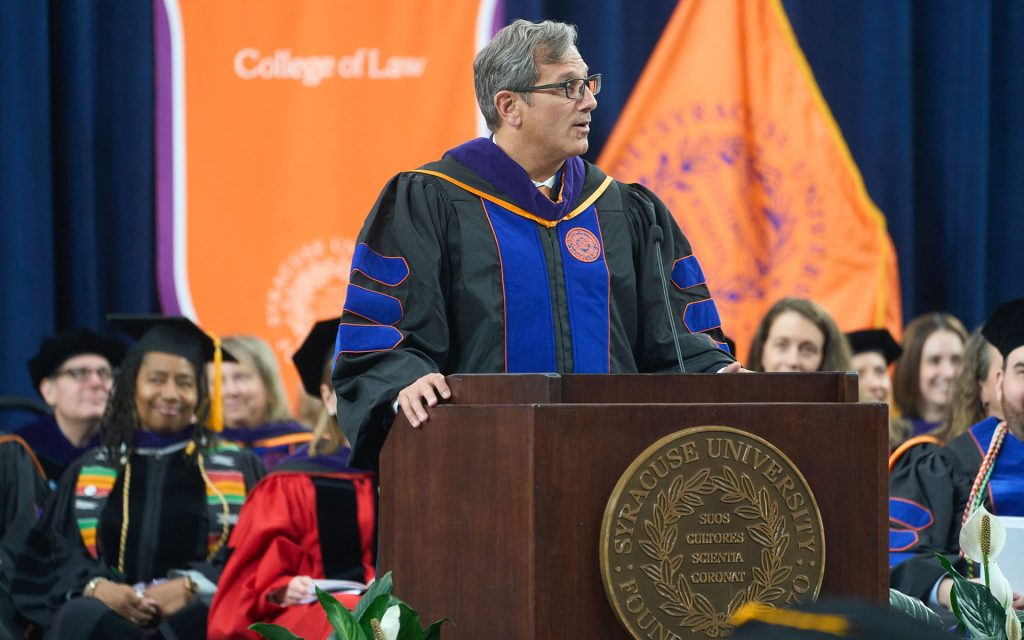
Commencement Speaker Frank Ryan, Americas Chair, Global Co-Chair, and Co-CEO of DLA Piper and a Member of the Syracuse College of Law Board of Advisors.
Frank Ryan IV ’90, L’94, the Class of 2025 Commencement Speaker, emphasized the need for resilience as graduates step into the legal profession amid a time of complexity and uncertainty. “The finest and greatest professionals, who often are those who seem to be the happiest and most fulfilled in their professional lives,” he explained, “have three core characteristics: (1) they have a growth mindset, (2) they are anti-fragile, and (3) they understand the power of time.”
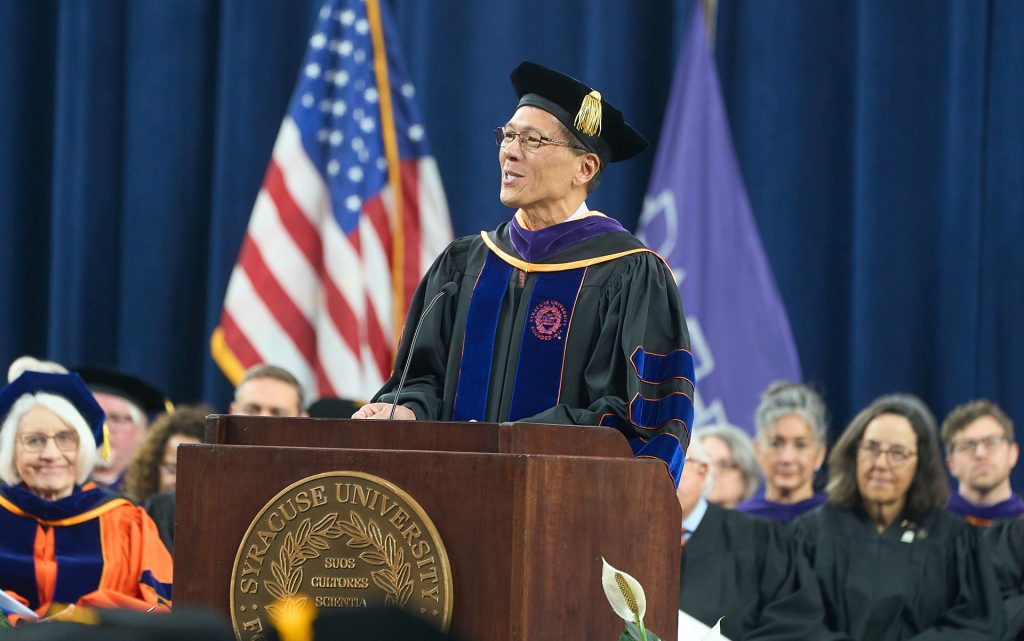
Dean Terence Lau addresses the Class of 2025.
In his first Commencement address, Dean Terence Lau reminded the Class of 2025 that above the main entrance of the Supreme Court of the United States are the words “equal justice under law.” And yet carved on the back, just as commanding, are the words “justice, the guardian of liberty.”
“These words remind us that liberty is not passive,” he said. “It doesn’t endure on its own. It’s protected and upheld every day by people like you. People who are called to serve justice with fairness, with wisdom, and with compassion. That’s the role of a lawyer. Not just to interpret the law, but to help make it work for everyone and ensure it is accessible and just. And in doing so, you help strengthen the public’s trust in the very foundation of our democracy.”
During Commencement, the J.D. Class of 2025 awarded Associate Professor of Law Laura Lape the Res Ipsa Loquitor Award (voted upon by the graduating class in recognition of a faculty member who has demonstrated exceptional commitment and service to the College of Law).
Associate Professor of Law Laura Lape carries the mace to begin the Commencement Ceremony, a symbol of tradition and academic excellence.
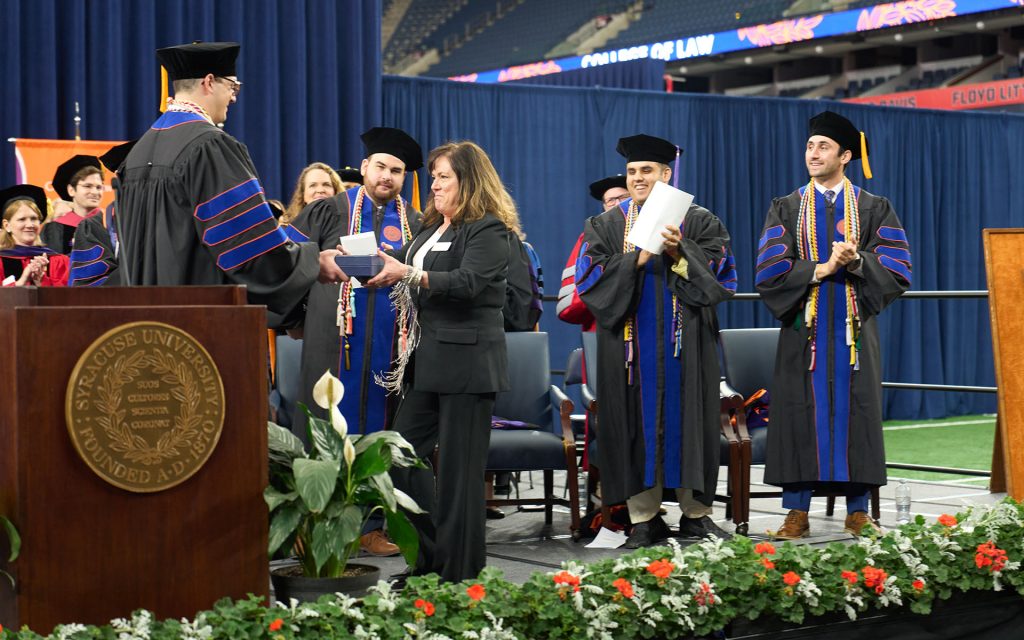
Associate Director of Academic and Bar Success Lou Lou Delmarsh was awarded the Staff Award (voted upon by the graduating class in recognition of a College of Law staff member in recognition of their support of students and faculty, and their accomplishments that make the College run day-to-day).
Lou Lou Delmarsh receives the Staff Award.
The LL.M. Class of 2025 awarded Teaching Professor of Law Richard Risman the Lucet Lex Mundum Award (voted upon by the graduating LL.M. class, it recognizes the professor who has made a significant impact on the success and experiences of LL.M. students during their studies).
Professor of Law Emeritus William C. Banks provided historical background for an article on the Alien Enemies Act in The Telegraph. President Trump has indicated the law’s use for the deportation of immigrants.
For Banks, using the act sent a powerful message to voters.
“The language of the legislation uses the term invasion, and another term, predatory incursion,” he told The Telegraph
“That sounds like language that strikes fear into the hearts of Americans and so on. So it served a very powerful rhetorical purpose when he gave his inaugural address on January 20, and then in a series of executive orders that he promulgated on that day and then several days afterwards,” he said.
“Legally, it has almost certainly no application to the circumstances that the United States now finds itself in. It was written, as you probably have learnt, in the 1790s in anticipation of what was feared to be a coming war with France,” said Banks.
University Professor David Driesen spoke with Mother Jones for an extensive article on the “unitary executive” theory.
“The unitary executive theory is a pathway to autocracy,” says Driesen, whose 2021 book, The Specter of Dictatorship, details the dangers of centralizing power in a single leader. “In every functional democracy I’m aware of, there is a civil service that can’t be easily fired, and there also are pockets in the government where even the top levels are somewhat independent of the head of state.”
In countries like Poland, Hungary, and Turkey, which have all recently experienced democratic backsliding, Driesen says civil service purges were an early step in the project of replacing the rule of law with autocracy. “The unitary executive theory is important,” he says, because it “legitimates this kind of thing in the minds of the elite.”
“The vision of the founding is that the president was to faithfully execute the law. That’s what the Constitution says,” says Driesen. “That’s what the rule of law is all about.”
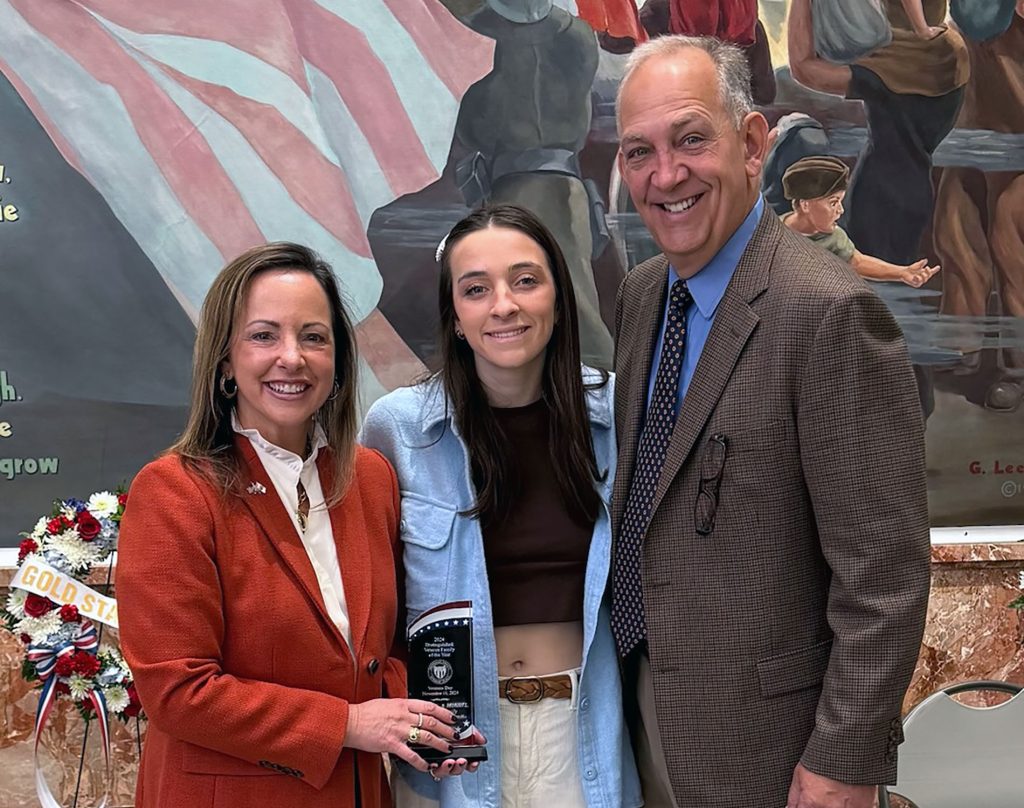
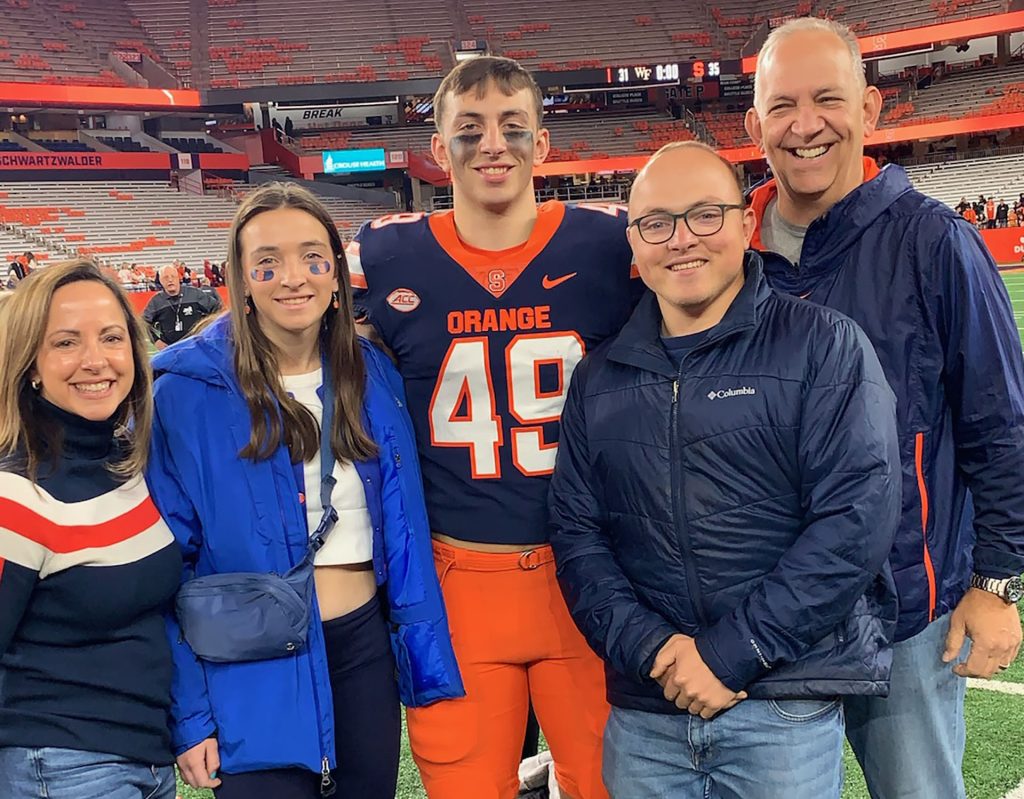
Some families ski or hike together. Others volunteer in their religious communities or participate in local service projects. The Kubala family, however, serves their country together. In honor of Military Appreciation Month this May, we recognize the extraordinary dedication of the Kubala family, Elizabeth and Michael and their children Zachary, Josh, and Lindsey, who embody the spirit of service across generations. Their decades of commitment were recently honored as they were named the 2024 Onondaga County Military Family of the Year, the first time a military family received this distinction at a ceremony held at the Onondaga County War Memorial.
The Kubala family has close ties to the military, but it also has a long-term connection to Syracuse University and the College of Law. Teaching Professor Elizabeth (Beth) Kubala joined the faculty of the College of Law in 2020 and is currently the executive director of the Office of Clinical Education and the director of the Betty and Michael D. Wohl Veterans Legal Clinic, where she oversees law students assisting local veterans applying for military benefits. She is also the director of Veteran and Military Affairs for the College of Law.
A graduate of the U.S. Military Academy at West Point, Beth received her commission as a military intelligence officer. Later, she was selected for the U.S. Army’s Funded Legal Education Program, where she earned a J.D. and an LL.M. in military law from the University of Missouri-Kansas City. She transitioned into the Army’s Judge Advocate General’s (JAG) Corps, where she served in a number of critical roles, including at the Pentagon. On active duty for 22 years with the Army, her last post was at Fort Drum, north of Syracuse in Watertown, New York, where she served as a JAG officer and then a military judge, retiring with the rank of lieutenant colonel.
But it was Beth’s husband, Michael Kubala, who first brought his family to Syracuse University. After being an Army aviation officer for 25 years, he took a position in 2011 as a professor and chair at Syracuse University’s Department of Military Science, where he was an advisor, mentor, and instructor for the more than 120 students enrolled in ROTC at the University. When he separated from the Army with the rank of lieutenant colonel, he became the compliance coordinator for the Syracuse University Office of Athletics and today is a civilian administrative officer for research and development services at the U.S. Department of Veterans Affairs (VA).
The couple met at Fort Wachau in Kansas and have been married for 31 years. While both serving in the Army, they had three children, all born in different states. Being a military family meant they were separated from their extended family, but it also meant they operated as a tight-knit team as they moved from place to place.
“Military kids are resilient,” Beth says. “I think our kids saw the importance of military life and how rewarding it can be, and I am proud that my husband and my service has left a positive impression on them. I don’t think any of us would trade the time or adventures we’ve had as a military family for anything.”
The Kubala children respected the sacrifices their parents made and came to see the military as an extension of their own family, no matter where they lived. They learned the importance of helping others, both through their parents’ service and as some of the thousands of family members around the world who support the U.S. military in countless ways. The Kubala children grew up with those values instilled in them, and it is something they continue to live by today.
Oldest son Zachary Kubala ’21 recently completed four years as a battalion supply officer in the Army at Fort Riley Kansas. Zachary attended Syracuse University on a scholarship through the Army’s ROTC program, earning a bachelor’s degree from the College of Engineering and Computer Science in aerospace engineering.
Josh Kubala ’26 is currently a junior majoring in political science at the Maxwell School of Citizenship and Public Affairs with a minor in business through the Whitman School of Management. He is also a member of the Syracuse University football team and enrolled in the Army’s ROTC, from which he received a full scholarship.
“It felt natural for me to pick up ROTC, as I grew up in a home of teamwork, discipline, and hard work,” says Josh. “I wanted the challenge of someday becoming an Army officer. Hopefully, I can branch out into aviation one day and fly helicopters like my father, but I’m also considering military intelligence.”
The youngest, Lindsey Kubala ’28 (VPA), is in her first year at Syracuse University, studying environmental and interior design at the College of Visual and Performing Arts. While Lindsey may not serve in uniform, she is able to attend Syracuse University through her parents’ GI Bill benefits and serves as a VA work study student in the Office of Veteran Success.
Beth and Mike Kubala are proud to have served their country and see how their family has grown together to respect the work of the military and continue actively helping veterans. As for the award, the entire family is proud but takes it in stride.
“The award is obviously wonderful, but, more importantly, it speaks to how our parents raised us,” says Josh. “Today they are both working in the civilian world but doing so in ways that are still giving back to the military community. They’ve led us by example, and my hope is that this award will inspire others to do the same.”
Professor of Law Gregory Germain spoke with The Guardian for the story “Judge cautions prosecutors in healthcare exec murder trial to refrain from public comments.” The Judge in Luigi Mangione’s murder trial recently pointed prosecutors to a district court policy barring lawyers on both sides from making “public commentary that could impede Mr. Mangione’s right to a fair trial”.
It is hard to say exactly when out-of-court statements by public figures might have an impact.
“The rules are vague enough that it’s hard to know when they cross the line,” said Germain.
“What the judge did is what judges usually do if they think they’re getting close to the line: they admonish them and remind them of their obligation,” he said. “They hope then that the prosecutors will behave themselves and not try the case in front of the public, but try the case in the court and not impair the defendant’s right to a fair trial.”
Professor Lauryn Gouldin will present her research on pretrial appearance and criminal court scheduling practices at the National Conference of Bar Examiners Annual Bar Admissions Conference. She will participate on Friday’s panel “Remote Courts 2.0: Building Sustainable Hybrid Justice Systems”. The panel will be moderated by Chief Justice Mary Russell of the Supreme Court of Missouri.
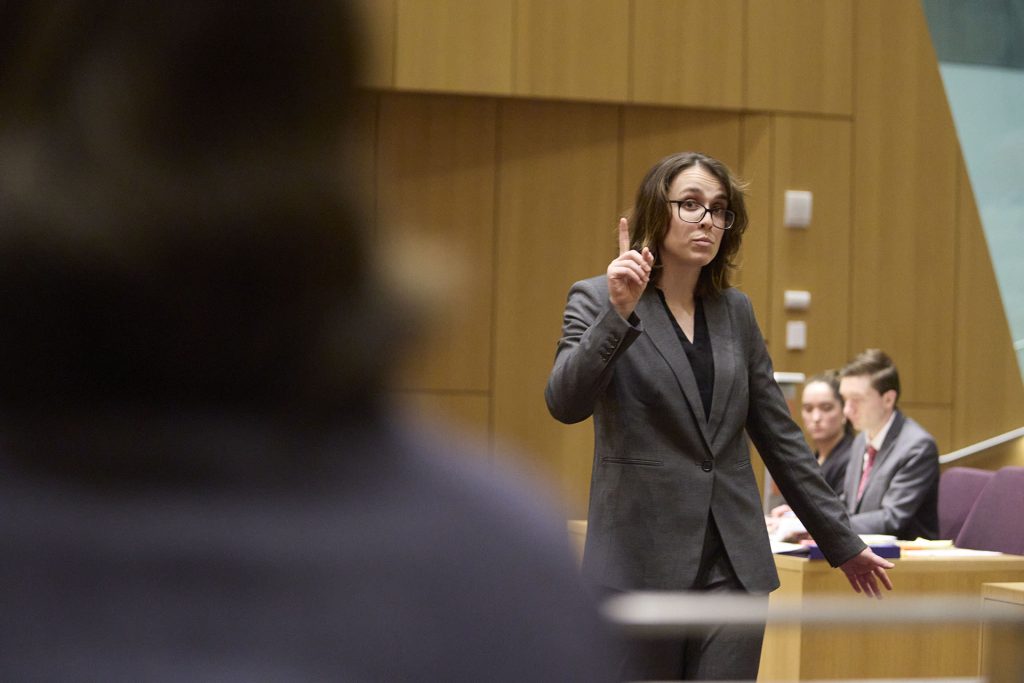
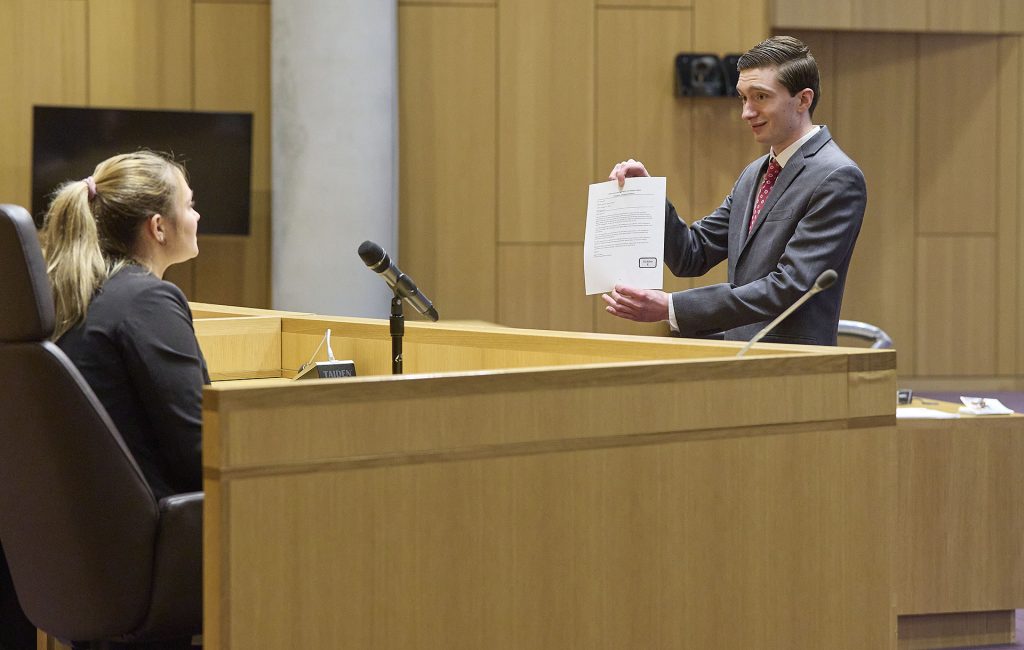
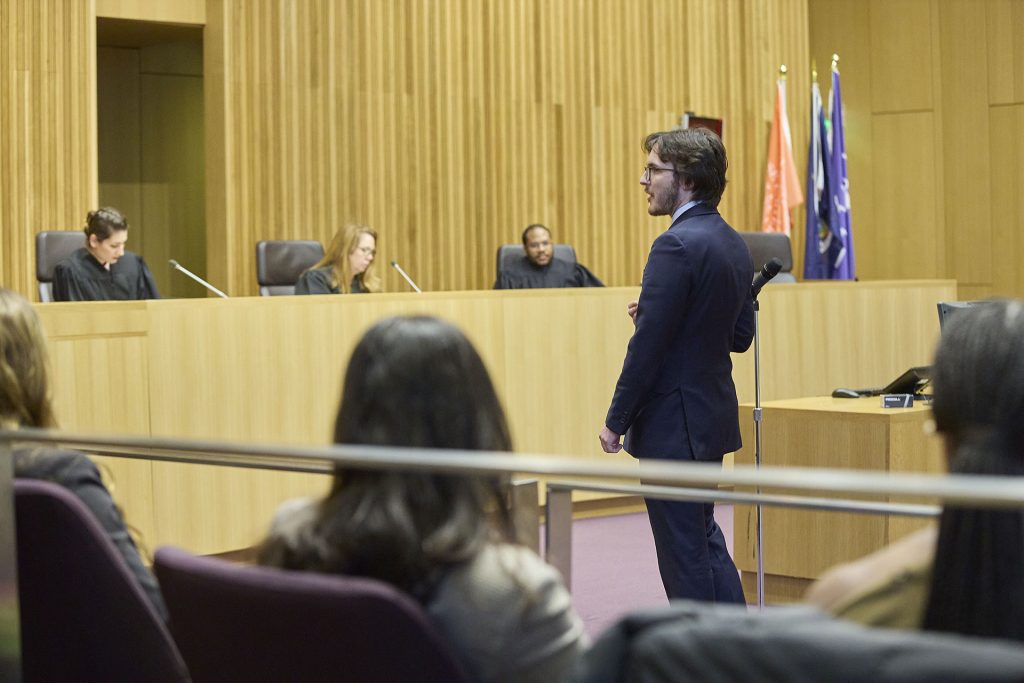
This academic year, the College of Law’s Travis H.D. Lewin Advocacy Honor Society (AHS) advocacy teams frequently advanced to the semi-final round, or better, in more than a dozen regional and national competitions held in-person and virtually. Several students were also recognized for their advocacy skills.
“This academic year was one of the most successful in terms of team and individual accomplishments,’ says Professor Todd Berger, Director of Advocacy Programs at the College of Law. “I am proud of our students who tirelessly prepare for the competitions and continually deliver at the biggest advocacy events against the best students from other law schools.”
AHS hosts five intercollegiate competitions and six intracollegiate competitions throughout the year. In addition, the College of Law offers the only joint J.D./LL.M. in Advocacy and Litigation along with numerous academic offerings and skills-based courses that prepare graduates to be ready for the courtroom. The program is supported by a select group of Advocacy Fellows, experts with many years of experience in advocacy and litigation, who coach many of the competition teams.
“I also want to acknowledge the coaches who prepare and encourage our students, spending countless hours helping the teams be amazing advocates. We couldn’t achieve these results without them,” says Berger.
The College of Law is ranked #8 in Trial Advocacy in the 2025 U.S. News & World Report rankings.
Fall Competitions
The College of Law team of 2L Haethyr Johnson, 3L Ethan Leonard, 3L Megan Qualters, 2L Skylar Swart, and 3L Lu Weierbach reached the semifinals of the Quinnipiac Criminal Justice Competition. The team was coached by Peter Hakes and Carly Zakaria L’24.
At the Buffalo-Niagara Trial Competition, 3L George Saad won best cross-examination. George’s cross-examination was deemed the best of the 96 cross-examinations during the competition’s preliminary rounds. The team of JDinteractive students finished fifth overall in the 24-team competition. In addition to Saad, the team members were 2L Dannah Henderson, 2L Lisa Musto, 3L Tania Rivera Bullard, 3L Kaylee Searcy, and 3L Taylor Shawver. The team was coached by Tyler Jefferies L’21.
Syracuse Law reached the semifinals of the National Civil Trial Competition. The team of 3L Gary Loope, 3L Charlotte McKeon, 2LJonathan Newsome, and 2L Tatiana Whitehorn was coached by Andrew Umanzor L’24 and Joanne Van Dyke L’87.
At the Judge Paul Joseph Kelly, Jr. Invitational Trial Competition, the College of Law reached the semifinals and 2L Jade Argueta won the award for Best Closing Argument. The team of Argueta, 2L Grace Hoffman, and 3L John Rutecki was coached by Gabrielle Groman L’23, Jimmy Lawler L’23, and Joanne Van Dyke L’87
2L Allison Carlos was selected as the National Trial League MVP (Best Advocate). The National Trial League is a College of Law-hosted bi-weekly virtual competition with fast-paced head-to-head trials in a sports league format. The National Trial League features some of the most competitive trial advocacy programs in the country.
Spring Competitions
The College of Law’s Black Law Student Association team finished in third place at the Northeast Regional of the Constance Baker Motely Mock Trial Competition, held by the National Black Law Student Association. The team of 3L Dachie Belony, 3L James Cameron III, 3L Suzan Elzawahry, and 3L Tatiana Vaz was coached by John F. Boyd II L’16 and William M.X. Wolfe L’20. Under the guidance of Boyd, the team has advanced to the national round of the competition in eight out of the last nine years.
AHS hosted a regional round of the National Trial Competition with 21 teams competing. This involved securing 122 evaluators and filling 156 witness positions. Hosting the competition was a success, owing in large part to the herculean efforts of Joanne Van Dyke L’ 87, 3L Katie Raumann, 3L Jacob Samoray, Vicki Donella, and many AHS students who played the role of witnesses and bailiffs. In addition, the teams of 3L John Rutecki and 2L Jade Argueta and 3L Gary Loope and 3L Charlotte McKeon reached the semifinals, with Loope and McKeon advancing to nationals. The teams were coached by Gabriella Groman L’23, Peter Hakes, and Joanne Van Dyke L’87.
The AHS trial team advanced to the national round of the American Association of Justice (AAJ) Trial Competition. AAJ is one of the largest trial competitions in the country and the College of Law’s region is one of the most competitive. The team consisted of 3L Brandon Bryant, 2L Allison Carlos, 2L Jonathan Newsome, and 2L Matt Reimann. The team was coached by Andrew Umanzor L’24 and Joanne Van Dyke L’87.
The AHS trial team also reached the finals of the Trials and Tribulations Trial Competition, one of the most competitive invite-only competitions in the country. It is also one of the most unique competitions because it features a third-party defendant. 3L Katie Raumann won the competition’s Best Advocate Award. The team members were 3L Garrison Funk, 2L Haethyr Johnson, 3L Terrence Kane, 2L Greg Patrick, 3L Megan Qualters, and Raumann. The team was coached by Peter Hakes, Jeff Leibo L’03, and Carly Zakaria L’24.