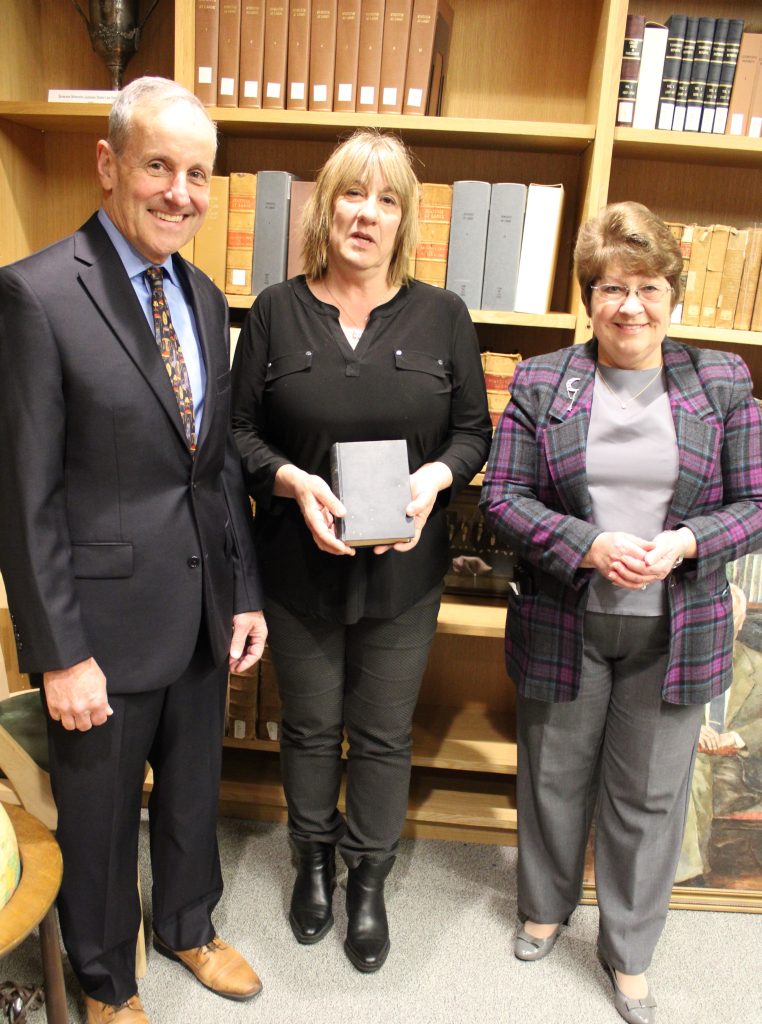
Goidel Law Group Internship Fund seeks applicants for the 2023-24 academic year. Graduate social work students are encouraged to apply by June 30.
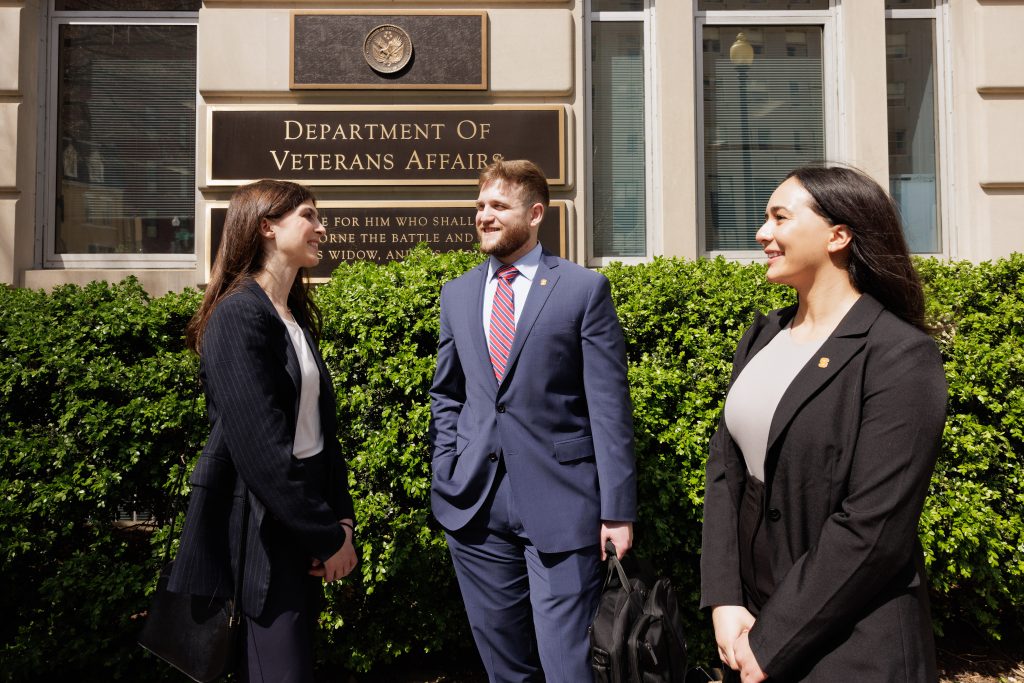
Veterans often face a unique set of legal issues related to their service that require specialized knowledge and understanding to resolve. Those issues can become increasingly complex as veterans age, further intersecting with various aspects of physical, social, and emotional well-being. According to the U.S. Census Bureau, more than 80% of U.S. military veterans are over the age of 55.
At Syracuse University, the College of Law and the Falk College of Sport and Human Dynamics have formed a partnership to help veterans, and especially aging veterans, access the legal services they need and obtain the benefits they have earned and deserve.
Staffed by attorneys from the College of Law’s Betty and Michael D. Wohl Veterans Legal Clinic, law students, and graduate social work students, the Legal-Social Work Partnership program provides free, high-quality legal services for veterans, such as assistance with disability claims and discharge upgrades, benefits counseling and more. The partnership also works to educate veterans about their rights and how to navigate the legal system.
The partnership operates under the College of Law’s Office of Clinical Education, where Syracuse law students apply doctrinal law while representing clients under the supervision of faculty-mentors.
The Legal-Social Work Partnership places an emphasis on addressing the social determinants of health. By assisting veterans with housing, employment, aging and other issues, the Legal-Social Work Partnership can help reduce veteran homelessness and suicide rates and improve the lives of veterans and military families.
Elizabeth Kubala, Teaching Professor at the College of Law, is the executive director of the Betty and Michael D. Wohl Veterans Legal Clinic. “The veterans we assist often have needs and challenges outside the scope of our legal representation,” she says. “Bringing a social work perspective into our legal clinic will not only result in better overall outcomes for our veteran clients but also a better understanding by the students of how to best serve veterans.”
As Syracuse law students and social work students learn how their respective disciplines interact in real-world practice settings, this program is building a stronger legal system that can address the holistic needs of clients.
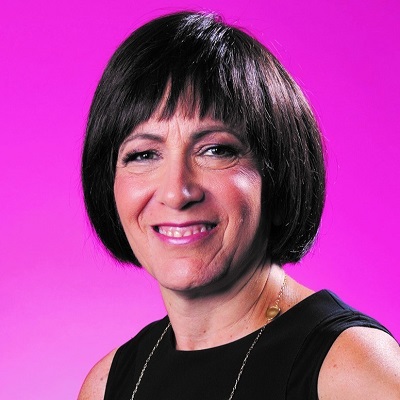
While there are law firms that employ social workers in their practices, it is still quite uncommon. Syracuse University alumna Wendy Goidel ’84, Esq., the founding and managing member of Goidel Law Group PLLC and its Estate Planning & Elder Law Center, is one of the few who is leading the way. Goidel is the founder and co-developer of Concierge Care Coordination, a holistic practice model, which merges geriatric social work with legal planning.
“While the interdisciplinary model in an elder law context is natural and essential, it should be replicated and embraced in other practice areas—such as matrimonial, family, medical malpractice, personal injury, and criminal—where legal problems are intertwined with social, medical, and emotional issues. There is no doubt that clients and their family members receive far superior services, strategies, and solutions when attorneys and social workers advocate and collaborate,” says Goidel.
Goidel established the Goidel Law Group Internship Fund to support social work graduate students interested in working at the intersection of law and social work, particularly with older adults, through the Legal-Social Work Partnership program at Syracuse University. Students will receive $5,000 stipends for their internship year while working within the Legal-Social Work Partnership.
“Collaborations between law students and social work students are essential in addressing the legal problems impacting the health and well-being of our nation’s veterans,” says Ken Marfilius, Falk College assistant dean for online and distance education and associate teaching professor in the Falk College School of Social Work. “Social work students will play a key role in connecting veterans to community resources beyond those typically addressed through legal representation, having a direct and immediate impact on veterans and their families.”
“In addition to addressing the critical needs of veterans, this project illuminates the needs of one of the fastest growing populations on our planet, and that is of aging individuals,” says Carrie Smith, chair of the Falk College School of Social Work. “Collaborative work among an increasing number of experts at the intersection of law and social work will be essential in addressing the myriad needs and concerns of this population.
“We are very appreciative of the pioneering work being led by Wendy Goidel in addressing these aims,” she adds.
Through the Goidel Law Group Internship Fund, two social work graduate students at Syracuse University will be selected annually for the Goidel Law Group Internship Fund. Students do not need to be enrolled in Syracuse University’s J.D./master of social work dual degree program to be selected. Interested students must apply online by June 30, 2023, for the 2023-24 academic year.
For more information about the Legal-Social Work Partnership program or the Goidel Law Group Internship Fund, please contact Elizabeth Kubala, 315. 443.8420 or egkubala@syr.edu, or Kenneth Marfilius, 315.443.5586 or kjmarfil@syr.edu.