News

Professor Nina Kohn Writes on Protecting the Voting Rights of Long-term Care Facility Residents

Writing at the American Society on Aging’s Generations Today digital publication, David M. Levy Professor of Law Nina Kohn discusses the need to protect the voting rights of residents of long-term care facilities. In the article, Voters Live Here: Understanding the Voting Rights and Needs of Long-term Care Residents, Kohn covers common barriers, legal protections, and how care facility staff can help.

“Whether long-term care residents can vote is not a trivial issue. Voting is a fundamental right, a powerful symbol of membership in the community, and can be an important source of self-worth. The right to vote also provides long-term care residents with an important opportunity to defend their interests—interests that are often pushed to the wayside. Moreover, long-term care residents’ votes could be decisive in critical races,” Kohn concludes.

Professor Nina Kohn Co-authors Guardianship Expert Opinion Article at Bloomberg Tax

Professor Nina Kohn has co-authored the expert opinion article “Modern Laws and Out-of-Court Solutions Can Advance Guardianship” at Bloomberg Tax Law.

Robert Dinerstein, American University Washington College of Law; Deborah Enix-Ross, American Bar Association, and Ellie Lanier, University of Georgia School of Law are co-authors of the article.

In her portion of the article, Professor Kohn discusses the need to increase court resources and reform at the legislative level to acknowledge the voices and rights of those served.

“Each of us has the potential to become a person subject to guardianship. Each of us has the potential to find a loved one entrapped in the guardianship system. It’s time to contact elected representatives and demand guardianship reform,” Kohn concludes.

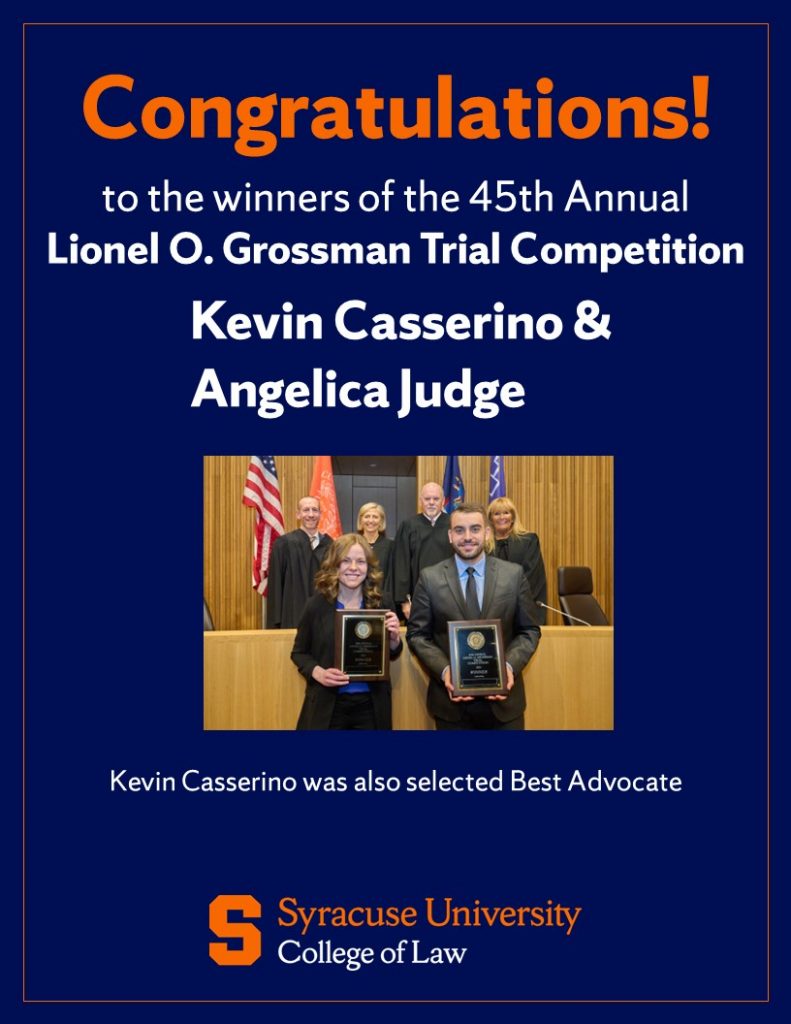
3Ls Kevin Casserino and Angelica Judge Win the 45th Annual Lionel O. Grossman Trial Competition

3Ls Kevin Casserino and Angelica Judge prevailed over 2Ls Daniel Bonsangue and Gavin Gretsky in the 45th Annual Lionel O. Grossman Trial Competition. Casserino was selected as the Best Advocate.

Final round judges were the Hon. Glenn T. Suddaby L’85 (Chief U.S. District Court Judge, Northern District of New York), the Hon. Bernadette Romano Clark L’89 (Oneida County Supreme Court Judge), the Hon. Jeffrey Leibo L’03 (Administrative Law Judge for New York State), and Julie A. North L’89 (retired, partner, Cravath.)

Professor Gary Pieples Discusses Onondaga County’s Use of Virtual Arrangements

In Onondaga County, virtual arraignments, enacted during the COVID pandemic on an emergency basis, continue to be used by Syracuse City Court. Professor Gary Pieples, Director of the Criminal Defense Clinic, explained that “virtual arraignments prevent attorneys from adequately being able to talk to clients, and prevent clients from asking questions of their lawyers during hearings.”

Read the full Central Current article.

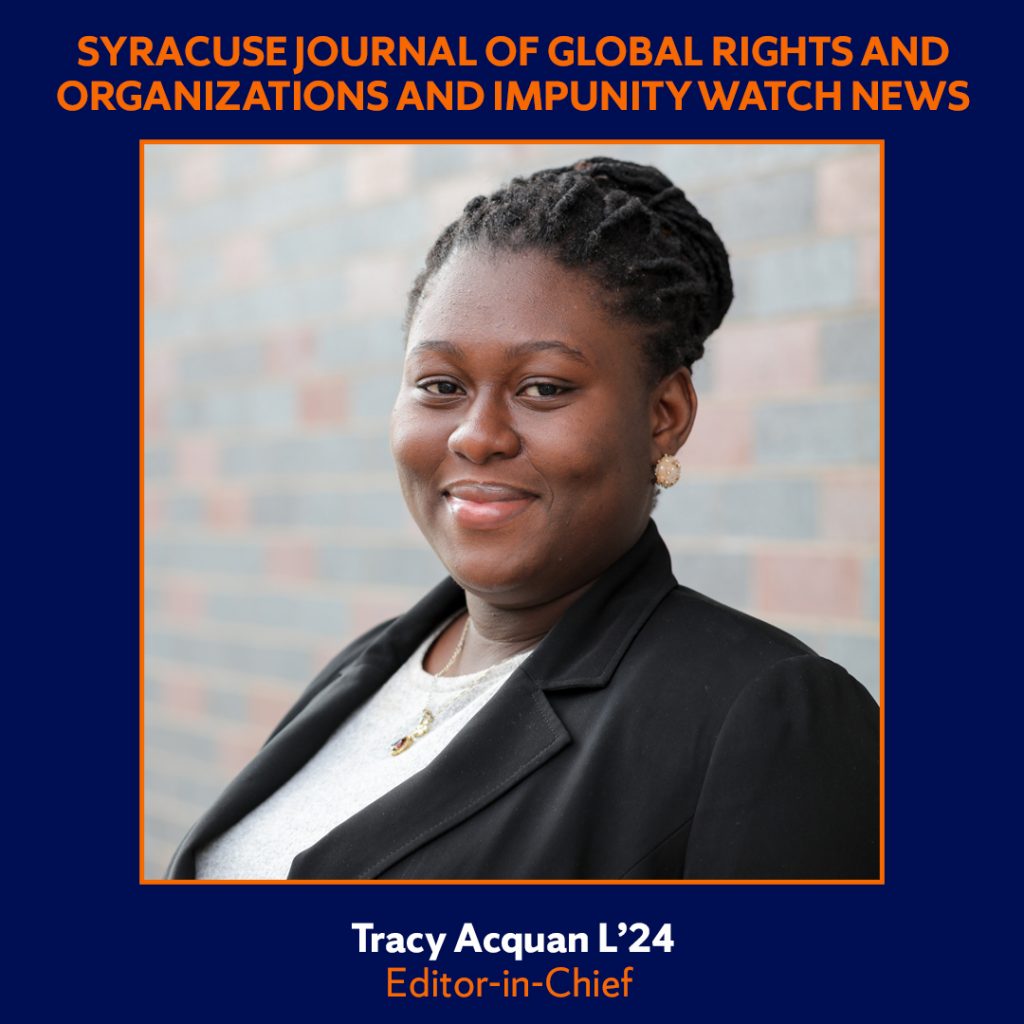
2L Tracy Acquan was elected the Editor-in-Chief of the Syracuse Journal of Global Rights and Organizations and Impunity News (JGRO) for the 2023-2024 academic year

Acquan is the first African American and first African American Woman to hold this title.

The JGRO is a biennial academic journal run by Syracuse University College of Law students and serves as a platform for cutting-edge legal scholarship and research in the area of human rights.  

Professor Cora True-Frost L’01 is the faculty advisor to JGRO.

Professor Jack Graves Discusses Crypto Regulations with Crypto Compass

Professor Jack Graves provides insight into the lack of regulation in domestic and international cryptocurrency exchanges and its risks and implications to consumers at Crypto Compass.

Graves explains that whereas exchanges reminiscent of Coinbase are licensed cash transmitters, they don’t seem to be broker-dealers. “As soon as you talk about broker-dealers of securities, that triggers a bunch of disclosure and custody requirements,” Graves states. “I happen to use Fidelity as my brokerage company, and if Fidelity goes bankrupt, I’m not an unsecured creditor in bankruptcy. So, I have a claim to my assets before all the unsecured creditors.”

THE WAR IN UKRAINE BY THE NUMBERS

Russia invaded Ukraine on February 24, 2022

CIVILIAN
7,200 / 11,800 Civilians killed + wounded

8 million Ukrainian refugees

900,000-1.5 million Civilians forcibly deported to Russia

5.4 million Internally displaced persons

MILITARY
120,000 / 200,000
Ukrainian + Russian soldiers killed or wounded

2,000
Russian tanks destroyed

100,000
US-made Howitzer rounds sent to Ukraine

8,000 / 1,600
US-made Javelins + Stingers sent to Ukraine

INFRASTRUCTURE
1,582 Ukrainian cultural + heritage sites damaged

$54 billion Cost to repair residential buildings

$36 billion Cost to repair Ukraine’s critical infrastructure

LEGAL & ECONOMIC
66,000 Reported war crimes

$138-750 billion Total estimated cost to rebuild Ukraine

35% Drop in Ukraine’s GDP in 2022

Sources & additional statistics

Presented by the Institute for Security Policy & Law

Professor Mary Szto Writes “Barring Diversity? The American Bar Exam as Initiation Rite and its Eugenics Origin” in the Connecticut Public Interest Law Journal

Professor Mary Szto has published the paper “Barring Diversity? The American Bar Exam as Initiation Rite and its Eugenics Origin” in the Connecticut Public Interest Law Journal. The article appears in 21 Conn. Pub. Int. L.J. 38 (2022).

Abstract

The American bar exam is an initiation rite that bars diversity in the legal profession.

According to the 2020 census, the US population is over 42% minorities. However, only 14% of the legal profession is. In 2020 the American Bar Association released data that the first-time bar exam pass rate was 88% for Whites, 80% for Asians, 78% for Native Americans, 76% for Hispanics, and 66% for Blacks.

Initiation rites often involve a separation from society, a liminal period, an ordeal, and then reincorporation into society. The bar exam follows this pattern. However, many minority candidates cannot afford months of unpaid isolated study, much less further bar attempts.

Racial disparities in first time bar passage rates are not coincidental, but rooted in the eugenics origin of the bar exam. Bar admissions standards arose amid teachings about Anglo-Saxon white supremacy in the late 1800s and early 1900s. Eugenics theory was then mainstream science and held that non-whites should be denied access to property ownership, education, and the legal profession. Minorities were excluded from most law schools, and there was widespread fear of immigrants diluting the US white population and the legal profession.

Eugenics-inspired federal redlining policies from the 1930s also led to huge racial wealth gaps then and now. Homeownership is the chief way Americans build intergenerational wealth. Redlining prevented non-whites from owning homes by blocking access to federally subsidized home mortgages. Thus, in pre-pandemic 2019 White families had eight times the wealth of Black families and five times the wealth of Hispanic families. Therefore, to diversify the legal profession, we must acknowledge this eugenics history and racial wealth gap and institute the diploma privilege, or create sequenced open book bar exams or other alternatives that do not require costly isolated study and bar preparation courses. Healing reform will help all candidates, and the public we serve.