The strong late-pandemic labor market is giving a lift to a group often left on the margins of the economy: workers with disabilities. Companies’ newfound openness to remote work has led to opportunities for people whose disabilities make in-person work — and the taxing daily commute it requires — difficult or impossible, reports the New York Times.
In the past, employers often resisted offering remote work as an accommodation to disabled workers, and judges rarely required them to do so. But that may change now that so many companies were able to adapt to remote work in 2020, said Professor Arlene Kanter, Director of the Disability Law and Policy Program.
“If other people can show that they can perform their work well at home, as they did during Covid, then people with disabilities, as a matter of accommodation, shouldn’t be denied that right,” Kanter said.
After decades of decline, the U.S. labor movement is once again on the rise, as workers turn to collective action to push back against stagnant wages and unsafe working conditions. What will this 21st century labor movement look like? How are workers challenging corporate greed and divide-and-conquer tactics?
A panel of prominent labor leaders met in Dineen Hall on Monday, October 24 to discuss these topics and the ongoing struggle for dignity and democracy at work in the 2022 Lender Center Conversation: Labor’s Revival: Unions and the Struggle for Racial and Economic Justice.
Professor Jenny Breen moderated discussion, speaking with panelists including Jan Brisack, Organizer, Starbucks Workers United; Johnnie Kallas, Director, Cornell University School of Industrial and Labor Relations Labor Action Tracker; and Chris Smalls, President, Amazon Labor Union.
According to coverage by Spectrum News and panelist’s expertise, unsafe working conditions, long hours and few breaks are just some of the reasons why workers choose to unionize.
“I’ve seen workers get carried out on stretchers,” said Smalls. “When I see workers get inspired by the efforts that we’re doing, that continues to resonate with myself. I know that there’s a bigger purpose, and that’s what motivates me to continue going.”
Last week, Supreme Court justices heard arguments in a case about copyright infringement and an iconic photograph of the musician Prince that was manipulated by the artist Andy Warhol. Justice Clarence Thomas posed a hypothetical question about the “copyrightability” of a blown-up version of the Prince photo in orange and the slogan, “Go Orange.”
In his preface to the question, he acknowledged that he was both a fan of Prince’s 1980s music and the Syracuse University Orange football team.
Professor Roy Gutterman L’00, Director of the Tully Center for Free Speech, wrote a guest opinion article featured on Syracuse.com about Thomas’s SU references. Of all the sports teams and college programs, how did Syracuse make it to the top of Thomas’s docket? Perhaps nobody will know for sure, Gutterman claims, later going into detail about Thomas’s 1991 commencement speech at the Syracuse University College of Law.
Professor Todd A. Berger, Director of the Advocacy Programs at Syracuse Law, sits down with CNN Senior Supreme Court Analyst Joan Biskupic as the Supreme Court starts its new term. Berger discusses hot topics facing the Court with the veteran reporter, including the Court’s legitimacy crisis, the idea of court packing, and the legacy of Chief Justice John Roberts.
Our understanding of citizenship can be transformed when viewed through the perspective of people with disabilities. How do disability rights fit into the modern Human Rights framework? Have universities become more accessible and if so for whom? Are disabled students fully included in higher education’s Diversity, Equity, and Inclusion efforts? And how do disability rights in New York State and the United States compare to other countries?
Professor Arlene Kanter, Founder and Director of the Disability Law and Policy Program (DLPP), and Yohannes Zewale LL.M. ’19 and current S.J.D. Candidate participated on the “Renewing Democratic Community: Disability Rights and Citizenship in the Modern Civil Rights Era” panel hosted by the Syracuse University Maxwell School of Citizenship and Public Affairs. The panel discussed how promoting disability rights moves us closer to realizing the promise of full citizenship in democracies here and around the world.
Led by Chris Faricy, Associate Professor of Political Science and the inaugural Hicker Family Professor in Renewing Democratic Community, additional panelists included Brian McLane, President of Paradigm Solutions; Beth Myers, Lawrence B. Taishoff Assistant Professor of Inclusive Higher Education; and Paula Possenti-Perez, Director for the Center for Disability Resources.
Professor Nina Kohn’s students often ask if an individual can be held liable for spreading COVID-19. Her Answer? “Well…maybe.”
In an opinion article published in Bill of Health, the blog of the Petrie-Flom Center at Harvard Law School, Kohn explains how an oft-ignored legal doctrine may hold the key to establishing liability in COVID-19 cases.
“The doctrine could enable plaintiffs with COVID-19-related claims to establish causation despite multiple sources of COVID-19 exposure,” Kohn says. “But if liability is not permitted to attach where one sufficient cause is ‘innocent’ — an approach seriously being considered for the Restatement Third of Torts — we should expect more COVID-19 claims to go off the rails despite clear evidence of wrongdoing.”
The College of Law co-sponsored the Raise the Age Summit this week in conjunction with the Franklin H. Williams Judicial Commission and the New York State Unified Court System Office for Justice Initiatives.
Panelists and keynote speakers examined the impact of the Raise the Age legislation on the courts, youth, and community. Passed in 2017, the Raise the Age bill increased the age of criminal responsibility in the state of New York to 18 years of age. New York was previously one of only two states that automatically prosecuted 16- and 17-year-olds as adults. The focus of the summit centered around how this new legislation impacts key stakeholders, including district attorneys, defense counsels, judges, and attorneys for the child.
“These issues concern all of us, including legal professionals and the broader community. Assessing the law at this juncture is timely and requires that we ask important questions to inform our decision making to guide our actions on juvenile justice and juvenile offenders. We must know empirically and experientially if the law is reaching its objectives, and if it applies equitably across racial, ethnic, gender and other diverse backgrounds,” says Professor Paula Johnson, a member of the Franklin H. Williams Judicial Commission who also moderated the first panel of the day, The Prosecutorial Perspective and Raise the Age Legislation: Where Do We Go from Here?
Thanks to Professor Johnson for organizing this learning opportunity for students, faculty, and guests, and to the over 30 speakers who offered their perspectives and input throughout the day.
Associate Dean Suzette Meléndez participated on a panel at the 2022 Associate Dean Conference at the Texas A&M School of Law earlier this month. Meléndez’s panel addressed issues related to Diversity, Equity, and Inclusion, including the recent addition of ABA Standard 303(c), which requires law schools to provide education to law students on bias, cross-cultural competency, and racism.
Additional sessions at the conference included panels on bar passage, professionalism and leadership, online and hybrid JD programs, rankings, and advice for those who want to become a law dean.
The College of Law’s Criminal Defense Clinic has been helping students gain practical experience in the courtroom and hone their craft since 1971.
The CDC represents low-income individuals pro-bono throughout Onondaga County, working mainly on civil matters such as shoplifting, vandalism and traffic violations. Students involved in the clinic said the experience has made them realize the impact of their work. Always under faculty supervision, they learn how to negotiate plea agreements, conduct legal research, and analyze the criminal justice system as a whole.
Members of the clinic typically discuss their cases with Gary Pieples, the director of the CDC and a teaching professor at SU. They then travel to one of several courts to meet with their clients prior to appearing before the judge.
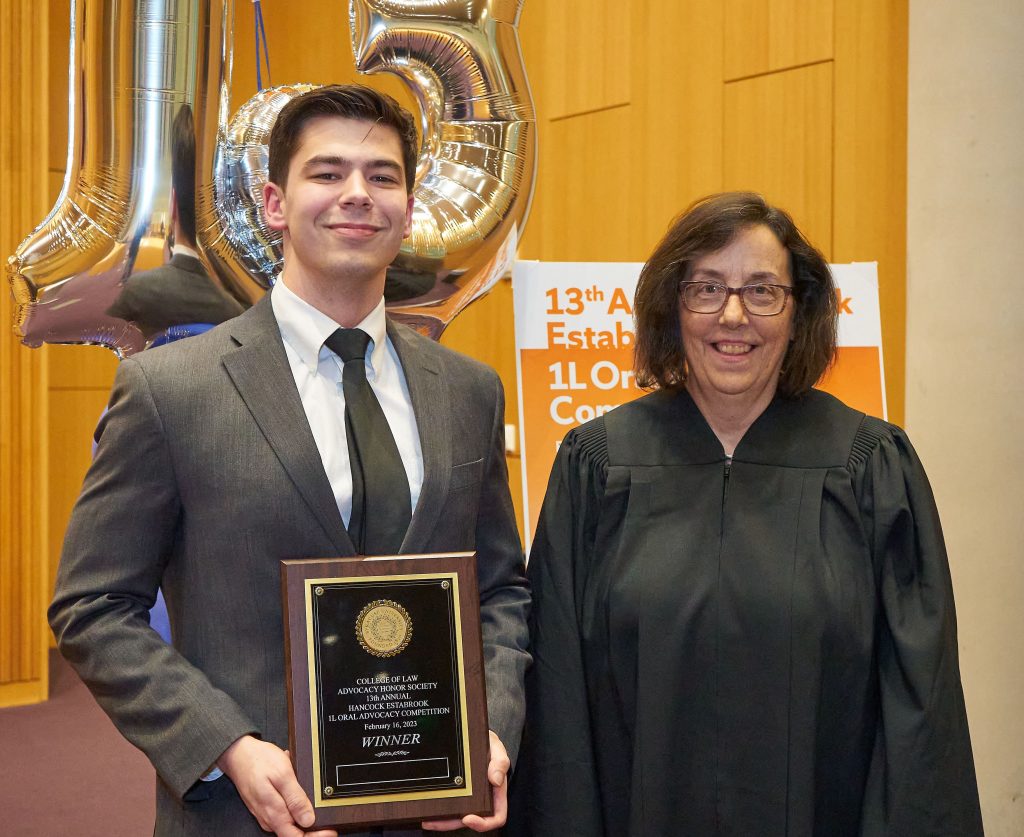
Second-year students Patrick Farrell and Alexander Shaw took home first place in the 51st Mackenzie Hughes LLP Edmund H. Lewis Appellate Advocacy Competition. The pair also won Best Brief, and Farrell was awarded Best Advocate. 3Ls Carlos Negron and Matthew Calogero reached the finals and placed second.
“Congratulations to both Patrick and Alexander on their advocacy performance and a clean sweep of awards!” says Professor Todd A. Berger, Director of Advocacy Programs. “I’m proud of all of our competitors for all their hard work, preparation, and dedication to this year’s competition.”
Sponsored by Syracuse law firm Mackenzie Hughes LLP, this competition is open to two-person teams consisting of second and third-year Syracuse law students. The competition is named for the Hon. Edmund H. Lewis L’1909, a distinguished alumnus of Syracuse University College of Law, a partner at Mackenzie Hughes, and a Chief Judge of the New York Court of Appeals. Each year, volunteer judges evaluate the teams’ written appellate briefs as well as oral argument performance through multiple rounds.
This year’s final round judges included: John F. Boyd II L’16, Court Attorney, Fifth Judicial District of New York; Lauryn P. Gouldin, Laura J. & L. Douglas Meredith Professor of Teaching Excellence
2022–2025 & Crandall Melvin Professor of Law; David Katz L’17, Litigator, Smith, Sovik, Kendrick & Sugnet, P.C.; and Thomas M. Leith, Appellate Attorney, Hiscock Legal Aid Society.
16 additional judges, including alumni and professors at the College of Law, judged the preliminary, quarterfinal, and semifinal rounds. Thank you to Professor Courtney Abbott-Hill L’09, Craig Atlas, Piotr Banasiak, Professor Emily Brown L’09, Peter Calleri, Josh Cotter L’09, Carly Dziekan, Professor Roy Gutterman L’00, David Katz L’17, Professor Aliza Milner, Professor Gary Pieples, Brandan Ray, Michael Paul Ringwood, Professor Richard Risman, Neil Smith L’02, and Professor Monica Todd.
This year’s problem involved the epicenter of the opioid epidemic in the State of West Hampshire, now second only to West Virginia in the opioid overdose death rate. Following the rapid rise in opioid overdoses in 2017, the United States Drug Enforcement Administration (“DEA”), acting in coordination with the Burlington Sheriff’s Department, initiated an investigation into the illicit distribution of prescription opioids to West Hampshire and New Hampshire. The August 2017 search identified Brittney Cooper as an individual with an alarming number of opioid prescriptions. Cooper was charged with fraudulently obtaining several prescriptions for OxyContin and Percocet and distributing the opioids to individuals throughout West Hampshire and New Hampshire, across states, under 21 U.S.C. § 841(a)(1).
In pretrial motions, Cooper filed a motion to suppress the prescription drug records acquired from the Database. She argued that the DEA and Burlington Sheriff’s Department violated her Fourth Amendment rights against unreasonable searches and seizures because she had a reasonable expectation of privacy in her prescription drug records. The District Court denied the motion, holding that Cooper had no reasonable expectation of privacy because these records are held by a third party (the state government) and because the prescription drug industry is highly regulated. The case is currently pending before the Supreme Court of the United States.
Questions before the court are first whether an individual has a reasonable expectation of privacy in prescription drug records held in state databases of controlled substance prescriptions under the Fourth Amendment, and also whether the database search was a valid administrative and special needs search, waiving the probable cause and warrant requirements.