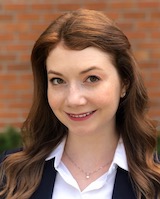
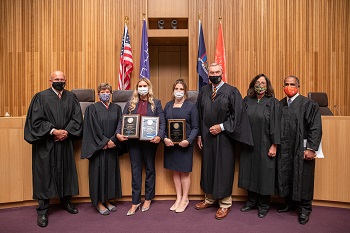
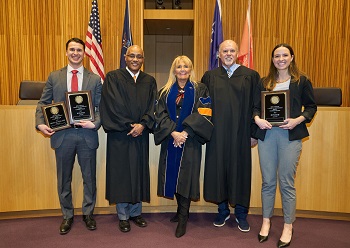
Rising third-year law student Hayley Rousselle has won second place in a writing competition organized by the Association for Education in Journalism and Mass Communication Law and Policy Division, the accreditation group for communications and journalism schools and colleges. Rouselle will present her paper—“Social Media and the Economy of Hate.”—on an Aug. 4, 2021, panel during AEJMC’s virtual conference.
“Hayley wrote her paper for my Media Law 737 class last fall and we worked pretty closely getting it ready for the competition,” says Professor Roy Gutterman L’00, Director of the Tully Center for Free Speech. “The law division has some of the top media law scholars in the country. The competition is pretty tight.”
Rouselle explains that her paper addresses Section 230 of the Communications Decency Act, which grants social media companies immunity in making good-faith efforts to regulate content on their platforms.
“However, this legal norm does nothing to encourage transparent, consistent, or effective regulation of harmful content such as hate speech,” Rouselle observes. “Instead, Section 230 has left social media companies in a position where they can go unchecked in profiting from the harmful content they often claim to prohibit.” Her article examines how Congress can amend Section 230 to best incentivize social media companies to enforce their policies that prohibit hate speech.
The Syracuse University Alumni Association (SUAA) has elected Carey Ng G’02, L’02 as a Vice President. Ng is an assistant district attorney in the Suffolk County District Attorney’s Office who joined the SUAA Board in 2020.
Ng received the College of Law’s Law Honors Award in 2021 and served as Vice President from 2014 to 2016 and President from 2016 to 2018 of the Syracuse University Law Alumni Association.
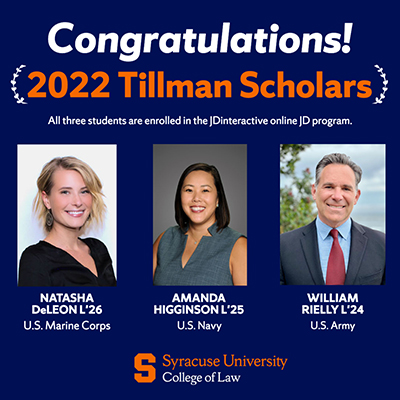
The Pat Tillman Foundation has announced its scholars for 2022 which includes three Syracuse University College of Law students: Natasha DeLeon (USMC Veteran), Amanda Higginson (Navy veteran), and William Rielly (Army veteran.) They join a fourth Syracuse University Tillman scholar, Anthony Ornelaz, Master of Fine Arts, College of Arts and Science, Air Force Veteran.
“Tillman Scholarships are extremely competitive and are only awarded to those who have made an impact through their service. I am both pleased and grateful that not one, but three College of Law students have been awarded Tillman scholarships for this year. Natasha, Amanda, and William are living extraordinary lives through their military commitments and now they are on the path to becoming extraordinary Orange lawyers,”
College of Law Dean Craig Boise
The three students are enrolled in the College’s JDinteractive (JDi) program. Reilly is in his second year, Higginson is in her first year, and DeLeon will start the program in the Fall 2022 semester.
An ABA-Approved Online Law Degree Program, JDi is taught by Syracuse University College of Law faculty to the same high standards as Syracuse’s residential J.D. program. JDi is designed for students who desire a high-caliber legal education with substantial flexibility, such as those with military commitments. The program combines real-time, live online class sessions with self-paced instruction, on-campus courses, and experiential learning opportunities.
Read this story for more information on the Syracuse University 2022 Tillman scholars.
Natasha DeLeon, USMC Veteran
Natasha DeLeon joined the United States Marine Corps to pursue her goal of serving others on a grand scale. As a Marine, she worked to deploy service members to combat locations in support of various operations. In 2014, she deployed to Afghanistan in support of Operation Enduring Freedom, where she aided in the return of over 120,000 service members to their families back home.
While serving in the Marine Corps, DeLeon began volunteering in San Diego’s foster care system as a Court-Appointed Special Advocate. This led her to pursue a Bachelor of Arts in Psychology and work part-time at a group home for teen foster boys. Upon completion of her service, her passion for social work grew. DeLeon earned a Master of Social Work in 2019, while she also interned as a therapist. During this time, she lived in Togo while supporting her husband during his active-duty Marine Corps career. While in West Africa, DeLeon led physical self-defense courses for women in vulnerable positions and volunteered with non-profit organizations centered around eliminating gender-based violence.
Following their tour in Togo, DeLeon and her family moved to Colombia where she began working remotely as a paralegal for a private law firm. This is where she began to connect the injustices in the legal and social work systems. From here, DeLeon developed a passion for criminal defense and family law. She is pursuing a Juris Doctor degree so she can provide legal assistance and advocacy as an attorney.
Amanda Higginson, Navy Veteran
Adopted as an infant, Amanda Higginson’s upbringing in South Florida was anything but typical. Her father, who was shot and paralyzed in the Vietnam War, taught her about extreme resilience and persistence in the face of adversity. Wanting to give back to military medicine, Higginson received a Navy Health Professions Scholarship and earned her medical degree at the Alpert Medical School at Brown University. She completed her residency in Pediatrics at the Walter Reed National Military Medical Center Bethesda and served on active duty for seven years alongside her husband, deploying twice.
Currently the interim Associate Dean for Student Affairs at the Brody School of Medicine at East Carolina University, Higginson supports students on their journey to achieve their personal, academic, and career goals. She continues to practice general outpatient pediatric medicine, caring for children in a largely rural, underserved area. Choosing to enter law school as a mid-career physician, Higginson saw law school as an opportunity to enhance her advocacy for children particularly related to social determinants of health, as well as expand her knowledge of issues that impact the daily functioning of an academic medical center in order to more effectively advocate for her students. At the intersection of law and medicine, Higginson hopes to create structural change both at work and in her community to empower others to live, work, and achieve their goals at their full potential.
William Rielly, College of Law, Army Veteran
William Rielly is an Army veteran and West Point graduate. His career has ranged from leading artillery units in Germany to executive roles at Microsoft and Apple. While working at Apple, Rielly started volunteering in California state prisons and found the incarcerated men he worked with wanted to be accountable for their actions and create a positive future. He discovered immense untapped potential among the incarcerated men and was inspired to leave his job at Apple and focus full-time on reform efforts in the criminal legal and parole system.
Rielly intends to change the parole and probation laws across the country to create pathways of redemption for incarcerated and formerly incarcerated people so they can leverage their talents, achieve their full potential, and positively impact their communities. He intends to lead this innovation and create a better system through legal advocacy, changing the public’s perception of the issues, and enlisting advocates inside and outside the current system. The outcomes he foresees are better, safer communities; more highly qualified employees; and a criminal legal system of accountability and redemption.
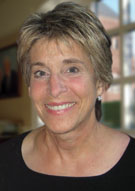
Hannah R. Arterian, dean emerita of Syracuse University’s College of Law who oversaw the building and opening of the school’s state-of-the-art facility, Dineen Hall, died April 8 in Los Angeles. She was 72.
Arterian served as dean of the College of Law from 2003-15. During her tenure, she increased the quality and size of the college’s faculty, diversified educational opportunities for students, and brought Dineen Hall, one of the most ambitious building projects in the University’s history, to life. The College of Law moved into Dineen Hall, a 200,000-square-foot building on the western side of campus, in August 2014. The building brought together the law school community under one roof for the first time and has been rated as one of the most architecturally attractive law school buildings in the world.
“Our College of Law community mourns the loss of Dean Emerita Hannah Arterian,” says Craig Boise, dean of the College of Law. “Her leadership and influence, her impact on the lives of countless alumni, faculty, and staff, and her many accomplishments as dean, including the successful fundraising campaign that gave us Dineen Hall, will always be a part of our story.”
Arterian was raised in Staten Island and attended Elmira College, where she earned a bachelor’s degree in English literature magna cum laude in 1970 and was inducted into Phi Beta Kappa. She attended the University of Iowa College of Law, where she was the first woman to hold an editorial position on the Iowa Law Review and was a member of the Order of the Coif.
After earning her juris doctorate, Arterian worked for the New York City law firm Dewey, Ballantine, Bushby, Palmer & Wood, practicing corporate tax law. She then returned to University of Iowa’s law school as a visiting professor and joined the faculty in 1978, one of the first women to teach at the college.
Arterian went on to hold teaching positions at Arizona State University (ASU) and University of Houston’s law schools before returning to ASU in 1985. Arterian became the first woman to serve as the college’s associate dean in 1992. When she began teaching at ASU in 1979, she was the only woman on the college’s law faculty and only the second to hold a faculty position in living memory. There, she taught courses on labor relations, employment law, and employment discrimination and wrote in the area of Title VII— particularly on the dilemmas for pregnant women employed in chemically toxic work environments.
She was named the 11th dean of Syracuse University’s College of Law—and the second woman appointed to the position—in 2002. She fundraised $1 million during the first year of her tenure and laid the groundwork for financial success and opportunities for the school. Arterian cultivated a diverse and accomplished faculty, developed relationships with alumni across the globe, and recruited many of the college’s board of advisors, with the long-term goal of increasing the quality of the college’s legal education and constructing a new building.
Arterian introduced an expanded orientation program for incoming students into the College of Law, which included alumni from all over the United States, as well as formal ceremonies to welcome new students into the college. One of her major projects was building the College of Law’s alumni association, as well as reinvigorating alumni connections to the school.
She worked with colleagues to forge strong relationships with Korean alumni by attending annual meetings and alumni events in Seoul. These visits included visiting the Korean Constitutional Court and discussing U.S. and Korean Supreme Court decisions with justices of the Korean Supreme Court. These international connections were also cultivated through Arterian’s work with colleagues to further develop the Law in London Program. Many programs and institutes, such as the Institute for National Security and Counterterrorism (now the Institute for Security Policy and Law); the Institute for the Study of the Judiciary, Politics, and Media; the Veterans Legal Clinic (now the Betty and Michael D. Wohl Veterans Legal Clinic); Securities, Arbitration and Consumer Law Clinic; Elder Law Clinic; and the externship program, were created, expanded and/or fostered under Arterian’s leadership.
With her colleagues and the Board of Advisors, Arterian raised $40 million to construct Dineen Hall, one of the nation’s premier law facilities.
“She is part of the ethos of that place. She was a visionary,” says Alexandra Epsilanty L’92, former associate dean of advancement in the College of Law and a close colleague of Arterian.
“Dineen Hall and the education of the next generation of legal minds are part of her legacy. She fought tooth and nail for the law school. It was like one of her kids. She cared about the law because she cared about civil society.”
During her tenure at ASU and at the College of Law, Arterian worked with the American Bar Association (ABA) to perform site inspections of law schools throughout the country and assess the qualifications of nominees to the federal judiciary and served on committees for the ABA, as well as the American Association of Law Schools. She was also a co-editor, with Jeremy Paul, of the SSRN Journal on Legal Education. In 2007, Arterian aided in the vetting process of then-vice-presidential nominee Joseph R. Biden Jr. L’68. In 2009, she joined AccessLex Institute (formerly Access Group), a nonprofit comprising representatives of accredited law schools with the mission of education financing and debt management for law graduates, as well as investigating loan options and loan policy advocacy. After becoming a member of its executive committee in 2011, Arterian was elected as the chair of the AccessLex Board of Directors in 2014.
Arterian is survived by her children, William Furnish, Susannah Arterian, Diana Arterian, and Cordelia Arterian; three granddaughters, Marnie and Celeste Arterian, and Helena Muñoz Furnish, and her sister, Susan Arterian.
In lieu of flowers, donations may be made to the organizations Arterian held dear—the Fresh Air Fund, Humane Society Legislative Fund, or to your own alma mater or institution of learning.
By Robert Nassau, Associate Director, Office of Clinical Legal Education; Director, Low Income Taxpayer Clinic; and Teaching Professor
Robert Nassau
Except for two weeks at the start of the spring semester, things were pretty much back to normal in the Office of Clinical Legal Education during the 2021–2022 academic year . . . although it’s probably more accurate to say: “back to a new normal.”
While in-person meetings between Student Attorneys, Clinic Directors, and clients resumed, Zoom meetings and hearings are certainly not a thing of the past and will likely remain prevalent moving forward. It’s hard to imagine what current legal practice would look like if the pandemic had not occurred, although it likely just accelerated a move to more online, hybrid, and remote work—something our Student Attorneys gained experience doing throughout the year.
Below are brief summaries of some of the amazing work performed by our Student Attorneys and Clinic Directors during the past academic year. These summaries are just the tip of the proverbial iceberg for all that we have accomplished. To repeat what I wrote last year: while the pandemic has created significant obstacles, it also provided teachable moments and learning opportunities that will better prepare our Student Attorneys for legal practice in a post-pandemic world.
CLINIC REPORTS
Bankruptcy Clinic
Director: Adjunct Professor Lee E. Woodard
The Bankruptcy Clinic had a successful and busy year with a Student Attorney enrollment of ten new students (plus one or two returning Clinic II students) each semester. The Clinic filed between 20 and 30 Chapter 7 bankruptcy petitions for clients. Several Student Attorneys obtained 2022 Summer Clerkships in the Bankruptcy Departments of “Big Law” firms, and one of our former Student Attorneys became a confidential law clerk to the U.S. Bankruptcy Court Judge for the Utica Division of the Northern District of New York.
Clinic students are rewarded by helping their clients get a new post-bankruptcy start in their lives. Between inflation and the end of COVID stimulus funds, bankruptcy cases will continue to be on the rise for the foreseeable future. Accordingly, the Bankruptcy Clinic will continue to be a needed and valuable resource in our community.
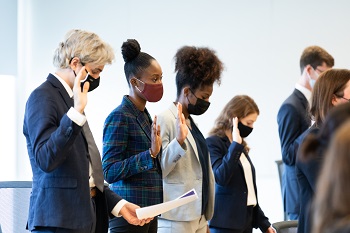
Judge Ramon Rivera administers the oath to student lawyers.
Betty and Michael D. Wohl Veterans Legal Clinic
Executive Director: Professor Elizabeth Kubala
The Betty and Michael D. Wohl Veterans Legal Clinic (VLC) provides representation for veterans and their families who are either seeking benefits from the U.S. Department of Veteran Affairs (VA) or upgrading a military discharge.
Student Attorneys in the VLC performed a broad array of administrative actions and court appeals to challenge wrongful denials of federal veterans’ benefits. The students adapted to the VA’s new tele-hearing format and regularly appeared with their clients before Veterans Law Judges at the Board of Veterans Appeals. Appeals to the Board involved issues. Students collaborated to practice before the U.S. Court of Appeals for Veterans Claims on cases dealing with a veteran’s chronic fatigue syndrome, as well as a deceased veteran’s claim for asbestos exposure that his widow is continuing to pursue on his behalf Finally, Student Attorneys are practicing before the U.S. Court of Appeals for the Federal Circuit on behalf of a widow who has been denied the military’s survivor benefit plan.
Over the past year, Student Attorneys in the VLC embraced new and innovative ways to best serve our community’s veterans. In the fall of 2021, the Office of Clinical Education migrated its law practice management system to a new cloud-based legal platform that provides students with direct experience with industry-leading law practice management technology. Our students are getting hands-on experience managing the daily tasks of running a law firm and technical experience in matter management, timekeeping, and management skills that provide them a competitive edge for their future legal careers.
The VLC remains engaged with the local community. As part of the Central New York Veterans Parade and Expo, Student Attorneys from the VLC teamed up with the Volunteer Lawyers Project of CNY for Valor Day at the New York State Fairgrounds where Clinic students and local attorneys provided free legal consultations for veterans and their family members as part of our area’s Veterans Day events.
The VLC joined SyracuseServes this year, an initiative of Syracuse University’s Institute for Veterans and Military Families. In collaboration with the City of Syracuse, the SyracuseServes network connects veterans and their families to local community providers to ensure that care, resources, and services are easily and successfully navigable. Student Attorneys in the VLC are trained to identify veteran clients who require resources beyond the legal services we provide. The VLC then refers those veterans to SyracuseServes for efficient and timely support.
Events like Law Alumni Weekend strengthen connections between the VLC and our alumni. In 2021, the VLC hosted an event titled “Serving Veterans at the College of Law and in the Community.” Current VLC students shared clinic and Syracuse University-wide updates and impact with our alumni. The oldest living College of Law alumnus and WWII and Korean War-era veteran, Robert Gang L’42, 104, was recognized in front of current faculty, alumni, students, and honored guests
Rising 3Ls Ryan Carson, Domenica “Sunny” Lostritto, and Abigail Gorzlancyk
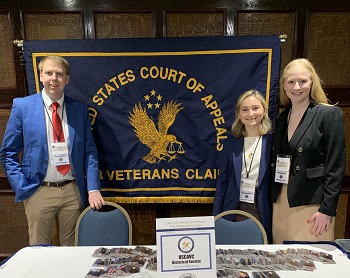
Wrapping up the year, three students from the VLC traveled to Washington, D.C. to attend the U.S. Court of Appeals for Veterans Claims 15th Judicial Conference. Students gleaned valuable insights into new developments in Veterans Law from judges, government attorneys, private practitioners, and public officials. A highlight of the conference was hearing from Senator Tammy Duckworth and U.S. Department of Veterans Affairs Secretary Denis McDonough who addressed attendees and answered questions. All three students who attended the Conference have internships this summer in the field of veteran law.
Low Income Taxpayer Clinic
Director: Professor Robert Nassau
The operative word this year in the Low Income Taxpayer Clinic (LITC), for both Student Attorneys and our clients, has been “patience.” As the media have accurately reported, anything involving the Internal Revenue Service or the United States Tax Court takes a very long time to reach a resolution. It can easily take a year for the IRS to review an Amended Return, a taxpayer’s response to an Audit Letter, or a Petition filed with the Tax Court. Hopefully, these timelines will improve soon.
In the meantime, the Student Attorneys of the LITC continue their work as the “Public Defenders of Tax.” Among the many tax controversies that LITC Student Attorneys helped resolve this year were those involving: the earned income tax credit and other child-based tax benefits; stimulus payments; identity theft; innocent spouse relief; and collection alternatives. Perhaps most notably, LITC Student Attorneys obtained a client’s proper New York State tax refund, after a hearing in the Bureau of Conciliation and Mediation Services; and successfully resolved a long-running Tax Court case involving the proper tax treatment of a post-bankruptcy deed in lieu of foreclosure.
Transactional Law Clinic
Director: Professor Jessica Murray
The Transactional Law Clinic (TLC) has been working with many clients in food-related businesses who are interested in protecting their brands with a U.S. or New York State trademark registration. (It is probably not a coincidence that Clinic Director Jessica Murray loves food and cooking.) Clinic trademark clients have included entrepreneurs with pudding, taco, pasta sauce, olive oil, and vegan cheese businesses.
With the involvement of Student Attorneys during four successive academic years, the TLC successfully registered two trademarks for The Shuga Pie Shop (name used with permission), a bakery that sells exclusively what they call “cake sandwiches,” delicious sandwiches made of two circles of cake with frosting between them, in many creative flavors.
One of the many benefits of being back in person: this year’s Student Attorneys were able to celebrate their work when The Shuga Pie Shop provided samples for the class. Services provided by the TLC to The Shuga Pie Shop included submitting trademark applications and responding to several Office Actions, resulting in the successful registration of the marks.
The TLC participates in the United States Patent and Trademark Office’s Law School Certification Program. As part of that program, representatives of the USPTO visited the TLC and the College of Law’s Intellectual Property Law Society—via Zoom—to discuss the work of the USPTO and careers there.
The TLC also worked with numerous clients who were starting not-for-profit organizations and non-food-related businesses, providing such services as incorporating, dissolving, forming LLCs, obtaining federal and state tax exemptions, counseling about intellectual property rights and protection, and drafting various types of agreements.
The College of Law’s externship program continues to evolve to meet the educational and professional demands of today’s law students, including those in the JDinteractive program, well beyond the core regions of Central New York, New York City, Philadelphia, and Washington, D.C.
The summer of 2021 was the first time JDi students participated in externships, joining a growing number of residential students who accelerate their practical experiences and legal skills via field placements to complement lessons learned in the classrooms. With JDi students stationed all over, the program was able to place students throughout the country.
As always, College of Law alumni came out in full force, and with their assistance, the Office of Career Services placed 145 students, including 60 JDi students, in 29 states, for whom the externship is a graduation requirement during the academic year.
As she ramped up the program, Director of Externships and Career Services Dafni Kiritsis ’97 (pictured left) also implemented a few systems changes for real-time data collection and tracking and to ensure ABA compliance.
2022 Program Highlights
JDI:
3L JDi student Meghan Steenburghwas a full-time extern this summer with the Defense Intelligence Agency which has led to a post-graduate employment offer. The DIA is one of the only members of the Intelligence Community to offer legal placements to law students, including three Syracuse Law students in 2022! As an extern at the DIA, Steenburgh gained experience working for an organization that provides military intelligence in support of U.S. military planning and operations and weapon systems acquisition.
NYC:
2L Sam Brewster completed a full-time spring externship with BSE Global, a new externship placement partner in New York City. BSE Global manages and operates Barclays Center, the Brooklyn Nets, and the Long Island Nets. BSE Global also provides several shared services to the New York Liberty, the WNBA sister team of the Brooklyn Nets.
CNY:
This spring, 2L Paul DiPaduaexterned at Carrols Restaurant Group, a new externship placement in Central New York. Carrols Restaurant Group is a dynamic publicly traded company located in Syracuse and is one of the largest restaurant companies in the United States, operating over 1,000 restaurants and employing 25,000 people.
Externship Placements
Of the 145 placements, the overwhelming majority of hosts are College of Law alumni. The success of the externship program is reliant on these partnerships. The College of Law thanks all placement hosts for their support.
Summer 2021 Externship Placements
JDi Externships:
Apple
National Association of Criminal Defense Lawyers (NACDL) Legal Aid Hawaii
International Reproductive Law Group Inc. Page Law Firm, LLC
Lewis & Clark Criminal Justice Reform Clinic Washington Appeals Court
New Jersey Superior Court, Judge Rodney Thompson L’93 Legal Aid of Southeastern PA
Montana Legal Services Association
CNY:
Syracuse City Corporation Counsel
United States Attorney’s Office for the NDNY United States Attorney’s Office for the WDNY Gregg A. Starczewski, Esq.
The 2021-22 academic year marked another first for the College of Law, with the matriculation of the inaugural cohort of Doctor of Juridical Science (S.J.D.) students. Comparable to Ph.D. programs in other disciplines, S.J.D. is an advanced research doctorate program during which students work under the supervision of a College of Law faculty member to produce an original dissertation that makes a substantial contribution to legal scholarship.
Inaugural S.J.D cohort with Professor Kanter and Assistant Dean Horsfall
“The College of Law’s new S.J.D. program builds on our highly successful LL.M. program that offers unique specialties in international and comparative disability law, national and international security law, technology and innovation law, as well as other disciplines,” says Professor and Faculty Director of International Programs Arlene Kanter.
“Syracuse also offers S.J.D. students the opportunity to pursue interdisciplinary coursework and academic engagement with other academic programs of Syracuse University—an R1 research institution— including at the world-renowned Maxwell School of Citizenship and Public Affairs, S.I. Newhouse School of Public Communication, and Whitman School of Management.”
Four students entered the S.J.D. program this year:
Ricardo Britto Pereira LL.M.’18 from Brazil, to focus his research and dissertation on expanding enforceable legal protections for people with disabilities who face discrimination in employment in Brazil. His advisor is Professor Antonio Gidi.
Jawad Salman LL.M.’18 from the Palestinian Authority, to focus his research and dissertation on the taxation of foreign income by the United States, the Palestinian Authority, and Israel. His advisor is Professor Robert Nassau.
Renci “Mercy” Xie LL.M.’20 from China, to focus her research and dissertation on the role of human rights indicators in advancing the right to inclusive education for students with disabilities in China pursuant to Article 24 of the UN Convention on the Rights of People with Disabilities. Her advisor is Professor Arlene Kanter.
Yohannes Takele Zewale LL.M.’19 from Ethiopia, to focus his research on a comparative legal analysis of the application of “reasonable accommodation” requirements under the Americans with Disabilities Act, the UN Convention on the Rights of Persons with Disabilities, and Ethiopian law. His advisor is Professor Michael Schwartz.
Including the S.J.D. students, nearly 50 students and scholars representing the legal education systems of 21 countries attended the College of Law in its International Programs in 2021-22. Forty-two LL.M. students took classes at the College of Law this year, 24 of whom graduated in the spring of 2022.
Visiting Scholars
The College of Law also welcomed three semester-long exchange students from Italy and visiting scholars from Brazil, Georgia, Japan, and South Korea in the spring of 2022. They joined their counterparts who had arrived in the fall of 2021 from Brazil, Georgia, India, Japan, Poland, and South Korea.
The College’s visiting scholars program provides a unique opportunity for researchers worldwide to work with the College of Law’s renowned faculty, observe course lectures, use Syracuse’s state-of-the-art facilities, access vast print and digital library collections and reference librarians, and share their expertise with the College of Law community. Visitors are integrated into the academic life of the College, assigned a faculty advisor, and participate in and attend public lectures and faculty workshops.
International Scholar Lecture Series
In the spring, Syracuse Law students learned new and broad perspectives from lawyers around the world through the College’s international scholar lecture series. Lectures covered a wide array of subjects, including:
LL.M. student Beheshta Rasekh presents “The Winding Road to Justice for Women in Afghanistan
“Perhaps Everything is Going to Be Fine(d): Pecuniary Sanctions and the Path towards Indonesian Criminal Justice Reform” by LL.M. student Sabrina Nadilla.
“The Winding Road to Justice for Women in Afghanistan” by LL.M. student Beheshta Rasekh.
“The Metaverse: The Future of the Internet or a Futuristic Idea? Copyright Challenges in the Metaverse” by Visiting Scholar and Fulbright Fellow Levan Nanobashvili.
As a part of the lecture series, S.J.D. students also presented their research to the Syracuse community:
“No Free Rides Anymore: A New Tax Policy!” by Jawad Salman.
“Enforcing International Law to Enforce Systemic Employment Discrimination Protections in the Workplace Through Union- Initiated Class Actions” by Ricardo Jose Macedo De Britto Pereira.
“Voting Systems and Their Implications for Representing Persons with Disabilities” by Yohannes Takele Zewale. “Human Rights Indicators, A New Way to Think about
Protecting Human Rights” by Renci (Mercy) Xie.
“Unions’ Class Actions Against Systemic Discrimination in the Workplace in the United States and Brazil” by Ricardo Jose Macedo De Britto Pereira.
“Beyond Laws and Numbers: What Happens in the Real World?” by Renci (Mercy) Xie.
“The Legal System and Policy of the Taxation of Foreign Income of The Palestinian Authority and Israel Within the Vision of the U.S. Tax Legal Policy and International Economics” by Jawad Salman.
New and Renewed Partnerships
The newly launched partnership between the College of Law and the Republic of Georgia Bar Association (GBA) earlier this academic year yielded a five-part lecture series to members of the GBA in the spring to discuss a range of topics that covered foundational aspects of the U.S. legal system, and nuances of criminal procedure, commercial law, national security law, and intellectual property.
The College of Law was a natural partner for this inaugural institutional effort, given the broad expertise of our faculty, overall interest in supporting internationalization efforts, and alumni members of the GBA.
Executive Director of the GBA Giorgi Tshekhani praised the partnership, commenting that “while enhancing the quality of justice in Georgia is one of our priorities as well as main challenges, sharing of knowledge and experience from our highly qualified U.S. colleagues is of significant importance. I would like to thank the representatives and professors of the S.U. College of Law for their active and valuable involvement in the lecture cycle.”
This partnership not only promotes the expertise of the College of Law faculty, but also advances the teaching of law and exposure to diverse perspectives beyond borders and provides visibility to prospective students in countries around the world.
A guest lecturer in the series, on United States Criminal Procedure, Professor Todd Berger explained, “this program builds on several different international collaborations that we’ve done with other academic institutions over the years, connecting us with actual practicing lawyers in other countries. Each partnership, including this one with the GBA, shines a bright light on key differences and new perspectives from around the world that are illuminating to our faculty as we conduct our own research and incorporate abundant points of comparison from which to learn in our classrooms.”
In a similar spirit of partnership, Professors Jamie Baker and Cora True-Frost L’01 traveled to the University of Bialystok in May for a training and research visit. While there, they each delivered public lectures and met with members of the faculty, students, and the local judiciary to discuss topics around human rights, migration, and the rule of law, all within the context of the current war in Ukraine.
Building upon past relationships, the College of Law renewed partnerships this year with Adam Mickiewicz University (Poland), including ongoing visiting faculty members and an online international criminal law course co-taught by faculty from both colleges, and with the University of Rome Tor Vergata and the University of Florence (both in Italy), who send visiting scholars to the College of Law on a regular basis.
Glowing Reviews and Looking Forward
According to a recent survey sent to 193 alumni regarding their LL.M. degree, over 90% said they would recommend the program to others due to their positive experience. Over half of the College of Law LL.M. alumni obtained a new job within a year after graduation with their new skills and qualifications, and nine percent chose to continue their education. The College’s Office of International Programs looks forward to continuing to evolve and enhance our programs and partnerships in the 2022-23 academic year, equipping new classes of future Orange lawyers with the tools they need to succeed.
This was another groundbreaking year for the Travis H. D. Lewin Advocacy Honor Society (AHS), adding additional “firsts” to its long list of accomplishments.
In the first-of-its-kind trial competition format, the National Trial League (NTL) kicked off in the fall of 2021. Developed by Director of Advocacy Programs Professor Todd Berger, NTL enables schools across the country to participate in a competitive, short-form online setting throughout the semester. Over three months of rigorous online competition from August through November, teams competed in seven rounds with six different fact patterns. With two conferences of six teams each—like a typical sports league— the top four teams advanced to the playoffs based on their overall win/loss records. Congratulations to the winner and runner-up of the final round, St. Mary’s University School of Law and the University of South Carolina School of Law!
In another first, AHS partnered with the National Disabled Law Students Association (NDLSA) to co-host the inaugural National Disability Law Appellate Competition (NDLAC), held virtually in March 2022. This new advocacy competition featured teams from law schools across the country to argue a significant and timely legal issue in disability law regarding the accepted use of service animals. The competition consisted of an appellate brief writing component and an oral argument component. The College of Law team was coached by Professor Monica Todd, and Chancellor Kent Syverud was the Judge. Congratulations to the College of Law team of 2L Sarah Bucker, 2L Marquez Baez, and 2L Jessica Senzer for winning second place close behind the winning team, the University of Missouri School of Law.
2021-2022 Intercollegiate Competition Highlights
Black Law Students Association Team
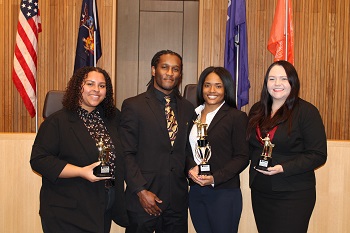
For the third year in a row, the College of Law team won the regional round of the Black Law Students Association (BLSA) Constance Baker Motley Mock Trial Competition. The team consisted of 3L Kendall Anderson,3L Autumn Burgin, Alexis Eka L’22, Randi Gray L’22, and Abigail Neuviller L’22. Burgin won the award for Best Cross-Examination and Neuviller won the award for Best Direct Examination. Thanks to John Boyd L’16 for coaching our team!
The College of Law reached the semifinals of two competitions hosted by American University. In the King of the Hill Trial Competition, the College’s team included 2L Giovanni Antonucci, 3L Lilian Baah, 2L Alan Berlucchi, 2L Gabby Groman, 2LAustin Milone, and 3L Gabby Verdone.Jeff Leibo L’03 coached the team. Next was the Burton D. Wechsler National First Amendment Moot Court Competition, with team members 3L Scott Ceurvels and 2L Caleb Gieger. Sophie Bober-West L’19 coached the team.
The College of Law virtually hosted the third annual Syracuse National Trial Competition (SNTC) in October 2021. The SNTC is an invite-only trial competition over four days that features leading moot court teams from the nation’s top law schools. The advocates are judged by distinguished members of the bench and bar from all over the country. The winner of this year’s SNTC was the George Washington University Law School.
During the spring semester, the College of Law again partnered with Queens University Belfast to host the second annual Transatlantic Negotiation Competition (TANC), held virtually In April. The competition gives law students globally an opportunity to hone their negotiation and communication skills in a transnational setting, with particular emphasis on the importance of cross-cultural negotiation and communication in resolving disputes and facilitating client agreements. Twenty-four schools spanning the globe competed against each other using problems that commonly occur in international trade, business, and political disputes. The University of Auckland took home first place for this year’s TANC.
During Law Alumni Weekend 2021, the College of Law celebrated the 50th anniversary of the Mackenzie Hughes LLP Edmund H. Lewis Appellate Advocacy Competition. Congratulations to the winning team of 3Ls Gabriella Kielbasinski and Cierra Thomas. The team of 3L Diana Rogatch and 2L Paige Kinder received the award for Best Brief, and Thomas won Best Oral Advocate. The College is grateful to all those who have contributed to the competition for the past half century and who made the 50th final round competitive and celebratory, especially our final round judges: the Hon. Frederick J. Scullin Jr. L’64, Senior U.S. District Judge, U.S. District Court of the Northern District of New York; Hon. David E. PeeblesL’75, U.S. Magistrate Judge, U.S. District Court of NDNY; Hon. Ramón E. Rivera L’94, Judge, New York Court of Claims; Hon. Brenda K. Sannes, U.S. District Judge, U.S. District Court of NDNY; and Hon. Thérèse Wiley Dancks L’91, U.S. Magistrate Judge, U.S. District Court of NDNY.
In October of 2021, the team of 2Ls Jamie McLennan and Hailey Poolerwon the 10th Annual Bond, Schoeneck & King Alternative Dispute Resolution Competition. McLennan also won Best Oral Advocate. Thank you to the final round judges: Hon. Anthony ParisL’73, New York State Supreme Court (ret.) and Special Counsel at Costello, Cooney & Fearon; Hon. Bernadette Romano Clark L’89, Oneida County Supreme Court; and Brian Butler L’96, Bond, Schoeneck & King PLLC.
In early 2022, Mikayla Barrett won the 12th Annual Hancock Estabrook LLP 1L Oral Advocacy Competition, triumphing over finalist Nikita Norman and 36 other students. Dean Craig Boise served as a judge, along with Hon. Andrew T. Baxter, U.S. Magistrate Judge for the Northern District of New York; Hon. Thérèse Wiley Dancks L’91, U.S. Magistrate Judge for the Northern District of New York; Hon. Ramón E. Rivera L’94, New York State Court of Claims Judge; and Hon, Brenda K. Sannes, US District Judge for the Northern District of New York.
Lionel O. Grossman Trial Competition
The 44th Annual Lionel O. Grossman Trial Competition saw 3Ls Morgan Steele and Jackson Somes prevailing over finalists 2L Giovanni Antonucci and LL.M. student Dessi-Ann Yetman. Somes also received the Best Advocate award. Many thanks to the Hon. Glenn T. Suddaby L’85, Chief U.S. District Court Judge, Northern District of New York, for serving as the presiding judge of the final round. Thanks also to evaluators the Hon. Bernadette Romano Clark L’89, Oneida County Supreme Court Judge and the Hon. Rodney Thompson L’93, Presiding Judge, Family Division, Superior Court of New Jersey.
3Ls Robert Rose and Bradley Ace won this spring’s Entertainment and Sports Law Negotiation Competition prevailing over 2Ls Meghan Ellsworth and Jessica Johnson in the final round. Rose won Best Advocate. The judges for the final round of competition were Professor John Wolohan, Syracuse University Falk College of Sport and Human Dynamics; Daniel GreeneL’16, Associate, Newman Lickstein; and Erin Phillips L’15, Associate, Newman Lickstein Lickstein.
2022 AWARD AND SCHOLARSHIP WINNERS
Travis H. D. Lewin Advocacy Honor Society Executive Director’s Award:
Brandon Bourg L’22
Margaret Santandreu L’22
Richard Risman Appellate Advocacy Award:
Scott Ceurvels L’22
Courtcall Scholarship Award (Advocacy Director Award):
Gabby Kielbasinski L’22
Penny Quinteros L’22
Morgan Steele L’22
Ralph E. Kharas Award:
Olivia Stevens L’22
Lee S. Michaels L’72 Advocate of the Year Scholarship Award:
Austin Milone 2L
Emil Rossi L’72 Scholarship Award:
Autumn Burgin 2L
Angelica Judge 2L
Models of Excellence in Advocacy Award, (In Honor of Michael S. Olsan L’89):
In 2021, Dean Boise appointed Professor Suzette Meléndez as Syracuse Law’s first Associate Dean for Equity and Inclusion. With the growing national attention directed to issues of diversity, equity, and inclusion (DEI), creating such a position provides direct leadership for the effort to sustain inclusivity within the College of Law. In assuming this role, Professor Melendez will be able to draw on her experience as a member of Syracuse University Chancellor’s Workgroup on Diversity and Inclusion.
Suzette Melendez
Working with the College’s Inclusion Council, Meléndez has been reviewing the College’s policies and procedures in all aspects of our operations, including in partnership with Syracuse University’s Human Resources Department. Their work has also generated extensive feedback on Syracuse University’s Plan for Diversity, Equity, Inclusion & Accessibility, and on the development of data dashboards to track our institutional progress.
Student leaders have been an important part of this process, both as members of the Inclusion Council and as leaders of student organizations. Among other things, students are involved in the implementation of Transformative Dialogue Groups among students as we begin the 2022-2023 academic year.
Orange Advance
Diversifying the legal profession requires innovative efforts to support the success of aspiring lawyers of color as they apply to, prepare for, and matriculate in law school. In 2019, Dean Boise announced a diversity pipeline program, which we now call Orange Advance, in partnership with three HBCUs in the Atlanta University Center (AUC): Clark Atlanta University, Morehouse College, and Spelman College. We are grateful to be supported financially in this effort by AccessLex.
With the easing of the pandemic, the College of Law for the first time welcomed a cohort of 21 students to Dineen Hall in May for a week-long pre-law residency. Representing all three AUC schools, the students traveled to Syracuse to explore the breadth of career opportunities in the legal profession; participate with faculty and practitioners in classroom lectures and panel discussions on the study of law and the American legal system; and begin to familiarize themselves with law school admissions processes and eligibility requirements, including strategies to prepare for the LSAT. During their time here, the students also discovered Syracuse and our broader Syracuse University campus.
“I never had a formal introduction to law school,” says Eric Jones, a rising senior from Morehouse College. “I’ve talked about law school with a few lawyers but haven’t had any exposure to it otherwise. When I came across this opportunity, I thought—why not? The special incentive here was that there was no financial burden for me as a student. I could come and participate for no extra charge.”
The working goal is to tap into the formidable talent pool of our partner schools’ students and give them the early understanding of the legal profession that is frequently missing for first-generation law students. It is likely that some of the students who participate in Orange Advance will matriculate at other law schools, but we view this as our contribution to increasing the diversity of all law schools, and ultimately the diversity of the profession. To this end, Dean Boise shared details of the program with fellow law deans across the country to inspire similar efforts elsewhere and expand participation in pursuing this shared goal.
An Educational Journey
A good deal of the work of inclusion is to set expectations among faculty and staff and ensure that appropriate training opportunities are in place. This year, workshops for faculty and staff included insights on being equity-minded, avoiding micro-aggressions, navigating difficult conversations, moving from cultural competency to cultural proficiency, and building awareness and confidence in using pronouns and preferred names.
For law students, last year, the curriculum was expanded to include DEI primers, and College of Law faculty reviewed and adjusted the 1L curriculum to ensure that foundational courses of study intentionally address DEI implications. Effective this fall, and in alignment with Syracuse University’s similar requirement for undergraduate students, all College of Law students must choose at least one course from a list of options created by the faculty that addresses themes and materials on diversity, equity, and inclusion.
The aim of this cultural competency requirement is to help students in their second or third year of law school develop an awareness of the ways identity, difference, culture, and explicit or implicit bias can condition and constrain the pursuit of equal justice under law. “Law students must be prepared to practice in a diverse society so that they can become the best legal professionals possible in whatever legal capacities they serve in diverse local, national, and global communities,” explains Meléndez. “By incorporating the cultural competency curriculum into their course of study, law students will be prepared to meet the legal needs of clients whose backgrounds, experiences, and perspectives may differ from their own.” This new requirement will help to reinforce the core principle that legal professionals have the obligation to ensure that the rule of law applies equally to all persons.
A Work in Progress
Diversity, equity, and inclusion are not new concepts. But they are concepts that have yet to be fully realized. Much work remains to be done and we are early in the journey. Consistent with our mission, our focus is on education: learning ourselves so that we can better educate and prepare our students.
The Burton Blatt Institute (BBI) at Syracuse University builds on the legacy of Burton Blatt, former dean of SU’s School of Education and pioneering disability rights scholar, to better the lives of people with disabilities.
With its focus on research, education, and outreach in law and public policy, BBI incorporates cross-disability issues, focusing with an intersectional lens across the whole of life, to advance the civic, economic, and social participation of people with disabilities, while building on the University’s longstanding commitment to diversity and inclusion.
Below are a few examples of BBI’s far-reaching, impactful work this year.
The U.S. News and World Report Lists BBI as One of Two Leading Centers in the Country for Disability Rights
In July of 2022, the U.S. News and World Report listed the Syracuse University College of Law as one of two of the most prominent law schools in the country with specific centers or programs focused on disability rights or advocacy.
Containing advice for law school applicants with disabilities, U.S. News and World Report offers tips to successfully navigate the admissions process and the full law school experience. Topics range from disability accommodations for the LSAT and in law school, to the option to disclose disabilities as a law school applicant and programs and resources for law students with disabilities.
Peter Blanck
University Professor Peter Blanck, Chairman of BBI, notes, “applying to law school requires strong self-advocacy and patience that puts a unique burden on students with disabilities.” Depending on an applicant’s specific disabilities, those burdens can vary, from stress and time burdens to practical barriers. Not all disabilities are visible, and some applicants may also have impairments such as cognitive or learning disabilities and/or mental health issues.
“Just be the best lawyer you can be,” Blanck advises. “In a competitive legal environment, it is important to have a basic grounding to be a well-rounded lawyer.”
BBI Awarded $6.2 Million Grant to Advance Understanding of Rights and Under the Americans with Disabilities Act Through its Southeast ADA Center
For the third time in 15 years, BBI has been awarded a five-year, $6.2 million grant. The funding comes from the US Department of Health and Human Services’ Administration on Community Living National Institute on Disability, Independent Living, and Rehabilitation Research (NIDILRR).
Based in Lexington, Kentucky, the SEADA Center is one of 10 regional centers in the ADA National Network, providing information, training, and guidance about the ADA throughout the eight-state Southeast region. BBI provides the center with analyses of legal issues affecting the ADA as well as other resources such as “plain language” legal briefs written by Syracuse Law students.
“The complexity of the issues facing the disability community is daunting, along with the increasing need for reliable information in the public domain. The Southeast ADA Center will continue to provide up-to-date, accurate, and accessible information on all aspects of the ADA,” said Blanck. “The center’s role is, perhaps, most important than ever in making a positive difference in the lives of individuals with disabilities and their families by fostering ADA understanding and compliance.”
SEADA Center’s educational and advocacy work—providing ADA training, technical assistance, research, and user-friendly information—reaches and supports more than one million stakeholders annually across the Southeast region. The renewed funding will allow the center to achieve multiple objectives, including:
Encouraging and supporting meaningful partnerships among the disability community, government, business, and community organizations to facilitate ADA implementation.
Improving and expanding training, technical assistance, and information dissemination that promotes voluntary compliance with the ADA.
Empowering individuals across the diversity of disabilities and at the intersection of race, ethnicity, age, and gender to increase understanding of ADA rights and responsibilities.
Customizing and disseminating outreach materials to culturally and linguistically underserved populations, including Black, Indigenous, and People of Color (BIPOC), and Latinx communities.
Conducting research that produces new knowledge and understanding of barriers to employment and economic self-sufficiency, to increase the civic and social participation of people with disabilities.
Creating a comprehensive website with a searchable database that is regularly updated.
Supporting advocacy and education among students and youth with disabilities.
The new funding will support the center’s initiatives through 2026.
BBI Study Featured in Legal Management’s “Best Practices for Making Your Law Firm More Inclusive for People with Disabilities”
A study by the BBI and the ABA, “Diversity and Inclusion in the American Legal Profession,” was featured in “Best Practices for Making Your Law Firm More Inclusive for People with Disabilities,” by Legal Management, the Magazine of the Association of Legal Administrators (ALA).
According to the study, “people with a health condition or impairment, and who identify as a person with a disability, reported experiencing proportionately more overt forms of discrimination, such as bullying and harassment, as compared to people who do not have such conditions.”
The study and research offer tips for law firms to make sure diversity policies don’t fall short when it comes to accessibility, including building policies collaboratively, creating an accepting culture that encourages self-identification, encouraging broad participation, and being intentional with policies and accommodations.