Syracuse University College of Law achieved 94% Ultimate Bar Passage rate for 2025 (representing the Class of 2023), further demonstrating the impact of the College’s mission of supporting its students from admission through the bar exam. Graduates took the bar exam in 25 states, reflecting the national reach of our hybrid online J.D. program, JDinteractive.
The Class of 2024 has also already achieved 94% Ultimate Bar Passage rate with two bar administrations remaining.
“I want to congratulate our graduates who have passed the bar and are practicing all over the world,” said Dean Terence Lau L’98. “This is a direct result of the College’s and Dean Kelly Curtis’ ongoing commitment to supporting our students throughout their legal education right up to the crucial bar exam.”
The College continues to strategically invest in academic and bar support efforts, including increasing the number of staff in the Office of Academic and Bar Support (OABS). The OABS is charged with delivering highly targeted bar preparation programming and support. Bar preparation initiatives include:
Intensive “boot camp” sessions that focus on bar exam topics and study strategies
Bar preparation checklists
Bar-related courses
Quarterly email newsletters
Individual support for students most at risk on the bar exam
A partnership with Kaplan Bar Review that provides students with materials from the 1L year through the bar exam
“The 2025 results continue our upwards trajectory in Ultimate Bar Passage rate, and I am proud of the accomplishments of our graduates,” said Associate Dean of Students and Teaching Professor Kelly Curtis. “The Office of Academic and Bar Support and our faculty continue to refine and adapt our bar preparation programming to meet the changing needs of the profession, most notably the NextGen Bar Exam.”
Furthermore, eight of the past nine graduating classes have exceeded 90% Ultimate Bar Passage rate.
Dean Curtis’s efforts in academic and bar support were recently recognized by the American Association of Law Schools Section on Academic Support as the recipient of its Impact Award, which recognizes legal educators who are “inspiring students and peers in the academic support profession today and catapulting us forward to a stronger tomorrow.”
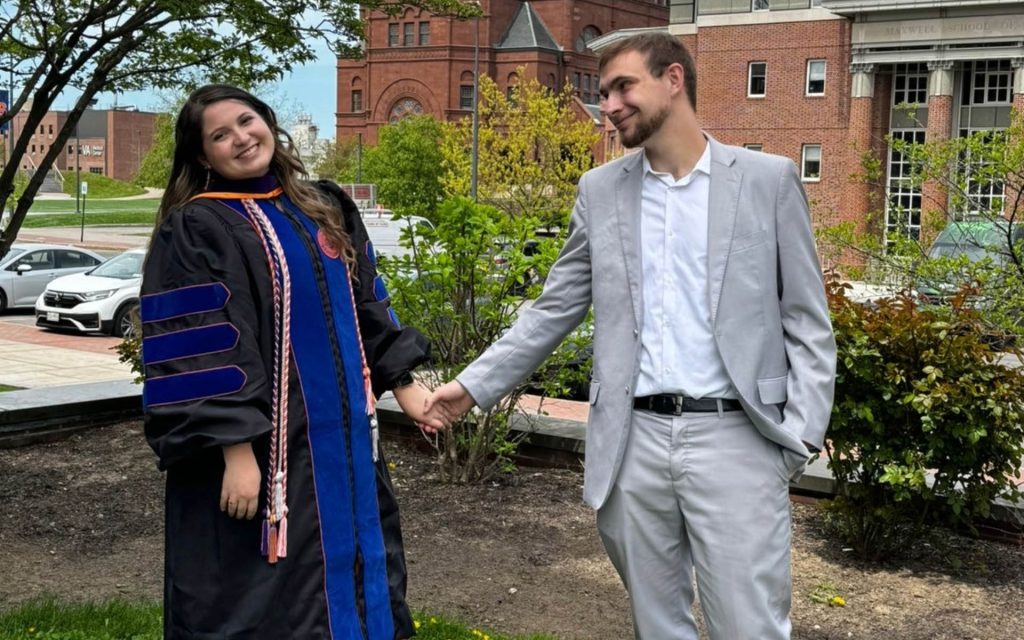
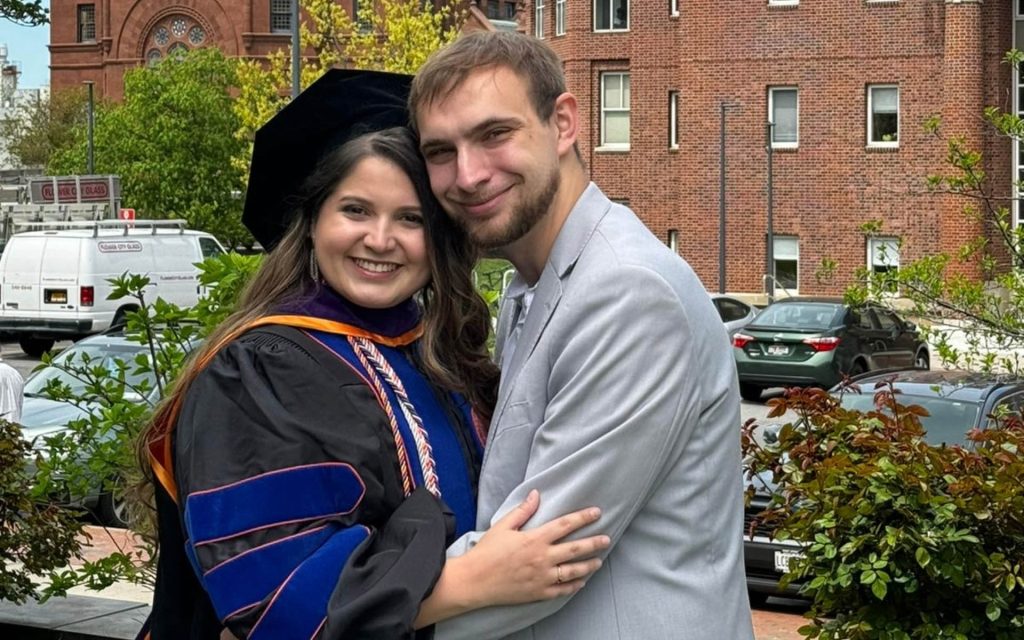
When Luiza Cristovam LL.M.’23, L’26 walks across the stage at the Syracuse University College of Law Commencement Ceremony this May, she’ll be celebrating more than a degree. That same day, surrounded by her family from Brazil and his family from Snohomish, Washington, she and Arick Grootveld Ph.D. ’27 will spend the second half of their day celebrating their marriage.
Luiza and Arick’s story began the way some of the best ones do: by accident.
Long before she ever set foot on campus, Luiza’s journey to Syracuse began in Brazil with a canceled interview, a neighborhood power outage, and a last-minute change of plans.
Her father, a judge, had been scheduled to appear on a legal podcast. When a power outage forced the interview to be postponed, it was rescheduled for a later date—one that Luiza decided to attend with him while her mother was traveling. That day, she crossed paths with Professor Antonio Gidi, who was also being interviewed. During the conversation, Luiza’s father mentioned that his daughter spoke English fluently and was interested in studying abroad. Professor Gidi took notice and the next day, he followed up.
“Professor Gidi called and said, ‘Luiza needs to come to Syracuse to pursue her LL.M. degree,’” she recalled.
What began as a chance encounter quickly became an opportunity. Luiza applied, was accepted, and soon found herself preparing for a year of legal study in Central New York, unaware that it would become much more than that.
When she arrived in Syracuse, her story continued with another twist of fate. She mistakenly arrived too early, thinking orientation started on August 7 instead of August 14. New to the city, alone in her apartment, and eager to meet people, she downloaded a few dating apps. On her second day here in Syracuse, she went out for a pizza dinner with Arick for a first date, and the two have been inseparable since.
As the year passed while she was completing her LL.M. degree, Luiza began to get the feeling that she was not ready to leave Syracuse. She had Optional Practical Training (OPT) as an F-1 visa holder, which would allow her 12 months to work in the U.S. to gain practical work experience, but she didn’t feel ready to leave either Syracuse, Arick, or the law.
“I soon decided to invest in the on-campus J.D. program to give myself a chance at practicing law in the U.S. in the future,” she said. “I loved what I was doing professionally. And I also wanted to see where this relationship would go.”
Back home in Brazil, Luiza holds an LL.B. and is already a lawyer. Her initial plan was to earn an LL.M. in the United States and return to Brazil to teach law. Legal study runs in the family, as her father is a Brazilian judge, and she grew up surrounded by the legal profession.
As her connection to Syracuse deepened through her studies, her growing sense of purpose, and her relationship with Arick, Luiza began to see her time here not as a temporary chapter, but as the foundation for everything that would come next.
“It was an easy decision to stay,” she said. “Immigrating is hard. Coming from another country is hard. But it is worth it—and he is worth it.”
What began as a one-year plan had become a life she wasn’t ready to leave.
Looking Ahead—Together
After Commencement, Luiza will turn her attention to preparing for the bar exam in July before beginning her legal career as an attorney with the Cortland County, NY Public Defender’s Office, a path she discovered after attending a public defense talk on campus.
For Luiza, the role represents both professional purpose and personal growth—a chance to serve communities while continuing to build the life she and Arick have envisioned together. Meanwhile, Arick is working towards his doctoral thesis on quantum information theory and preparing for the next stage of his academic career.
Throughout their time together, Luiza says, Arick has consistently shown his commitment not only through words, but through action. One of the clearest examples is language. Since they met, Arick has been steadily learning Portuguese so he can better communicate with Luiza’s family and understand her culture. He practices daily and regularly surprises her with new phrases and expressions.
“He even reacts the way Brazilians typically do sometimes,” she said, laughing. “It means so much to me.”
That same thoughtfulness extends to every part of their relationship, from helping classmates and friends to supporting Luiza through the most demanding moments of law school. Now, with graduation approaching, their focus is on balancing celebration with preparation. On Commencement Day, they will walk from ceremony to courthouse, beginning their married life on a day that unites Luiza’s academic journey, her family, and her future.
Looking back, Luiza sees a series of coincidences that led her exactly where she was meant to be, from a rescheduled podcast in Brazil to a first dinner date in Syracuse.
“There was no universe but this exact universe where we met,” she said. “Everything happened the way it had to.”
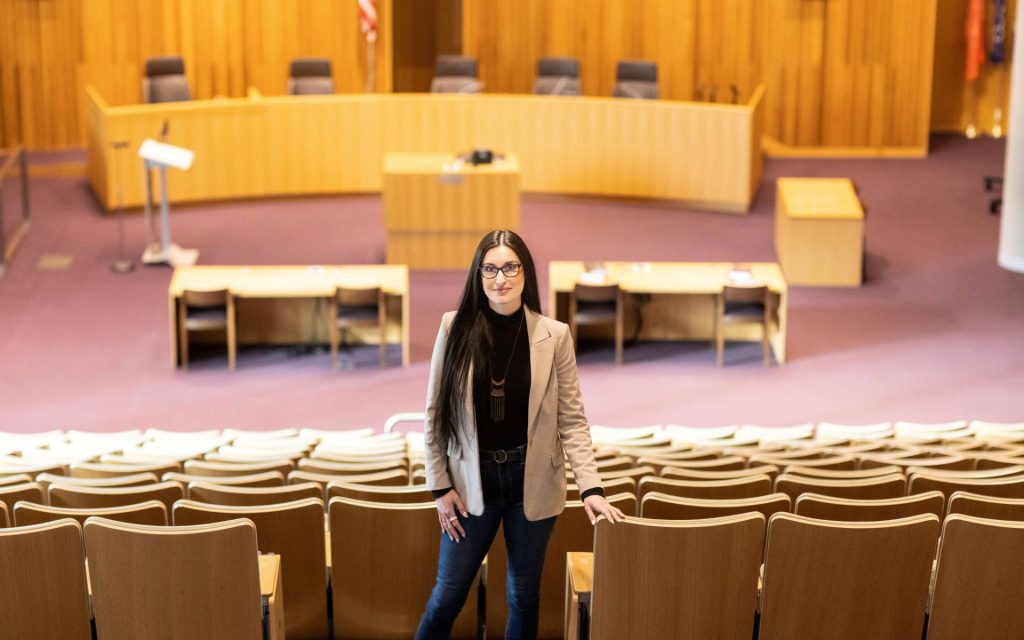
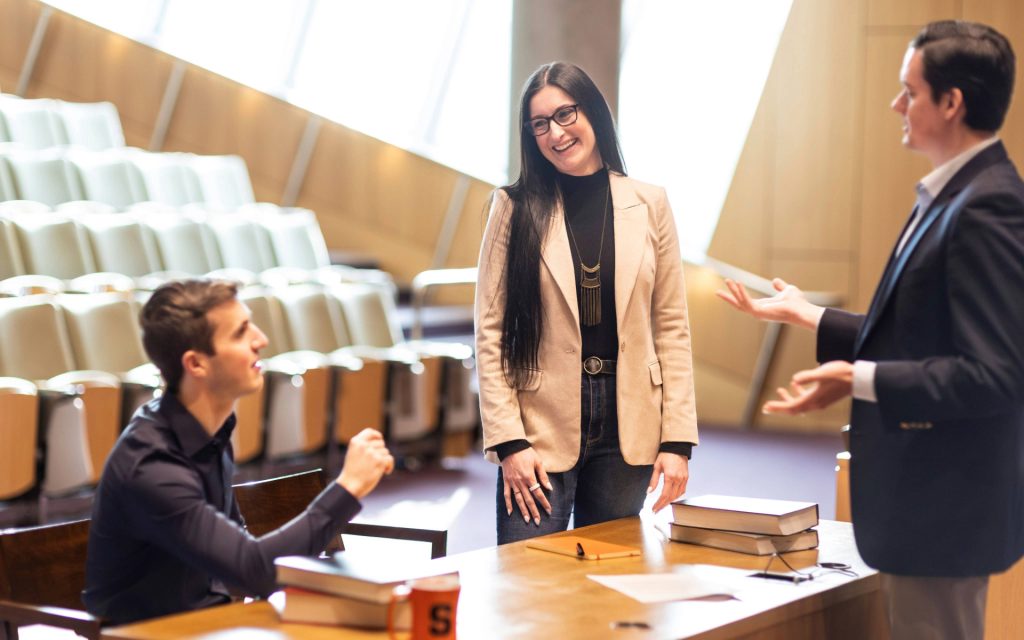
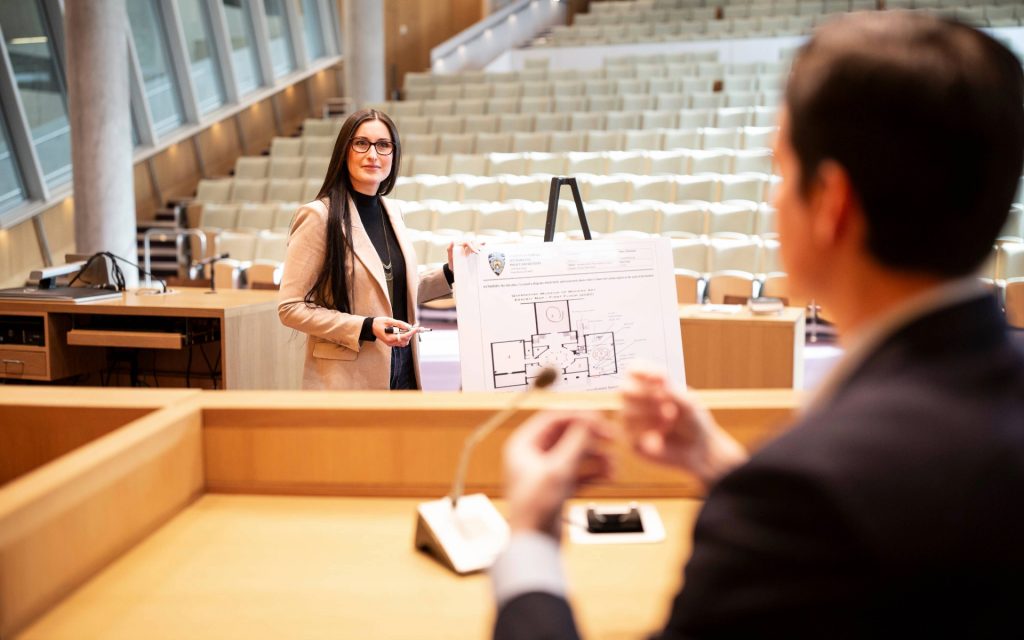
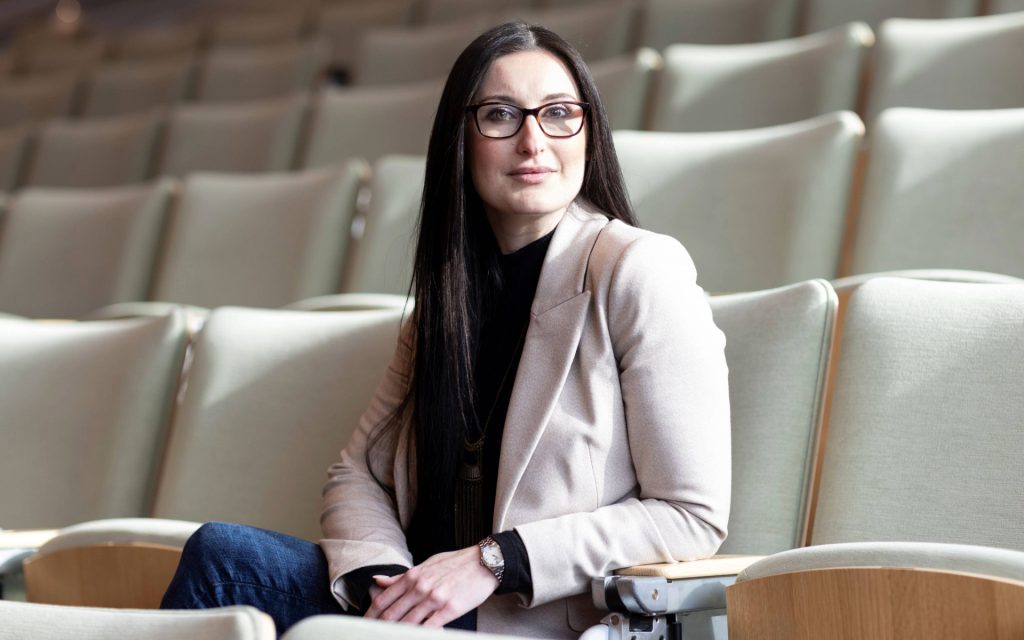
As early as her 1L year at Syracuse University College of Law, Allison Carlos ’23 (MAX/VPA), L’25, was drawn to the College’s Advocacy Program and trial competitions. What began as a desire to strengthen her litigation skills quickly evolved into something far more meaningful —a strong group of colleagues, alumni, and mentors who helped shape her development as an advocate, guided her to summer externships, and ultimately supported her path to securing her first job as a litigator after graduating this past December.
“The Syracuse alumni network is strong,” says Carlos, noting that after she competed in the Hancock Estabrook First Year Oral Advocacy Competition as a 1L, Hon. Thérèse Wiley Dancks L’91, chief U.S. magistrate judge for the Northern District of New York, saw her skills in action and offered her a summer externship in 2024.
She was also fortunate to work for another alumna in the Fall of 2025 when she accepted a judicial externship with Hon. Deborah H. Karalunas L’82, which gave her additional exposure to advocacy in the courtroom, while also providing invaluable insight into the perspective of a trial judge.
Trial Competitions Expand Syracuse Law Network
While her internships gave her valuable experience, and her coursework stressed the necessary skills to become an outstanding litigator, including writing, oral arguments, and trial procedures, it was her participation in trial competitions that really put her knowledge to the test, often in front of actual judges. This gave her the ability to fine tune these skills in Syracuse Law’s state-of-the-art courtroom facilities and across the country under the watchful eye of dedicated faculty, coaches, mentors, and other legal professionals. According to Carlos, she was fortunate to interact with many well-respected lawyers and judges—many alumni—eager to help share their experience and offer real-world opportunities to students.
Carlos competed in several mock trial advocacy competitions as a member of the Syracuse Law Travis H.D. Lewin Advocacy Honor Society (AHS). AHS holds five internal competitions each year and sends teams to compete in intercollegiate competitions across the country—some in-person and other virtual—against top students from other law schools. In preparation for these highly competitive events, students often work closely with Syracuse Law Advocacy Fellows, a slate of alumni who devote an exceptional amount of their time to give team members a competitive edge.
One such competition was the American Association for Justice (AJJ) with the team of Carlos, Brandon Bryant L’25, Jonathan Newsome L’25, and Matt Reimann L’26 at the Student Trial Advocacy Competition in March 2025. Her team—coached by Joanne Van Dyke L’87, director of trial competition teams, and Andrew Umazor L’24—won the regional competition in Philadelphia, to the national finals in Atlanta.
Carlos is especially grateful for the preparation she received from Van Dyke, noting “I am continually in awe of Coach Van Dyke’s unwavering dedication to the Advocacy Team and the passion and commitment she brings to developing us into confident, effective advocates.”
Carlos’s consistent, exceptional performance and passion for advocacy helped her earn a spot on the College’s highly competitive National Trial League team in 2025. She was fortunate to be mentored by advocacy fellow Kaylin S. Grey L’06, a partner at the Miami defense litigation firm of Wilson Elser. Much of the mentoring took place virtually due to the distance, but according to Carlos, Grey was an excellent mentor who gave pertinent advice, helped her emphasize her strengths, address areas for growth, and thoroughly prepare her for competition.
While Carlos appreciated having such a committed mentor, Grey, in turn, was so impressed by Carlos’s talents that she helped her secure an internship at Wilson Elser for the summer of 2025.
“Having Kaylin as a mentor for the National Trial League was incredibly valuable and being able to continue learning from her and her colleagues through my internship was extraordinary,” says Carlos. “After seeing me in action on the Trial Team, she was eager to challenge me and provide hands-on litigation experiences that students and even incoming associates rarely receive. The combination of her mentorship and the internship was truly incredible.”
Awards and Rewards for Competition Skills
Carlos’s participation in the National Trial League competition really helped define her law school career. She was “honored and deeply humbled” to receive the 2025 National Trial League MVP (Best Advocate) Award based on the skills she demonstrated during the competition.
“Throughout the semester-long National Trial League, Allison exhibited advocacy skills on par with the best students in the country,” says Professor of Law Todd Berger, director of the Syracuse Law Advocacy Program. “Her diligence, preparation, and ability to translate work into effective advocacy made it no surprise that she earned the MVP honor.”
In addition, Carlos received the Lee S. Michael L’67 Advocate of the Year Award and scholarship in 2025, through an endowed award presented annually by Syracuse Law thanks to the generosity of Michael.
Moving Forward and Giving Back
Already the owner and operator of Roadside Warriors, LLC, one of the largest towing companies in Watertown, New York, she will soon be relocating to Miami after receiving a full-time job offer from Wilson Elser. This single mom of three young children will continue to operate her towing company remotely, while also taking on a full-time job as a civil defense litigator working in areas like complex commercial litigation and business counseling, general and premises liability, maritime and real estate litigation.
“Syracuse Law’s Advocacy Program and trial competitions truly brought out the best in me and gave me invaluable, real-world experience, along with an incredible network of mentors and peers. I’m excited to carry this strong foundation with me as I begin my legal career,” says Carlos. “I wouldn’t be where I am today without the support of Syracuse faculty, alumni, and the advocacy community, and I fully intend to pay it forward by mentoring future Syracuse Law students.”
In 2025, Syracuse University College of Law was named the No. 8 trial advocacy program in the country by U.S. News & World Report. See here for more information on the program.
Who is allowed to work in the United States—and under what conditions—has long been shaped by the intersections of immigration and employment law. While these questions are frequently in the national spotlight today, the complex layers and legal frameworks behind them have been evolving for decades.
Recognizing both the historical significance and modern urgency of these issues, Syracuse University College of Law launched its first JDinteractive (JDi) residency focused on the interweaving of immigration and employment statutes and regulations, drawing students eager to explore how policy, economics, and legal precedent converge.
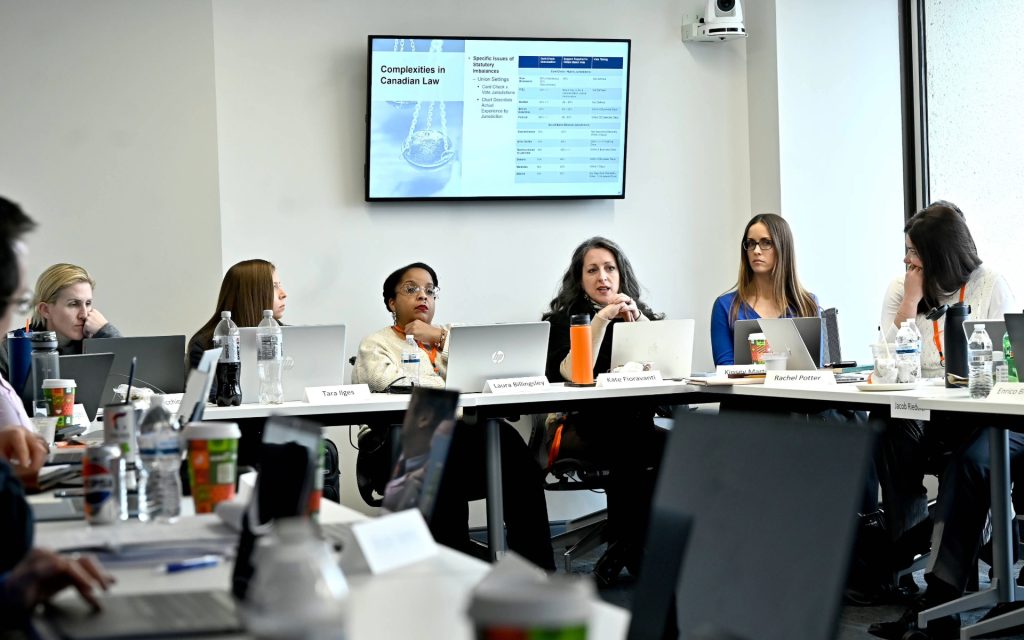
The Intersections of Immigration and Employment Policy and Law: In the Courts, the Agencies, and in the Congress, a four-day residency option designed for JDi students and open to on-campus students, took place last December in Washington, D.C. This popular residency drew a diverse group of students— including a union steward, a sheriff, an individual with an H-1B visa, and many other professionals working in a variety of fields—all of whom brought interesting perspectives to the classroom.
The residency was led by the Hon. Randel Johnson, Chair and Chief Judge, Administrative Review Board, U.S. Department of Labor (presenting on his own behalf) and a distinguished immigration law scholar with more than 25 years of experience working in immigration and employment law on Capitol Hill, with the Department of Labor, and in the private sector.
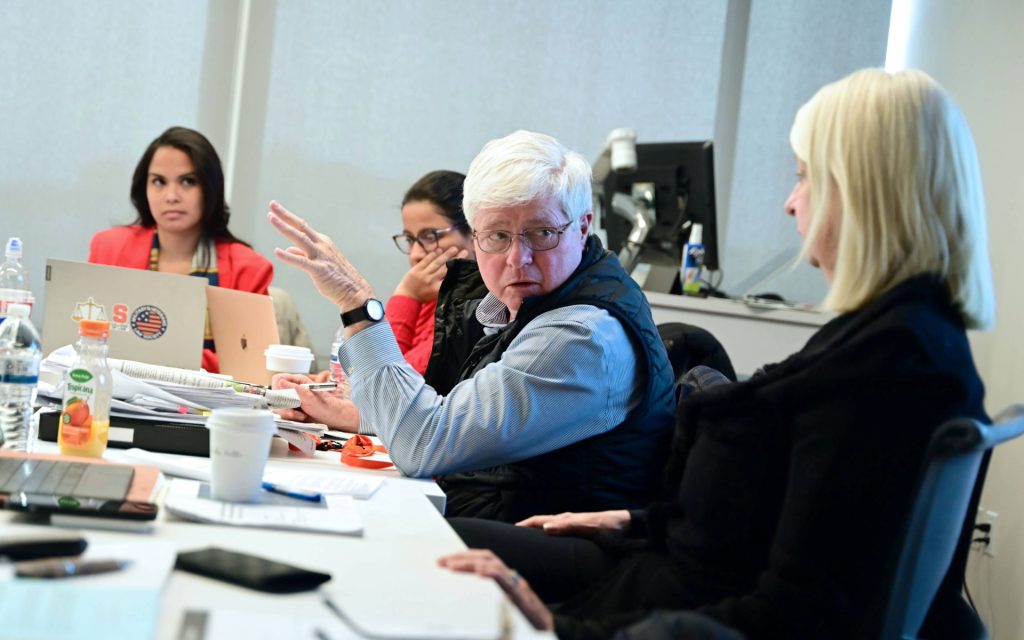
The Hon. Randel Johnson teaching in class with Camille Olson.
According to Johnson, the residency was not designed to concentrate on immigration under the current administration, although those issues were certainly discussed. Instead, it offered a much broader perspective, looking at how conflicts between the courts and enforcement agencies are resolved using a review of general statutory interpretative principles and court cases that examine the interactions of immigration and employment laws. The residency also examined other legal conflicts as exemplified under the Federal Arbitration Act; the congressional deliberations surrounding the Border Security, Economic Opportunity, and Immigration Modernization Act; and the Administrative Procedure Act, well as some of the more influential court decisions handed down over the past six years, such as Loper Bright, v. Raimondo, SEC v. Jarkesy, and Muldrow v. City of St. Louis.
“This residency clarified that immigration law, employment law, and administrative law do not operate as separate systems but continuously shape one another— and that their interaction has long-term consequences beyond individual cases,” says attendee Kate Fioravanti L’26, who is a full-time school administrator in a Connecticut urban public school district and the president of the local union affiliate of the AFL-CIO.
“Through discussion of doctrines like Hoffman Plastics, mandatory arbitration, agency deference, and cases such as Plyler v. Doe, the course highlighted how legal rules governing work authorization, enforcement, and access to institutions ultimately influence who participates in the workforce, who remains economically stable, and how communities develop,” she says. “For me, the important takeaway was understanding how these legal frameworks collectively affect the country’s labor force, schools, and economic capacity, making them questions of structural design rather than isolated doctrinal debates.”
Jacie Rodriguez L’26 also found the residency enlightening.
“The best thing I took away was that immigration policies and laws are not simple,” says Rodriguez, a bilingual claims specialist for the U.S. Social Security Administration. “There are many parties invested in the outcome of immigration law, and reform can come to a near standstill without compromise. Policymakers, administrative agencies, Supreme Court decisions, public interest groups, and the president himself—everyone has a role that will either stagnate or propel momentum.”
Extensive Network of Speakers Added Unique Expertise
Not only did Johnson utilize case studies and examples from his extensive career in immigration and employment law, but he also tapped into his vast network of experts in this space to speak to and network with the JDi students, adding to the richness of the experience.
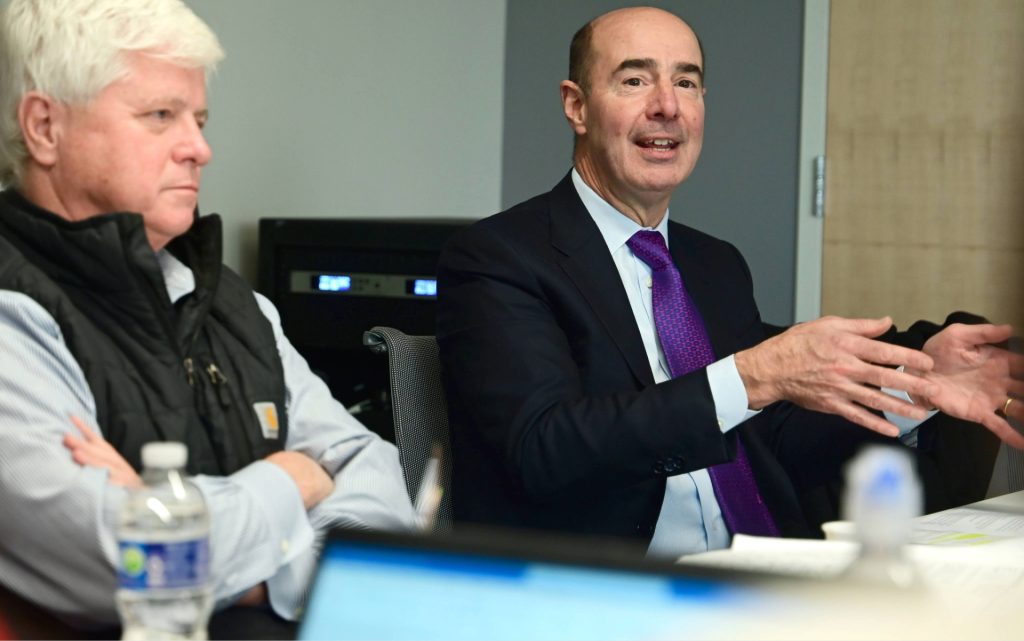
Gene Scalia guest speaking in class with Hon. Randel Johnson.
“I’m blessed to have such a huge network of professional colleagues—and I’m grateful they took time out of their very busy lives to share their views and experiences with our JDi students,” says Johnson. “When I was going through the students’ final exams, everyone identified different speakers and their appeal, as well as the opportunity to hear about various career backgrounds and, to some degree, think about post-graduation opportunities outside of big law.”
Students left the residency with a greater knowledge and understanding of U.S. immigration and employment law, including the layered complexities within each area. They also gained insight into how courts resolve seemingly inconsistent mandates between statutes, and how to effectively advocate for clients when confronted with conflicting and/or overlapping mandates. They further honed their skills by analyzing immigration law cases and looked closely at how trends shape the law and Congressional deliberations.
“I believe the JDi students walked away with a sense of how this topic is more than just today’s headlines but is a blend of the law and societal mores, and that, as these societal mores change, the law does not remain static,” adds Johnson. “The skills shared at the residency are transferable to a lot of other aspects of the legal field. So no matter what area of the law they choose to pursue, I hope the experience gave them another arrow in their quiver as they go through life and represent clients.”
Residency Welcomes High-Level Thought Leaders
The following joined the JDi residency to share their expertise on various topics related to immigration and employment law.
Jon Baselice, Executive Vice President and Head of Government Affairs, Vantoe, explained negotiations over the worker program in S. 744 and why employers were quite willing to overrule Hoffman while unions thought it would be a win
Josh Bernstein, Director of Immigration Policy/Director of Immigration for the Service Employees International Union SEIU, U.S. Chamber, immigration programs, spoke about immigration policy, Capitol Hill negations with the U.S. Chamber, and immigrant worker programs
Joshua Breisblatt, Democrat Chief Counsel, Immigration Subcommittee, U.S. House Judiciary Committee: Immigration negotiations on Capitol Hill.
Kristie De Pena, Vice President for Policy and Director of Immigration Policy, Niskanene Center, gave an update and observations on recent immigration developments and chance of reforms
Danny Kaufer, Partner, Borden Ladner Gervais, Montreal, spoke about lessons and parallels under Canadian employment law
Roger King, Senior Labor and Employment Counsel for the HR Policy Association, presented the basics of the NLRA and crossroads with immigration law.
Camille Olson, Partner, Seyfarth Shaw, and Chair, U.S. Chamber’s EEO subcommittee, presented on statutory overlaps.
Laura Reiff, Shareholder at Greenberg Traurig and Co-chair of GT’s Immigration Practice, talked about union management negotiations and compliance issues
Gene Scalia, past Secretary of Labor and Solicitor of Labor, explained the balancing legal interpretations of statutes and review of key Supreme Court decisions relating to the APA
Chris Thomas, Partner, Holland & Hart, spoke about immigration enforcement focus and practical problems faced by employers
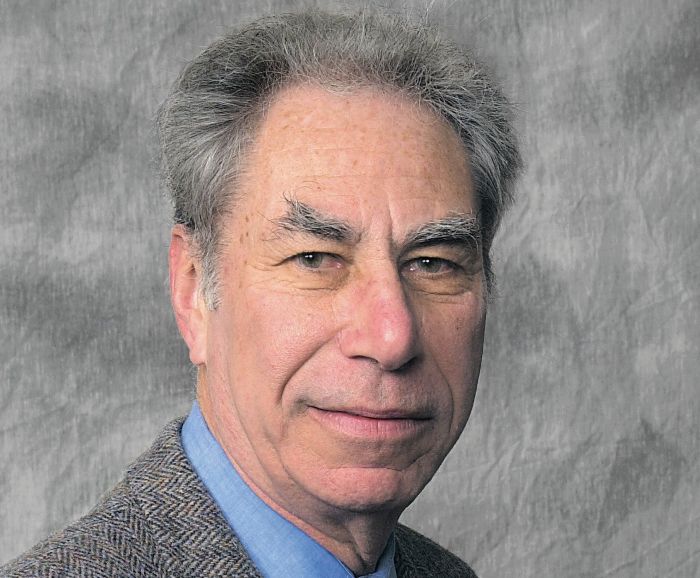
I am deeply saddened to share that Professor Martin Fried has passed away.
Marty was a distinguished member of our community who dedicated his career to excellence in teaching and service. He earned his B.A. from Antioch College in 1955, his J.D. from Columbia Law School in 1958 as a Harlan Fiske Stone Scholar, and his LL.M. from New York University in 1968. After practicing in New York City and teaching at Washington University, the University of Iowa, and the University of Cincinnati, he joined our faculty and was named the Crandall Melvin Professor of Wills & Trusts in 1990.
Marty was a gifted and dedicated teacher who trained countless attorneys in federal income taxation, trusts and estates, and property law. He authored Taxation of Securities Transactions and numerous articles on tax and trusts and estates. His commitment to students extended well beyond the classroom—he was known for his encouragement and mentorship, helping students find their path even in difficult moments. One alumnus, now a partner at Baker & McKenzie, recalled: “When I was 20 years old and a 1L, and others were telling me to drop out, Marty told me: Let’s see how they would be doing at 20. Stick with it. Find your way. I became a tax lawyer because of him.”
Beyond teaching, Marty served the Law School and broader community in many ways. He served as Associate Dean for Academic Affairs, founded and directed our LL.M. in Taxation Program in the 1990s, coached intercollegiate tax teams, and helped reform the Moot Court Program. He was deeply involved in faculty governance at both the College and University level, and volunteered at Housing Court helping those facing eviction. He was a member of the American Law Institute and later served as of counsel at Hancock & Estabrook LLP.
Marty was also a devoted internationalist who traveled abroad with our Law in London program. Together with his late wife Daisy Fried, who worked in Syracuse University’s Study Abroad program, Marty and Daisy were fixtures on campus and beloved members of our broader University community. Marty was also an avid runner and tennis player, part of the College of Law “runners club” whose members could be seen jogging around campus.
On a personal note, Professor Fried was my 1L Property professor. He will be greatly missed.
Services:
Synagogue Service Thursday, February 5th at 11:00 AM Temple Beth Shalom 1050 S Tuttle Ave Sarasota, FL 34237 (941) 955-8121
Cemetery Service Sunday, February 8th at 10:00 or 11:00 AM Temple Adath Yeshurun Cemetery 924 Jamesville Avenue Syracuse, NY 13210
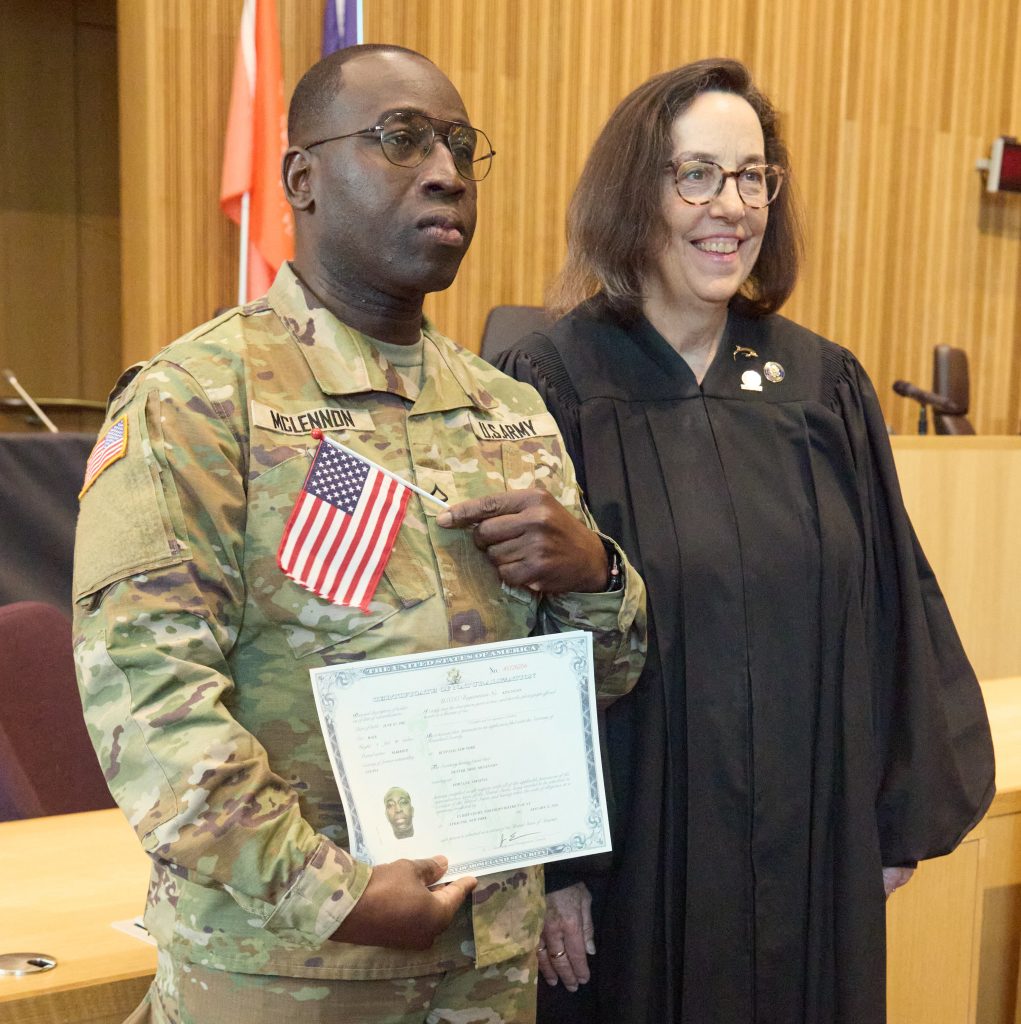
Syracuse Law faculty, staff, students, along with friends, families, and dignitaries from the Syracuse area helped welcome 34 new American citizens at a U.S. Citizenship Naturalization ceremony in Dineen Hall.
The new citizens, representing 18 nations, were sworn in by the Hon. Thérèse Wiley Dancks L’91, Chief Magistrate Judge for the Northern District of New York. Several active-duty military service members wore their uniforms as they became citizens.
“These ceremonies are so important and so beautiful and so meaningful to me,” Dancks said. “I consider my service to the court as my personal love letter to my community and to my country, and I consider myself deeply patriotic.”
The ceremony featured remarks from College of Law Dean Terence Lau L’98, Gladys McCormick, Associate Dean for Strategic Initiatives and Professor of History and the Jay and Debe Moskowitz Endowed Chair in Mexico-U.S. Relations at Syracuse University Maxwell School of Citizenship and Public Affairs, and Patricia Cardona L’20, an Immigration Attorney at the Cardona Law Firm.
“This moment holds deep personal meaning for me. I stood where you stand today in 1999, one year after graduating from this law school, taking the Oath of Allegiance and becoming an American citizen. I know the mixture of pride, gratitude, and anticipation you feel. The journey that brought you here, from distant homelands, through challenges and perseverance, now culminates in this transformative moment,” said Dean Terence Lau L’98.
The Hon. Deborah Karalunas L’82, Administrative Judge, Fifth Judicial District, Supreme Court of New York, received the Betty D. Friedland Award for Trial Excellence in recognition of her contributions to the legal profession across New York state, excellence in legal education, courtroom practice, and ethics.
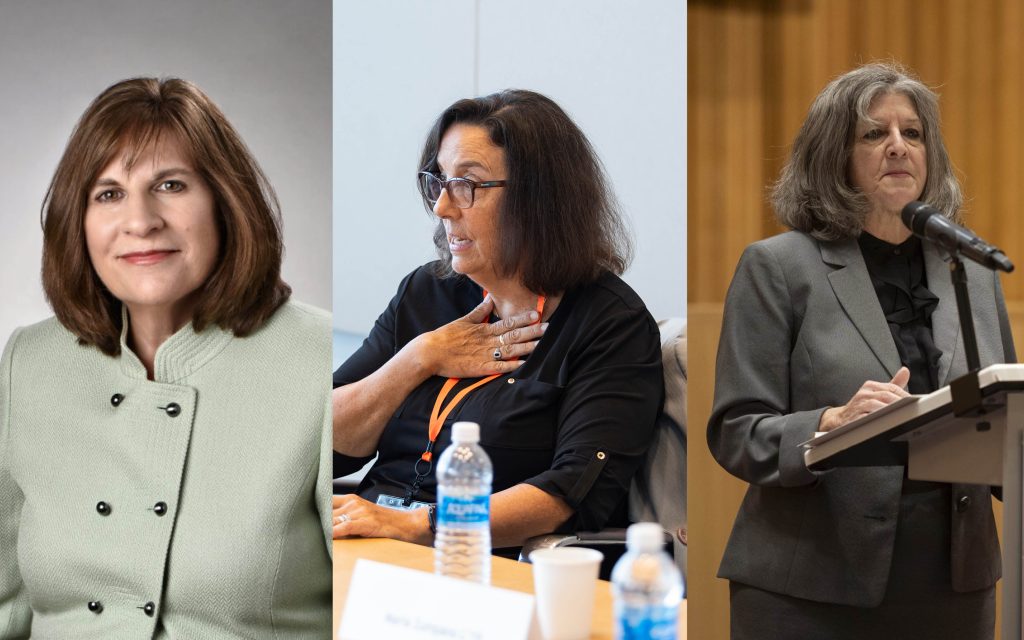
The Hon. Mae A. D’Agostino L’80, The Hon. Thérèse Wiley Dancks L’91, and The Hon. Deborah Karalunas L’82.
As the U.S. reflected on the 60th anniversary of the Voting Rights Act of 1965, Syracuse University College of Law marked the moment by bringing students to the heart of the conversation. The new Voting Rights and Policy residency, designed for hybrid online JDinteractive students and open to on-campus J.D. students, was held in Washington, D.C. for four days in December and was taught by Ryan Suto G’13 M.S. (NEW), G’13 M.S. (MAX), L’13, senior government affairs manager at FairVote.
The residency addressed the urgency surrounding voting rights in today’s political climate while also examining the law’s origins, impact, and the ongoing challenges related to protecting Americans’ right to vote throughout history.
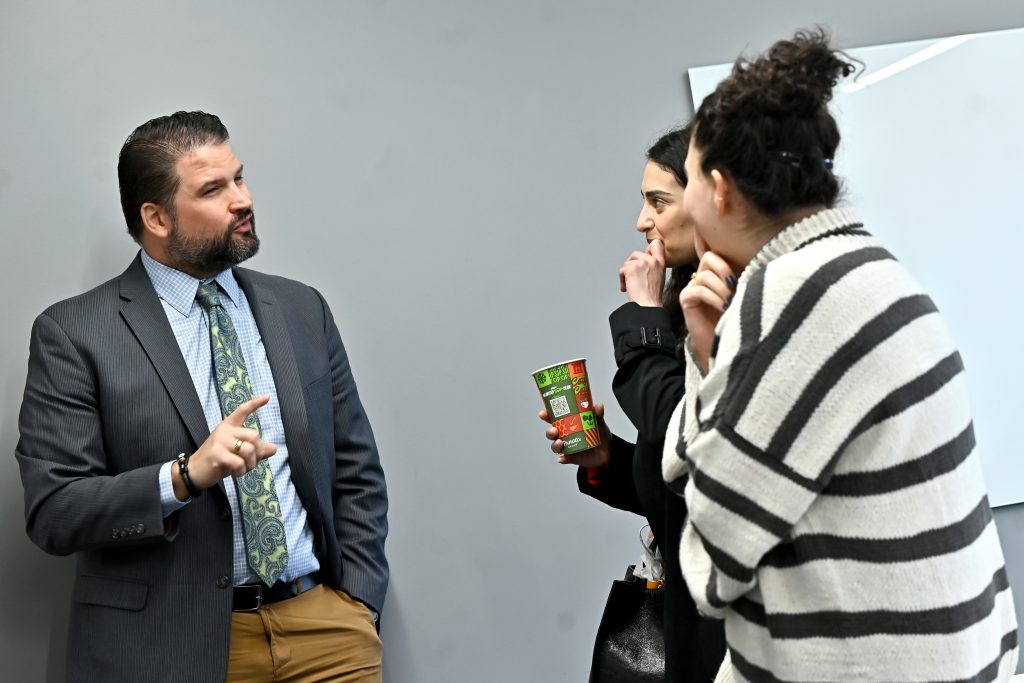
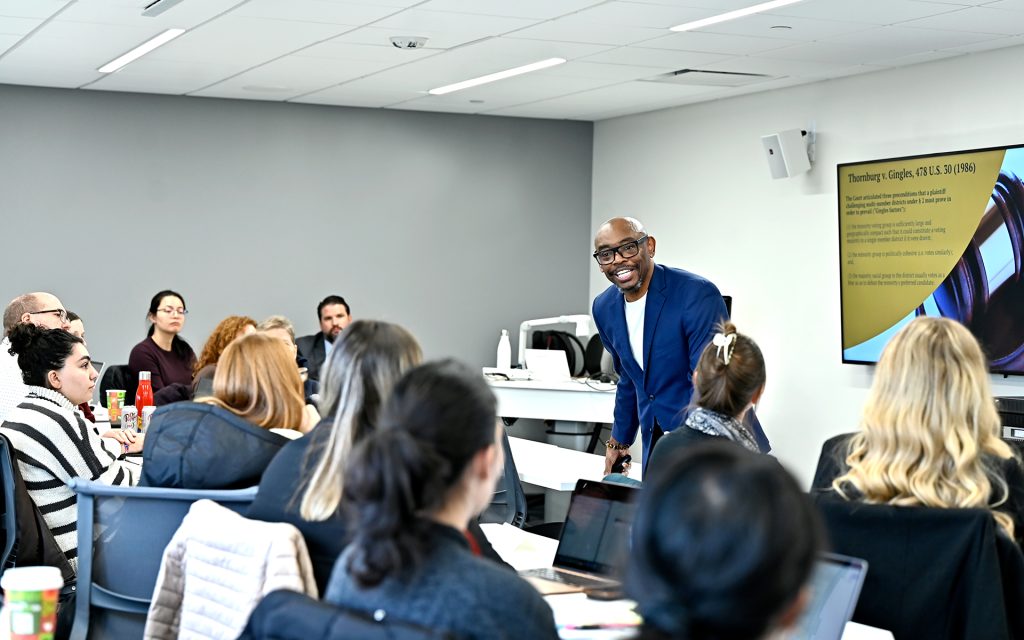
Ryan Suto G’13 M.S. (NEW), G’13 M.S. (MAX), L’13 speaks in class with a student and guest speaker, Sara Rohani.
A Universal Right Not Stated in the Constitution
“There is actually no individual right to vote in the Constitution. Instead, it protects voting through a number of constitutional amendments. The history of voting rights is intertwined in our country’s history, and this residency was a good frame to understand the struggle for civil rights, disability rights, the rights of Black and Latino communities, and more,” says Suto. “Familiarity with voting rights helps our students understand the difference between equality and equity.”
In response to student interest, Syracuse Law reached out to Suto about creating this new residency. He designed the course to familiarize students with major federal and state court decisions and federal legislation, deepen their understanding of how federal and state governments interact with voting rights, and prepare them to critically assess and participate in future developments within the area of law.
JDi Students Found Topic Valuable in Wake of Current Events
Ryan Dudley L’26 enjoyed attending the residency. He currently works as the state policy manager for the Freedom from Religion Foundation.
“I chose this residency because I was very interested in this topic, especially given the current political climate around redistricting and the Supreme Court’s interest in taking a further look at the Voting Rights Act,” he says. “It gave me a clearer understanding of the Voting Rights Act, the history of the laws, and the threat to the law and voting rights in general.”
“One of the best parts, however, was the opportunity to have in-person interaction with others in my cohort,” he adds. “The JDi program is great because, although we are all participating from all over the country, there is a real sense of friendship and camaraderie within our group, and it’s great to connect with others at the residencies.”
Highlights of this residency included several prominent speakers: Sara Rohani, assistant counsel of the NAACP Legal Defense Fund; Fred McBride, Ph.D. senior advisor, voting rights, for the Southern Poverty Law Center; and Robert Weiner, director of the Voting Rights Project, The Lawyers’ Committee for Civil Rights Under the Law.
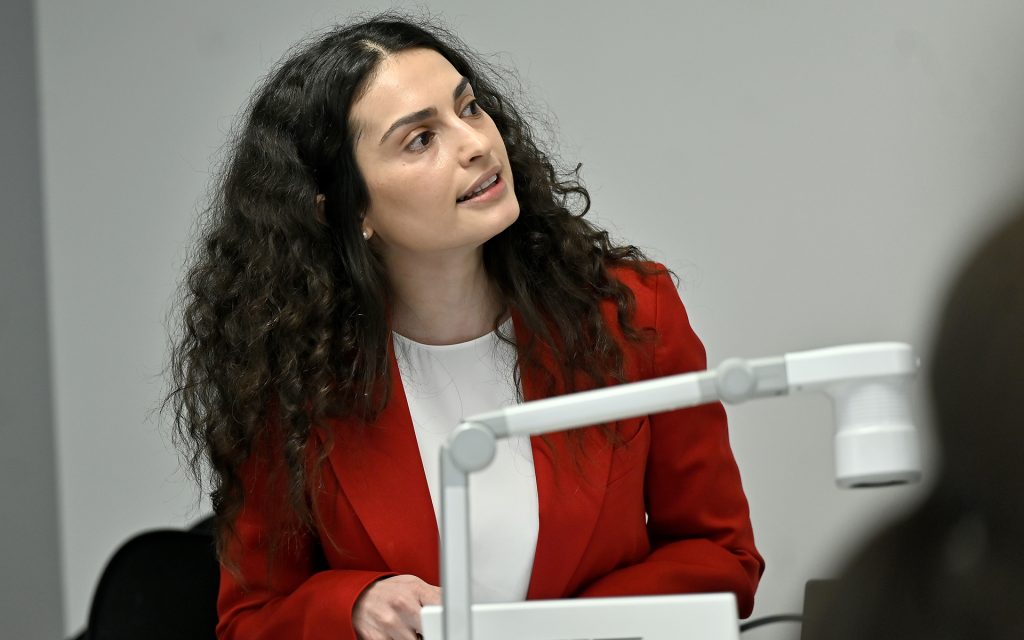
Sara Rohani, assistant counsel of the NAACP Legal Defense Fund, speaks with students at the Voting Rights and Policy residency.
Residency Brought Together Students with Diverse Expertise
Even though many of these students may not pursue careers specifically in voting rights, they wanted to understand how the law shapes and impacts communities. And because JDi students tend to be working professionals attending law school to advance or change their careers, they also brought real-life experiences to the topic. For example, one student was an elected official in Pennsylvania, another worked in state government, and another was a teacher, adding depth and practical relevance to the conversations in the room.
Michael Roach L’26 is the county judge of Stephens County, Texas.
“In my role as a county judge, I see firsthand how voting rules affect both election administrators and voters on the local level,” he explains. “I was particularly interested in getting a deeper understanding of how federal voting rights policy has developed, been interpreted, and implemented beyond the courtroom.”
“One of the most valuable aspects of the residency was exposure to practitioners working directly in the voting rights space, including our guest speakers who shared real perspectives for advocacy and enforcement,” Roach says. “And Professor Suto brought a unique level of insight, drawing on his experience at the forefront of drafting and advising on legislation designed to promote fairness, access, and integrity in the electoral process. All of the information throughout the residency helped connect legal theory to real policy outcomes.”
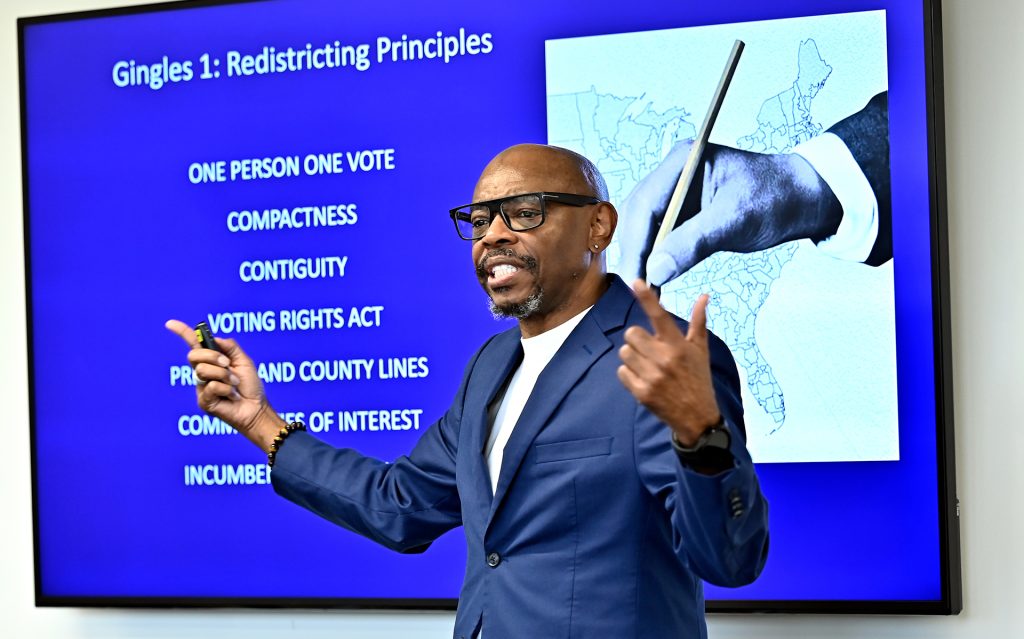
Fred McBride, Ph.D. senior advisor, voting rights, for the Southern Poverty Law Center, teaches students about Redistricting Principles as a guest speaker.
Students Tasked With Final Assessment of Writing Bill
According to Suto, the residency emphasized familiarity with voting rights and statutory drafting, instead of analyzing what someone else had already written.
“I like the exercise of saying, ‘This is the jurisprudential frame. What would you do in the middle of that?’ and asking students to see the gap between law and politics,” Suto explains, adding that the final assessment of the residency was to draft a bill.
The inaugural Voting Rights and Policy residency was a success. According to Suto, he received very positive, informal feedback from those who participated. Given the headlines voting rights have been making in today’s political climate, he hopes to present a similar residency to students in the future.
See here for more information on upcoming JDi residencies.
Joanne “Joanie” Mahoney ’87, L’90, President of the State University of New York College of Environmental Science and Forestry (SUNY ESF), will deliver the Commencement address at Syracuse University College of Law’s Class of 2026 Commencement on Friday, May 8, 2026, in the JMA Wireless Dome.
Mahoney was appointed SUNY ESF President in November 2020. She previously served as Onondaga County Executive for 11 years, during which she earned national recognition for her environmentally friendly stewardship. Before her elective office, she worked as an attorney both in private practice with the Harris Beach law firm and for five years as a criminal prosecutor in the Onondaga County District Attorney’s Office. Mahoney received her Juris Doctor from Syracuse University College of Law in 1990 and her Bachelor of Science from Syracuse University Whitman School of Management in 1987. She currently serves on the College of Law’s Board of Advisors.
As Onondaga County Executive (2008-2018), the first woman elected to this position, Mahoney created the nationally acclaimed Save the Rain green infrastructure program, transforming stormwater management. Her leadership helped restore Onondaga Lake from one of America’s most polluted lakes to swimming-quality water. She helped the county maintain the highest bond ratings among all New York State counties while championing the Say Yes to Education partnership. Governing Magazine named her Public Official of the Year in 2011.
As SUNY ESF’s fifth president and first woman to lead the institution in its 110-year history (2020-present), Mahoney has elevated SUNY ESF nationally in Princeton Review’s “Most Environmentally Conscious” ranking. She serves as Co-Chair of SUNY’s system-wide Sustainability Advisory Council. Her concurrent service as Chair of the New York State Thruway Authority (2015-2025) included overseeing completion of the $4 billion Governor Mario M. Cuomo Bridge, one of the nation’s largest infrastructure projects at the time.
Mahoney has sustained and strengthened the historic Syracuse University-SUNY ESF partnership, ensuring joint diplomas, shared opportunities for students, and collaborative academic programs. A Syracuse native from a family of nine children, she has championed regional development including helping to secure the $500 million CNY Rising award from the state.
“I am honored to give the commencement address to my alma mater’s 2026 graduating class,” said Mahoney. “I look forward to providing this next generation of leaders with insights into what awaits them as they start their careers.”
“I am pleased to welcome Mahoney back to the College of Law and am excited to stand with her as we welcome our most recent graduates into the powerful alumni network of Syracuse Law,” said College of Law Dean Terence Lau L’98.
Anyone taking on the rigors of law school expects it to be demanding, but Emely Recinos L’26 has the added challenge of reading case law, breaking down briefs, and participating in late night study sessions—all without the ability to see. Now a 3L preparing to graduate, Recinos has proven that what some might consider a barrier has instead helped her find her own voice and ignite a passion for advocating for marginalized people facing the legal system.
Diagnosed with a degenerative eye condition at age 7 that led to blindness, Recinos remembers doctors and school administrators telling her family that getting an education would be difficult. School made her feel isolated and depressed, and other children didn’t understand her disability. “It was a dark time without a lot of positivity around it,” she says.
Thankfully, a devoted teacher who worked with the visually impaired made it her mission to be sure Recinos left sixth grade with the ability to read and write braille—an essential foundation for her future success. She also convinced Recinos to use her white cane, increasing the young girl’s independence and providing an outward sign to others that she was blind. It was a turning point, allowing her to grasp the many possibilities ahead of her. Recinos didn’t know it then, but one of those things was studying to become a lawyer.
Understanding the Legal Needs of Other Marginalized Groups
Recinos excelled in college, earning an undergraduate degree in international relations from New York University. Upon graduation, she worked as a case support associate for the Young Center for Immigrant Children’s Rights in New York City. It was there that she came to understand first-hand how other marginalized groups—specifically unaccompanied immigrant children—needed reputable legal representation. This struck a chord and inspired her to pursue a law degree as a way to create meaningful change.
Recinos understood that navigating Syracuse Law would require thoughtful preparation. Before beginning law school, she worked with an orientation specialist to familiarize herself with Dineen Hall and continues to map out the routes to her classes ahead of each semester.
The staff at Syracuse University’s Center of Disability Resources has also helped her access course material in an accessible format. Recinos uses screen reader software on her laptop that turns digital content into synthesized speech, as well as a device with a Perkins-style braille keyboard that allows her to take notes and can be connected to her laptop.
Getting Involved and Exploring Orange Flex
Recinos was eager to get involved in activities at the law school. As a 2L, she joined the Disabled Law Students Association, a student organization that provides support and information for those with disabilities, that is open to all Syracuse Law students. The association helps connect members with volunteer opportunities, brings in speakers on pertinent topics, and promotes individuality throughout the entire Syracuse University campus. This year, Recinos is serving as co-president of the organization.
Starting last summer, Recinos was placed at the New Jersey Consortium for Immigrant Children, a nonprofit helping minors with immigration matters, including those with no legal guardians in the U.S. According to Recinos, the current political climate has resulted in continuous changes in fees and rules for obtaining special immigrant juvenile status, so the organization works to ensure minors have effective legal representation.
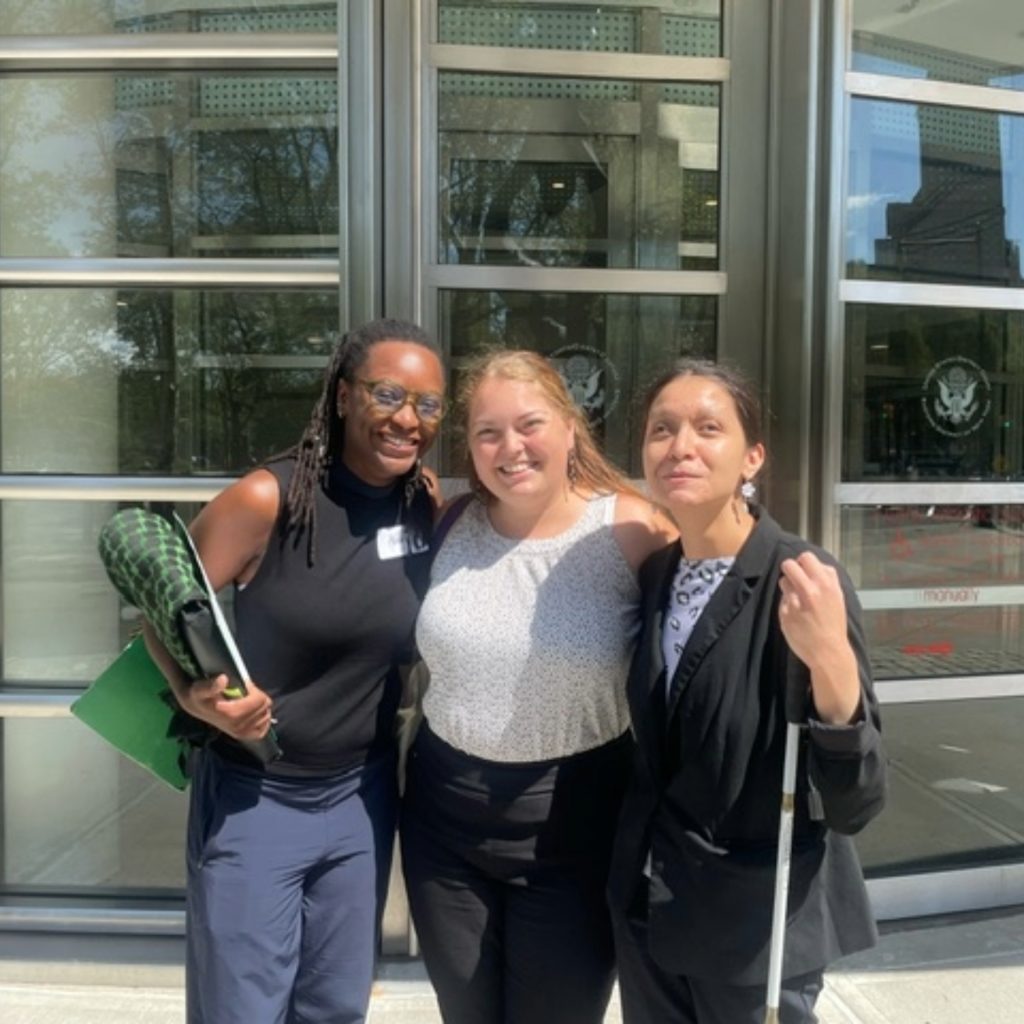
Emely Recinos ‘26, right, visited the U.S. District Court for the Eastern District of New York during her 2025 fall internship with the New Jersey Consortium for Immigrant Children. Pictured with her are, left to right, Abena Hutchful, policy and litigation attorney at the Young Center for Immigrant Children’s Rights, and internship supervisor Katarina Martucci.
Over the course of her internship, Recinos assumed expanded responsibilities, including serving as a lead on a case under attorney supervision and drafting certification briefs. She liked the work so much that she requested to stay on for the fall 2025 semester.
“I enjoy immigration law and working with children who feel like their voices aren’t being heard,” she adds, noting that her fluency in Spanish was helpful in her role. “When I was a child, I often felt people were speaking for me or over me, and I want to do what I can to make sure these children have a voice.”
Realizing Her Education Came With Options
Through her experiences at Syracuse Law, Recinos realized that having a disability didn’t mean her only option was to practice disability law. She has discovered that there are many ways her personal and professional experiences intersect with education, employment, civil rights, and international human rights.
As she prepares to graduate, Recinos wants to continue to help those with immigration issues or disabilities access to quality legal representation. She is currently exploring post-graduate opportunities with various civil rights organizations. Recinos also recently wrote “The Overlooked Tourist: Enhancing the Market for Disabled Travel,” soon to be published by the College of Law’s Journal of International Law and Commerce.
Eventually, Recinos sees herself working on policy to ensure that those with disabilities or anyone who feels unheard due to their circumstances will be protected under the law.
“I feel like I’ve been able to accomplish so many things here at Syracuse Law, particularly how to use my own voice to advocate for myself and others,” she says. “I’ve found wonderful mentors, a community of peers, and professors who’ve taken that extra step for me. I know I have a lot of options moving forward, and I’ve been empowered by that.”