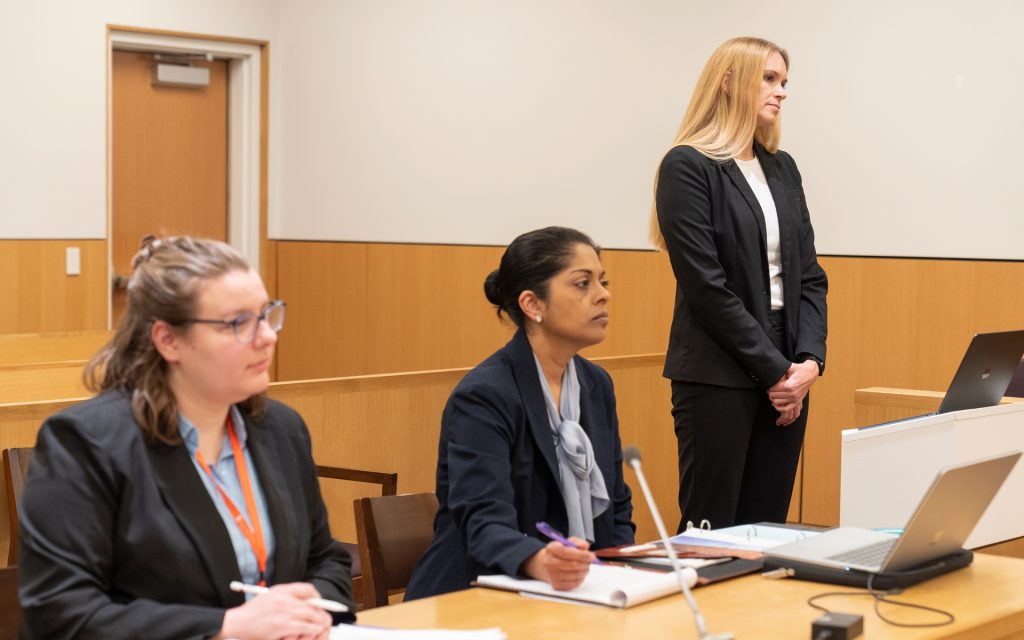
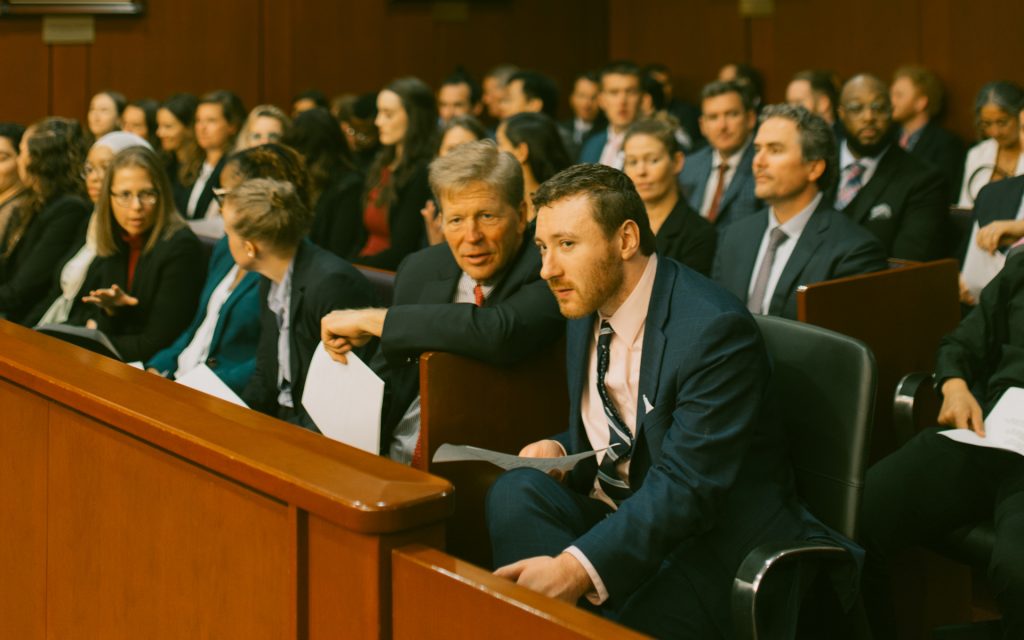
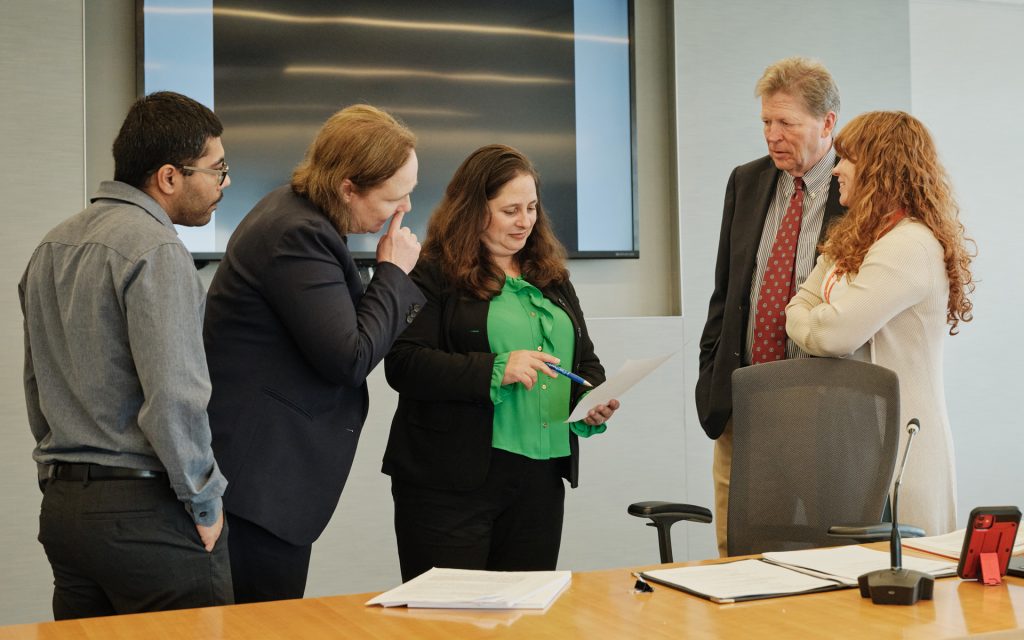
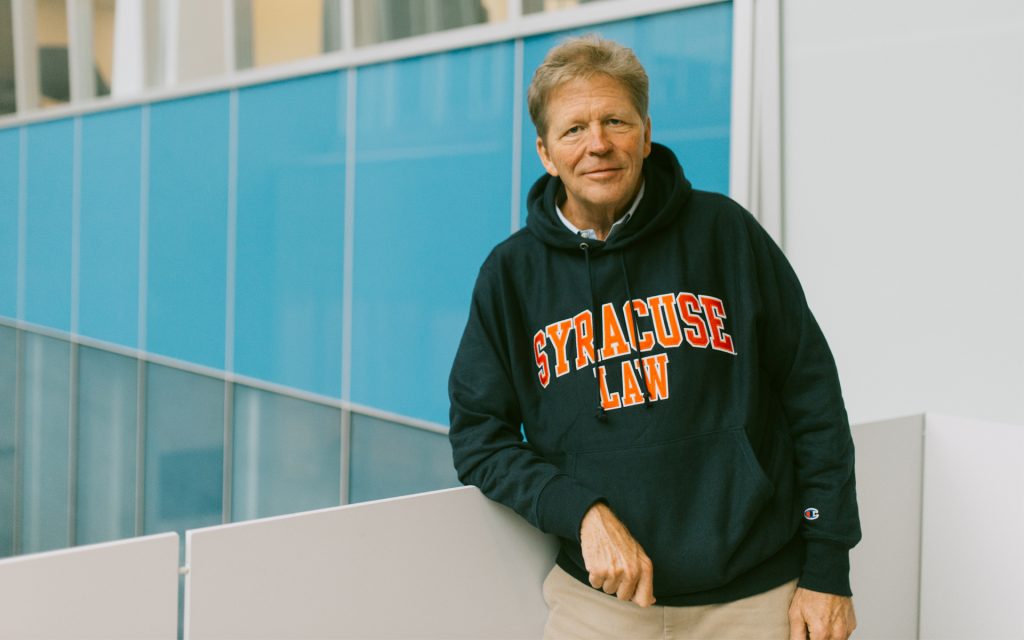
The sixth Annual Syracuse National Trial Competition occurred from October 18-20, 2024.
The quarterfinalists were:
Belmont University College of Law
Quinnipiac University School of Law
Stetson University College of Law
Western State College of Law
In the final round, Stetson University College of Law prevailed over Western State College of Law.
The individual advocacy awards were:
Best Closing Argument Award: Matthew De Santos, Western State College of Law
Best Direct Examination Award: Madeleine Bodiford, Stetson University College of Law
Best Cross Examination Award: Cristine Khachatoorians from Loyola University Law School, Los Angeles
Best Open Statement Award: Tie between Isabella Diaco from Stetson University College of Law and Alleanne Anderson from Chicago-Kent College of Law
Overall Best Advocate for the Preliminary Rounds: Chase Gleason, Western State College of Law
Best Overall Advocate for the Final Round: Tie between Laith Hatoum from Stetson University College of Law and Matthew DeSantos from Western State College of Law
Joanne Van Dyke (SNTC Director) drafted the fact pattern, entitled Bobby Blair v. Go West Movies, Inc. The Plaintiff was hired by the Defendant to act in a Western they were producing. Toward the end of production, the Plaintiff was seriously injured as a result of a shooting incident. The fact pattern was balanced in terms of results as there was a 50-50 split between Plaintiff and Defense wins throughout the whole competition.
Andrew Umanzor and Carly Zakaria (SNTC Coordinators) dedicated countless hours and worked nonstop throughout the competition, and more than forty members of the Syracuse Law Advocacy Honor Society volunteered as bailiffs. Your help was greatly appreciated.
We’d like to thank the Honorable Miroslav Lovric (United States District Judge Northern District of New York), who presided over the final trial, as well as all of the judges and attorneys who judged/evaluated. Many of the judges and attorneys evaluated multiple rounds, and some traveled two to three hours to Syracuse for the competition.
We’d also like to thank Judge Deborah Karalunas, Don Doerr, Esq., Mary Monashefsky, Chief Steven Bigzia, the court officers and the courthouse staff, who made hosting the tournament such a success.
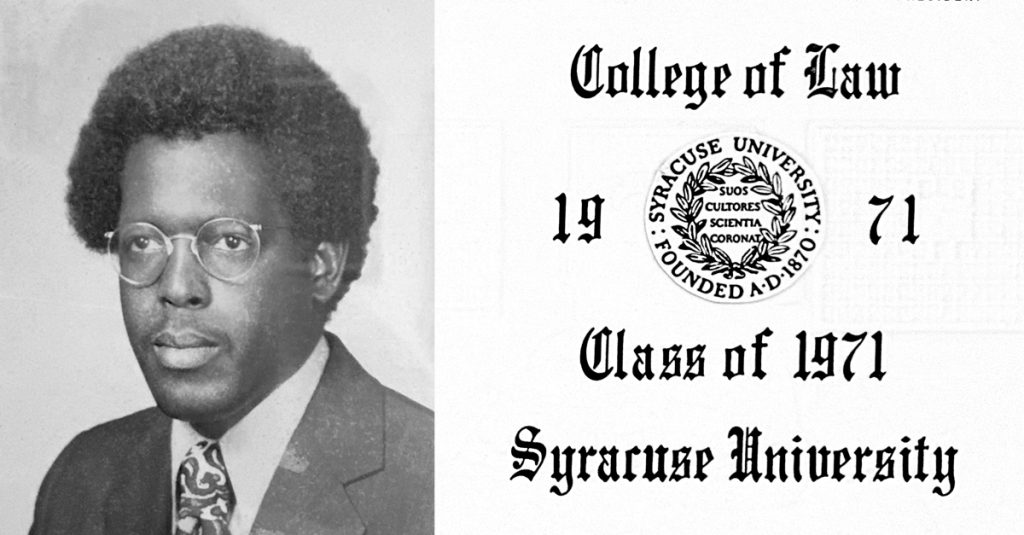
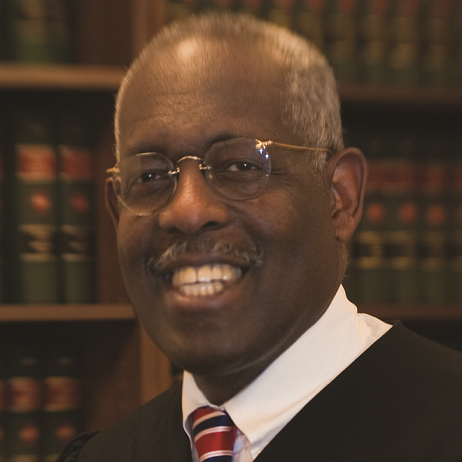
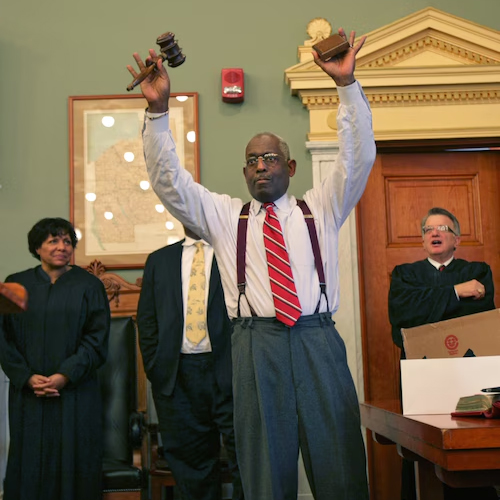
On Wednesday, October 30 at 4:30 p.m., political, legal, and civic leaders from across the state will gather at the Honorable James C. Tormey, III Criminal Courts Building at 505 South State Street, Syracuse, New York for the dedication of The Hon. Langston C. McKinney Courtroom. The Hon. Langston C. McKinney L’71 served in many critical public interest leadership positions and applied his legal acumen across many practice areas and roles. He was appointed the first Black Syracuse City Court Judge in 1986 and served with honor, distinction, and compassion until his retirement in 2010.
Judge McKinney was born in Miami, FL on October 27, 1944. He graduated from Howard University in 1965 with a degree in chemistry and was recruited by Carrier Corporation to come to Syracuse to work as a chemist where he was the first Black scientist in their research and development division.
Judge McKinney served two years in the U.S. Army and then returned to Syracuse in 1968 to attend Syracuse University College of Law. While in law school he co-founded the Syracuse chapter of the Law Students Civil Rights Research Council and would spend a summer working in the South on civil rights legal work, fueling his passion for justice. Also, while in law school he started to work for Onondaga Neighborhood Legal Services (ONLS). It was there that he came to understand the plight of people trapped in poverty and social and economic injustice. This experience sharpened the lens through which he saw the need for justice, equality, and the rule of law.
Upon graduating from Syracuse Law, Judge McKinney began his legal career at ONLS as a staff attorney. Among the many causes he championed was the issue of tenants’ rights. He would later be honored by having a housing complex named after him – McKinney Manor. Judge McKinney later joined the legal staff at Hiscock Legal Aid Society where his reputation as a criminal defense attorney began to grow. Eventually, Judge McKinney joined with two other Syracuse lawyers to form the law firm of Maye, McKinney & Melchor, the first Black law firm in Syracuse.
In 1986 Judge McKinney was appointed by Mayor Tom Young to be the first Black American Syracuse City Court Judge. He was then elected in 1987 and re-elected in 1997 and 2007. One of Judge McKinney’s proudest accomplishments was partnering with the Center for Community Alternatives to establish the Syracuse Community Treatment Court.
Although Judge McKinney retired in 2010, he remained active in the pursuit of justice. He was instrumental in founding the first African American Bar Association in Onondaga County – The William Herbert Johnson Bar Association – named after a fellow African American legal trailblazer.
“Judge McKinney had faithfully and respectfully served Syracuse as a jurist, community leader, and mentor to many in the legal profession and other disciplines,” says Professor Paula Johnson, who served on the committee securing the courtroom dedication.
It takes more than 30 hours by plane for Lisa Phair L’25 to get to the Syracuse University College of Law, but, for her, it’s definitely worth the trip.
Currently a 3L in the Syracuse Law’s JDinteractive (JDi) program, Phair lives in the Mariana Islands, a U.S. territory in the middle of the Pacific Ocean. Raised in Alaska, she and her husband moved to the Mariana Islands 11 years ago when he took a one-year contract job as a pharmacist. However, the natural beauty and multiculturalism of the islands made them decide to stay.
Today, Phair and her husband have two children, age 10 and 15. Phair works as a Scuba instructor and dive shop manager, as well as an adjunct instructor at Northern Marianas College, teaching Social Psychology of Business Management and Operations Management.
Law school had only been a thought in the back of her mind until the pandemic hit in 2020, locking down the islands from the rest of the world. While a U.S. territory, the Mariana Islands’ population is only made up of 35% U.S. citizens. Others are from around the world, there on various work or travel visas. When the lock down occurred, many of Phair’s friends were at the mercy of immigration. They lost jobs due to COVID but, as non-citizens, they were not eligible for the U.S. welfare system. This created a hardship for people just to put food on the table and take care of every day essentials.
When the world started opening up, Phair began thinking more seriously about pursuing law school, particularly immigration law in response to the difficulties she had seen non-U.S. citizens tackle during the pandemic. She didn’t find many law schools that offered immigration law specifically and also didn’t want to uproot her family. So, when Phair came across the Syracuse Law JDi program, which offered international law, she took a chance.
“I was nervous about the hybrid program not being a traditional law school set-up, but the talented people in my cohort have truly elevated my experience. I’m so impressed with my classmates—people with a lot of other demands on their time—and how we’ve developed a great rapport with one another.”
—Lisa Phair L’25
Now, due to the 14-hour time difference, Phair often finds herself logging on to her classes at night from the local McDonald’s, which is her closest internet access. But, that hasn’t stopped her.
“The JDi has exceeded my expectations,” she says. “I was nervous about the hybrid program not being a traditional law school set-up, but the talented people in my cohort have truly elevated my experience. I’m so impressed with my classmates—people with a lot of other demands on their time—and how we’ve developed a great rapport with one another.”
Part of the requirements of the JDi program are six residency programs on special topics. Phair has traveled to eight—five residencies on the Syracuse campus, as well as others in Rome (Comparative Legal Systems), Washington, D.C., (Federal Practice and International Law) and London (Comparative Trial Advocacy).
Phair not only values the information she learned at the residencies but also the opportunity to interact face-to-face with classmates and faculty. “It was a great comfort to see those familiar faces and spend time with each other,” she says. “And, I’m so grateful for the valuable topics, caliber of teaching and guest speakers who were brought into each residency program.”
As she completes her final year, Phair continues to focus on international law. She recently wrote a blog post for Syracuse Law’s Journal of International Law and Commerceabout the battle between the U.S. and China to establish diplomatic ties with Pacific Island nations and the potential impact if China continues to move further into the region—something that resonates with her as a resident of the Mariana Islands. And, this semester, she is excited to be taking Space Law and Policy.
While she has enjoyed all of her classes, she has special appreciation for Professor of Law Todd Berger, Adjunct Instructor Raul Velez and Professor Andrew Greenberg for the humor they bring to the classroom, as well as Associate Dean for Online Education Shannon Gardner, Assistant Director of Academic and Bar Success Lou Lou Delmarsh and Assistant Director of Online Programs Stephanie Rinko for their friendship and guidance.
After graduation, she plans to take the New York State Bar exam, which has reciprocity that will allow her to practice back home. The following year, she intends to take the Commonwealth of the Northern Mariana Islands (CNMI) bar exam, too. Phair hopes to start her career clerking at one of the courts on the islands, while also honing her grant writing skills to raise money for a practice she and a friend intend to open to offer pro bono legal assistance to those on the islands facing immigration issues.
In the spring of 2025, Phair will again take that 30-hour trip to receive her diploma from Syracuse Law, and she is excited to celebrate this achievement in person with her law school friends and professors.
“Living on the Mariana Islands is amazing, but Syracuse’s JDi program has also been an amazing adventure that has changed my life,” she says. “I am eager to see what a future in law has in store for me.”
At issue in the case is whether NJ Transit is using patented rail worker-safety technology without permission in the cross-jurisdictional tunnels that connect New Jersey and New York.
This is a rare instance of the defendant raising a sovereign immunity defense in a patent infringement case.
According to the article, if NJ Transit proves it qualifies for sovereign immunity, the question will become whether it’s “waived that immunity or consented to suit.”
Waivers are particular to any given entity, but if the New York district court finds “some specific language” where NJ Transit waived its 11th Amendment immunity, it could help Railware in cases against other transportation authorities, says Ghosh.
The district court “might do something as bold as to say that the 11th Amendment doesn’t apply to this case for some reason,” Ghosh added. “But it’s unlikely to do that. That’s going to create some conflict with the Supreme Court precedent.”
Professor Gregory Germain recently participated in a question-and-answer article on personal and business bankruptcy at lawfirm.com.The article covered the basics of filing for bankruptcy, alternative solutions, and when a lawyer should be involved in the process.
Germain advises to those contemplating filing for bankruptcy is “Facing the situation, taking action to address the situation, and developing a long-term plan to save money are the only ways to improve your financial life.”
David M. Levy L’48 Professor of Law Nina Kohn recently spoke with AARP for their article “Nursing Home Residents Could Tip Elections, if They Find a Way to Vote” which examined roadblocks to voting that nursing home and other long-term care residents encounter along with laws that protect their voting rights.
Kohn touched on the barrier that nursing home staff may present. “If staff don’t see voting as something that is important for residents — whether that’s because they don’t think residents are the type of people who can or should vote, or whether because they themselves are not politically active, then they may simply not place priority on voting.”
On voter eligibility, she says “As long as a person can express a voting preference, they have capacity to vote. And of course, that is effectively the standard that we hold people without a diagnosis of dementia to.”
Being able to vote gives nursing home and long-term care facility residents a voice in issues affecting their lives. “Most nursing home residents are not in a position to march in a protest. They’re not in a position to knock on doors or show up at their elected representative’s offices. The one thing they can do is vote,” Kohn says. “It’s a badge of belonging and citizenship, and it’s, in many cases, the last source of power.”
Syracuse University College of Law will hold its eighth annual Supreme Court Preview on Friday, November 1 from 9 a.m. to noon in the Gray Ceremonial Courtroom in Dineen Hall. Robert Parker, Chief of the Criminal Division’s Appellate Section at the U.S. Department of Justice, will deliver the Keynote Lecture “Supreme Court and Appellate Practice at the Department of Justice.”
The following panel discussion will examine key cases to be heard during the 2024-2025 Supreme Court term.
The Moderator will be Keith J. Bybee, Vice Dean and Paul E. and Hon. Joanne F. Alper ’72 Judiciary Studies Professor of Law.
Ghosh noted that it isn’t clear if the statement has any legal backing and it won’t limit OpenAI from enforcing its rights under copyright, trade secret, or contract laws.
“Computer source code that guides ChatGPT would be protected by copyright law and trade secret law,” Ghosh said. “Terms that OpenAI includes in its terms of service would still be enforceable as contracts. Should OpenAI engage in conduct that deviates from the pledge, for example by suing another company or an individual for patent infringement, what OpenAI has lost temporarily is credibility.”
George Boehme L’26 jokingly calls himself “the oldest law student in America.” At age 64, after a successful career as a newspaper publisher, he decided to enroll in Syracuse University College of Law’s JDinteractive (JDi) program with the intention of starting his next chapter doing pro bono work to help those in need.
“I thought going to law school was a lost opportunity for me. I had no idea a program like Syracuse’s JDi existed, but the time, effort and investment that the University has put into this program is much better and of higher quality than anything else I found. I would recommend it to anybody.” —George Boehme L’26
According to Boehme, he had an “ah-ha” moment a few years ago that made him feel that he had not taken the opportunity to make the world a better place. He looked to his wife, a physician, who has been able to make a true difference in other people’s lives and knew he wanted to reach out to those who had not been dealt an easy hand. Still, the idea of law school didn’t seem possible until he discovered Syracuse Law’s JDi program.
“I thought going to law school was a lost opportunity for me” says Boehme, who had explored law schools near his home in Houston. “I had no idea a program like Syracuse’s JDi existed, but the time, effort and investment that the University has put into this program is much better and of higher quality than anything else I found. I would recommend it to anybody.”
Boehme is currently an academic success fellow in civil procedure for Professor of Law Margaret Harding, helping other students with academic and study skills. He also is willing to share the wisdom that comes from starting something new later in life.
“Law school is tough and can be intimidating, but I’ve seen people who are scared of their shadow become confident after just a semester,” he explains. “Age can be comforting in that respect, and I think I’m good at encouraging those who might be struggling.”
When he completes his law degree, he intends to serve others as an attorney and maybe even teach law at some point. Boehme plans to stay in Texas working or volunteering with several organizations that cater to pro bono work in multidisciplinary areas.
“Blessedly, when I get my law degree, I won’t need to earn a living from it, and I won’t have any debt,” he explains. “But, I will be able to provide high quality civil legal representation to poor folks pro bono, particularly in the critical area of aggressive debt collection civil defense, more narrowly as it relates to the horrific pay-day lending industry.”
In the meantime, Boehme still has some work to do to earn his law degree. However, since he is retired, Boehme has the time to take a heavier load of classes and hopefully graduate early, eager and willing to reach his goal of helping others as a practicing attorney.
“If you want a fulfilled happy life, burst out of your bubble and improve the plight of those you would otherwise never meet,” he says of his choice to pursue law school through the JDi program. “I’m too old to endeavor to solve all the ills of society, but I have enough time left to focus on helping one person at a time.”
University Professor David Driesen recently spoke with the Washington Post on the legality of Department of Justice Special Counsel Jack Smith’s filing in the January 6 case so close to the presidential election.
“What the Justice Department and the judge did is they followed the rules around criminal proceedings,” said Driesen. “They followed the law, which is not to protect Trump or his political candidacy.”