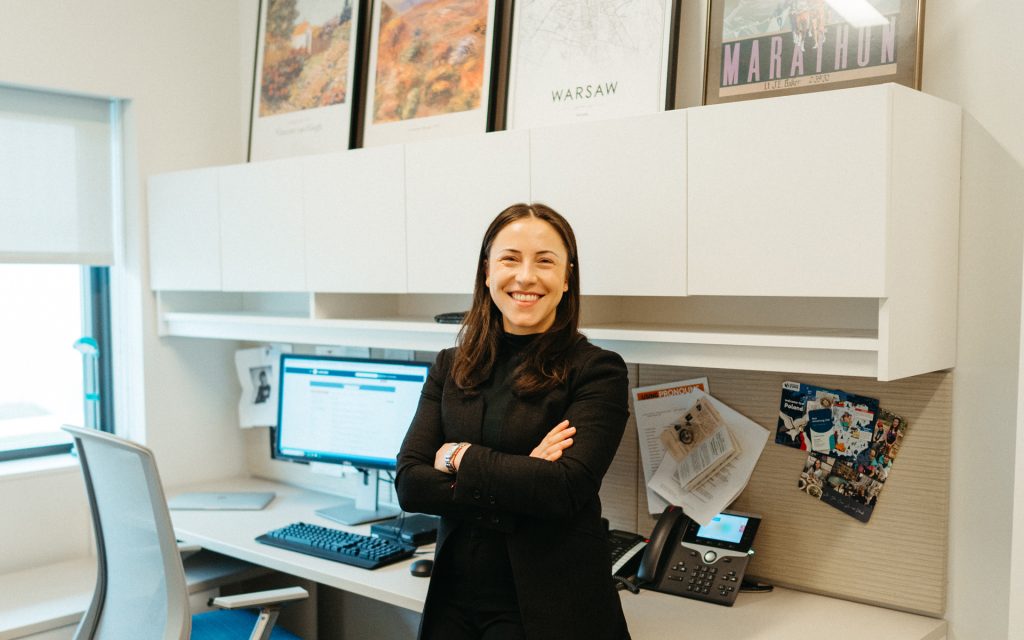
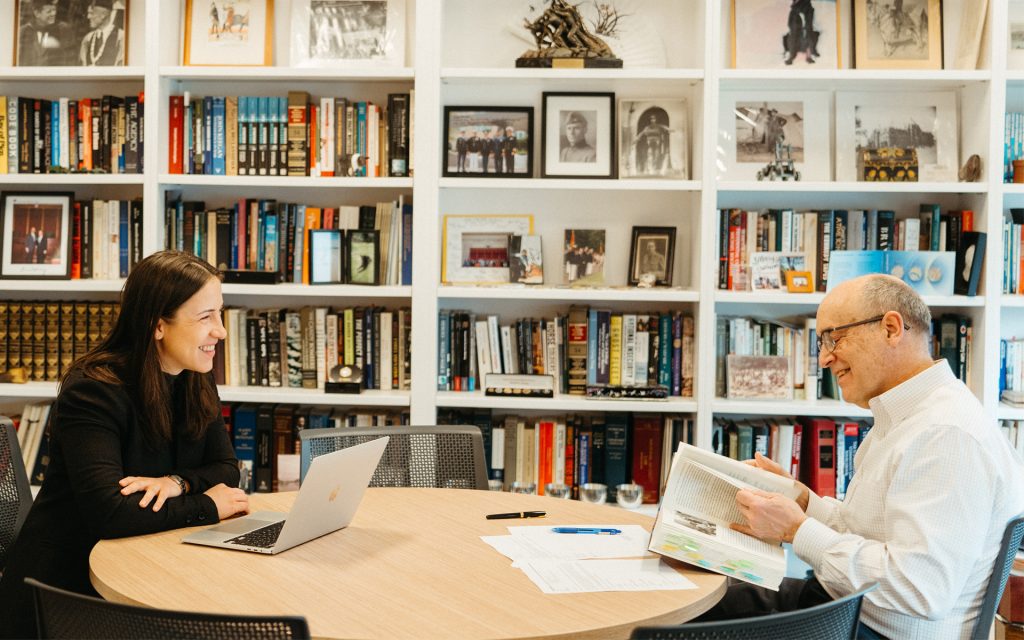
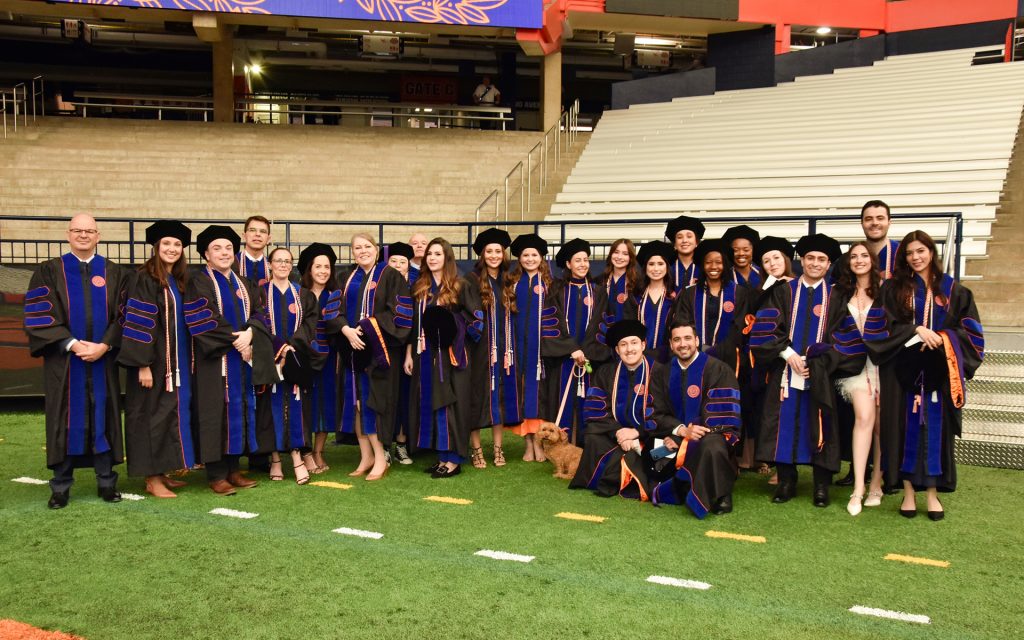
Over several semesters, students from the Transactional Law Clinic, under the supervision of director Jessica Murray, helped the Neezen Toze Theater Company in Tully, New York, complete several legal matters for the not-for-profit specializing in original children’s and family-oriented productions.
Trisha Black L’24, Amanda Hepinger L’23, Zebedayo Masongo L’23, Michael Ortizo L’24, Matthew Patrizio L’24, and Andrea Rojas L’23 drafted and filed a Certificate of Incorporation with New York State, drafted bylaws and other organizational documents, applied to the IRS for recognition of tax-exempt status, registered with the New York State Attorney General’s Charities Bureau, applied to New York State for exemption from State Franchise and Sales taxes, and provided ongoing counsel to Neezen Toze leadership.
“On behalf of everyone associated with Neezen Toze, I would like to thank you for your diligence, kindness, patience, and effectiveness as our advocates in this, a process that would have likely taken us much longer (if we’d been able to complete it at all). Matthew and Michael, while you helped us over the finish line, we are well aware that this was a process shepherded by numerous members of the Clinic’s student staff and are eternally grateful for the help and support we received. I am not being hyperbolic when I say that I can’t imagine having done this by myself. Congratulations on your upcoming graduations, and best wishes in your future endeavors!” wrote Michael Lipton, Creator and President of Neezen Toze.
Syracuse University is consistently ranked as one of the best private schools for veterans in the country, and that commitment extends from supporting veterans in the classroom to serving veterans in the community. Veterans make up a major part of the Syracuse community, both on- and off-campus. Onondaga County has one of the largest veteran populations in New York, with approximately 23,000 veterans located throughout the entire region and over 5,000 in Syracuse alone. Two schools at Syracuse University, the College of Law and the Falk College of Sport and Human Dynamics, came together to create a program that simultaneously teaches students important social work concepts while also putting them into practice to create a positive impact and assist the local veteran community.
The Legal-Social Work Partnership Program was established in 2023 by Falk alumna Wendy Goidel ’84, Esq. While there are law firms that employ social workers in their practices, it is still quite uncommon. Goidel, the founding and managing member of Goidel Law Group PLLC and its Estate Planning & Elder Law Center, is one of the few who is leading the way. Goidel is the founder and co-developer of Concierge Care Coordination, a holistic practice model, which merges geriatric social work with legal planning. Hoping to offer social work graduate students the opportunity to participate in fieldwork with the College of Law’s Betty and Michael D. Wohl Veterans Legal Clinic, Goidel needed to find the right social work supervisor for the program’s student. The lack of social workers operating in law, however, made it a difficult task. Goidel returned to her alma mater and met with Ken Marfilius, the Assistant Dean of Online and Distance Education and an Associate Teaching Professor in the School of Social Work.
“Ken Marfilius from Falk reached out and we put our heads together about how we could start a program for a student here. It was just a great opportunity to set up an internship for a social work student to be assigned here at the Veterans Legal Clinic at the College of Law.”
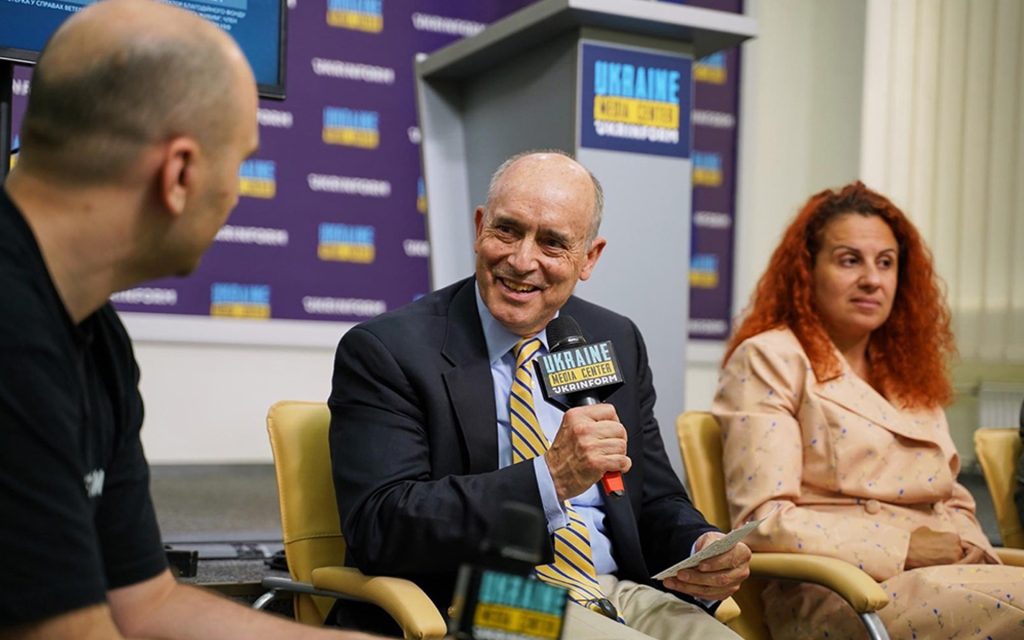
Elizabeth G. Kubala, Executive Director of Clinical Education, Director of Veteran and Military Affairs, Executive Diretor of the Betty and Michael D. Wohl Veterans Legal Clinic
Marfilius’ background as a United States Air Force Veteran, specifically serving in the U.S. Air Force Biomedical Science Corps, made him the perfect candidate to start the program. While on active duty, Marfilius held many titles, including mental health therapist, family advocacy officer in charge, and manager of the alcohol and drug prevention and treatment program. Jumping on the opportunity, Marfilius reached out to Syracuse Law’s Elizabeth G. Kubala, Executive Director of the Betty and Michael D. Wohl Veterans Legal Clinic (VLC), a U.S. Army veteran who served on active duty as an Army Judge Advocate General’s Corps officer for 22 years. The clinic provides representation to veterans and their families seeking benefits from the U.S. Department of Veteran Affairs (VA) or upgrading a military discharge through various military branches.
“Ken Marfilius from Falk reached out and we put our heads together about how we could start a program for a student here,” Kubala said. “It was just a great opportunity to set up an internship for a social work student to be assigned here at the Veterans Legal Clinic at the College of Law.”
Together, Kubala and Marfilius were able to navigate challenges and create a program that would benefit both College of Law and Falk students as well as the local veteran community in Syracuse. The last step, however, was to find the right graduate student for the job, and beginning in the Fall of 2023, Benetta Dousuah became the Legal-Social Work Partnership Program’s first Fellow.
“While I was in the Army, a lot of people did not want to go to Behavioral Health because of the stigma associated with mental health,” Dousuah said. “Once I got out, I said ‘Wait, let me go be a social worker’ and I can someday work for the army to encourage young soldiers to get Behavioral Health help.”
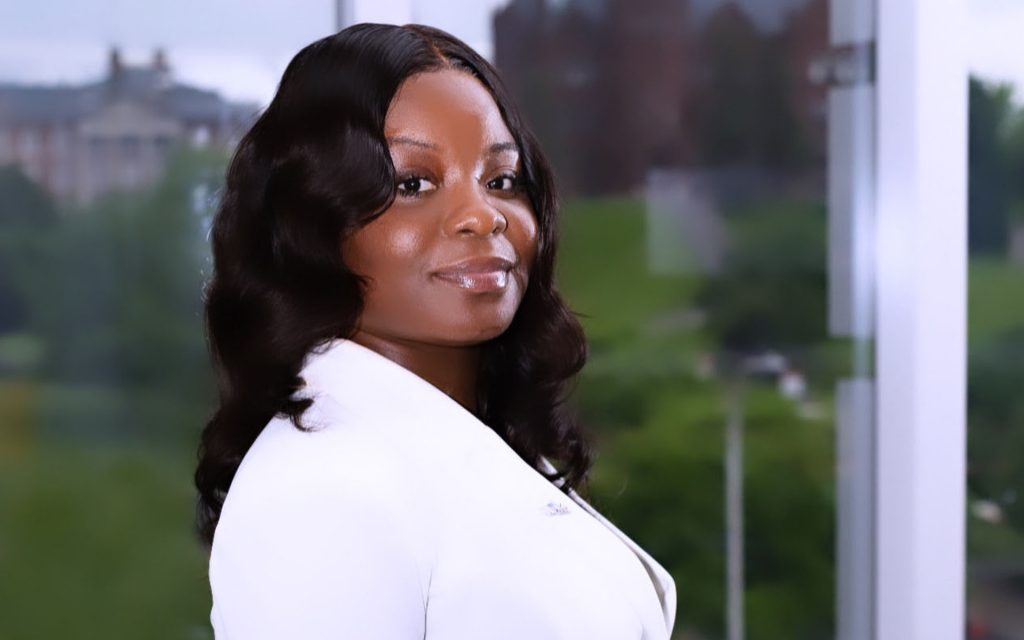
Benetta Dousuah
A Helping Hand
Originally from Ghana, Dousuah grew up in northern New Jersey before serving in the Army for six years as a 92 Yankee, or Unit Supply Specialist. However, it was not until she witnessed, and personally experienced, poor mental health support that inspired her to pursue social work and support those who have served, or are actively serving, the country. The legal challenges veterans face are unique, typically related to the details of their service, and require a certain background and understanding to solve. As veterans age, these barriers can worsen and begin to involve different areas of their physical, social, and emotional health. With over 80% of veterans being over the age of 55, there is a tremendous demand for legal and social support.
“If you don’t have a discharge status of Honorable Discharge, you may not be entitled to certain services, specifically VA services and even VA disability compensation, which is financial assistance,” Marfilius said. “Prior to their discharge upgrade, they’re often dealing with psychosocial issues, potentially mental health issues, that could affect employment, housing, legal, et cetera.”
Without the right discharge, many veterans cannot even apply for the services that help them face these broader issues. This lack of access has only caused more hardships, with 22 veterans committing suicide each day, and thousands more struggling to navigate additional resources and assistance. While the VLC provides remarkable legal support to veterans, assigning cases to law students who are participating in the clinic course, it could not always provide broader support with other issues that may be faced in daily life. Now, with the creation of the Legal-Social Work Partnership Program, law students are introduced to the role social work can play in law and have begun to learn more about how social workers can amplify services to veterans.
“While the law students are focusing on the legal aspect of the veteran claims, I am the social work intern who connects them with services outside of the law clinic through SyracuseServes.”
Benetta Dousuah
“It doesn’t take long for a new student to dive into a case and realize I can help with the disability part, but I can’t quite help with this family law matter that the veteran is dealing with,” Kubala said. “Then the students bring Benetta into the picture, with the approval of the client, and she’ll put on her social work hat to analyze the various challenges that the veterans are facing and help connect them to local resources in the community. She’s kind of the first step in a helping hand.”
By working with Dousuah, law students are actively observing and learning various social work skills, giving them a better understanding of empathy and awareness, specifically towards the bigger picture past individual legal problems. The law students have begun to adopt more holistic approaches, realizing their limitations, and recognizing when they should find a resource that is better suited to handle certain problems. This, in turn, creates stronger student-attorney/client relationships, which results in more positive outcomes and success for veterans seeking support. As a result, more than 100 veterans were served through the Legal-Social Work Partnership Program.
After identifying additional needs, Dousuah is responsible for referring veterans to SyracuseServes, a program of the D’Aniello Institute for Veteran and Military Families. The program connects local veterans in Onondaga County with other services, allowing them to request assistance in various realms they may not be able to access otherwise. Dousuah’s initial assessment describes who the veteran is and what exactly they are looking for, leading to a more thorough intake process performed by an on-campus representative, who will then provide connections to local services, guaranteeing each veteran receives assistance unique to their case.
“While the law students are focusing on the legal aspect of the veteran claims, I am the social work intern who connects them with services outside of the law clinic through SyracuseServes,” Dousuah said.
The impact of the Legal-Social Work Partnership program not only extends to both Syracuse University students and professors but also to the broader veteran community found within Onondaga County. With hopes of only expanding the program, and even possibly becoming a model for other universities to replicate in their communities, the program will continue to reach more and more veterans across the nation. Through the Goidel Law Group Internship Fund, the program will only continue to grow as it allows for two social work graduate students to be selected as fellows each year, providing $5,000 stipends for their internship with the program.
“We’ve seen how valuable it can be when you’re assisting someone and they have additional individuals who are also invested in their success,” Kubala said. “It’s been really eye-opening to see how critical a role the social services play, and working with our local veteran population, it’s all kind of coming together at once.”
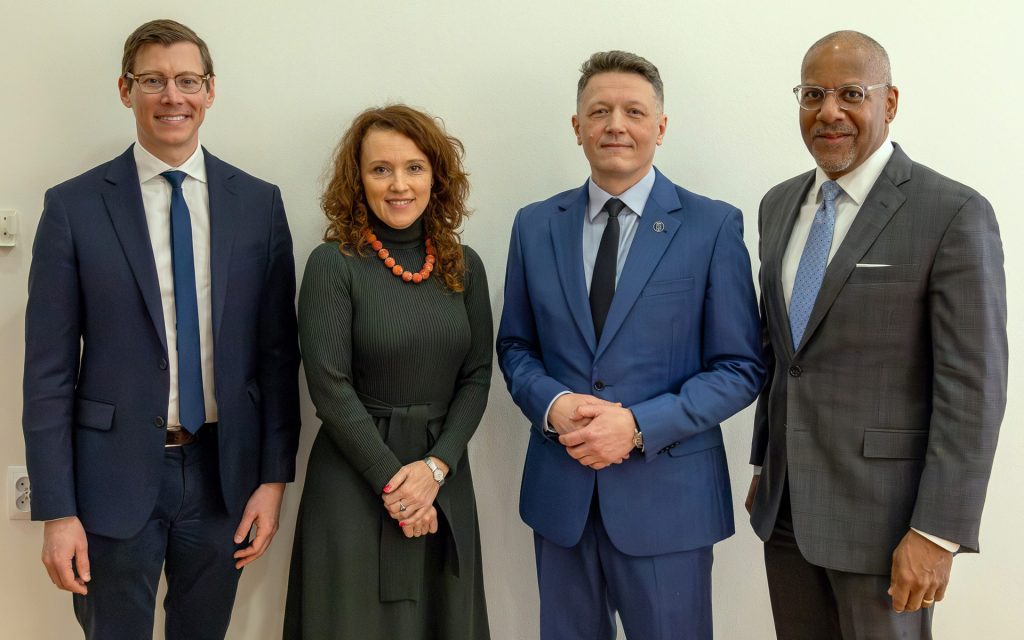
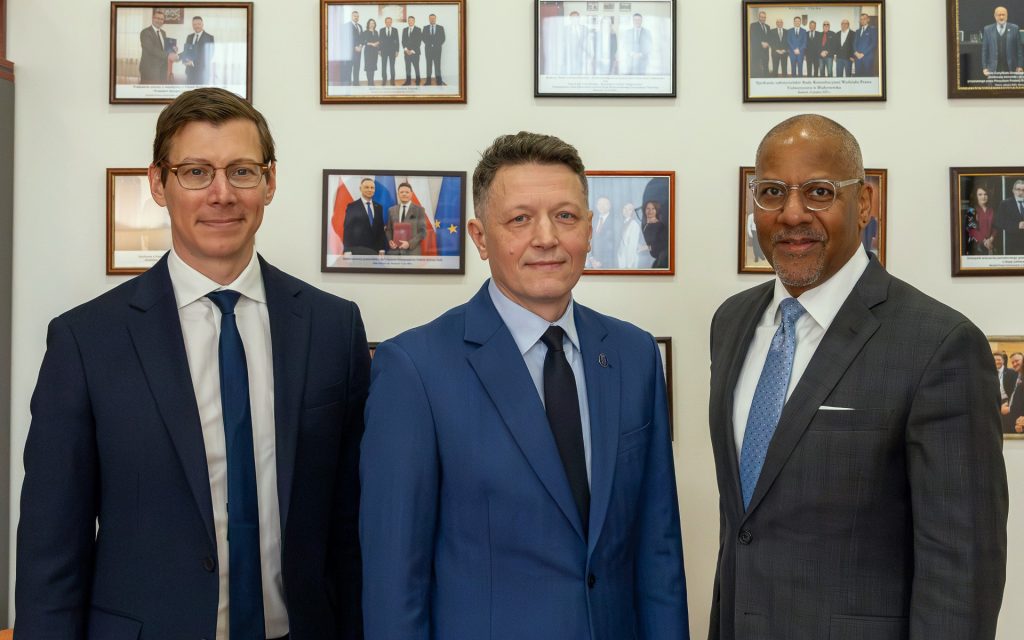
Andrew Horsfall, Vice Dean for International Cooperation and Development, dr hab. Izabela Kraśnicka, prof., Dean dr hab. Mariusz Popławski, prof. and Craig Boise
While the University of Bialystok and its Faculty of Law in Bialystok, Poland, may be more than 4,000 miles away from Syracuse Law, the exchange and collaboration of faculty, students, and knowledge on both sides have created a close relationship that has heightened learning on the legal, political, and cultural fronts, expanding a world view for so many, here and there, at a time when cross-cultural, global understanding may be more important than ever.
In 2016, Professor Izabela Kraśnicka, former vice dean for international cooperation and development at the University of Bialystok and head of the international department; and Professor Maciej Perkowski, head of the Department of Public International Law at the University’s Faculty of Law, were involved in a number of projects related to disability issues, including autism.
At the time, the University of Bialystok was proud to have its first Ph.D. student with autism, Maciej Oksztulski, who was working on his doctoral thesis, International Legal Standards of the Right to Education and Their Practical Implementation by National Scientific Institutions in Relation to Students on the Autism Spectrum, a comparative analysis that referenced Poland and the U.S. He had received a grant to complete further research, which required a comparative aspect to learn how foreign universities attracted and accommodated students with autism. To support Oksztulski’s work, Perkowski, who supervised his thesis, thought it was necessary to approach high-profile institutions like Harvard and Yale. Kraśnicka went to great lengths to convince Oksztulski that while those schools may hold prestige, it was also important to consider that other universities in the U.S. may be better suited to support his work.
“We needed a school that had extensive experience with supporting people with disabilities,” says Kraśnicka. After much research, she discovered Syracuse Law. Kraśnicka was drawn to the school’s Disability Rights Clinic, an initiative with a reputation for excellence directed by Associate Professor of Law Michael A. Schwartz, a supervising attorney and faculty member.
Kraśnicka coordinated with Schwartz and Andrew Horsfall L’10, assistant dean of International Programs, to arrange a visit for Oksztulski and a few faculty members from the University of Bialystok in 2017. Not only did this allow him to further his research, but he was able to see first-hand the ways autism was supported and recognized in the U.S. (Oksztulski successfully defended his thesis in 2022 and is now on the faculty at the Department of Public International and European Law at the University of Bialystok.)
From this initial collaboration, Kraśnicka and Horsfall launched a new partnership between their two institutions that would mutually benefit their faculty and students.
In 2019, Schwartz, who is deaf, was the first Syracuse Law faculty member to travel to the University of Bialystok to participate in the Axiological and Legal Aspects of Disability conference held at the University of Bialystok’s Faculty of Law to create a space for scientific research and the exchange of viewpoints regarding disability law. Schwartz presented Valuing Disability Rights: A Deaf Insider’s Perspective at the conference.
During his visit, he was hosted by the Student Legal Clinic at the University of Bialystok Faculty of Law, where he exchanged experiences with Polish students on how law clinics operate in Poland versus the U.S. His visit culminated by publishing an article, titled: Providing Effective Communication Access for Deaf People: An Insider’s Perspective in the University of Bialystok’s legal studies journal.
Soon after Schwartz’s visit, Kraśnicka identified funding available through the prestigious Erasmus+ grant program that broadened the partnership and exchange with additional Syracuse Law faculty members. The grant program, among other things, supports teaching, research, networking and policy debate on European Union (EU) topics. After coordinating with Hirsfall in May of 2022, the exchange was set up. Professors Cora True-Frost L’01 and James Baker were on their way to Poland.
“There is always a celebration when a U.S. professor comes to visit,” says Kraśnicka of True-Frost and Baker. “Our students are very interested in their experiences, and they want to see and learn from U.S. faculty and students, as well as hear about human rights from an American common law perspective.”
While in Bialystok, Baker and True-Frost were welcomed by Maria Cudowska, then a faculty member at the University of Bialystok Faculty of Law, who came to Syracuse Law for a sabbatical leave for the 2022-2023 academic year. Later, in July of 2023, Sylwia Leszczuk and Ewa Szpiganowicz, both graduates of the Faculty of Law and part of the University of Bialystok’s International Cooperation Office, came to Syracuse.
A Robust Exchange of Information
Cora True-Frost L’01
True-Frost is the Bond, Schoeneck and King Distinguished Professor of Law, director of the Journal of Global Rights and Organizational/Impunity Watch News, and a faculty advisor to the Journal of International Law and Commerce. With an interest in global and human rights, she described her visit as a “full, robust week of exchanging information.” She gave several lectures at the University of Bialystok related to her scholarship and work in international human rights law and international law, while also pursuing information on her interest in nongovernmental organizations (NGO) working in disability law and responding to Russian aggression by receiving Ukrainian refugees. NGO partners from the University of Bialystok arranged meetings with both disability advocates and recently arrived Ukrainian refugees to Poland at the time when Russia’s invasion of Ukraine had just begun.
“Experiencing and understanding world events from various perspectives is critical to my teaching and scholarship in international law,” True-Frost says. “Although I was raised in Germany as an Army brat, I had never visited, let alone worked, in Poland. The Erasmus exchange in Bialystok offered tremendous insight into the daily experience of what Russia’s invasion of Ukraine means to Eastern and Northeastern Europe.”
“As a result, the exchange deepened and broadened my own perspective of Russia’s invasion, including the calculus of my own government’s response,” she adds. “Comparing migration and disability issues in Poland with related discussions in Europe and in the United States adds texture to the basic value of dignity, the right to life and the right to not be invaded, details which I have woven into teaching disability rights law and international law. I look forward to continued collaborations with our partners in Bialystok and the region.”
Visiting Scholar Turned Fellow Embraces Opportunities at Syracuse Law
When True-Frost and Baker first visited the University of Bialystok, they were hosted by Cudowska, who graduated from the University of Bialystok with a Ph.D. in 2019 and a post-doctoral degree in legal translation in 2021. Cudowska graduated from Michigan State University (MSU) of Law with an LL.M. She continued her research at MSU Law as a Polish American Kosciuszko Foundation research fellow in 2021. As a licensed civil facilitative mediator, Cudowska retains ties with the state of Michigan by chairing the Board of the Southeastern Dispute Resolution Services.
Cudowska never imagined she’d be spending three years in Central New York at Syracuse Law. Her expertise and collegiality with the professors from Syracuse led to a sabbatical from Bialystok, which she chose to accept. Enthusiastic about bringing her research interests to the U.S., she was on her way to Syracuse Law in the fall of 2022 for a year-long stint as a visiting scholar.
Cudowska and Baker
As a visiting scholar, Cudowska worked under the guidance of True-Frost researching disability rights and human rights. Cudowska’s independent research projects concerned dispute resolution, as well as climate change, national security law, and international relations. When approached to consider a two-year fellowship with the Institute for Security Policy and Law (SPL), Cudowska jumped at the chance to continue her work in the U.S.
“Organically, the stars aligned. It wasn’t planned, but there was a Research Fellow position, and I applied,” she explains. She received the fellowship, which began in August 2023 and will run for two academic years through spring 2025. Cudowska is very grateful for the support of her colleagues at Syracuse Law, especially Baker, for encouraging her to accept and for supporting her in her current role.
She spent the fall 2023 semester focused on grant writing to help move the SPL projects forward, including Ring Around Russia (RAR), while also preparing two classes that she taught this spring: National Security, co-taught with Baker; and a National Security Research Seminar, which focused on national security and climate change.
“What stands out is the collegiality coupled with the level of care, attention to detail, and help that I received on all fronts: openness, kindness, and friendliness,” she says of her experience at Syracuse Law. “I’ve developed a number of professional relationships here that have become friendships, and I have the opportunity to teach at a prestigious U.S. institution, which means a lot in terms of my experience and career. I hope to make the most of my stay here and dive into every advantage and opportunity of academic life.”
Continuing the Partnership
Michal Stokowski
While Cudowska will continue her work in Syracuse through the 2024-25 academic year, and Baker will continue to travel back and forth in his efforts with Bialystok’s Szymanski, other faculty on both sides of the Atlantic have also been able to take advantage of the partnership:
In Spring 2023, Professor Anand pursued research on the law of the European Union on a sabbatical that took him to the University of Bialystok as a visiting scholar, Adam Mickiewicz University, also in Poland, as a visiting scholar, and to the Max Planck Institute for Comparative Public Law and International Law in Heidelberg, Germany, as a visiting researcher.
In Fall 2023, Michal Stokowski from the University of Bialystok came to Syracuse Law to further his research on his Ph.D. thesis, The Act of August 31st, 1944: On the Punishment of Fascist-Hitler Criminals Guilty of Murdering and Abusing the Civilian Population and Prisoners of War, and Traitors to the Polish Nation, known as August Decree. Stokowski researched WWII legislation from a comparative perspective under Baker’s supervision.
R.J. Naperkowski L’23
R.J. Naperkowski L’23 has been working with Baker on RAR, writing grants pertinent to the rule of law, national security pedagogy, and veterans affairs. In December 2023, Naperkowski and Baker traveled to Slovakia to attend Helping Ukrainian Refugees, a Visegrad Fund V4 minigrant project, in Oravice, Slovakia, and Witow, Poland. The project’s idea arose from the general concept of the RAR, with the greater goal of helping Ukraine. It focuses on helping young people in the Visegrad and selected neighboring countries to enhance their democratic values and civic virtues. Kraśnicka, Szymanski, Baker and Naperkowski, along with their Slovak counterparts, Dr. Martin Bulla and Dr. Miroslava Mittelmannova, both from Trnava University; and Professor Miroslava Chekh from Ukrainian Catholic University were lecturing on the importance of the role of law and civil society.
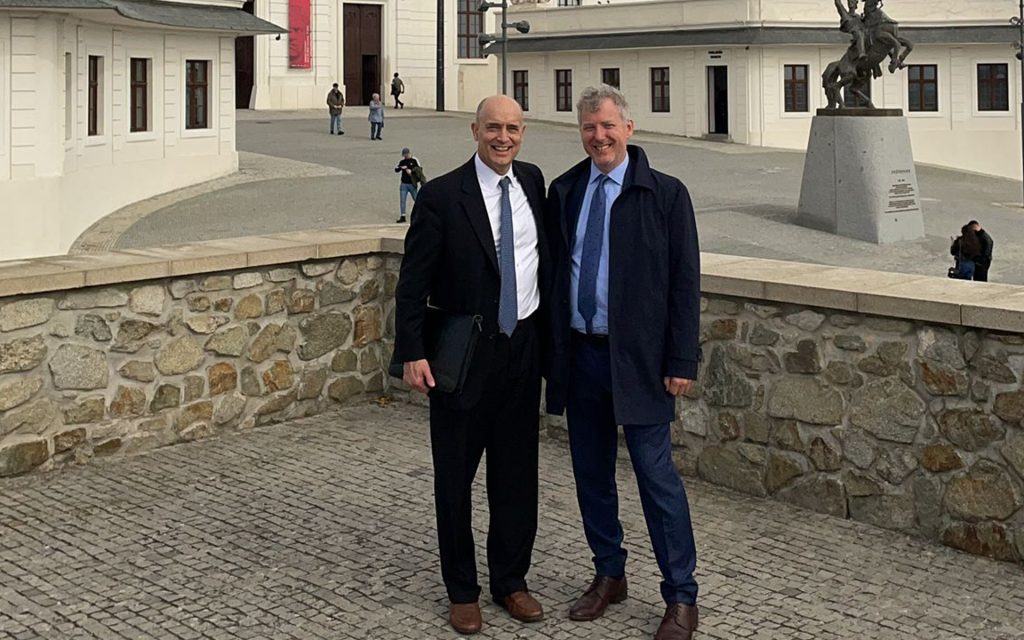
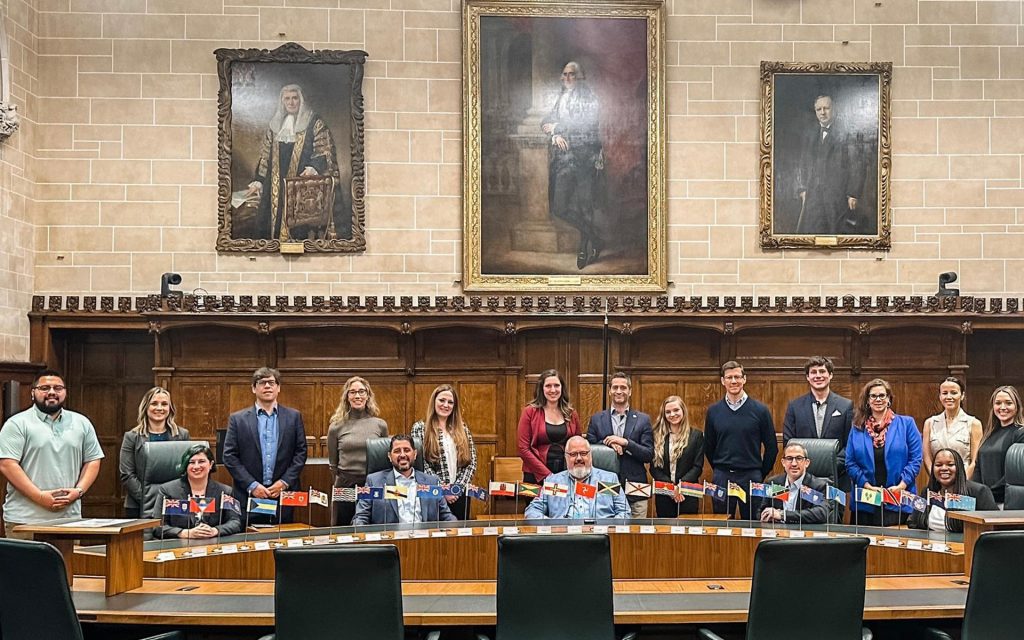
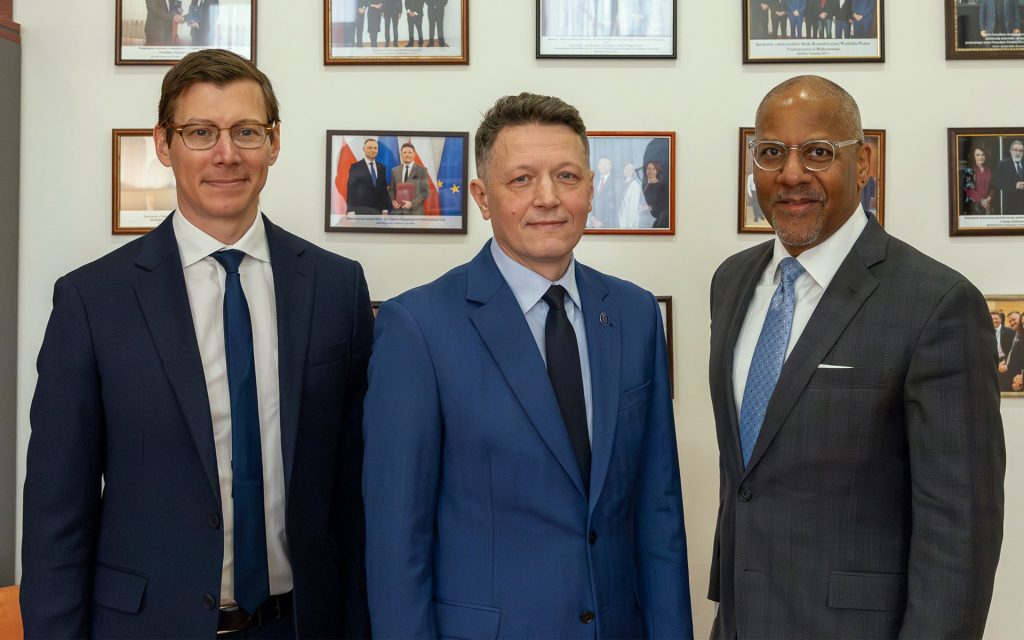
Andrew Horsfall L’10, Dean dr hab. Mariusz Popławski, Craig Boise during a visit to the University of Bialystok in 2024.
In March 2024, Dean Craig Boise and Horsfall made their first visit to the Faculty of Law at the University of Bialystok to meet with counterparts there in furtherance of an already well-established and robust partnership. Horsfall and Kraśnicka explored expanding the partnership into new areas, including short-term study abroad courses where students from both schools can visit the other to explore various subject matter and content of interest. They also discussed hosting exchange students at Syracuse for a semester using grant funding that Bialystok recently received through the EU’s Erasmus program. According to Horsfall, Syracuse will host its first exchange student from Bialystok in the fall of 2024 as part of this new feature of the partnership.
Office of International Programs Offers Pathways to Syracuse Law
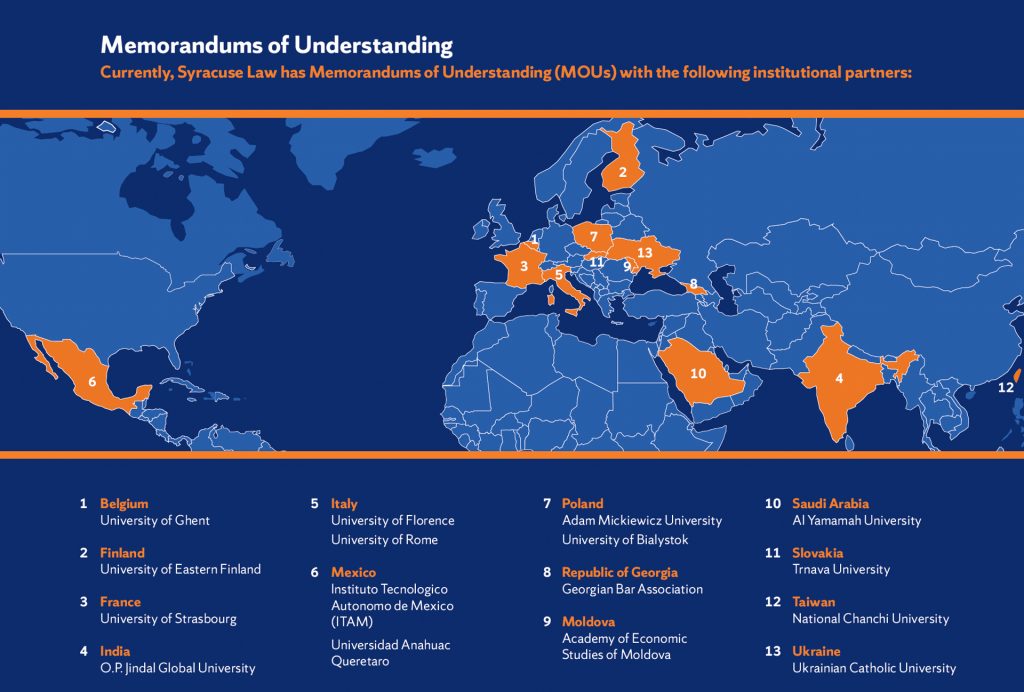
Horsfall believes the University of Bialystok is an outstanding example of the importance of establishing relationships with international law schools, bar associations, and other partners and institutions. He notes that Syracuse Law has a number of Memorandums of Understanding (MOUs) with schools throughout Europe, Asia and South America, all of which serve as a channel to bringing visiting scholars, exchange students, or those interested in the LL.M. program for foreign attorneys looking to be educated in the American legal system.
“The strong relationship we’ve developed with the University of Bialystok would not be possible without the hard work and dedication of Andrew Horsfall,” says Dean Boise. “Andrew has had the vision to see the opportunities that benefit our faculty and our students. Syracuse Law has been open to understanding the development of law both within Poland and throughout the E.U. Our partnership with Bialystok, and, in particular, Andrew’s counterpart, Izabela Kraśnicka, has facilitated that possibility, even as faculty and students there have learned from the American legal experience. Our connection with Bialystok will continue to grow and make a significant impact on both schools.”
As can be seen from just some of these examples, the expansion of Syracuse Law’s international footprint around the world has engaged faculty, students, staff, and even alumni in meaningful and exciting ways,” says Horsfall. “It continues to be a significantly worthwhile endeavor to bridge understanding across various legal cultures. I’m grateful to be working at an institution and alongside colleagues to share in these values.”
Syracuse, Bialystok Students Collaborate Through New Online Law Course
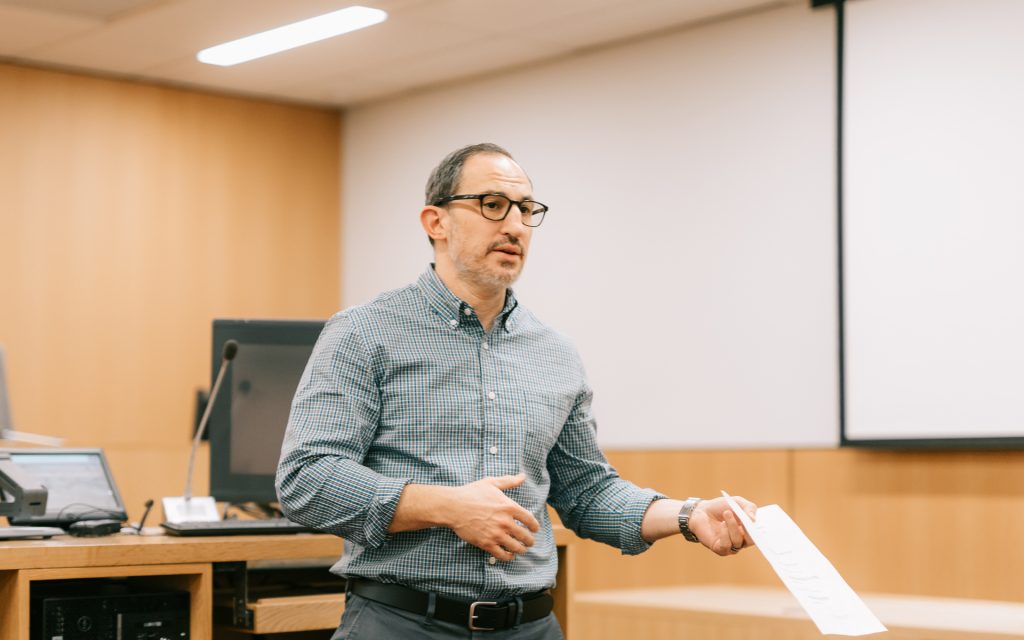
Todd Berger
This spring, Professor Todd Berger, director of advocacy programs, debuted an online collaborative course with the University of Bialystok focusing on transnational alternative dispute resolution. Ten Syracuse Law students, five residential and five JDi, along with another 10 from the University of Bialystok Faculty of Law took the one-credit class, which was taught together with Dr. Marta Kuklo, a faculty member at the University of Bialystok, who is an international expert in negotiations and mediation.
The course focused primarily on negotiations, mediation, and the universality of the skills sets used in both, as well as building a cross-cultural and transnational context specifically through the comparison of how the mediation process works in the U.S. versus Poland. Several guest lecturers on transnational negotiations were invited to the class, which was a very popular component. The class was taught in English, and all the students and instructors had to navigate the six-hour time difference. Students often worked in pairs (one from the U.S., one from Poland) on experiential exercises in negotiations and mediations throughout the course.
According to Berger, the class was very successful, and plans are in the works to expand it to a 2-credit course next year. “It was a great experience to teach with someone like Marta, who is so accomplished in her field, and I learned from her myself,” he says. “And, the exposure that both students got working with others from across the world built competencies that will most certainly help them succeed in the 21st century, as it continues to be more interconnected and diverse.”
James Baker is a professor of law at Syracuse Law and the director of the Syracuse University Institute for Security Policy and Law (SPL), as well as a professor of public administration at the Maxwell School of Citizenship and Public Affairs. He has an extensive resumé in international law and security that includes serving as an infantry officer in the U.S. Marines, as an aide to former Sen. Daniel Patrick Moynihan (D-NY), as legal advisor to the National Security Council, and as a chief judge of the U.S. Court of Appeals for the Armed Forces.
Since 2020, Baker has been working with groups in Ukraine on issues surrounding cybersecurity and artificial intelligence (AI), but, in fall 2021, his focus shifted to the pending Russian invasion of Ukraine and a series of presentations he collectively called “Everything I Would Want to Know if I Was About to Be Invaded by Russia.” The idea was to share observations from his career that might be helpful to Ukraine in the area of intelligence, intelligence oversight, crisis management, presidential command and control, the law of armed conflict, and war crimes. His presentations were widely attended by academics, lawyers, and officials in the Ukrainian government, including members of Ukrainian President Volodymyr Zelenskyy’s office.
When the opportunity to visit the University of Bialystok through an Erasmus+ grant (a European Union program to support education, training, youth and sport) came about, Andrew Horsfall, assistant dean of International Programs at Syracuse Law asked Baker if he was willing to travel to Poland at a time when that country was concerned about being next in line to be invaded by Russia. Baker didn’t hesitate, as he has a long-held interest in advising and working with the many frontline states that live in the shadow of Russia.
Baker (left) and Charles Szymanski.
When the University of Bialystok’s Professor Charles Szymanski heard that Baker was coming to visit, he sought him out. “Jamie impressed me, and we gravitated toward one another in our common interest in international law,” says Szymanski. “Jamie believed that the frontline states that had once been occupied by the Soviet Union were behind in their development of democratic and law-based security structures, particularly now that there was a war going on next door. He wanted to help.” “They don’t have national security law as a discipline in many of the frontline states, yet,” Baker explains, which was also noted on a trip to Tbilisi, Georgia, that Horsfall and he made at the invitation of the Georgian Bar Association. “So, we decided to teach and promote the components of national security law and process as a model that frontline countries can adapt to their own laws.”
Szymanski, who is American-born and married to a Polish attorney, has extensive contacts with universities throughout the frontline states. Those connections combined with Baker’s experience created an opportunity to help frontline states with an initiative called Ring Around Russia (RAR).
Ring Around Russia Brings Network of Frontline Scholars, UniversitiesTogether Based on Shared Legal Values
Ring Around Russia (RAR): The Partnership for Law and Policy is an interdisciplinary network of scholars and universities from the U.S., Ukraine, and the frontline states committed to a vision of national security based on shared legal values and a desire to rebut Russian aggression and support European and U.S. security. Both Syracuse Law and the University of Bialystok consider RAR a promising long-term project that has only been made more urgent by Russia’s war on Ukraine.
Szymanski has been a lead at the University of Bialystok for RAR, who has helped Baker to network throughout the region and gain support for the initiative. Baker has traveled to Ukraine, Slovakia, Romania, Moldova, Georgia, Finland, and Estonia to build a network of scholars and to meet with government and military officials. Baker and Szymanski have contributed expertise and information on topics including intelligenånational security process, and anti-corruption, always while helping to articulate why Ukraine matters to NATO’s security and U.S. security.
Szymanski also had the opportunity to travel to Syracuse last summer as part of the Erasmus+ grant, where he met with Baker and other colleagues at Syracuse Law and across the University. Recently, Szymanski also joined the faculty of Syracuse Law teaching online in the JDinteractive program (JDi) from Poland.
“We’ve accomplished a lot by sharing expertise and information, or so we hope. However, the most important thing we may have done is show up. At one leading university in a frontline NATO state, my host exclaimed upon my arrival, ‘You are the first American professor we have seen in 10 years!’” says Baker. “That is the national security reason Andrew’s work and projects like this are important. They help to build the academic and cultural bonds premised on shared values that hold alliances together.”
SPL is in the process of applying for relevant grants to fund these efforts going forward.
The Institute for Security Policy and Law’s Scholarship with Ukraine Furthers Syracuse Law Status
Baker’s contributions have only heightened the reputation of Syracuse Law and Syracuse University in the frontline states, as he draws on 20 years in academia and his career in the military, government, and policy globally.
A few of his significant contributions from just the past two years include:
Attending the International Academic Forum in Kyiv in April 2024, along with SPL Fellow RJ Naperkowski L’23, which was hosted by the Ukrainian Ministry of Defense and the NGO GlobSec on Military Innovations in Contemporary Warfare. Baker and Naperkowski were the only two Americans in attendance and presented a paper, “Mobilizations and Recruitment in Ukraine: Challenges and ChallenSolutions.” This was one of four recent trips for Baker to Ukraine—two others took place in 2023—where he conducted over 100 meetings with ministers, NGOs and collaborating university counterparts on RAR while representing Syracuse Law.
Providing a policy report on caring for Ukrainian veterans to the Ukrainian Ministry of Veterans Affairs and the U.S. Embassy in Ukraine in August 2023.
Drafting a report, which included a chapter by Assistant Professor Lenny Grant of Syracuse’s College of Arts and Sciences and Naperkowski on treating veterans with PTSD, which was hand delivered to Ukrainian President Volodymyr Zelenskyy last fall.
Teaching a seminar, Road to Recovery, in fall 2023, as one of seven international experts—including those from Stanford University, Harvard University, and the University of Notre Dame—at Ukrainian Catholic University.
Making over 20 other international presentations in the frontline states and at international symposia on the importance of Ukraine to the rule of law to NATO and U.S. national security, including at King’s College London and the University of Helsinki.
Chatura Patil LL.M.’24 grew up in India, where her mother and brother are doctors, and her father is a successful businessman. Her parents expected her to be a doctor, too, but she chose another route: the law. That decision put her on an interesting career path that eventually brought her halfway around the world to Syracuse Law’s LL.M. program, opening up a new world of opportunities for her.
After earning a bachelor’s degree in finance in India, Patil moved to New York City to work as an intern. In 2014, she returned to India to earn an LL.B. from Bharati Vidyapeeth University and then an LL.M. in corporate and financial law from O.P. Jinal Global Law University, a partner school of Syracuse Law. After that, her legal career began to take off, working at several law firms as an intellectual property associate, a senior legal associate, and later in contract management and compliance.
While working for Udemy, a leader in online learning, as international commercial counsel for the E.U. and Middle East region and then for North America and Canada, she came to appreciate the utility of possessing a license to practice law in the U.S. as a way to advance her career. She then decided it was time to pursue another LL.M., and she began down the path that led her to Syracuse Law.
If she was going to pursue an LL.M. in the U.S., she knew she wanted to study in New York State. Patil had always lived in big cities, so she was eager for a slower-paced, mid-size city like Syracuse.
“Syracuse Law checked off all the boxes, and I was drawn by the engagement with the faculty and the many pro bono programs and extracurricular activities I could participate in to expand my knowledge of the law. There are so many resources here. Every time I’d hear of an opportunity, I’d put it on my checklist. I decided I would check off everything on that list before I graduated.”
Chatura Patil LL.M.’24
“Syracuse Law checked off all the boxes, and I was drawn by the engagement with the faculty and the many pro bono programs and extracurricular activities I could participate in to expand my knowledge of the law,” she explains. “There are so many resources here. Every time I’d hear of an opportunity, I’d put it on my checklist. I decided I would check off everything on that list before I graduated.”
She’s done an outstanding job at accomplishing that goal. Patil has been involved in several student organizations, including the Women’s Law Student Association, of which she was the class representative this past year. She was also elected by her peers to serve as the Class of 2024 LL.M. representative to the Student Bar Association.
“American law has a very different structure from Indian law. India is a conservative and developing society, where women tend to steer towards corporate law, not litigation. When I see the legal landscape in America, especially through my work at the Volunteer Lawyers Project, I see that you don’t have to worry about your gender. There’s that difference where men and women are following the same dream in their profession.”
Chatura Patil LL.M.’24
“American law has a very different structure from Indian law. India is a conservative and developing society, where women tend to steer towards corporate law, not litigation,” she explains. “When I see the legal landscape in America, especially through my work at the Volunteer Lawyers Project, I see that you don’t have to worry about your gender. There’s that difference where men and women are following the same dream in their profession.”
She also worked as a justice fellow at the Volunteer Lawyers Project of CNY, Inc., a fellowship she started last January, and worked on immigration law matters pro bono.
Patil is grateful to a number of faculty and staff for helping her succeed in the LL.M. program. Her biggest supporter has been the Assistant Dean of International Programs, Andrew Horsfall, who “has been a mentor to me since Day 1,” she says. “He has answered my questions, let me share good news and bad, helped me choose the right classes, and just been there for me. Without Andrew, there is no LL.M. program.”
She was also struck by how accessible the professors are to students, citing Professors Paula Johnson, director of the Cold Case Justice Initiative, and Rakesh Anand, as two who have been particularly impactful to her while she was in the LL.M. program.
“Professor Johnson is just an amazing soul. She is a really busy person, but she’s very down to earth,” Patil says. “I told her how criminal law was a new subject for me and how hard it was to keep up. She gave me a one-hour recap that would have taken me two months to learn on my own,” Patil says. “And, Professor Anand is amazing. I haven’t even had him for a class, but you don’t have to be in his class for him to remember you. He is willing to talk to you and give you good career advice. I really respect him and appreciate getting feedback from him.”
Now that she has just graduated from the LL.M. program, Patil is preparing to take the New York State Bar Exam. Starting in August, Patil will be clerking for the Hon. Robert Bingham II, of the Mercer County (N.J.) criminal court. Ultimately, she would like to practice in the U.S., but she is open to wherever all of this takes her. Navigating the LL.M. program in a new country was a challenge for Patil, but one she has met quite successfully. She is glad she took a chance on herself and came to Syracuse Law to further her education.
“If I do something, I want to be the best at it. Indian parents are always pushing their children to do more. You grow up with that mindset, and you don’t see anything wrong with that,” she says of where she got the strength to pursue her dreams. “I am my parents’ daughter; nothing in life is too big to achieve.”
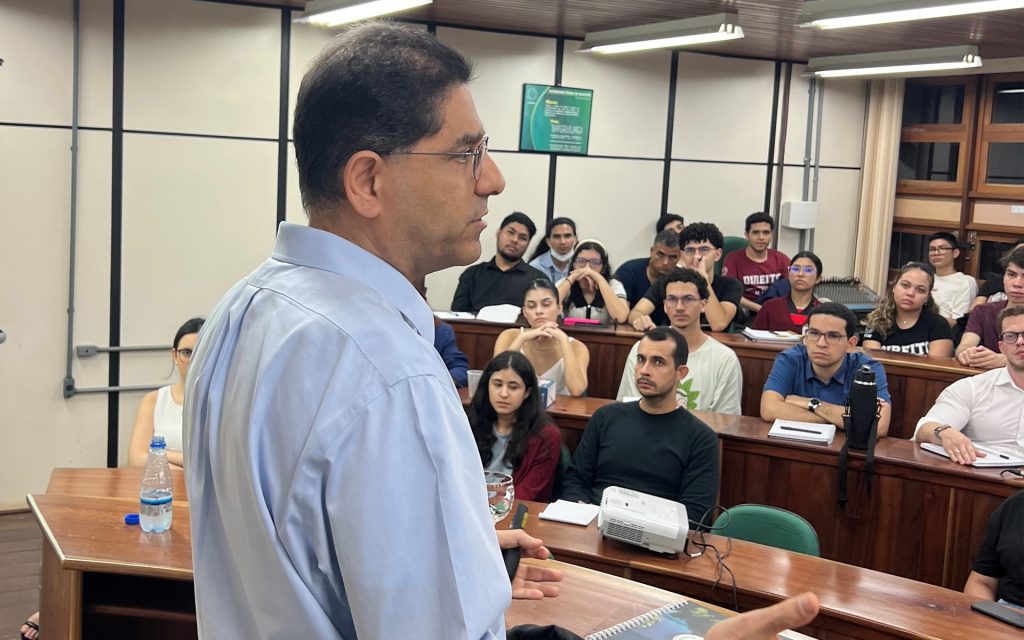
Professor Antonio Gidi is a scholar in civil procedure and class actions, teaching a heavy course load each fall at Syracuse Law and traveling internationally during the spring and summer semesters to present papers and teach at several universities and institutions. His work has created a major pipeline for students from his native Brazil, as Syracuse Law’s LL.M. Program consists of approximately one-third of Brazilian students annually.
Gidi has extensive academic credentials as a visiting professor of law in Brazil, as well as Mexico, Italy and France. His contacts in Brazil, in particular, have allowed him access to private and public lawyers, as well as state and federal prosecutors and judges, while also giving lectures and teaching about the law to organizations within the government.
According to Gidi, Syracuse University offers the perfect academic destination for Brazilian legal professionals, and they flourish. Over the past decade, Syracuse Law has hosted dozens of judges, prosecutors, and lawyers. Most of them are prestigious mid-career professionals, some of whom already hold advanced degrees. Through their exposure to American law, they enrich their own careers, and, at the same time, contribute to the American students’ exposure to international influences. “It’s a win-win proposition,” he says.
Gidi has also recruited a number of students from Mexico, mostly graduates of the Instituo Tecnologico Autonomo de Mexico (ITAM), which tend to be a younger cohort, many of whom are recent graduates just starting out in their law careers. “They, too, benefit from the LL.M. program, as they learn more about the U.S. legal system and culture, while sharing elements of their own country’s laws with others at Syracuse Law,” he says. “Gidi is a wonderful partner for our recruitment efforts,” says Andrew Horsfall, assistant dean of International Programs. “He has been generous with his time and efforts to use his connections towards building partnerships in other countries, particularly Brazil, and he is quite successful at it. This is such a great benefit to a diverse experience for the students and faculty at Syracuse Law.”
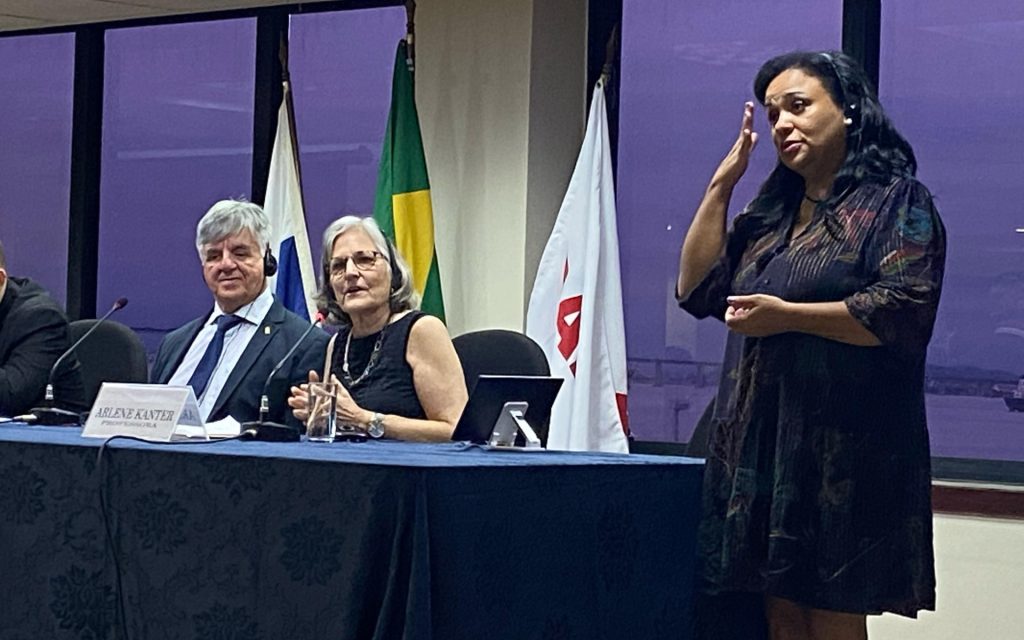
Other members of Syracuse Law faculty have had the opportunity to visit Brazil, as well. In February, Professor Arlene Kanter, founding director of the Disability Law and Policy Program (DLPP) and faculty director of international programs, was invited to spend two weeks in Brazil meeting with judges, lawyers, and students, and lecturing about disability rights, particularly about the United Nations Convention on the Rights of Persons With Disabilities (CRPD), which she helped to draft. An internationally acclaimed expert in international law, human rights, and comparative disability law, Kanter also met with government officials, Human Rights Watch, and 10 other disability organizations to discuss their ongoing efforts to achieve greater equality and inclusion for people with disabilities in Brazil, particularly in the area of education and for those at risk for institutionalization.
“I’m interested in how other countries have implemented the CRPD, which, by the way, is a treaty that the U.S. has not yet ratified,” she explains. “The disability laws are very different in many countries where I have worked, but the issues are the same—horrific conditions in institutions for people labeled mentally ill or developmentally disabled, unchecked violence against women with disabilities in institutions and in the community, denial of equal educational opportunities for children with disabilities who are sent to segregated and inferior schools, and lack of involvement by people with disabilities, themselves, in the development and implementation of the laws, policies, and practices that impact their lives. I’ve found that governments want to do right by people with disabilities, but, in many places, they just don’t know how. Brazil, for example, has enacted many excellent laws, but the hard part is implementing them. They have made great progress there, but they still have a long way to go.”
Kanter established the DLPP at Syracuse in 2007, which has recruited students with and without disabilities from all over the world to pursue careers in disability law. Her message has influenced lawyers, judges, government officials, and students in Brazil—and around the world—who come to Syracuse and study disability law through the LL.M. program. Many of those students have gone back to their respective countries to assume high level government jobs, to teach disability law, or to establish new organizations to promote disability rights.
Kanter acknowledges that despite excellent laws, much more needs to be done in the U.S. to ensure inclusion for people with disabilities in all aspects of life. “Learning from other countries is one way we can improve our own laws and practices,” she says.
After a 37-year career at Syracuse Law, Kanter retired at the end of the Spring 2024 semester. Year. But, given the ongoing requests for her assistance, she expects to continue to advocate for disability rights in the U.S. and elsewhere. In June, she traveled to Berlin at the request of the U.S. Department of State to provide training on international disability law to government offices there.
Congratulations to Syracuse Law’s LondonEx Program as it celebrates 45 years of sending students abroad during the summer break to gain exposure to the British legal system and take in the culture of London.
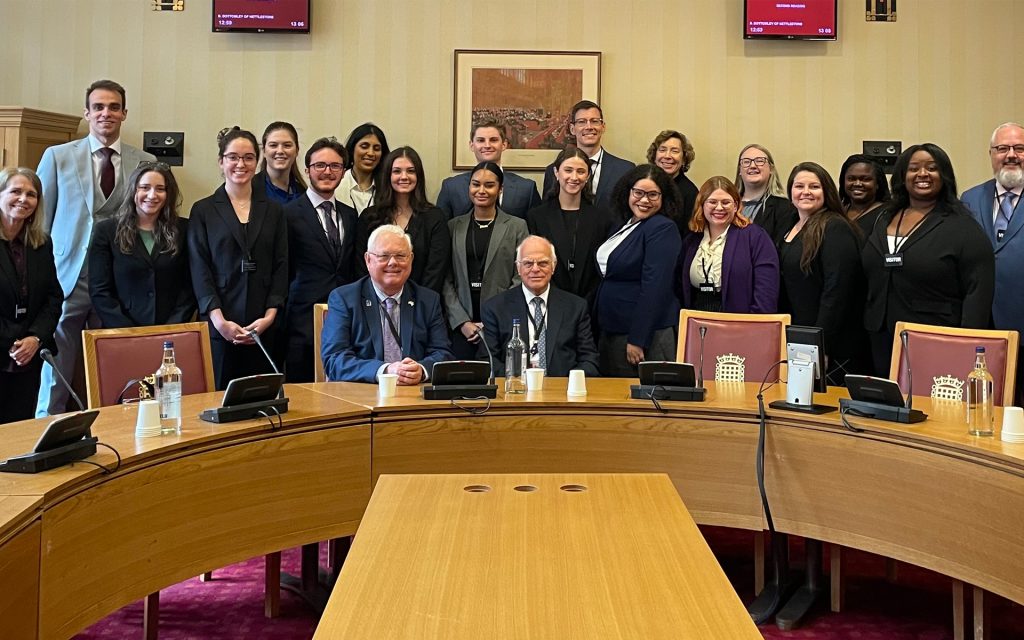
Working with the Syracuse University London Centre, Faraday House, students from the College of Law and other ABA-accredited law schools take in an immersive experience that offers the practice of law in a global setting. The first week of the program is spent in an orientation where students gain insight into the legal system of the United Kingdom from guest lecturers, as well as tours through various “legal London” sites such as the Inns of Court, the Old Bailey, and British Parliament, as they start to understand the law beyond the U.S. system.
Students then begin six weeks of work in a professional legal setting alongside civil and criminal barristers, solicitors, and judges in the Crown Court system, human rights and international law NGOs, and others. The cohort comes together throughout the summer over evening lectures, networking events, and programming designed by the program’s co-directors, Assistant Dean Horsfall and Professor Margaret Harding.
The program typically enrolls 15-20 students each summer who have completed their 1L year. This year, Horsfall has been working in London to recruit more sites to host future LondonEx students.
“It was a fantastic opportunity to see how the English system is a bit different from the U.S. During the first week of the program, we took tours to see different places where the barristers practice. We went to Parliament and were able to speak to some of the Members and Lords, and we had the unique experience of seeing a bill passed into law.”
Alex Stolfe ’23, L’25
Alex Stolfe ’23, L’25 studied abroad in Florence, Italy, as an undergraduate, but once she joined Syracuse Law, she thought her days of international study and travel were a closed chapter. Then, she heard about the LondonEx program and was eager to spend time abroad once again, while pursuing the opportunity for an externship to gain experience unlike those of her classmates who remained in the U.S. after their 1L year.
“It was a fantastic opportunity to see how the English system is a bit different from the U.S.,” says Stolfe, who spent the summer of 2023 in London. “During the first week of the program, we took tours to see different places where the barristers practice. We went to Parliament and were able to speak to some of the Members and Lords, and we had the unique experience of seeing a bill passed into law.” Stolfe is Canadian, which made it an even more fascinating experience with yet another legal system to compare.
She spent the next six weeks at an externship at Withers Worldwide, a global litigation firm with expertise in a range of practice areas and legal services for private individual and business clients, art museums, high fashion and luxury brands. There, she was assigned to one of the firm’s partners in the litigation and dispute resolution practice area.
“The biggest difference for me is that the British system doesn’t seem as adversarial,” she says. “It’s very cordial with the barristers wearing their traditional beautiful wigs and robes. They addressed each other with phrases like, ‘My learned friend,’ when speaking to opposing counsel.”
“And, beyond the work and class experience, we made sure we got to see all of the city, including plays in the West End, group dinners, and meeting other mentors in the program, as well as alumni networking events with Syracuse graduates living and working in London.
Alex Stolfe ’23, L’25
Stolfe also had the opportunity to get to know other students spending the summer in London. “The University sets up everything for you,” she says. “And, beyond the work and class experience, we made sure we got to see all of the city, including plays in the West End, group dinners, and meeting other mentors in the program, as well as alumni networking events with Syracuse graduates living and working in London. We definitely became fast friends.”
Stolfe is very pleased that she spent time in London learning about the law in the U.K. “I’ve always been an advocate for exposing yourself to other cultures, and I’m very grateful for the LondonEx program,” she says. “It helps to create more well-rounded lawyers and better global citizens.”
Assistant Dean of International Programs at the College of Law Andrew Horsfall ’05, L’10 has a career that has put him all over the map. Most recently his travels have taken him to London, Poland, and Switzerland, but the stamps in his passport are too numerous to count.
Horsfall’s journey with Syracuse University began as an undergraduate at the Maxwell School of Citizenship and Public Affairs, where he earned a bachelor’s degree in political science and government with a minor in French and Francophone studies. After graduating, he went to work as an admissions counselor for Syracuse Abroad, helping undergraduates spend a semester in another country, while also supporting Syracuse Law’s summer externship program in London (now referred to as LondonEx). In hindsight, he sees that this first foray helped him understand how international higher education could become a profession he might enjoy.
Andrew Horsfall with JDi students in London during the Comparative Trial Advocacy course in 2023.
But first, he decided to become a lawyer, earning his J.D. from Syracuse Law in 2010 and becoming a practicing attorney with Smith, Sovik, Kendrick & Sugnet P.C., in Syracuse. After a few years, however, another opportunity surfaced. “At the time, I wasn’t sure I would transition out of private practice altogether, but Syracuse Law had very recently launched its LL.M. program and was looking for someone to develop it who had familiarity with international higher education, legal education, and legal practice,” says Horsfall. “My experience brought together all of these, and I found myself in the right place at the right time.”
“The great diversity of students the program has attracted has led to a more vibrant and rich program for Syracuse Law. Faculty and students regularly interact with LL.M. students who are academics, judges, and lawyers of varied expertise.”
Twelve years later, he has led the development of a robust portfolio of international programs that have allowed foreign-educated lawyers, academics, and judges to earn an LL.M. or Doctor of Juridical Science (S.J.D.); expanded the LondonEx program and short-term study abroad opportunities in several other countries; built strong partnerships with dozens of foreign governments, sponsoring organizations, NGOs, private organizations and global universities to support enrollment in the Syracuse LL.M. program; and fostered academic partnerships, created recruitment strategies for prospective student exchanges and managed programs that welcome visiting scholars and semester exchange students. In turn, these international relationships have also allowed Syracuse Law faculty and students to benefit from many of these programs and experiences, as well as represent the College at recruitment events, conferences and speaking engagements around the globe.
Syracuse University College of Law LL.M. Class of 2024
The LL.M. program in 2012 started with just two students from South Korea and Sierra Leone but has since built itself into a program that welcomes 30-40 students each year from disparate corners of the globe.
“The great diversity of students the program has attracted has led to a more vibrant and rich program for Syracuse Law,” Horsfall explains. “Faculty and students regularly interact with LL.M. students who are academics, judges, and lawyers of varied expertise.”
The LL.M. class at orientation in August of 2023.
Horsfall has worked diligently to build pathways for students from various countries and cultivate routes to Syracuse Law on a regular basis through in-country visits by him and others at the College of Law. “The cultivation of relationships and development of new partnerships takes consistent effort that is well worth it. It can take months, if not years, to see ideas for collaboration culminate in a new project or the mobility of students or faculty, but the rewards are invaluable to everyone involved,” he says. “Facilitating the exchange of ideas, the exposure to otherness, and the widening of perspectives and opportunities to learn from one another are my core drivers.”
Currently, Syracuse Law has a number of Memorandums of Understanding (MOU) with foreign law schools (see sidebar). Horsfall’s intention is that these MOUs don’t only bring students to Syracuse Law but also create valuable partnerships that foster the exchange of researchers and professors as visiting scholars to collaborate on projects, lecture to students and faculty, and explore new ways of working together. He says support among faculty, which is high at Syracuse Law, through their own relationships and referrals from abroad are also key to success. See Syracuse Law’s thriving partnership with Poland’s University of Bialystok.
Andrew Horsfall, University of Bialystok Dean dr hab. Mariusz Popławski and Craig Boise pose for a photo during a visit to the University of Bialystok in spring 2024.
While Horsfall oversees these international initiatives, he is quick to praise faculty colleagues and staff in the Office of International Programs. “Most of these accomplishments would not have been possible without the team effort among various faculty and staff who understand and support the mission of the Office,” he says.
However, most at the law school give Horsfall a tremendous amount of credit for growing the program to its current popularity, as well as continually looking for other opportunities to make Syracuse Law’s international connections even more robust.
“I don’t think you can talk about the success of our international programs without talking about Andrew’s contributions,” says Shannon Gardner, teaching professor and associate dean of online education. “He has been a part of this growing initiative to bring foreign students and professors here, while also finding ways to send others to various countries, which is beneficial in every way. Part of our success at Syracuse Law is the richness and diversity that these programs bring to our school and our students, which makes for an extraordinary law school experience.”
Professor Emeritus William C. Banks spoke with Independent on the SCOTUS ruling that narrowed the definition of obstruction in January 6 riot cases.
“The decision will not have tremendous significance in the January 6 cases, including that of former president Trump, because in almost all cases there are other charges that have a felony status alongside the obstruction charge,” says Banks.
He continued “The basic question before the court was the meaning of a straightforward statute banning obstruction of an official proceeding. Sixteen of 17 federal judges had construed the statute to reach the kind of obstruction at issue in most of the January 6 cases. Today, the Supreme Court majority read the statute differently and said that the obstruction statute applied only to documents. Their reading of the statute is contrary to plain meaning of the law.”
Media wishing to interview Professor Germain on this or related topics should email Rob Conrad, director of communications and media relations or Syracuse University’s media team by email.
The Supreme Court ruled today, as I predicted in my commentary on Law 360, that non-debtor third parties cannot obtain non-consensual discharges or releases as part of a plan of reorganization in another debtor’s bankruptcy case. Harrington v. Purdue Pharma, Slip Op (June 27, 2024).
Purdue’s bankruptcy plan sought to release the non-debtor Sackler family from $40 trillion (yes trillion) in tort claims by Purdue Pharma’s creditors. The Sackler family owned and ran Purdue, which manufactured and falsely marketed OxyContin as a safe and non-addictive pain killer. OxyContin was the main culprit in the opioid epidemic in the United States, which has killed more than 247,000 people from overdose and has ruined millions of lives.
In return for the release of claims against them, the Sackler family agreed to repay Purdue $5.5 billion over 10 years, plus $500 million in contingent payments – a fraction of the $11 billion that the Sackler family caused Purdue to distribute to them in dividends between 2008 and 2016. The bankruptcy court found that the Sacklers hid those dividends in offshore trusts, self-settled spendthrift trusts, and other asset protection schemes to make it difficult or impossible for their creditors to collect from them.
A high percentage of the creditors who voted on Purdue’s plan of reorganization accepted it (between 88% and 95% of each class), but fewer than 20% of claimants voted at all. The bankruptcy confirmation process only counts those creditors who vote, so non-voters are ignored in the confirmation process.
The Court of Appeals for the Second Circuit upheld Purdue’s plan and non-debtor release, relying on prior Second Circuit authority recognizing the bankruptcy court’s inherent equitable power to discharge third party claims in extraordinary cases. Three other circuit courts, the Fifth, Ninth, and Tenth had previously held that bankruptcy courts do not have the power to discharge third party claims.
The statutory debate was framed by two provisions of the Bankruptcy Code: Section 524(e), providing that a bankruptcy discharge “does not affect the liability of any other entity on, or the property of any other entity for, such debt”, and Section 1123(b)(6), which allows a plan of reorganization to “include any other appropriate provision not inconsistent with the applicable provisions of this title.”
While I correctly predicted the result, I did not correctly predict the split among the judges. Gorsuch, Thomas, Alito, Barrett and Jackson made up the majority, barring third party releases as part of the plan without creditor consent. Gorsuch’s opinion recognizes that the Bankruptcy Court has the power to discharge claims only against the debtor who files bankruptcy and submits their property to the jurisdiction of the court. Third party releases can be granted only with the creditors’ consent.
In a surprise to me, four judges (Roberts, Sotomayor and Kagan, led by Kavanaugh) dissented. They thought the vague catchall in Section 1123(b)(6) should give the bankruptcy court the power to confirm a non-debtor release without the consent or participation of the parties whose claims were being released, even if the releases were broader than the third parties could have received if they themselves had filed bankruptcy.
So what happens to Purdue, the Sacklers, and their creditors now, and more importantly, what happens with all of those bankruptcy plans that have previously been confirmed that contain now-illegal provisions releasing claims against third parties?
What Happens Next for the Sacklers?
Assuming that Congress and the President do not step in to pass a law for the Sacklers’ benefit (a scenario that strikes me as nearly impossible), the Sacklers have two options.
The Doomsday Litigation Scenario
The first possibility is doomsday litigation, where the government and private creditors pursue their claims against the Sacklers and try to reach their assets. These cases would be very expensive to litigate for both sides, and the outcome would be uncertain for both sides. In the Sacklers favor, the government failed to address the addiction problems with OxyContin for 20 years, allowing the drug to be sold by prescription to an unwitting public. The Sacklers have statute of limitations defenses to the many claims, and they have engaged in extensive asset protection planning to shield their money from the claims of creditors in self-settled and foreign trusts that will make recovery for successful plaintiffs difficult.
The creditors are in three basic groups:
Claims by the Corporate Debtor, Purdue Pharma.
Many claims that could be asserted by creditors of Purdue outside of bankruptcy now belong to the corporate debtor and cannot be brought by creditors, including fraudulent conveyance and other claims against the Sacklers for causing harming Purdue.
While Purdue has strong substantive fraudulent conveyance claims against the Sacklers for the $11 billion that the Sacklers pulled out of Purdue with knowledge that creditors were likely to come after them, these claims are subject to strict statutes of limitation – transfers within two years before bankruptcy under Section 548 claims, and maybe 6 years from the transfer under state law, although delay in discovery of the claims may extend the timing.
And then there is the difficulty of collecting from the Sacklers, who have transferred their money in to spendthrift trusts and other asset protection schemes in the US and abroad. There is a special 10 year statute of limitations for transfers to self-settled trusts in Section 548(e)(1) of the Bankruptcy Code, but that 10 year period runs from the filing of personal bankruptcy petitions by the Sacklers, not from Purdue’s filing, and the only way to force the Sacklers into bankruptcy would be by filing involuntary bankruptcy petitions. An involuntary petition would require three creditors holding liquidated undisputed claims (11 U.S.C.§ 303(b)), and to avoid dismissal the petitioning creditors would have to show that the Sacklers were “generally not paying their debts when due.” 11 U.S.C. § 303(h). Presumably, an involuntary could not be filed by the creditors until they obtained judgments, and the delay in obtaining judgments would reduce the amounts recoverable through the running of the 10-year lookback period. Collection by Purdue will be difficult.
Governmental Consumer Protection Claims.
The biggest claims are held by the state attorneys general, who have billions or trillions of dollars in claims against the Sacklers under their states’ consumer protection statutes. These claims pose the most serious threats to the Sacklers. The government entities could also potentially bring criminal and civil forfeiture claims against the Sacklers in a doomsday litigation scenario. These claims would be very expensive for the Sacklers to defend and for the states to prove, and would seriously threaten the Sacklers’ peace and security. They are also subject to many defenses including statutes of limitations and collection problems will also exist, although the potential for prison sentences can often be used to obtain repatriation of funds controlled by the Sacklers.
Individual Claims by OxyContin Users and Their Families.
The individual and family victims’s personal injury and fraud claims, are (as Justice Sotomayor pointed out at the hearing) primarily claims against Purdue, which manufactured and sold the pills. While these claims are the most sympathetic, they are also the most difficult claims for the individual creditors to fund and win against the Sacklers. To hold the Sacklers liable as shareholders of Purdue, the creditors will have to pierce the corporate veil, which under the laws of most states requires a two prong showing: (a) the “alter ego” prong that Purdue did not honor its separate corporate existence, usually by commingling property and failing to follow proper corporate formalities, and (b) thereby committing “fraud and injustice” on the creditors. The piercing requirement will pose a significant barrier to success for the individual creditors.
Some of the Sacklers may have committed direct torts by approving or participating in Purdue’s fraudulent representations, but these will not be easy claims to prove. All of the claims are also subject to statute of limitations defenses.
Finally, even after recovering judgments against the Sacklers on the merits, the creditors would need to break through the asset protection trusts adopted by the Sacklers. Funds in offshore asset protection trusts cannot be recovered directly because the foreign governments generally will not comply with orders from our courts. If the trust beneficiaries are physically located in the US, the courts could order them to repatriate their trust funds, hold them in contempt if they do not comply, and put them in jail until they do comply, but only the Sacklers can be shown to have the power to comply with the courts’ orders. Well drafted offshore protection trusts generally purport to limit the beneficiaries’ control over the funds, so the courts would have to determine whether the beneficiaries have the ability to comply with the orders before holding the beneficiaries in contempt. Furthermore, the courts may not have jurisdiction over beneficiaries living outside of the US.
While collecting from the foreign and spendthrift trusts would be difficult, the creditors (especially the governments) would make litigation expensive and miserable for the Sacklers for many years, and could prevent the Sacklers from accessing their money. The Sacklers were formerly honored members of their communities and would suffer continuing public condemnation and humiliation if the cases are not settled. If the government creditors are successful, the Sacklers could lose their assets and maybe their freedom.
An understanding of the legal realities for both sides explains why the Sacklers were willing to pay $5.5 billion for peace, and why the active creditors were willing to accept that amount. There remains a huge incentive for the parties to reach an agreement to avoid the doomsday scenario of scorched-earth litigation.
The Revised Plan of Reorganization Scenario
The second option is for the parties to return to the bargaining table to negotiate a settlement similar to the one they previously reached, but without attempting to release or discharge the claims of non-consenting creditors.
The Supreme Court made it clear that parties can consensually release third party claims as part of a bankruptcy plan settlement. Presumably, the parties who vote in favor of the plan will be bound to its terms, including any release, by consent.
That leaves three groups: (1) the few active creditors who explicitly voted against the plan, (2) the large number of creditors (80%) who did not and are likely not to vote at all, and (3) unknown future creditors.
The plan will not be able to release or discharge the claims of creditors against the Sacklers who vote “no” on the plan. But they are few in number. Similarly, unknown creditors cannot consent. There is a question of whether a guardian could be appointed for unknown creditors who could consent to the plan. This may be an important consideration in mass tort cases involving large numbers of unknown creditors, but Purdue probably has a good idea who the creditors are since they purchased prescription drugs.
That leaves the large number of creditors who did not vote. Does Purdue need the affirmative “opt-in” vote to bind creditors, or can they bind creditors who have the right to but do not “opt out.”
The US Trustee argued that creditors must specifically “opt in” to the release by voting for the plan or signing a consent. But I see no reason for that to be true. Class actions regularly bind creditors who do not “opt out,” and I see no reason that the class action model could not be utilized in a bankruptcy case. If the plan required creditors to “opt out,” the large number of creditors (maybe 80%) who do not participate would be bound by the release. That would leave the Sacklers to defend only a small number of committed angry creditors who will likely lack the resources to win their cases and reach the Sacklers’ assets.
The Sacklers’ plan payments could be reduced pro tanto for creditors who are not bound by the plan, leaving those small non-consenting creditors free to bring their claims in state court and try to run the Sacklers’ gauntlet of defenses: statute of limitations, piercing the veil, proving the merits, and collecting from the trusts. Without the support of the sophisticated government creditors, the small creditors do not stand much of a chance against the well-funded Sacklers.
What Happens to Other Plans That Were Previously Confirmed?
Bankruptcy courts have been confirming plans with non-debtor releases for the past 20 years. We now know, after the Supreme Court’s decision in Purdue, that these plans’ provisions for non-debtor releases were unlawful. Does that mean that the creditors who did not explicitly consent to the plan can now sue the third parties who were wrongly released in the plan?
The Court explicitly ducked that question in the majority opinion in Purdue: “Additionally, because this case involves only a stayed reorganization plan, we do not address whether our reading of the bankruptcy code would justify unwinding reorganization plans that have already become effective and been substantially consummated.”
But the Court has previously addressed a similar issue. Just because a confirmed plan contains unlawful provisions does not mean that those unlawful provisions are not binding and enforceable. Indeed, the general rule is that you must appeal an unlawful order or judgment against you, or you are bound by it. The Supreme Court in a unanimous opinion in United Student Aid Funds, Inc. v. Espinosa, 559 U.S. 260 (2010), held that a confirmed and final Chapter 13 bankruptcy plan, which purported to discharge a federal student loan that was explicitly non-dischargeable under the Bankruptcy Code, was nevertheless enforceable against the creditor who did not appeal from the confirmation order. The longstanding rule prevents parties from “collaterally-attacking” an order of a court, by challenging the order in a different court, rather than directly appealing the order.
The Court in Espinosa recognized exceptions to the rule of finality if the court lacked jurisdiction to issue the order, or the party seeking to collaterally attack the order did not receive notice and due process. But absent the court’s lack of jurisdiction to issue the order, or a due process violation, the order is binding unless appealed, and cannot be collaterally attacked, even if the order was wrong.
Thus, confirmation orders in other cases providing for an illegal release or discharge of third party claims are going to be very difficult to collaterally attack by parties who received notice of, and had the ability to participate in and appeal, the case. They will likely have to show that the discharge was “jurisdictional,” and not simply a legal error. Espinosa suggests that granting discharges or releases, which the court has the power to do under certain circumstances (with consent in Purdue or by making a finding of “undue hardship” in Espinosa, is not jurisdictional, and does not render the order subject to collateral attack.
Does Espinosa sanction bad faith conduct by litigants, or by judges seeking to confirm plans, even though they contain known unlawful provisions? Justice Thomas’s opinion in Espinosa recognized the potential for abuse: “We acknowledge the potential for bad-faith litigation tactics. . . . But . . . [a]s we stated inTaylor v Freeland & Kronz, 503 U. S. 638 (1992), ‘[d]ebtors and their attorneys face penalties under various provisions for engaging in improper conduct in bankruptcy proceedings.’ The specter of such penalties should deter bad-faith attempts to discharge student loan debt without the undue hardship finding Congress required. And to the extent existing sanctions prove inadequate to this task, Congress may enact additional provisions to address the difficulties United predicts will follow our decision.”
Therefore, I believe that creditors in other cases, who received proper notice and could have objected to and appealed the conformation order, will be bound by the bankruptcy court’s confirmation order discharging third party claims even though that order was unlawful. These creditors will not be allowed to collaterally attack the confirmation order.
On the other hand, creditors who did not receive notice of the case (and were not at least virtually represented by a guardian ad litem or by some similar method), should be free to pursue their claims since they could not be bound by the order or judgment because they did not receive due process. Because of the limitation on collateral attacks, the decision in Perdue is unlikely to ignite a firestorm of litigation against parties who settled prior cases.