In this profile, Higginson discusses her unique career path and how the flexibility of JDi is enabling her to achieve her dream of being a lawyer.

In this profile, Higginson discusses her unique career path and how the flexibility of JDi is enabling her to achieve her dream of being a lawyer.
Professor Arlene Kanter, director of the Disability Law and Policy Program, was profiled in the February issue of the Jewish Observer of Central New York for her work fighting for the rights of people with disabilities.
February is Jewish Disability Awareness and Inclusion Month.
In this ABA Standing Committee on Law and National Security podcast, Judge Baker revisits the laws and treaties that apply to Russia and this conflict.
Crandall Melvin Professor of Law Shubha Ghosh discussed with Reuters the U.S. Department of Justice’s recent Google antitrust suit. The DOJ suit is similar to several state actions that seek to limit Google’s position in the online advertising market.
“If the ultimate goal is to change the structure of the company, the federal government is in a much stronger position [than the states],” Ghosh said.
Professor Arlene Kanter‘s blog post on how work-from-home initiatives positively impacted the disabled workforce is quoted in this Business Insider article.
“Remote work offers disabled employees the chance to work, but in their own homes, which provides greater flexibility, accessibility, savings in commuting time and expenses, and even privacy that may be needed to address medical issues that cannot be addressed in the workplace,” writes Kanter.
The paper, Considerations for the Setting up of The Special Tribunal for Ukraine on the Crime of Aggression, co-authored by Distinguished Scholar in Residence David Crane L’80, Rohan Bhattacharjee L’24, Lotta Lampela LLM’23, and Kanalya Arivalagan L’22, was cited in the European Parliament Report.
The report played a role in the January 2023 resolution of the European Parliament calling for the establishment of a Special Tribunal for Ukraine.
Professor Crane is the Former Chief Prosecutor, Special Court for Sierra Leone.
(Syracuse, NY | January 23, 2023) Syracuse University College of Law’s Innovation Law Center (ILC) has been designated a top-scoring program in the Innovation and Experience category of Bloomberg Law’s inaugural Law School Innovation Program.
ILC students work with Syracuse University engineering and business school students, advise clients on their intellectual property, and deliver regulatory, patent, and market research to support the commercialization of new technologies. ILC faculty conduct classes on bringing technologies to market, and related legal fields. The program provides extensive hands-on learning opportunities for students to provide guidance to real clients on new technologies. ILC’s clients include both start-ups and established companies, as well as several university tech transfer offices.
This experiential, interdisciplinary education prepares College of Law students for careers in IP law, technology, and the innovation ecosystem. . Recognized as the sole New York State Science & Technology Law Center, the ILC delivers critical economic development support across the State of New York.
“The College of Law is honored to be recognized by Bloomberg Law in the field of legal experiential education,” says College of Law Dean Craig M. Boise. “The Innovation Law Center pioneered the educational field of technology commercialization law 30 years ago and continues to expand educational options and opportunities for its students and deliver vital research to its clients.”
“What is special about the ILC is that the work conducted by the Center benefits so many people and organizations. Our students receive invaluable experience working with real clients that positively position them for success in the job market. Our clients benefit from important research that guides them through the commercialization process and mitigates risk during the critical early stages of funding. The ILC’s high placement rate, reflecting our track record of converting student experiences into employment successes, is one of our proudest measures.” says Brian Gerling L’99, Executive Director of the ILC.
The College of Law’s National Trial League also received recognition from Bloomberg Law as a high-scoring program in the Innovation and Student Development category.
The Bloomberg Law’s Law School Innovation Program identifies, recognizes, and connects law school faculty, staff, and administrators who are pioneering educational innovations that benefit their students, their schools, and the legal field. Through the Law School Innovation Program, Bloomberg Law seeks to acknowledge these innovators while raising overall awareness of innovation in legal education.
(Syracuse, NY | January 23, 2023) Syracuse University College of Law proudly celebrates its Advocacy Program’s National Trial League (NTL) as among the top-scoring entries in the Student Development category of Bloomberg Law’s Law School Innovation Program.
The College of Law created and launched the NTL in 2021 as a new trial competition that brings together 12 top national law school trial teams to compete in a season-long format resembling a traditional sports league. The bi-weekly matches are conducted virtually using short fact patterns.
The NTL is comprised of two conferences of six teams. The teams compete in bi-weekly matches through seven rounds in their conference and in one cross-conference match. The top two teams from each conference advance to the playoffs. This year, the championship match was held in person at Syracuse University College of Law.
“The College of Law is honored to be recognized by Bloomberg Law in the Student Development category for our nationally ranked Advocacy Program’s National Trial League,” says College of Law Dean Craig M. Boise. “At its heart, the NTL is a dynamic experiential opportunity for aspiring trial lawyers across the country to hone their advocacy skills in the courtroom, under conditions that simulate the pressure of appearing before a bench of judges.”
Explains NTL organizer Professor Todd Berger, Director of Advocacy Programs at Syracuse University College of Law, “Before the NTL, inter-collegiate trial competitions occurred over the course of a few days and featured long, complex fact patterns. Most real-world trials involve much shorter fact patterns and are conducted over a few hours, particularly bench trials.”
The College of Law’s Innovation Law Center also received recognition from Bloomberg Law as a high-scoring program in the Innovation and Experience category.
Bloomberg Law’s Law School Innovation Program identifies, recognizes, and connects law school faculty, staff, and administrators who are pioneering educational innovations that benefit their students, their schools, and the legal field. Through the Law School Innovation Program, Bloomberg Law seeks to acknowledge these innovators while raising overall awareness of innovation in legal education.
In this ABC 7 news story, Professor Nina Kohn discusses significant issues in the adult guardianship system across the U.S. and proposed changes to adult guardianship laws.
“It’s far too easy to appoint guardians for people and it’s far too easy to give those guardians much broader powers than they actually need to protect the individual,” she said.
Kohn said legislators have not made guardianship reform a priority.
“You just have to think that these people are worth it and the reality is that legislatures have not treated these people as worth it,” she said.
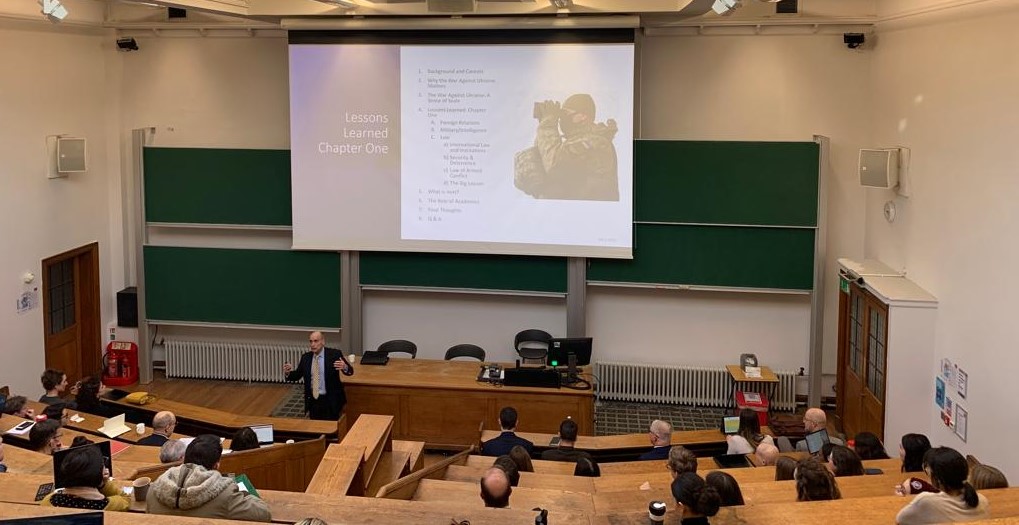
Judge James E. Baker, director of the Syracuse University Institute for Security Policy and Law, recently spoke about the Russian-Ukrainian War to a group of more than 100 students, faculty, and select invited practitioners (including from several Embassies in London). Held at King’s College London Department of War Studies, the event was supported by the King’s Intelligence and Security Research Group and by the British Academy Global Professorships program.