Around Syracuse Law

Syracuse Law Team Competes in the National Veterans Law Moot Court Competition

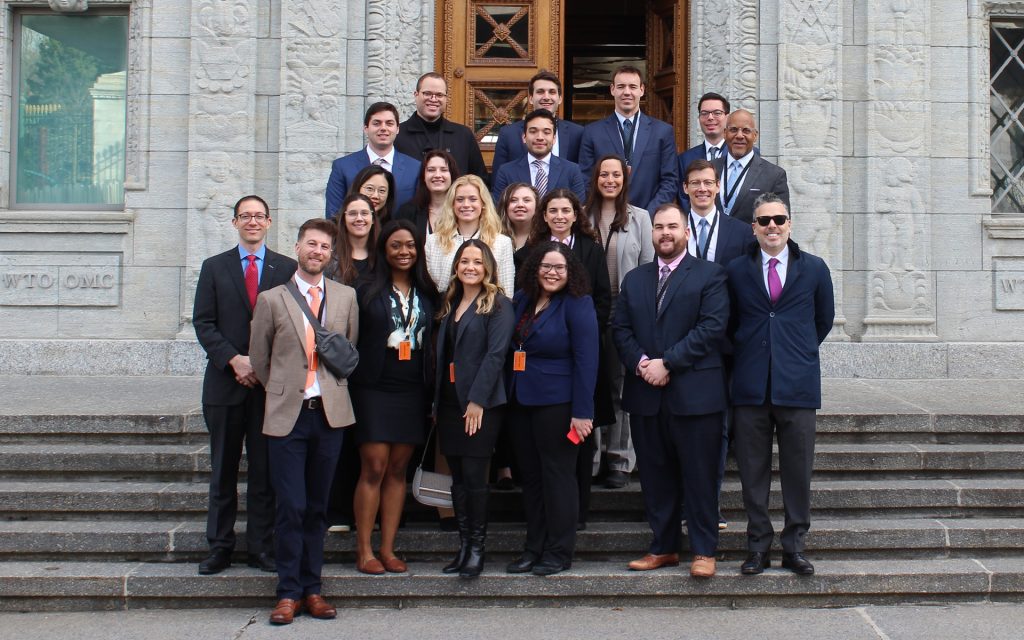
Alexa Connaughton L’25 and Elyse Maniccia L’26 recently competed in the National Veterans Law Moot Court Competition (NVLMCC), the nation’s most prestigious veterans law appellate competition. Seth Owens L’24, Betty and Miachel D. Wohl Veterans Legal Clinic Staff Attorney, coached the team and was assisted by Army JAG Major Nick VanErp.

The students were judged 1/3 on the content of their brief, 1/3 on their first argument, and 1/3 on their second argument. While the Syracuse Law team did not advance past the initial round, they proudly represented the College of Law. They had a positive experience learning the unique complexities of veterans law. 

“I am very proud of their effort; both students were great ambassadors for Syracuse Law. One may even be interested in changing their preferred career path to pursue veterans law after this experience,” says Owens. “I would also like to note that we were the only team eliminated on day one to attend all rounds of the final arguments. The students enjoyed watching the competitors and used it as an opportunity to further their advocacy skills and self-reflect.”

First organized in 2009, NVLMCC is sponsored annually by the U.S. Court of Appeals for Veterans Claims (CAVC), the Court of Appeals for Veterans Claims Bar Association, and the George Washington University Law School (GW Law). The NVLMCC is the nation’s premier moot court focusing on veterans law. Hosted close to Veterans Day each fall in Washington, DC, the NVLMCC brings together 28 teams of two students from around the country to argue cutting-edge veterans law issues before panels of distinguished practitioners and judges.

The NVLMCC prides itself on the authenticity of the problems and the quality of its judges. The record on appeal and the documents included look like what would be found in a real veterans law case. The judges for the briefs and the oral arguments are drawn from the ranks of experienced veterans law practitioners. In particular, the final round of each NVLMCC is presided over by a panel of judges from the CAVC in their courtroom. Few moot court competitions can boast an experience that is so true to actual practice.

George Saad L’25 Wins Best Cross-Examination at the Buffalo-Niagara Trial Competition

George Saad L’25 won the Best Cross-Examination award at the Buffalo-Niagara Trial Competition. His cross-examination was deemed the best out of 96 cross-examinations during the preliminary rounds. The Syracuse Law team of Tania Rivera-Bullard, Dannah Henderson, Lisa Musto, Saad, Kaylee Searcy, and Taylor Shawver finished in 5th place out of 24 teams.

The team was coached by Tyler Jefferies L’ 21.

Helping First-Generation Law Students Feel Welcome

The National First-Generation College Celebration is celebrated annually on November 8 to mark the anniversary of the signing of the Higher Education Act of 1965.

Professor Courtney Abbott Hill smiles warmly across a desk at a student during a one-on-one meeting. The student is seen from behind, wearing a green top, as they engage in conversation with Professor Abbott Hill in a brightly lit office.

Being a First-Generation Law Student (FGLS) presents unique challenges, unfamiliar surroundings, and new experiences for those pursuing a J.D. The journey through law school can be demanding, but the accomplishment of reaching this stage is significant.

Each entering class at Syracuse Law includes many FGLS, creating a supportive network of peers with shared goals. Additionally, many faculty and staff at Syracuse Law were first-generation students in college and/or law school and are available to serve as mentors, advisors, and sources of support throughout the experience.

Chief among them is Professor Courtney Abbott Hill L’09, a Syracuse native and Syracuse Law alumna who obtained her J.D., magna cum laude, in 2009. In addition to teaching Legal Communication and Research (LCR) to first-year students, she is also the Faculty Advisor to the First-Generation Law Student Association (FGLSA).

Like many law students, her path to the legal profession was not traditional. “I was a political science major at Nazareth College, and everyone asked if I was going to law school.  At the time, pursuing a career as an attorney was not something I had really considered. After graduating, I was teaching and working on a master’s in education, but going to law school was always in the back of my mind. I finally took the LSAT to see whether I could get accepted at Syracuse, which was the only school I applied to.”

As a proud lifelong resident of the area, being accepted to Syracuse Law meant the world to Professor Abbott Hill. She excelled at law school, serving as Managing Editor of the Syracuse Law Review and receiving the honors of Order of the Coif and the Justinian Honor Society, among many others.

Returning to her alma mater after serving as an Appellate Court Attorney at the New York State Appellate Division, Fourth Department, and then as a regional director for a national bar prep company, meant she was able to combine her love of teaching and the law in her role on the faculty.

“I returned to Syracuse Law to teach in the bar success program. Later, I had the opportunity to teach an LCR class and fell in love with it. I was fortunate to have mentors like my first-year LCR Professors, Ian Gallacher and Aliza Milner, who recognized I’d be good at this before I did and encouraged me to apply for a full-time position teaching LCR. I am so grateful for that encouragement because I have the greatest job in the world.”

Professor Courtney Abbott Hill, in a gray suit, is focused as she writes on a document at her desk while a student in a green shirt watches attentively. Shelves filled with books and decor are visible in the background of the office.

Abbott Hill can trace her passion for teaching and mentoring back to spending summers working as a camp counselor and later as a teacher and coach at a Syracuse high school. “Even if I didn’t always know I wanted to teach in law school, in hindsight, it all makes sense,” she says.

“FGLSA is an amazing organization. Student leadership purposefully doesn’t define what a first-generation law student is because they want it to be the most inclusive, supportive organization for any student, residential or JDi, that wants to be a part of it.”

—Professor Courtney Abbott Hill L’09

These experiences help inform how Abbott Hill teaches first year law students in LCR, where they learn how to research and apply law to complex factual situations.  She sees teaching or assessing students through the rigors of LCR as a not one-size-fits-all proposition. “I see my job as helping students identify goals for their legal education and partnering with them to achieve those goals.  There is a steep learning curve the first semester of law school, so I’m willing to try non-traditional things in the classroom to help students understand and execute difficult legal concepts.”

As the Faculty Advisor to the FGLSA, Abbott Hill uses all her skills and experiences as a lifelong mentor and educator to make an impact on Syracuse Law students. “FGLSA is an amazing organization. Student leadership purposefully doesn’t define what a first-generation law student is because they want it to be the most inclusive, supportive organization for any student, residential or JDi, that wants to be a part of it.”

Professor Courtney Abbott Hill sits across from a student in a casual, supportive meeting setting at a round table. She is writing in a notebook while the student, dressed in a green top and jeans, listens intently.

The FGLSA facilitates several programs for its members, including pairing first-year and upperclassmen as “buddies”, hosting panels and symposia on issues important to FGLS, networking events, and other opportunities to build community.

“We want to make that transition to law school a little smoother to those that may feel like a fish out of water,” says Abbott Hill.

U.S. Marine Corps Veteran Continues Commitment to Service Through the Law

The man stands leaning against a glass wall at Syracuse University College of Law. His reflection is visible in the glass, and he is smiling slightly, dressed in a blue blazer and white shirt.

Anthony J. Ruscitto ’22, ’23 MPA, L’27, has lived a life of service since he enlisted in the U.S. Marine Corps at age 17. And, while he’s no longer flying in military helicopters around the world, he has landed in a place close to home where he can be a voice to those in need: the Syracuse University College of Law.

Ruscitto served for five years as a CH-53H Super Stallion helicopter crew chief, which included two deployments overseas as a sergeant, weapons and tactics instructor, responsible for training enlisted aircrew at the squadron level. He received the Navy and Marine Corps Achievement Medal (2nd award), Marine Corps Good Conduct Medal, and Sea Service Deployment Ribbon (2nd award) for honorable service.

It was the military that first showed him how critical it is to master the basics before you practice something and dig deep to fully understand rules and regulations. Ruscitto has since adapted those lessons to navigate his continuing commitment to helping others, as well as drill down into military regulations and learn what options, resources and benefits are available to him and other veterans.

The man is standing between library shelves in Dineen Hall, looking at an open book with two other people nearby, engaging in a conversation and smiling.

After completing his military service, the Central New York native earned a bachelor’s degree in psychology and forensic science from Syracuse University’s College of Arts and Sciences paid for entirely through the Post 9/11 G.I. Bill.  Next, through the G.I. Bill and with scholarships available to veterans at Syracuse University, he was able to earn a master’s degree in public administration (MPA) from the University’s Maxwell School of Citizenship and Public Affairs.

During his time on campus, he served as president of the Syracuse University Student Veterans Organization and as a program advisor and graduate student researcher for the Syracuse University D’Aniello Institute for Veterans and Military Families (IVMF). His commitment to serving other veterans was recognized when he was named one of the Top 8 student-veterans in the nation in 2022 and, in 2023, was named Student-Veteran of the Year by the Syracuse University Office of Veterans and Military Affairs. True to his nature, he also found other paths to service, too, volunteering as a CPR instructor and an EMT for Syracuse University Ambulance Services.

After earning his master’s degree, Ruscitto spent a year working as an administrative intern at the Onondaga County Veterans Service Agency, where he assisted veteran service officers with preparing and submitting  claims for benefits from Veterans Affairs, as well as interacted with local advocacy agencies to bring a greater awareness of the needs of local veterans.

The man stands in a library aisle, examining a large law book. Rows of books on legal topics are visible on the shelves around him. He is dressed in a blue blazer and focused on the book in his hands.

This fall, he returned to campus with a new mission: becoming a lawyer who could assist the military community by pursuing public interest or criminal defense law. His law school tuition was covered through the Veteran Readiness Program and the Department of Veteran Affairs.

“The idea that I can be the person in a courtroom who advocates for others, particularly those who have served our country, is very important. I can be a louder voice for the people who need one, and I believe that’s what public service is really all about.”

—Anthony J. Ruscitto ’22, ’23 MPA, L’27

Ruscitto’s approach to the challenges of law school is also rooted in his time in the military. “Every time I start something new, I go back to what I learned in the Marines: be honest, work hard and be humble,” he says.

“I know that I’m not the smartest person in the room and acknowledge that each person can teach me something. That encourages me to listen more closely to others’ perspectives. This mindset—that we can learn from everyone around us —comes from the Marines and has led me to continued success in ways I never thought possible,” Ruscitto adds.

Already, Ruscitto is finding his niche. He is the first-year representative for the Syracuse University Military and Veteran Legal Society, And, he is enjoying part-time work as a Syracuse Law ambassador, giving tours and introducing the law school to prospective students.

The man is sitting on a bench outside Syracuse University College of Law's Dineen Hall, smiling as he interacts with a small, fluffy dog standing on its hind legs with its paws resting on his lap.

“I recently had the chance to interact with an undergraduate who is also a student-veteran, and I could tell he was uncertain about whether he could make it in law school,” Ruscitto explains. “So, I was excited to be able to show him that I am a student, I am a veteran—and I’m getting it done, and you can, too! The following week, we met up again. When you’re a veteran, it’s not always easy to see a clear path to law school, so I wanted to show him it was possible.”

Ruscitto is also enthusiastic about volunteering in the Syracuse Veterans Legal Clinic while at Syracuse Law. He says, “What better way to learn and apply the law than by helping veterans and their spouses in applying for the benefits they already earned?”

When Ruscitto graduates and adds “lawyer” to his long list of accomplishments, he intends to continue to advocate for veterans and members of the military. “I hope to stay in my own back yard and help veterans and citizens right here in the Syracuse community. Maybe that will be as a prosecutor or as a defense attorney. I don’t know yet, but, in the end, I’ll get to help people,” he says. “It’s a duty, and it’s an opportunity. No one should have to worry if they are getting fair treatment, even if they find themselves on the wrong side of the law. The idea that I can be the person in a courtroom who advocates for others, particularly those who have served our country, is very important. I can be a louder voice for the people who need one, and I believe that’s what public service is really all about.”

A view of the man from behind as he walks down a hallway inside Dineen Hall. The modern, open space is well-lit, with tall concrete columns and a polished floor.

3Ls Savana Conrade and Suzan Elzawahry Win the 47th Annual Lionel O. Grossman Trial Competition

3Ls Savana Conrade and Suzan Elzawahry prevailed over 3Ls Nathan Hankey and Olivia Murphy in the 47th Annual Lionel O. Grossman Trial Competition. Elzawahry was selected as the Best Advocate.

Dennis Scanlon L’19, Associate at Goldberg Segalla was the presiding judge with Nicole Macris L’18, Associate at Bond, Schoeneck, & King, and Thomas Taylor L’87, of Counsel at Bousquet Holstein serving as judge/evaluators.

From Left: Jacob Samoray (Competition Director). Thomas Taylor L’87 (Judge/Evaluator – Bousquet Holstein, PLLC), Dennis Scanlon L’19 (Presiding Judge – Goldberg Segalla), Savana Conrade, Suzan Elzawahry, and Nicole Macris L’18 (Judge/evaluator – Bond Schoeneck & King.)
 

Syracuse University College of Law Partners with Kaplan to Provide All Students with Free Prep Courses for the Bar Exam

Note to editors: Kaplan is a subsidiary of Graham Holdings Company (NYSE: GHC)
Press Contact: Russell Schaffer, russell.schaffer@kaplan.com

Fort Lauderdale, FL (October 28, 2024) ⁠— Syracuse University College of Law will begin providing all its graduating students with free comprehensive test prep for the bar exam through a new partnership with global educational services provider Kaplan, as part of its award-winning All Access initiative. Syracuse Law students in the Class of 2025 will be the first to take advantage of this new offering. Kaplan will also provide the school and students with other robust, comprehensive academic support services, from orientation through graduation, including integrated curriculum, diagnostics, and assessments.

Kelly Curtis, associate dean for academic and bar success at Syracuse Law, said:

“Kaplan’s program offers several resources to enhance our students’ preparation for the bar exam and our academic support efforts. We believe these added resources will significantly improve the support we provide our students as they prepare for the bar and beyond.”

Kimberly Batrice Hytree, executive director of bar institutional programs, Kaplan, said:

“Kaplan is proud to partner with Syracuse University College of Law to provide this transformative opportunity to all its students. As an All Access partner, Syracuse Law is investing in a holistic, integrated program that culminates in free bar exam prep, showcasing their commitment to supporting students from the very start of their law school experience. The bar exam is a challenging milestone for future attorneys, and we are dedicated to equipping students with the essential knowledge and skills they need, beginning on day one, so they can be successful throughout their academic journey.”

As part of Kaplan’s All Access initiative, institutions of higher learning, including law schools and medical schools, can help their students prepare for a variety of high-stakes admissions and licensing exams that they need to score well on to reach their ultimate professional goals—with zero out-of-pocket costs for students. Earlier this year, Fast Company named Kaplan’s All Access initiative the winner of its World Changing Ideas Award, in the large business category.

Kaplan has prepared students for standardized tests for more than 85 years, and Syracuse University College of Law is its newest All Access partner, joining Xavier University of Louisiana, Howard University, Delaware State University, Talladega College, Stillman College, Fisk University, Hampton University, Spelman College, and Cleveland State University, among others.

Interested reporters can contact Russell Schaffer at russell.schaffer@kaplan.com.

Syracuse University College of Law

Founded in 1895, Syracuse University College of Law offers a forward-leaning, rigorous legal education that prepares lawyers to succeed in the modern legal profession and related fields. The College is known for innovative programs, such as its online J.D. program, JDinteractive; an expansive externship program; a highly ranked Advocacy Program; three interdisciplinary institutes; and 11 joint degree options offered in partnership with the Maxwell School of Citizenship and Public Affairs, S.I. Newhouse School of Public Communications, and other schools and colleges at Syracuse University. Through its classroom and practical curriculum, the College of Law ensures that graduates have the knowledge, discipline, and analytical and practical skills required for 21st century legal practitioners in a fast-changing global and technological environment. Learn more at law.syracuse.edu.

About Kaplan

Kaplan, Inc. is a global educational services company that helps individuals and institutions advance their goals in an ever-changing world. Our broad portfolio of solutions help students and professionals further their education and careers, universities and educational institutions attract and support students, and businesses maximize employee recruitment, retainment, and development. Stanley Kaplan founded our company in 1938 with a mission to expand educational opportunities for students of all backgrounds. Today, our thousands of employees working in 27 countries/regions continue Stanley’s mission as they serve about 1.2 million students and professionals, 15,000 corporate clients, and 3,300 schools, school districts, colleges, and universities worldwide. Kaplan is a subsidiary of the Graham Holdings Company (NYSE: GHC). Learn more at kaplan.com.

 # # #

Sixth Annual Syracuse National Trial Competition Results

The sixth Annual Syracuse National Trial Competition occurred from October 18-20, 2024.

The quarterfinalists were:

  • Belmont University College of Law
  • Quinnipiac University School of Law
  • Stetson University College of Law
  • Western State College of Law

In the final round, Stetson University College of Law prevailed over Western State College of Law.

The individual advocacy awards were:

Best Closing Argument Award: Matthew De Santos, Western State College of Law

Best Direct Examination Award: Madeleine Bodiford, Stetson University College of Law

Best Cross Examination Award: Cristine Khachatoorians from Loyola University Law School, Los Angeles

Best Open Statement Award: Tie between Isabella Diaco from Stetson University College of Law and Alleanne Anderson from Chicago-Kent College of Law

Overall Best Advocate for the Preliminary Rounds: Chase Gleason, Western State College of Law

Best Overall Advocate for the Final Round: Tie between Laith Hatoum from Stetson University College of Law and Matthew DeSantos from Western State College of Law

Joanne Van Dyke (SNTC Director) drafted the fact pattern, entitled Bobby Blair v. Go West Movies, Inc. The Plaintiff was hired by the Defendant to act in a Western they were producing. Toward the end of production, the Plaintiff was seriously injured as a result of a shooting incident. The fact pattern was balanced in terms of results as there was a 50-50 split between Plaintiff and Defense wins throughout the whole competition.

Andrew Umanzor and Carly Zakaria (SNTC Coordinators) dedicated countless hours and worked nonstop throughout the competition, and more than forty members of the Syracuse Law Advocacy Honor Society volunteered as bailiffs. Your help was greatly appreciated.

We’d like to thank the Honorable Miroslav Lovric (United States District Judge Northern District of New York), who presided over the final trial, as well as all of the judges and attorneys who judged/evaluated. Many of the judges and attorneys evaluated multiple rounds, and some traveled two to three hours to Syracuse for the competition. 

We’d also like to thank Judge Deborah Karalunas, Don Doerr, Esq., Mary Monashefsky, Chief Steven Bigzia, the court officers and the courthouse staff, who made hosting the tournament such a success.

The Honorable Langston C. McKinney L’71 Courtroom Dedication to be Held on October 30

McKinny L'71 Syracuse Law student headshot

On Wednesday, October 30 at 4:30 p.m., political, legal, and civic leaders from across the state will gather at the Honorable James C. Tormey, III Criminal Courts Building at 505 South State Street, Syracuse, New York for the dedication of The Hon. Langston C. McKinney Courtroom. The Hon. Langston C. McKinney L’71 served in many critical public interest leadership positions and applied his legal acumen across many practice areas and roles. He was appointed the first Black Syracuse City Court Judge in 1986 and served with honor, distinction, and compassion until his retirement in 2010.

Judge McKinney was born in Miami, FL on October 27, 1944. He graduated from Howard University in 1965 with a degree in chemistry and was recruited by Carrier Corporation to come to Syracuse to work as a chemist where he was the first Black scientist in their research and development division.

Judge McKinney served two years in the U.S. Army and then returned to Syracuse in 1968 to attend Syracuse University College of Law. While in law school he co-founded the Syracuse chapter of the Law Students Civil Rights Research Council and would spend a summer working in the South on civil rights legal work, fueling his passion for justice. Also, while in law school he started to work for Onondaga Neighborhood Legal Services (ONLS). It was there that he came to understand the plight of people trapped in poverty and social and economic injustice. This experience sharpened the lens through which he saw the need for justice, equality, and the rule of law.

Upon graduating from Syracuse Law, Judge McKinney began his legal career at ONLS as a staff attorney. Among the many causes he championed was the issue of tenants’ rights. He would later be honored by having a housing complex named after him – McKinney Manor. Judge McKinney later joined the legal staff at Hiscock Legal Aid Society where his reputation as a criminal defense attorney began to grow. Eventually, Judge McKinney joined with two other Syracuse lawyers to form the law firm of Maye, McKinney & Melchor, the first Black law firm in Syracuse.

In 1986 Judge McKinney was appointed by Mayor Tom Young to be the first Black American Syracuse City Court Judge. He was then elected in 1987 and re-elected in 1997 and 2007. One of Judge McKinney’s proudest accomplishments was partnering with the Center for Community Alternatives to establish the Syracuse Community Treatment Court.

Although Judge McKinney retired in 2010, he remained active in the pursuit of justice. He was instrumental in founding the first African American Bar Association in Onondaga County – The William Herbert Johnson Bar Association – named after a fellow African American legal trailblazer.

“Judge McKinney had faithfully and respectfully served Syracuse as a jurist, community leader, and mentor to many in the legal profession and other disciplines,” says Professor Paula Johnson, who served on the committee securing the courtroom dedication.

The ceremony can be livestreamed at https://cmi.nycourts.gov/VirtualCourt/new/st-jd5/st-jd5-1 with the passcode 1986. A reception will follow at the CNY Philanthropy Center Ballroom.

JDi Program Prepares 3L to Tackle Immigration Issues Half Way Across the World

A woman, sitting at a desk in a bright office, looks toward the camera with a soft smile. She is wearing a green blouse and has a laptop in front of her. A Syracuse University pennant hangs on the wall behind her, with plants and office decor completing the background.

It takes more than 30 hours by plane for Lisa Phair L’25 to get to the Syracuse University College of Law, but, for her, it’s definitely worth the trip.

Currently a 3L in the Syracuse Law’s JDinteractive (JDi) program, Phair lives in the Mariana Islands, a U.S. territory in the middle of the Pacific Ocean. Raised in Alaska, she and her husband moved to the Mariana Islands 11 years ago when he took a one-year contract job as a pharmacist. However, the natural beauty and multiculturalism of the islands made them decide to stay.

Today, Phair and her husband have two children, age 10 and 15. Phair works as a Scuba instructor and dive shop manager, as well as an adjunct instructor at Northern Marianas College, teaching Social Psychology of Business Management and Operations Management.

Law school had only been a thought in the back of her mind until the pandemic hit in 2020, locking down the islands from the rest of the world. While a U.S. territory, the Mariana Islands’ population is only made up of 35% U.S. citizens. Others are from around the world, there on various work or travel visas. When the lock down occurred, many of Phair’s friends were at the mercy of immigration. They lost jobs due to COVID but, as non-citizens, they were not eligible for the U.S. welfare system. This created a hardship for people just to put food on the table and take care of every day essentials.

A silhouette of a woman in profile, walking through a hallway while holding a laptop. The bright window at the end of the hall contrasts with her shadowed figure. Minimalist office furniture and decor are seen in the hallway.

When the world started opening up, Phair began thinking more seriously about pursuing law school, particularly immigration law in response to the difficulties she had seen non-U.S. citizens tackle during the pandemic.  She didn’t find many law schools that offered immigration law specifically and also didn’t want to uproot her family. So, when Phair came across the Syracuse Law JDi program, which offered international law, she took a chance.

“I was nervous about the hybrid program not being a traditional law school set-up, but the talented people in my cohort have truly elevated my experience. I’m so impressed with my classmates—people with a lot of other demands on their time—and how we’ve developed a great rapport with one another.”

—Lisa Phair L’25

Now, due to the 14-hour time difference, Phair often finds herself logging on to her classes at night from the local McDonald’s, which is her closest internet access. But, that hasn’t stopped her.

“The JDi has exceeded my expectations,” she says. “I was nervous about the hybrid program not being a traditional law school set-up, but the talented people in my cohort have truly elevated my experience. I’m so impressed with my classmates—people with a lot of other demands on their time—and how we’ve developed a great rapport with one another.”

Part of the requirements of the JDi program are six residency programs on special topics. Phair has traveled to eight—five residencies on the Syracuse campus, as well as others in Rome (Comparative Legal Systems), Washington, D.C., (Federal Practice and International Law) and London (Comparative Trial Advocacy).

A group of attendees seated at a conference table during a presentation. In focus is a woman with long blonde hair, holding a laptop, appearing engaged with the speaker. Another woman in a yellow top sits nearby, along with other participants, in a well-lit room with framed art on the walls.

Phair not only values the information she learned at the residencies but also the opportunity to interact face-to-face with classmates and faculty. “It was a great comfort to see those familiar faces and spend time with each other,” she says. “And, I’m so grateful for the valuable topics, caliber of teaching and guest speakers who were brought into each residency program.”

As she completes her final year, Phair continues to focus on international law. She recently wrote a blog post for Syracuse Law’s Journal of International Law and Commerce about the battle between the U.S. and China to establish diplomatic ties with Pacific Island nations and the potential impact if China continues to move further into the region—something that resonates with her as a resident of the Mariana Islands. And, this semester, she is excited to be taking Space Law and Policy.

Three women participating in a courtroom simulation. Two women, seated at a table, wear professional business attire, focusing on their notes. One stands next to them, presenting with a laptop nearby. The courtroom setting has light wood paneling and neutral walls.

While she has enjoyed all of her classes, she has special appreciation for Professor of Law Todd Berger, Adjunct Instructor Raul Velez and Professor Andrew Greenberg for the humor they bring to the classroom, as well as Associate Dean for Online Education Shannon Gardner, Assistant Director of Academic and Bar Success Lou Lou Delmarsh and Assistant Director of Online Programs Stephanie Rinko for their friendship and guidance.

After graduation, she plans to take the New York State Bar exam, which has reciprocity that will allow her to practice back home. The following year, she intends to take the Commonwealth of the Northern Mariana Islands (CNMI) bar exam, too. Phair hopes to start her career clerking at one of the courts on the islands, while also honing her grant writing skills to raise money for a practice she and a friend intend to open to offer pro bono legal assistance to those on the islands facing immigration issues.

A woman in a green blouse, seated at a modern desk, working on a laptop in a bright office. The desk has a notebook, pen, and a Syracuse University pennant in the background, along with a decorative plant and books.

In the spring of 2025, Phair will again take that 30-hour trip to receive her diploma from Syracuse Law, and she is excited to celebrate this achievement in person with her law school friends and professors.

“Living on the Mariana Islands is amazing, but Syracuse’s JDi program has also been an amazing adventure that has changed my life,” she says. “I am eager to see what a future in law has in store for me.”