Professor Keith Bybee, the Paul E. and Hon. Joanne F. Alper ’72 Judiciary Studies Professor, spoke with WUSF/NPR on the state of civility one year into the Trump presidency.
Bybee, author of How Civility Works, discussed the history of civility in society, the ways norms of civility were broken throughout American history, and the impact of the current climate on civility across the political spectrum.
“There is some sense that if they go low and you don’t go high, then you become reduced to the level of the person you are disagreeing with,” said Bybee. “I would suggest something different, which is to focus on the real stakes of what are the boundaries of polite society, who gets the benefit of decent treatment and behavior in our society, who is owed basic respect. If we focus on that as the goal, perhaps it will make it less imperative that we engage in tit-for-tat or f-bomb-for-f-bomb.”
Associate Dean of Students and Teaching Professor Kelly Curtis recently received a significant honor highlighting her exceptional contributions to legal education: the American Association of Law Schools (AALS) Section on Academic Support Impact Award.
Curtis received the AALS Impact Award at the association’s recent Annual Meeting, where she also presented her current work in progress, “The Invisible Crisis: How Generative AI Transforms Risk Detection in Legal Education” at the “Fostering Impact and Resilience: Institutional Academic Support for Law Students and ASP Faculty” session, which demonstrates her leadership in shaping best practices across legal education.
The AALS Impact Award recognizes legal educators who are “inspiring students and peers in the academic support profession today and catapulting us forward to a stronger tomorrow.” Recipients must demonstrate significant impact through student support and mentoring, promoting diversity and expanding access to the legal profession, or developing innovative ideas and practices.
Under Curtis’s leadership, Syracuse Law has built comprehensive support systems that guide students from admissions through the bar exam. She has developed and now leads two critical offices: the Office of Student Experience (OSE), which fosters an engaging and inclusive environment for the entire law school community and oversees more than 30 student organizations; and the Office of Academic and Bar Support (OABS), which provides strategic academic guidance and programming tailored to each student’s success.
“Professor Curtis is dedicated to the growth and success of our students. Her professional, personal approach to guiding our students through their legal education sets them for success in their careers and as members of the communities they serve,” says Dean Terence Lau L’98.
In addition to her administrative leadership, Curtis maintains an active teaching portfolio, instructing courses in Professional Responsibility, Feminist Jurisprudence, and Law and Sexuality—work that earned her the Meredith Teaching Recognition Award for her sustained commitment to excellence in the classroom.
“I am honored to receive these awards. Everyone at Syracuse Law places our students’ success at the forefront of everything we do, and I’m grateful to be part of a community so deeply committed to providing an exceptional student experience,” says Curtis.
Anyone taking on the rigors of law school expects it to be demanding, but Emely Recinos L’26 has the added challenge of reading case law, breaking down briefs, and participating in late night study sessions—all without the ability to see. Now a 3L preparing to graduate, Recinos has proven that what some might consider a barrier has instead helped her find her own voice and ignite a passion for advocating for marginalized people facing the legal system.
Diagnosed with a degenerative eye condition at age 7 that led to blindness, Recinos remembers doctors and school administrators telling her family that getting an education would be difficult. School made her feel isolated and depressed, and other children didn’t understand her disability. “It was a dark time without a lot of positivity around it,” she says.
Thankfully, a devoted teacher who worked with the visually impaired made it her mission to be sure Recinos left sixth grade with the ability to read and write braille—an essential foundation for her future success. She also convinced Recinos to use her white cane, increasing the young girl’s independence and providing an outward sign to others that she was blind. It was a turning point, allowing her to grasp the many possibilities ahead of her. Recinos didn’t know it then, but one of those things was studying to become a lawyer.
Understanding the Legal Needs of Other Marginalized Groups
Recinos excelled in college, earning an undergraduate degree in international relations from New York University. Upon graduation, she worked as a case support associate for the Young Center for Immigrant Children’s Rights in New York City. It was there that she came to understand first-hand how other marginalized groups—specifically unaccompanied immigrant children—needed reputable legal representation. This struck a chord and inspired her to pursue a law degree as a way to create meaningful change.
Recinos understood that navigating Syracuse Law would require thoughtful preparation. Before beginning law school, she worked with an orientation specialist to familiarize herself with Dineen Hall and continues to map out the routes to her classes ahead of each semester.
The staff at Syracuse University’s Center of Disability Resources has also helped her access course material in an accessible format. Recinos uses screen reader software on her laptop that turns digital content into synthesized speech, as well as a device with a Perkins-style braille keyboard that allows her to take notes and can be connected to her laptop.
Getting Involved and Exploring Orange Flex
Recinos was eager to get involved in activities at the law school. As a 2L, she joined the Disabled Law Students Association, a student organization that provides support and information for those with disabilities, that is open to all Syracuse Law students. The association helps connect members with volunteer opportunities, brings in speakers on pertinent topics, and promotes individuality throughout the entire Syracuse University campus. This year, Recinos is serving as co-president of the organization.
Starting last summer, Recinos was placed at the New Jersey Consortium for Immigrant Children, a nonprofit helping minors with immigration matters, including those with no legal guardians in the U.S. According to Recinos, the current political climate has resulted in continuous changes in fees and rules for obtaining special immigrant juvenile status, so the organization works to ensure minors have effective legal representation.
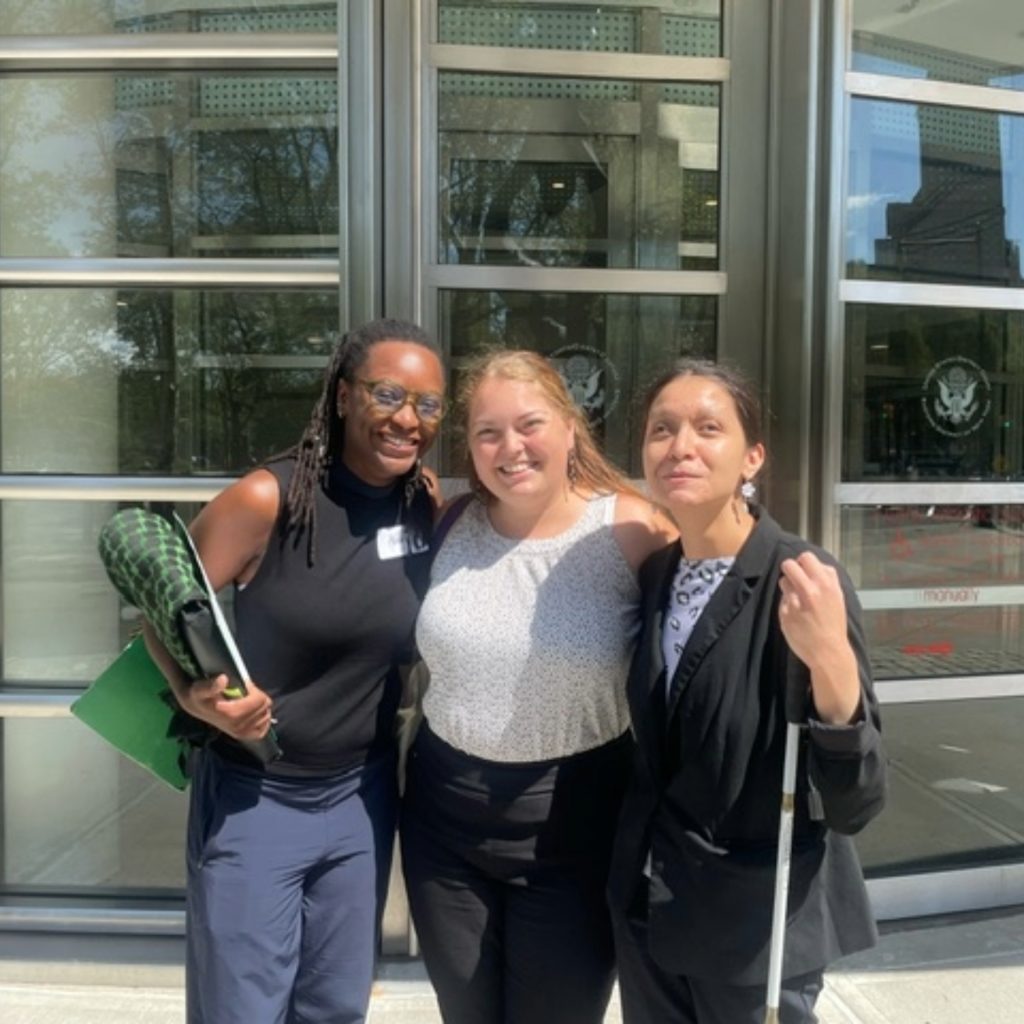
Emely Recinos ‘26, right, visited the U.S. District Court for the Eastern District of New York during her 2025 fall internship with the New Jersey Consortium for Immigrant Children. Pictured with her are, left to right, Abena Hutchful, policy and litigation attorney at the Young Center for Immigrant Children’s Rights, and internship supervisor Katarina Martucci.
Over the course of her internship, Recinos assumed expanded responsibilities, including serving as a lead on a case under attorney supervision and drafting certification briefs. She liked the work so much that she requested to stay on for the fall 2025 semester.
“I enjoy immigration law and working with children who feel like their voices aren’t being heard,” she adds, noting that her fluency in Spanish was helpful in her role. “When I was a child, I often felt people were speaking for me or over me, and I want to do what I can to make sure these children have a voice.”
Realizing Her Education Came With Options
Through her experiences at Syracuse Law, Recinos realized that having a disability didn’t mean her only option was to practice disability law. She has discovered that there are many ways her personal and professional experiences intersect with education, employment, civil rights, and international human rights.
As she prepares to graduate, Recinos wants to continue to help those with immigration issues or disabilities access to quality legal representation. She is currently exploring post-graduate opportunities with various civil rights organizations. Recinos also recently wrote “The Overlooked Tourist: Enhancing the Market for Disabled Travel,” soon to be published by the College of Law’s Journal of International Law and Commerce.
Eventually, Recinos sees herself working on policy to ensure that those with disabilities or anyone who feels unheard due to their circumstances will be protected under the law.
“I feel like I’ve been able to accomplish so many things here at Syracuse Law, particularly how to use my own voice to advocate for myself and others,” she says. “I’ve found wonderful mentors, a community of peers, and professors who’ve taken that extra step for me. I know I have a lot of options moving forward, and I’ve been empowered by that.”
This December I was contacted by a woman, let’s call her Jackie (not her real name). Jackie was in a dispute with a neighbor. The dispute involved Jackie’s placement of a deck and a wheelchair ramp along the side of her house in between her house and that of her neighbor. The ramp allowed Jackie to have easy and safe access to an entrance to her home, and a deck enabled her to enjoy her side yard. The issue with the neighbor arose because the width of the ramping and deck came within two feet of the neighbor’s property line, and the neighbor’s house was built very close to that line. The neighbor tried to block the installation of the deck and ramp.
Typically, these disputes involve compliance with public zoning regulations, but in this case the point of contention was a private restriction in the deed to Jackie’s property. At one point, Jackie’s land and that of her neighbor had been one parcel. When a portion of that parcel was sold to Jackie, a deed restriction in Jackie’s deed was included that prohibited Jackie from building any structure within 15 feet of the property line that separates her from the now complaining neighbor.
This posed an interesting problem. Jackie went to the zoning board to obtain a permit and applied for a variance because the zoning code also had certain property line setback requirements that would be violated by the size and width of the deck and ramping. Jackie received an exception to the zoning code and a permit to build based on her disability and the granting of a reasonable accommodation under Title II of the ADA. Based on the permit, Jackie added her deck and ramp. However, in her case, the neighbor objected, properly pointing out that while a public zoning board can adjust public land regulations, it has no authority to adjust a private restriction contained in a deed. The deed restriction can be enforced by the neighbor unless the neighbor voluntarily consents to waive the restriction. The neighbor sued for removal of the deck and ramp.
Even though she has a disability, Jackie does not have a remedy or a defense against her neighbor under the ADA because the ADA Title II does not apply directly to this private deed restriction. ADA Title II applies to programs, services, and activities of state and local government. This means it applies to everything that a planning and zoning office might do in regulating land uses. It does not apply to purely private land restrictions. However, Jackie does have a remedy under the Fair Housing Act (FHA). Under the FHA, Jackie can sue her neighbor for violating her right to a reasonable accommodation with respect to the private deed restriction. Jackie had formally requested a reasonable accommodation from her neighbor to permit the building of the ramp and deck. The neighbor said no. The neighbor must consider the request in terms of is it reasonable (does it impose an undue financial or administrative burden), are the deck and ramp necessary to address the disability so that Jackie can enjoy her property in a way similar to others without a disability, and does granting the accommodation fundamentally alter the ability to use the property. Of course, while not determinant, the conclusion of public zoning officials in favor of issuing a permit provided some evidence of reasonableness on the matter. Nonetheless the case must be made, and a decision is reviewable in court.
Jackie referred her case to the Department of Housing and Urban Development (HUD) alleging discrimination by the neighbor for failure to grant her a reasonable accommodation. This is one path to consider when seeking to address such matters. HUD agreed to take up the matter. This way the case is handled by HUD and Jackie does not have to take the neighbor to court on her own. Failure by the neighbor to grant a reasonable accommodation is actionable discrimination under federal law.
The lesson here, is that private deed restrictions must comply with our disability laws. Just because a land regulation is created under private law, as opposed to public land use and zoning law, does not mean that disability law is inapplicable. Even when the ADA does not apply, the FHA accomplishes the same outcome in many situations.
(A version of this article appeared in the Jan. issue of The Republican Newspaper, Danville, IN – serving Hendricks County)
“The basic idea, which emerged early on in the United States, is that there might be circumstances when state and local law enforcement resources and state and local militia, now the National Guard, would not be able to adequately contain protests or disturbances on the ground in their communities,” said Banks. “So the Insurrection Act allows the president to call forth the regular military or other federal forces to come into state or local communities and engage in law enforcement in an emergency circumstance.”
He noted that the basis for triggering the act “is incredibly open-ended” and the statute “basically says the president can do this whenever he determines that it’s impractical to enforce the laws.”
The Hon. Jamie Baker, Professor and Director of the Syracuse University Institute for Security Policy and Law, was interviewed on NPR’s On Point podcast about President Trump’s statements on Greenland and the possible impact on NATO. Baker’s interview begins at 21:39 of the podcast.
In response to the question, what would the US lose if there were no NATO, Baker replied, “The U.S. would lose the 21st Century. It would lose the cooperation, the assistance, bases, and intelligence support throughout the NATO countries and bases in Norway and intelligence capacity in Norway that helps secure the arctic and secure the sea routes in the arctic. You would risk the Article 5 border in the Baltics. America thought it could avoid European entanglements and war in Europe before. How did that work out with the First World War and the Second World War? We risk greater war if we pull out of NATO.”
The College of Law’s long-running LondonEx externship program was featured in the National Jurist article “Summer programs at home and abroad add perspective, build practical skills.”
LondonEx is a summer externship program in London, U.K., hosted by Syracuse Law. During a seven-week international summer experience, students gain exposure to clients, partner with professionals for personalized mentoring, and enjoy boundless cultural opportunities – in one of the world’s most dynamic cities. LondonEx is open to any full-time or part-time student from an ABA-approved law school who is in good standing.
In the article, Andrew Horsfall ’05, L’10, LondonEx Program Specialist, said a willingness to situate oneself in a novel area of legal practice in a foreign locale shows future employers a certain level of resilience.
Horsfall said one of the things that comes out in the first two or three weeks is just how pleasantly surprised the students are at the level of accessibility that they have to their mentors and just how good their mentors are.
“I think the students are in awe watching their mentors work, whether it’s arguing in court or presiding from the bench. They come to respect the level of preparation required and the level of detail necessary to do this work and do it well,” he said. “It leaves a meaningful impression on the students because they’re working with people who are operating at a very high level in their respective practices.”
The application for LondonEx is open through February 1.
Distinguished Professor of Law Nina Kohn provided Syracuse.com with perspectives on the recent New York State Supreme Court decision that the state law requiring city judges outside of New York City to retire at age 70 was unconstitutional.
Kohn said the Equal Rights Amendment, approved in 2024, could lead to a variety of legal actions.
“This case is the tip of the iceberg,” she said. “The new protections for age really call into question many of our laws and policies.”
Kohn pointed out other retirement ages or age-based ticket pricing as other laws that could be impacted by the Equal Rights Amendment.
Kohn agreed that there is no clear reason why age 70 should be the cutoff. For instance, the age cutoff in Pennsylvania is 75.
Professor Emeritus William C. Banks recently spoke with Newsweek about the Constitutionality of annexing Greenland.
Legally, the U.S. cannot forcefully acquire another territory, said Banks. “They couldn’t make a move like this without the approval of the Danes, as well as the Greenlanders.”
Trump himself could not annex Greenland without Congressional approval — an executive order, for example, would not have any legal authority, Banks told Newsweek. But Congress could vote to approve the annexation of Greenland, overriding international law, Banks said, although it would “be abhorrent to most Americans.” This is because the U.S. Constitution doesn’t set out any boundaries on acquiring territories.
“Remote work is what I’m hearing about” most often, Macfarlane said. Yet some employers remain staunch in their resistance to telework as an accommodation, thinking disabled workers are getting something they don’t deserve, she said.
The disability bias cases this year show judges are taking telework more seriously and seeing physical presence isn’t required for all jobs, the professor said.