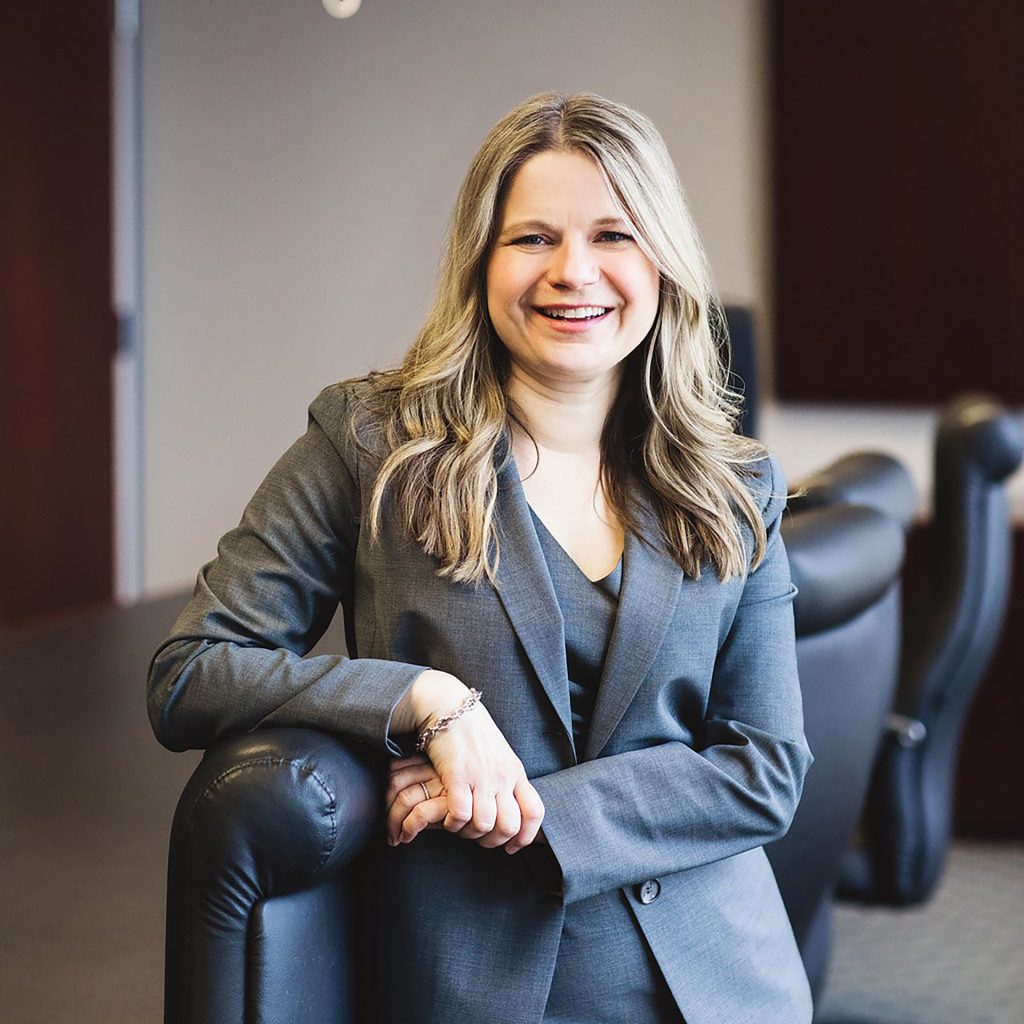
A 3L at Syracuse University College of Law, Kaitlin Sommer L’26 is always planning ahead. Throughout her life, she has continuously asked herself, “Is there a better or more efficient way to do this?”, “Am I advocating for what I need?”, “How can I figure this out by myself?” And, while this way of operating is a great skillset for any lawyer, Sommer has developed this method out of necessity and independence, as she navigates the world as a wheelchair user, as well as a child of Deaf adults (CODA).
Sommer attended Rochester Institute of Technology (RIT) as a political science major for her undergraduate degree as part of a 3+3 program with Syracuse Law, which allows students to transfer from RIT to the Law School after three years to finish their bachelor’s degree and at the same time start studying law.
As she prepares for her last year at Syracuse Law, Sommer has taken full advantage of many of the opportunities that come from being a law student—attending the Ms. JD Fall 2024 Leadership Academy Intensive hosted by the Harvard Women’s Law Association at Harvard Law School, and presenting at her alma mater’s third annual Together RIT: A Day of Dialogue centered on the theme of Deaf culture, disability and neurodiversity in her first ever public speaking appearance.
In January, Sommer added another responsibility to her already busy schedule: co-president of the Disability Law Society (DLS) at Syracuse Law, a position she shares with Emely Recinos L’26. The organization serves as a community for students with disabilities and their allies at Syracuse Law, while also raising awareness and providing related information across the greater University.
“This is a new venture that I’m really excited about. We are a small group of students at Syracuse Law, and it’s important that we have our voices heard,” she says, noting that only about 1.4% of lawyers in the U.S. self-identify as having a disability according to the American Bar Association. “Emely, who also has a disability, and I have a new take, which revolves around being more vocal about disabled students’ experiences and how the University can best support us. I want the Disability Law Society to see where we can set permanent roots and have a noticeable space to make our voices heard. And, of course, having this kind of community at the Law School has helped me to know that I’m not alone.”
When Sommer started at Syracuse Law, it seemed to make sense that she go into disability law, but some great advice from Professor of Law Katherine Macfarlane, a leading expert on civil rights litigation, disability law, and civil procedure, gave her the freedom to consider other areas, as well.
“Professor Macfarlane said that just because I’m a person with a disability doesn’t mean I have to go into disability law,” Sommer explains. “She made me see that being a disabled person in any legal space is also representative, and my personal experience will make me a better professional no matter which field of law I choose. She has been such a good mentor and support system for me and has encouraged me to advocate for what I want and need.”
Now, Sommer is very interested in pursuing national security law, while possibly finding a way to intersect that with disability law, too. She has since taken courses through Syracuse Law’s National Security Program and is working on her Certificate of Advanced Study in National Security and Counterterrorism.
Her hope is to live and work in Washington, D.C., in the future. As an undergraduate, she interned for Congressman Joe Morelle (D-NY) in the nation’s capital. Sommer recently completed an intern at the POPVOX Foundation, a nonpartisan organization that advocates for improvements in Congress. And, this summer, she is interning with The Spinal Cord Injury Law Firm, PLLC, in Washington, D.C. Despite these impressive opportunities, she is eager to learn more through her coursework and seek out other experiences to prepare to graduate from Syracuse Law in 2026.
“Having a disability does make things harder, but, at the end of the day, I’m so grateful. My own life experiences, along with lessons from the Law School, like critical thinking, have really helped me see how important it is to assess facts to see if what seems to be true really is true. This has made me a more open-minded person and will make me a better lawyer, too,” she says.
“After all, I never want people to make assumptions about me just because I use a wheelchair. I hope to be a positive example of a compassionate and knowledgeable disabled lawyer who can better connect with my work through my life experiences, and Syracuse Law is helping me get there.”
What happens when the person who is usually giving out awards gets selected to receive one?
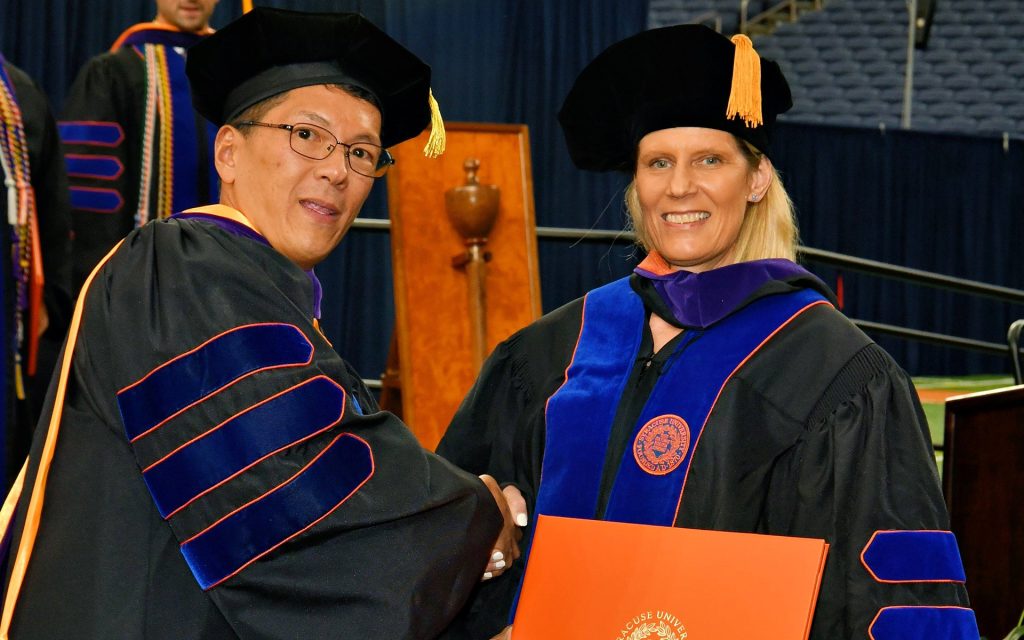
“It was a surprise. I don’t think of myself as a volunteer. Working with students and giving back is just what we do as attorneys. It was very kind of the Alumni Association and I am truly honored to be the recipient,” said Kim Wolf Price L’03.
Wolf Price received the 2025 Syracuse University Volunteer of the Year Award. The award is given in “the greatest expression of appreciation for alumni who have devoted themselves to long-term and consistent volunteerism and service to Syracuse University.” The Syracuse University Alumni Association and Office of Alumni Engagement presents the award annually.
Wolf Price frequently visits Dineen Hall as a guest speaker or panelist for Youth Law Day, Girls Rule the Law Day, Admitted Student Days, Orientation, and state and local bar association events.
In addition, Wolf Price often speaks with current Syracuse Law students and recent alums, hosts Syracuse University’s Pre-law Society for tours, and makes connections for other programs at Bond, Schoeneck, and King where she is the Chief Strategy Officer.
“We try to make connections at Bond with Syracuse University in many ways. Of course we are engaged at the law school, but we also have connections with Whitman, IVMF and other parts of campus as well,” she says. “The firm also hires a lot of College of Law graduates. But we don’t just work with the students we might hire. I get calls from students or young alums who have questions about their career path, want to network, and are seeking advice from me or someone else at the firm frequently.”
Being a volunteer with Syracuse University comes naturally to Wolf Price. “I am very lucky. I am the first in my family to get a bachelor’s degree (from Colgate University) and the first J.D. I got a full ride from Syracuse, and it opened entirely new career opportunities for me. I want to make sure I can pay that forward. It’s second nature to be involved in projects that affect the current law students and the undergrads,” says Wolf Price.
After graduating from Syracuse Law, Wolf Price and her husband Fred (who met on the first day of law school) ventured to New York City to start their legal careers. Later, they returned to Syracuse with Fred going to Bond as an attorney and Wolf Price landing at her alma mater in the Career Services department. She held several senior leadership roles, reaching Assistant Dean for Career Services, until returning to private practice at Bond in 2020.
One of her accomplishments at the College of Law was being the co-founder (along with Professor Lauryn Gouldin) of the Syracuse Civics Initiative. The Syracuse Civics Initiative develops community-facing civics education programming in partnership with other departments at the University, local judges and attorneys, and community organizations that support civics education.
Wolf Price has very simple advice for any alum looking to get involved with the University. “Every little bit matters. Even if it’s a mock interview with a student, you get just as much back as you have given. It strengthens our community, our institution and our profession,” she says.
“I realized how each of us can impact other people with small actions. If we take a few minutes to answer those questions that a student might have or take part in a panel discussion, speak in a class because you may have a certain knowledge base that’s helpful, you can make a big difference. It doesn’t take as much time as you think it does.”
During her comments at the Alumni Awards ceremony, she said, “This is an honor I am deeply grateful for it. I am not great at receiving awards, probably better at giving them but thank you very much I am deeply humbled.”
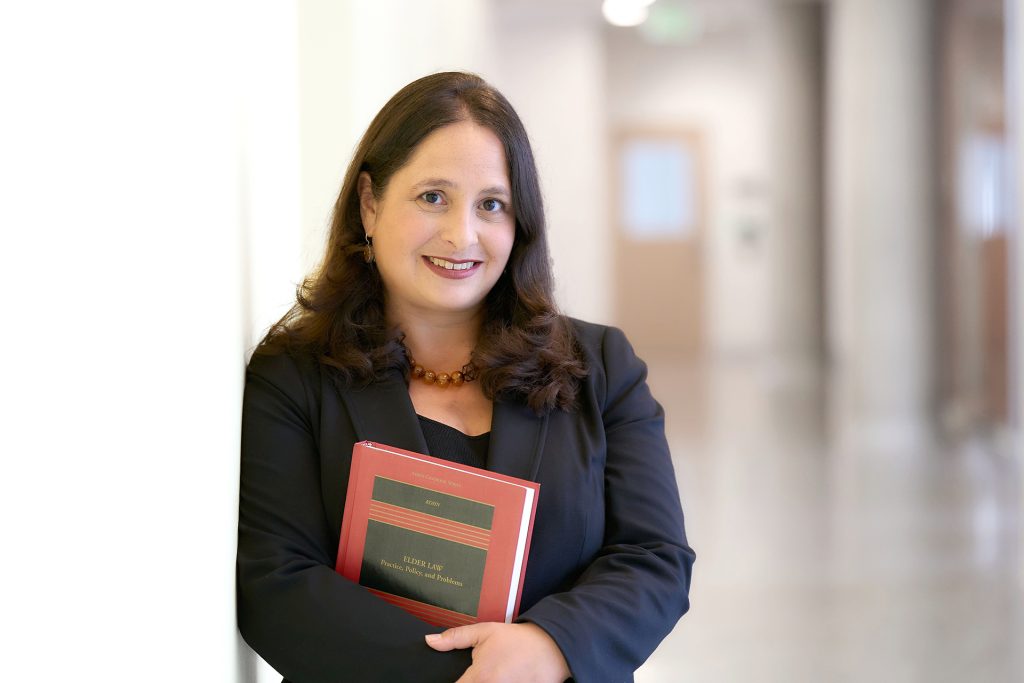
Syracuse University College of Law’s Distinguished Professor Nina Kohn is helping to create “gold standard” legislation on some of the most important issues facing older adults and individuals with cognitive disabilities.. Based on her legal expertise, including in the area of elder law, Kohn, the David M. Levy L’48 Professor of Law and newly named Distinguished Professor, has worked closely with the Uniform Law Commission (ULC) to create model legislation for the states.
Kohn has been selected not once, but twice, to serve as a reporter for the ULC. The first act she worked on with the ULC was the Uniform Guardianship, Conservatorship, and Other Protective Arrangements Act (UGCOPPA), which the ULC describes as a “comprehensive guardianship statute for the 21st century” that encourages person-centered guardianship reform, including promoting less restrictive alternatives to guardianship. The second act was the Uniform Health-Care Decision Act (UHCDA), a model law governing advance directives and healthcare decision-making for patients without surrogates.
Since joining the College of Law faculty in 2005, Kohn has been an active teacher and prolific scholar. Her research addresses a variety of legal topics associated with elder law, including age discrimination, family caregiving, elder abuse, and supported and surrogate decision making. She is also the author of the leading casebook on elder law. In addition, Kohn has taught on elder law, family law, trusts and estates, torts, and an interdisciplinary gerontology course. She has also served in a variety of public service roles for organizations such as the American Bar Association, the American Law Institute, and the Association of American Law Schools.
However, one of the highlights of her impressive career to date is being selected twice to be a reporter for the ULC, something she calls “the biggest compliment.”
“It’s hard to say ‘no’ when legislators are saying, ‘We’re interested in making our laws better. Can you help us?” she states. “It’s incredibly satisfying to be able to make a difference and see states improve their laws to make life better for families, patients, and health care providers.
“Being a reporter is part mediator and part editor, as you listen to and try to align the interests of diverse groups and commissioners,” says Kohn, noting that most states do not have the bandwidth to write this type of model law on their own. “Your function as a reporter is to enable a very deliberative, expert-informed, non-partisan approach that integrates various viewpoints and experiences into a model law that is as good as it can be.”
According to Kohn, the ULC model laws give states a solid, consistent starting point, which they may modify to suit their specific needs, budgets, or priorities. The details of the final laws are up to the individual state legislatures.
Kohn finds satisfaction in some recent successes in enacting the acts she has worked on. Consistent with the bipartisan nature of the acts, the UHCDA has been adopted into law in Delaware, a blue state, and Utah, a red state, in partisan efforts that will be beneficial to many. In addition, the UGCOPPA has been adopted in Maine, a blue state; the state of Washington, also a blue state; and Kansas, a red state.
She also believes that her expertise as a reporter has made her a better professor, as she is able to share with her students first-hand knowledge of cutting-edge legal debates and how the law is progressing on a state-by-state basis. Kohn reports that this work has also made her more sensitive about statutory drafting issues, and she has consequently spent more time in the classroom helping her students interpret, critique, and draft statutory language. She also says it has encouraged her to help students appreciate that even when people initially come at an issue from opposite viewpoints, there is often plenty of common ground to be discovered.
The work of a reporter can go on for years, but Kohn is prepared to stick with it in the hopes of seeing the two model laws enacted in as many states as possible.
“It’s hard to say ‘no’ when legislators are saying, ‘We’re interested in making our laws better. Can you help us?” she states. “It’s incredibly satisfying to be able to make a difference and see states improve their laws to make life better for families, patients, and health care providers. This process is an example of how we can work together in a partisan age, and it’s a source of pride to know that my work is helping to bridge differences and improve the law.”
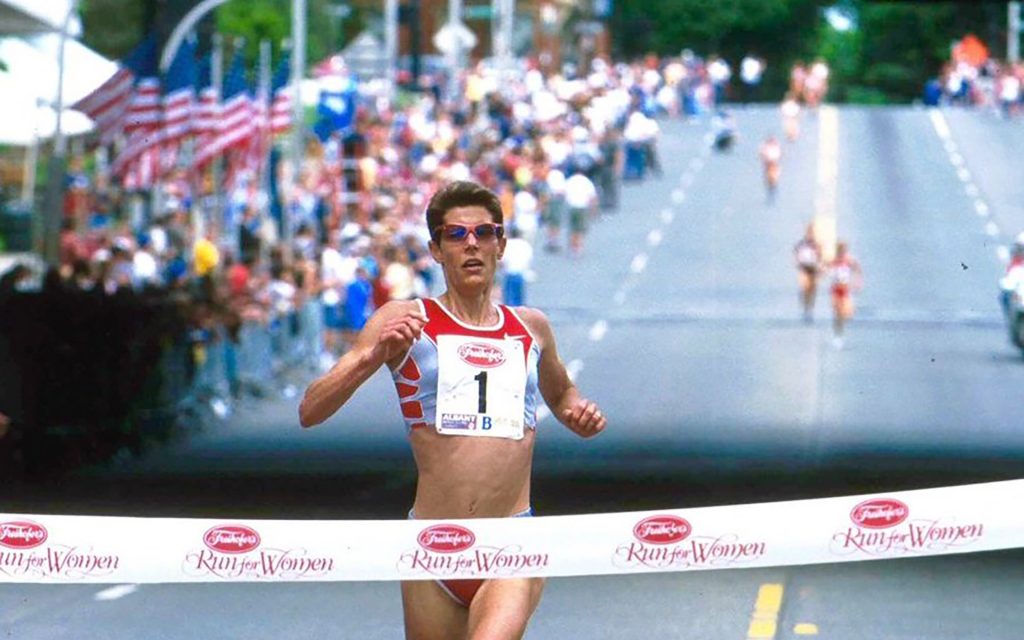
A runner for most of her life, Marla Runyan L’25 crossed yet another finish line when she walked the stage in May to accept her diploma from the Syracuse University College of Law. While this was quite an achievement, she is no stranger to hard work and success. Legally blind, Runyan has literally crossed hundreds of finish lines while competing in the Olympic and Paralympic Games in track and field. This month (July 2025), she will be inducted into the U.S. Olympic and Paralympic Committee (USOPC) Hall of Fame alongside such other greats as tennis phenom Serena Williams, gymnast Gabby Douglas, skier Bode Miller and basketball coach Mike Krzyzewski.
At age 9, Runyan lost much of her vision to Stargardt’s disease, but this never stopped her from participating in athletics, eventually competing in track and field at San Diego State University, where she received her undergraduate degree in education of the deaf and a master’s degree in education of deaf/blind children. (She also earned a second master’s degree from the University of Northern Colorado in special education, vision impairment.) Runyan competed in the 1992 Barcelona and the 1996 Atlanta Paralympic Games, winning five gold medals and one silver. After setting world records in the T13 classification in every event from the 100-meters to the marathon, Runyan stepped away from para athletics and set her sights on making the U.S. Olympic Team.
“After 1996, for me it was the Olympics or nothing,” Runyan explains, noting that she did not require a guide runner when racing. “I needed to compete in an environment where the expectation was that I was just like anyone else, competing and training with the best athletes in the world.”
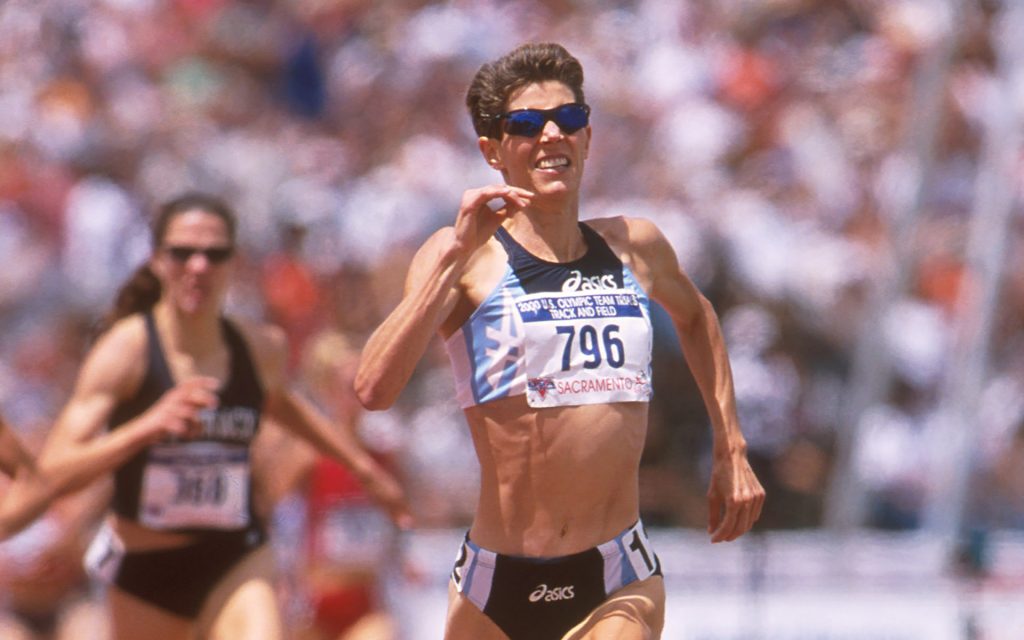
And she did just that. The only legally blind U.S. athlete to qualify and compete in both the Paralympic and Olympic Games, Runyan represented the U.S. in the 2000 Olympics in Sydney in the women’s 1,500 meters and in the 2004 Olympics in Athens in the women’s 5,000 meters.
“For much of my life, I felt I had to prove a point— that disability does not preclude excellence.” she explains. “Earning a spot on two U.S. Olympic teams was the realization of a lifelong dream, but it also gave me a platform to change perceptions and attitudes about what is possible.”
In addition to her Olympic success, Runyan also was the top American female finisher in the New York City (2002), Boston (2003) and Chicago (2004) marathons finishing fourth, fifth, and seventh in the professional women’s field for those events, respectively. She was also the National Champion at 5000-meters from 2001- 2003.
Marla Runyan at the 2000 USATF Olympic Trials in Sacramento,CA Photo: Victah@Photo Run
Runyan retired as a professional athlete in 2008, but her passion for equity and access carried through to her next chapter, which included working in digital accessibility at the Perkins School for the Blind in Boston; as a para athlete and accessibility manager for the Boston Athletic Association, where she created a new competitive division for para athletes in the Boston Marathon, as assistant director of digital accessibility at Syracuse University; and in her current role as accessibility policy and procurement strategist in the Executive Office of Technology Services and Security, for the Commonwealth of Massachusetts.
Her impetus to go to law school stemmed from her advocacy work for individuals with disabilities and her passion for sport equity. “Despite what I have accomplished in my lifetime, as a woman and a woman with a disability, I have felt underestimated in the work force, and for me to get things done I knew I had to be over-accomplished just to have the same opportunities, so I decided a law degree would support me in that endeavor,” she explains.
While Runyan was accepted at another law school in the Boston area where she lives, it was a full-time residential program that would have forced her to give up her job and sacrifice time with family. Syracuse’s JDinteractive (JDi) program was a much better fit for her, as its year-round hybrid program allowed her to spread out the online coursework and balance her career and time with her daughter.
And while law school came with challenges, this Olympian made it work.
“When you are a person with a disability, you become a constant problem solver because no environment you’re operating in is designed for you,” she says. “You have to have strategies in how to negotiate and not only participate but excel in life. There’s a difference between showing up and being excellent in what you do. I had no plans to just show up!”
Tackling law school as someone with vision loss meant having a deeper understanding of the materials than her sighted classmates, who could quickly refer to their notes.
“I had to know facts and holdings backwards and forwards and not be dependent on visuals, and that’s a very tall order when you’ve got 15 case briefs to remember for each class,” Runyan explains, “but I created my own short hand, key words and prompts to spur memories of the case or the main takeaways. I thought of every case as a story, and I’ve applied what I’ve done throughout my life in terms of persevering and problem solving to make it through.”
Runyan especially enjoyed the JDi program’s residencies, where she was able to meet faculty and members of her cohort in person. When she attended the Foundation Skills residency on the Syracuse Law campus, she got to know Associate Dean for Academic Programs and Teaching Professor Shannon Gardner, whose “style of interaction was really respectful of all students,” Runyan says. “I felt she was a very important part of my law school experience and that she deeply cared for us and wanted us to do well.”
Runyan started using what she learned in law school in her own work right away, drafting policy and contract language to support digital access for users of assistive technology across the Commonwealth of Massachusetts.
While she’s not currently practicing law, she is “leaving the door wide open.”
“Don’t count me out,” says Runyan, who will be taking the Massachusetts Bar Exam next February. “The J.D. degree has opened up so many opportunities. Anything is possible.”
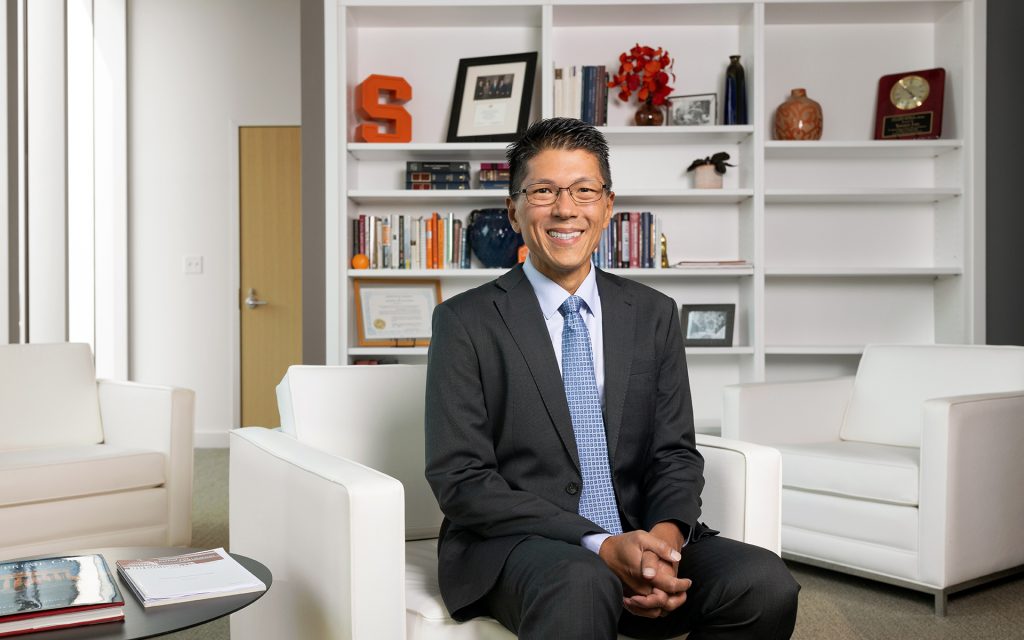
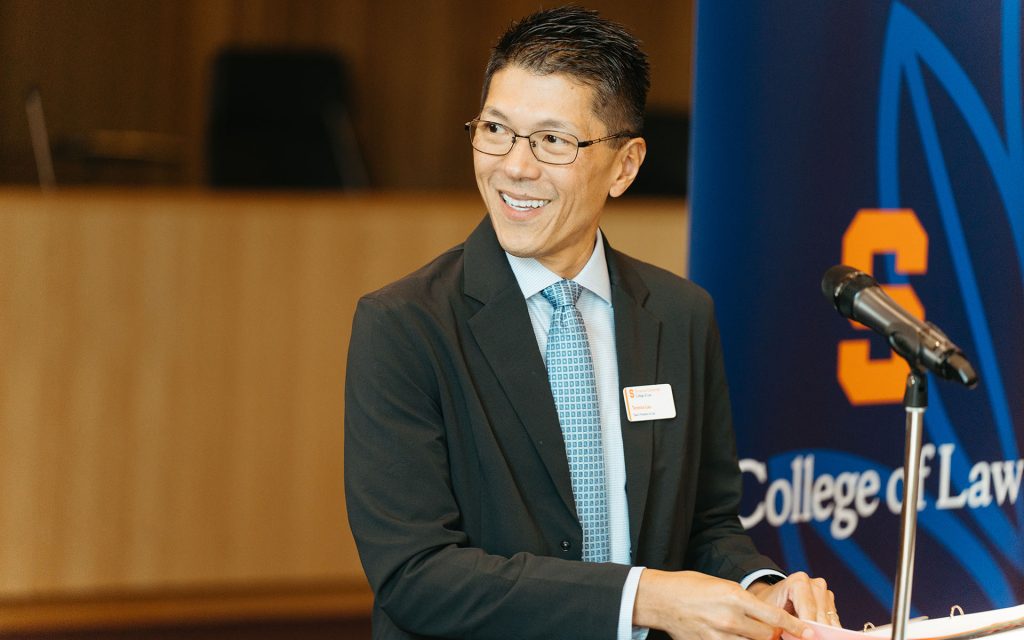
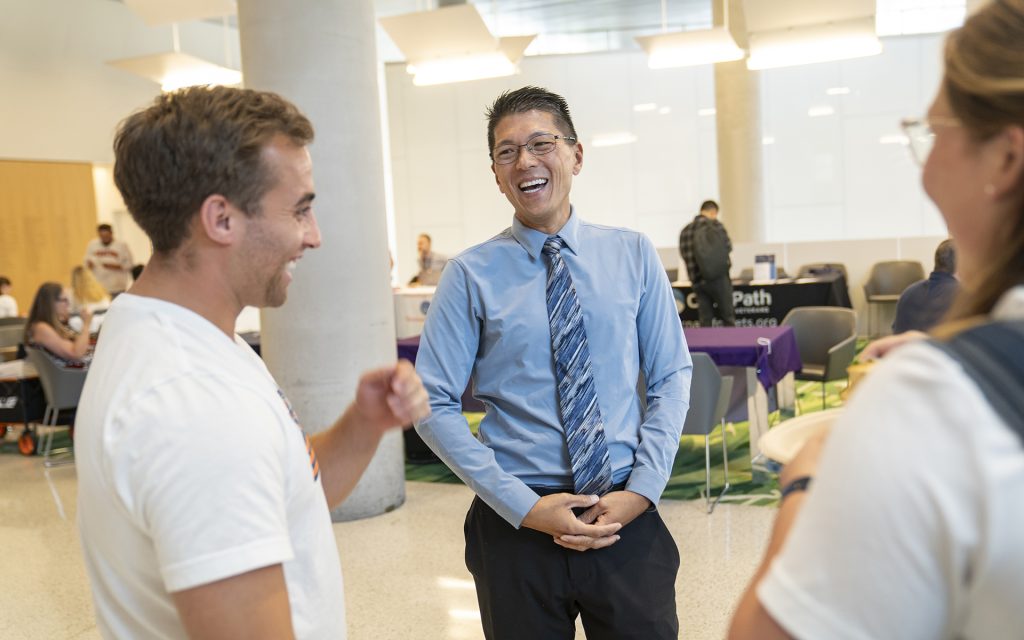
Three decades ago, Terence J. Lau L’98 walked the corridors as an eager student at the Syracuse University College of Law, then located in White Hall. He knew he had been given a rare chance—and a full scholarship—to be a part of Syracuse Law, and the opportunities ahead were endless. Today, his eagerness and enthusiasm are stronger than ever as he again walks through the halls of the Law School with the same sense that a rare opportunity has come his way. In August 2024, Lau began his role as the 13th dean of the Syracuse University College of Law — and the first alumnus to lead the Law School in its 130-year history.
Terence J. Lau L’98 has been named the 13th dean of Syracuse University’s College of Law.
The Foundations for a Career
Prior to applying to law schools, Lau was training to be a commercial airline pilot, but without the funds to continue, he needed a new plan. So Lau set his sights on the law. Syracuse Law not only offered him a scholarship but gave him the foundations for a successful career in law and higher education.
“Attending Syracuse Law changed the trajectory of my life,” says Lau. “I enrolled sight unseen, and it became my home for the next three years. I’m eternally grateful for the education and career opportunities the law school gave me. Returning to serve as dean is a true full circle moment.”
Lau stands out not only as an alumnus, but also for his unconventional path to becoming a law school dean. While he was a practicing attorney early on, much of his career has been in higher education, particularly in the business school space, giving him a distinct perspective in his new role.
Pivoting to Business in Academia
After receiving his J.D., Lau joined Ford Motor Corp. as an attorney, working in transactional, distribution, and international trade practice. In 2006, he became a fellow for the U.S. Supreme Court assigned to the Office of the Administrative Assistant to Chief Justice John Roberts.
Lau’s career quickly pivoted to a more business-oriented path when he joined the University of Dayton’s School of Business Administration, first as a professor of business law and then as director of international business programs, department chair of management and marketing, and, eventually, associate dean of undergraduate programs. In 2017, he spent a year in China serving as executive director of academic and corporate relations for the University of Dayton China Institute.
The following year, he returned to the United States to take on the role of dean of the College of Business at California State University Chico, a position he stepped down from just before coming to Syracuse.
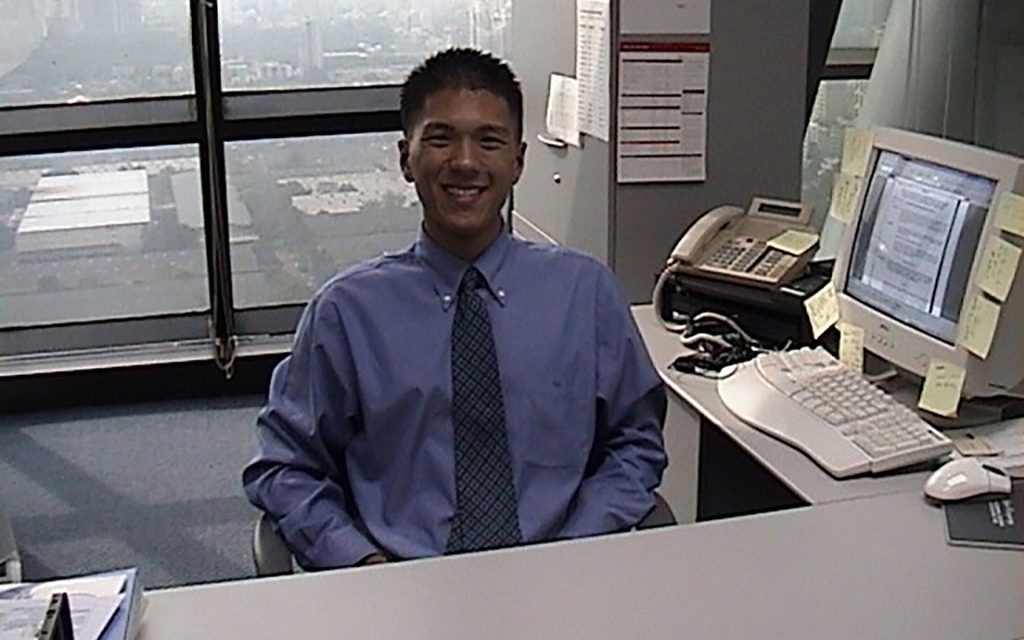
Dean Lau at his desk at Ford’s offices in Bangkok, Thailand.
Building a Long-Lasting Foundation
Taking on the role of dean at Syracuse Law has given Lau a chance to reflect on where he started and the path he took to get here today.
“I have great memories of law school, and I was also fortunate to experience the campus life of the greater University because, as part of my scholarship, I lived in the dorms as an employee of the Office of Residential Life for undergraduates,” he explains.
He says many of the best moments from law school revolve around the faculty. “When I run into other alumni, it seems everyone will talk about a specific faculty member who had a lasting impact on them,” Lau says. “And it’s that incredibly student-focused faculty who are a very integral part of what makes Syracuse Law much different from what you get elsewhere. They are practical and solution-oriented individuals who come to us having had a tremendous impact on the law through their scholarship and work experiences.”
Lau has his own list of faculty who made a lasting impression, including Professor of Law Emeritus Travis H.D. Lewin and former Dean Daan Braveman, now a distinguished lecturer in Syracuse Law’s JDinteractive (JDi) program.
“I was Professor Lewin’s research assistant, and he also coached me on the trial team. When we went into competitions, he would say, ‘Go to war; return in peace,’” says Lau. “Dean Braveman taught Civil Procedures my first year and told us, ‘You have to pass the “look yourself in the mirror every morning” test,’ referring to conducting yourself within the ethical and legal limits of the law. Both of these lessons have stuck with me as I navigated my career.”
A Personal Desire to Give Back
“Coming to Syracuse Law as a student is the center of all good things that have happened to me professionally, so I never lost touch with the law school,” says Lau, who has been an active alumnus since graduating. “I’ve been a donor for a long time because I wanted to pay forward what Syracuse Law gave to me, and, in 2022, I was honored to be asked to join the Board of Advisors and lend my experience to the law school and its future generations of lawyers.”
When Lau heard that Dean Craig Boise was stepping down, he offered his insights as a board member to the search committee, helping to shape the qualities they should seek in the next dean. His passion for Syracuse Law and his thoughts on new leadership clearly made an impression, as not long after, the search committee approached Lau to see if he was interested in the position.
The timing seemed right, as Lau was looking for another opportunity. Where better to further his career than his alma mater?
“Terence has a passion for the Law School and credits this place for a lot of his success,” says Professor of Law Todd Berger, co-chair of the Dean’s Search Committee. “For him, joining us as dean didn’t seem to be just the next step in his career. It was a very personal desire to give back to a place that truly impacted his life and his profession.”
According to Berger, the search committee was impressed by Lau’s background in higher education, particularly in a business school environment, as well as his foundation as a lawyer. “It gave an insider-outsider quality that made him a very intriguing candidate,” Berger says.
Nina A. Kohn, the David M. Levy Professor of Law, also co-chaired the search committee. “I think Terence brought a really sophisticated understanding of higher education and a sense of his vision of how the law school fits into the big picture of a research university,” she says. “And he has an outstanding ability to connect with a very broad and diverse group of stakeholders here, which is so important to our success.”
“I think it’s wonderful that he comes to us as an alumnus with a deep history of the College of Law,” Kohn adds. “He cares about the school in a very personal way, and I think it says a lot about how we value our students and about our confidence in the education we provide.”
Richard Alexander L’82, chair of the Syracuse Law Board of Advisors and partner and chair emeritus at Arnold & Porter, also admires the qualities Lau offered to the college.
“During the search process, Terence demonstrated a sophisticated understanding of the opportunities and challenges facing the Law School in the current environment,” says Alexander. “He impressed us with his enthusiasm and energy, as well as his commitment to driving success at the Syracuse University College of Law.”
From First-Year Student to First-Year Dean
Now that Lau has settled into his position as dean, he is solidifying his goals to retain the history and excellence of the school, while also working to see Syracuse Law reach its full potential.
“A lot has changed since I went to school here. The University as a whole has grown, climbed in the rankings and become more nationally and internationally known as the Orange brand has expanded. This has benefitted the Law School, as well,” he says. “But I’m proud to see that the values that I remember most — the role Syracuse University and the College of Law play in the greater community and the generosity to the region — have never wavered.”
Lau acknowledges that going from the dean of a business school to that of a law school is not the most common path. “Being a dean is largely the same skillset, but being a dean of a business school is not a natural step for a lawyer,” he explains. “However, this dual path has allowed me to become familiar with the study and operations of business such as management and budgeting, which are as necessary to running a law school as knowing the law. And it has allowed me to make decisions from both perspectives, which I believe will be a real benefit.”
Goals: The Roadmap to Tomorrow
Lau is solidifying his goals to continue the growth of Syracuse Law. While he has many ideas, some of his priorities focus on growing the JDi program, increasing the number of full scholarships the College of Law gives, creating an even richer campus culture by attracting more students to the international Master of Laws (LL.M.) program, and taking a careful look at what improvements might be made to the existing on-campus J.D. program.
According to Lau, one of the biggest strengths at Syracuse Law is its JDi program, which allows non-traditional students to become lawyers through a hybrid courseload.
“Business schools have had an online component for a while—but not so much law schools,” he explains. “Our JDi program started in 2019 and was the first program in the nation to be accredited by the American Bar Association (ABA). Today, almost half of our students are part of the JDi program, and it has become a legitimate alternative for working adults, those raising kids, and others who want a Syracuse Law education but can’t be on campus every day. That was simply never an option when I was in school. Only those who had the financial resources to take time off to be a full-time student could go to law school, which was very limiting.”
Lau believes the JDi program has expanded that level of opportunity and says the ABA has become more flexible about the rules for operating a hybrid program. (Students in Syracuse’s JDi program take classes and participate in activities online, but are required to attend several in-person residencies on campus or in a variety of other cities throughout the program.)
“Today, we have a whole group of students, from those on active duty in the military to retirees starting their next chapter. Many of these JDi students would not otherwise have had the opportunity to earn their law degrees,” he says.
Syracuse Law’s JDi program is currently limited by the ABA to 125 students, but Lau is determined to increase its capacity of qualified students “slowly and by demand.”
“Right now, we turn away a lot of qualified people, but by growing the program in an intentional, measured way, we can offer a quality legal education to a lot more people,” he explains.
Lau also intends to examine the existing on-campus J.D. program, which has not seen significant changes in years, to “offer different flavors, so students can become experts in a greater variety of areas of the law as they prepare to enter the professional legal arena.”
As someone who relied on a scholarship to attend Syracuse Law, he also hopes to increase the number of full scholarships the Law School provides. “I wouldn’t be here today if I hadn’t received a three-year scholarship,” he says. “The truth is we don’t give out many full-rides, and we need to take a closer look at improving on that in order to make Syracuse Law financially accessible to more people.”
Another important focus is the LL.M. program for international legal professionals. “There are some very accomplished people already working in the legal field as lawyers and judges from around the world who come here because they want a degree with a U.S. perspective,” says Lau. “We have the opportunity to expand this program, particularly in the area of tech transfer and technology, which is a growing need for foreign lawyers. Those enrolled in the LL.M. program add a richness to our campus community, and I’d like to see more of that in the future.”
One additional goal is continuing to strengthen ties across the greater University with more cross-disciplinary opportunities and initiatives.
“We know that there are many areas of interest across campus that pair nicely with the study of law, and I’d like to see us leverage more of that,” says Lau. “We already have a 3+3 program with the Whitman School of Management that allows qualified students to start law school after only three years of undergraduate work. And, we have several joint degree and certificate programs with the Maxwell School of Citizenship and Public Affairs, as well as our new center in Washington, D.C., which should allow us to maximize that relationship and provide a greater focus on public affairs and public policy laws.”
But it doesn’t end there. “We know there are other interests across campus like entertainment and sports management, and I’d like to see us do more with places like the Falk School of Sport and Human Dynamics or the Newhouse School of Public Communications, for example, to create mutual opportunities and greater options,” Lau says.
Dean Lau and Professor Elizabeth Kubala, Director of the Betty and Michael D. Wohl Veterans Legal Clinic, speak with a visitor to the 2024 Vet Fest held in Dineen Hall.
Faculty Is Heart of the College of Law
One thing Lau is certain of is the excellence of the current faculty, and he intends to work to further support their areas of interest as an important part of keeping Syracuse Law going strong.
“The long-standing and incredibly student-focused faculty we have here is the heart of the College of Law,” he says, noting they are one of the primary differentiators from the experience one might get at another law school. “The level of accomplishment in the legal field and their interest in transferring that knowledge to our students is extraordinary here.”
Lau believes that the best way he can support faculty is by encouraging their ideas and helping to find ways to fund them — “and then get out of the way!”
“We want to create a culture here where the faculty have the ability to try new things, get the funding they need and hopefully succeed, but also not be afraid to fail,” he explains. “I’d like to see a culture that rewards faculty for asking questions, taking risks and innovating. And having the resources to support these innovators and risk takers is absolutely critical and a benefit to us all.”
Solidifying Network of Alumni Support
As a graduate himself, Lau certainly recognizes the importance of solid relationships with Syracuse Law’s alumni. He intends to further increase alumni support and involvement to ensure that current students are entering the legal profession with the most current skillsets, legal experience, and access to a network of more than 11,000 willing to help them succeed.
“Syracuse Law alumni are found in the world’s largest law firms, in startups, government, as CEOs, judges, and in the public sector working for the common good,” he says, noting that the Law School is among the select few law schools that count a U.S. president, former President Joseph R. Biden L’68, among their alumni.
“Our alumni are known for their willingness to roll up their sleeves, and I hope to reach out even further into this network, listen to their ideas and rely on their support. I encourage any alumnus who would like to become more closely involved in the law school to reach out to me personally,” he adds.
Today, with a full academic year under his belt, Lau walks through Dineen Hall with a trifecta that truly no one else has — experience as a student, alumnus, and dean.
“I have always taken great pride in the College of Law and the various perspectives I have been fortunate to have here,” he says. “Certainly, being a graduate of Syracuse Law adds an additional layer of responsibility to lead with those students, faculty, former deans and other supporters who have come before me, but it is also a privilege to keep Syracuse Law on an upward trajectory creating the lawyers of tomorrow. And I am up for the challenge!”
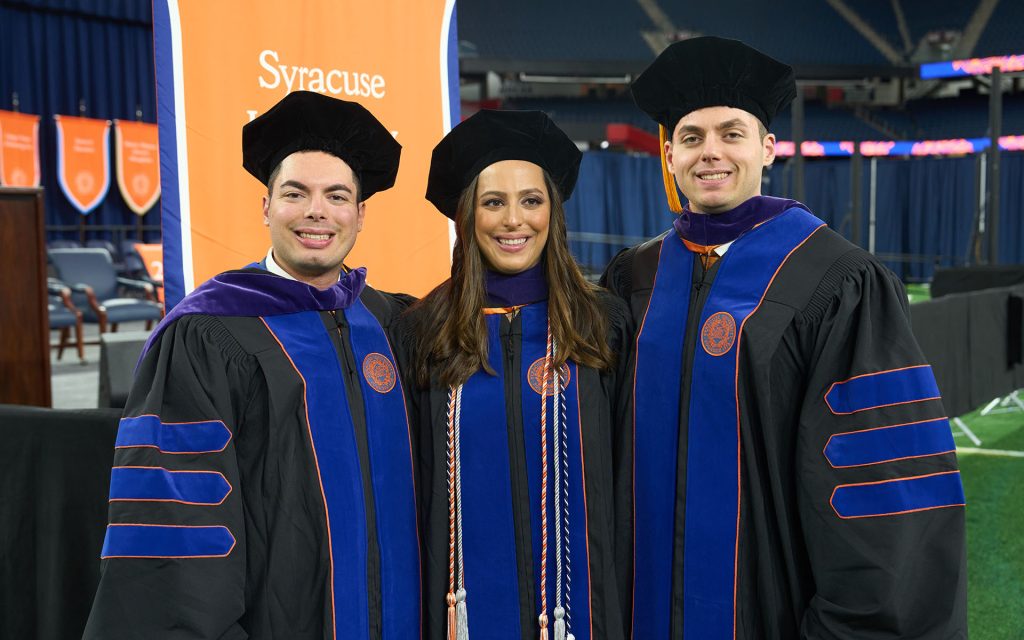
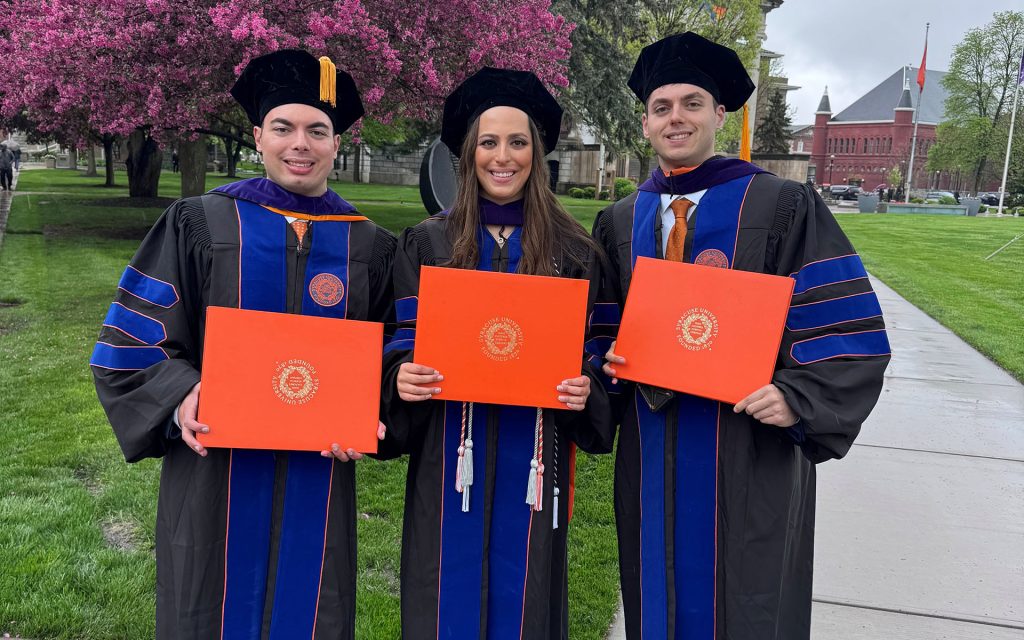
Nicole L’25, Robert L’25 and Matthew Gelb L’25 have the distinction of being triplets who graduated together from the Syracuse University College of Law in May. But that’s not the only unique thing about this close knit trio. They are also the fourth generation of their family to attend Syracuse Law and the only set of triplets to graduate together in the law school’s history.
The legacy started with Robert Miller L’29 who enrolled at Syracuse Law nearly 100 years ago. After that, his son, the Hon. Michael J. Miller ’60 (MAX), L’63; and daughter, Joan Miller ’58 (SOE), attended Syracuse. Joan married Allan Wolk ’58 (WSM), L’60, who graduated from the Law School. The couple had a daughter, Sandra Wolk Gelb L’92, who also attended Syracuse Law and is a real estate attorney. And this spring, Sandra and her husband, Jay, watched proudly as their triplets, Nicole, Robert and Matthew, crossed the stage to receive their law degrees, continuing the family tradition.
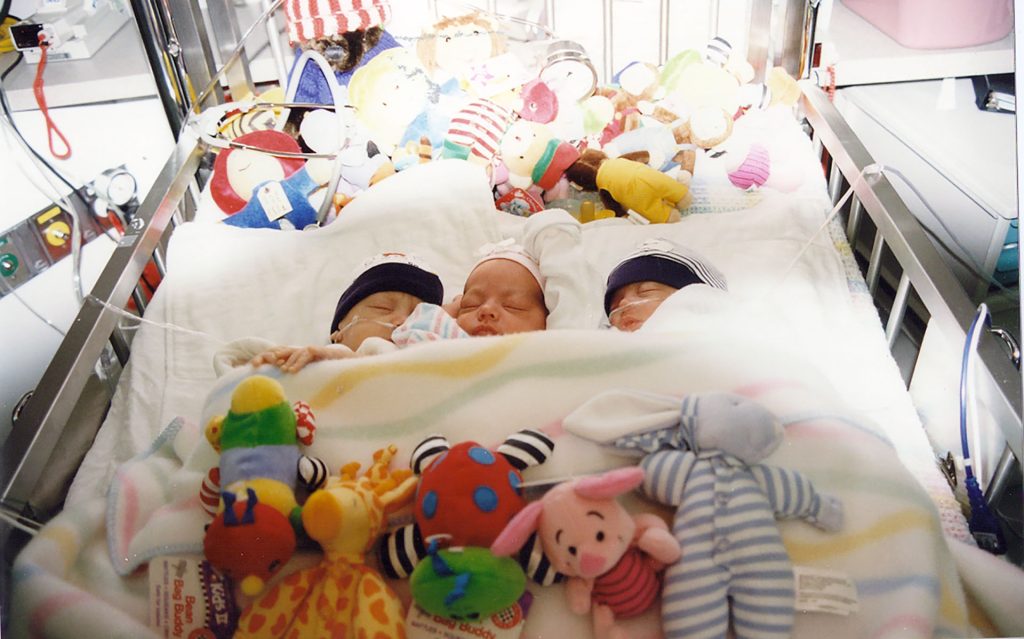
The triplets have been achieving challenging goals since the day they were born at only 29 weeks gestation. Matthew weighed only 1.5 lbs., Nicole 2 lbs. and Robert 2.5 lbs. They were given less than a 50% chance of survival, but these feisty micro preemies fought hard and three months later emerged from the NICU at Rochester’s Golisano Children’s Hospital as thriving babies.
Growing up, all attended grade school together, and then each made their own decision to attend their mother’s undergraduate alma mater, The University of Rochester (U of R). Robert and Matthew studied business, while Nicole pursued psychology, and all three participated on the U of R swim team. The triplets had individual college experiences but remained close, so when all three decided to pursue law school, they jumped at the chance to continue the family legacy at Syracuse Law.
While they are sometimes lumped together as “the triplets,” each have their unique strengths and interests. Matthew is drawn to real estate law, and he has wanted to be a lawyer since his mother brought the children into her law firm to meet the partners years ago. Nicole describes her brother as “the kindest person I’ve ever met” and says he stands out among everyone they know.
Nicole has wanted to pursue law school since she was a high school student with a particular interest in elder law sparked from volunteering at a nursing home. “She’s the CEO of the group,” says Sandra. “Nicole was born in the middle, and she’s been in charge of both boys ever since.” Her brothers describe her as a “people person” who is very caring but likes to argue, a good quality in a lawyer. Nicole hopes to eventually pursue a career in family law/elder law.
Robert, the youngest of the triplets, is described by his siblings as “funny and a great storyteller,” something his family thinks will benefit him in his law career, as he is often able to diffuse a tense situation with his humor. Named after his great-grandfather Robert Miller, the original family member to attend Syracuse Law, he is known for his strict study schedule and intends to specialize in tax law. “Robert is the most studious of the three of us. He takes it to the next level,” says Matthew.
While they are always there for one another, the Gelbs did not live together as undergraduates or in law school, each taking different classes and pursuing various interests. Nicole was drawn to the law school’s newly established Housing Clinic, assisting low-income tenants with issues like eviction and rental housing conditions, and the new Syracuse Medical Legal Partnership, a collaboration between SUNY Upstate Medical University’s pediatrics department and the Law School that provides advocacy to vulnerable members of the community and works together with medical professionals for positive health outcomes. Matthew also participated in the Housing Clinic, enjoying the challenge of juggling multiple clients. Robert was interested in the Transactional Law Clinic, assisting clients with contracts, copyright protection and more. However, all three did participate in the College of Law’s Bankruptcy Clinic, helping individuals in need of financial relief, and they also joined an International Tax Law residency last summer in Switzerland led by former Dean Craig Boise.
“We all excel at different things while having our love of the law in common, but I think the experience at Syracuse Law has been outstanding for all of us, as we not only earned our law degrees but have honored our family legacy times three,” says Nicole.
Now that the triplets have graduated, they have wasted no time studying for the bar exam in both New York and Florida, giving them more flexibility in their career paths. Their first steps are to work for the family business , which operates in both states.
Continuing a Legacy of Giving Back
Sandra and Jay could not be more grateful to the law school for their children’s success, and Sandra is especially proud to see the fourth generation graduate from Syracuse Law. The couple has also followed the family’s legacy of generosity to the Law School. Sandra’s father established a scholarship for deserving students in 1995. In 2000, Sandra and Jay decided to renew that gift with the establishment of the Robert Miller L’29, Joan ’57 and Allan Wolk ’58, L’60, Jay and Sandra Wolk Gelb L’92 Family Scholarship, providing financial assistance for students at the Law School with demonstrated financial need.
“Helping others succeed in the law is what we stand for,” says Jay. “The cost of any law school education is difficult for some to handle without outside support, so we like to give back to the Syracuse community and help others.”
Certainly, the Miller/Wolk/Gelb legacy is firmly cemented in the history of Syracuse University’s College of Law, as is the generosity and support of the family. “Our children are true miracles, and they are achieving goals beyond anything we could have ever expected on the day they were born,” says Sandra, who is a member of the College of Law’s board of advisors.
“The Law School has long been important to generations of my family, and today it is a beautiful, state-of-the-art facility with everything a future lawyer could need. The Syracuse network, both the Law School’s and the University’s, extends far and wide, and now our children are a part of that, too. We are so appreciative of the many opportunities the Syracuse University College of Law has given four generations of my family over the past century, and we are especially excited to see how our three brand new lawyers will succeed in the future.”
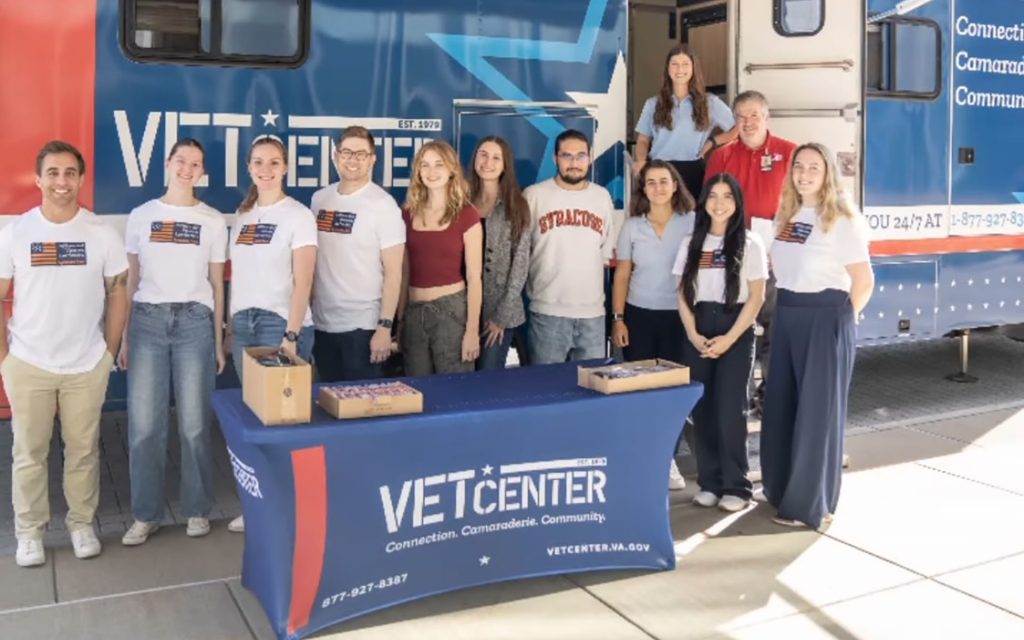
Last year, the College of Law and Syracuse University School of Social Work launched the Legal-Social Work Partnership Program to provide free, high-quality legal services for veterans, along with social work insight and guidance.
Established in 2023 with the help of Wendy Goidel ‘84, Esq., the partnership has worked to help reduce veteran homelessness and suicide rates while improving the lives of veterans and military families. The program provides Falk social work students who are interested in the intersection of law and social work with a Fellowship that allows them to conduct field work through Syracuse Law’s Betty and Michael D. Wohl Veterans Legal Clinic (VLC).
“I hear the collaborative energy, and see the law and social work students learn from one another and contribute their unique skills to the cause, which is certainly inspiring,” Assistant Dean of Online and Distance Education, and Associate Teaching Professor in the School of Social Work, Ken Marfilius said. “That’s exactly what Wendy set out when she first wanted to bring this model to life in this capacity.”
Benetta Dousuah G’25, the program’s first Fellow, played a key role in bridging the gap between legal support and social services, creating stronger student-attorney/client relationships by providing the law students with a better understanding of the empathy and awareness needed for the bigger picture, rather than an individual legal problem. Law students began adopting more holistic approaches, realizing the need for non-legal services and recognizing when they should find a resource that is better suited to handle certain problems to create outcomes for veterans seeking support. As a result, more than 100 veterans were served through the 2023-24 Legal-Social Work Partnership Program.
“Sometimes the VLC might be able to get that veteran access to VA healthcare and VA compensation, but they’re still having challenges with their family or getting a job or with their landlord,” Executive Director of both the VLC and Syracuse Law’s Clinical Education, and Director of Veteran and Military Affairs, Elizabeth G. Kubala said. “As a lawyer you want to make sure that your impact is sustainable, and sometimes you realize for that impact to be lasting, there are a number of other things that need to fall into place as well.”
Treating the Whole Person
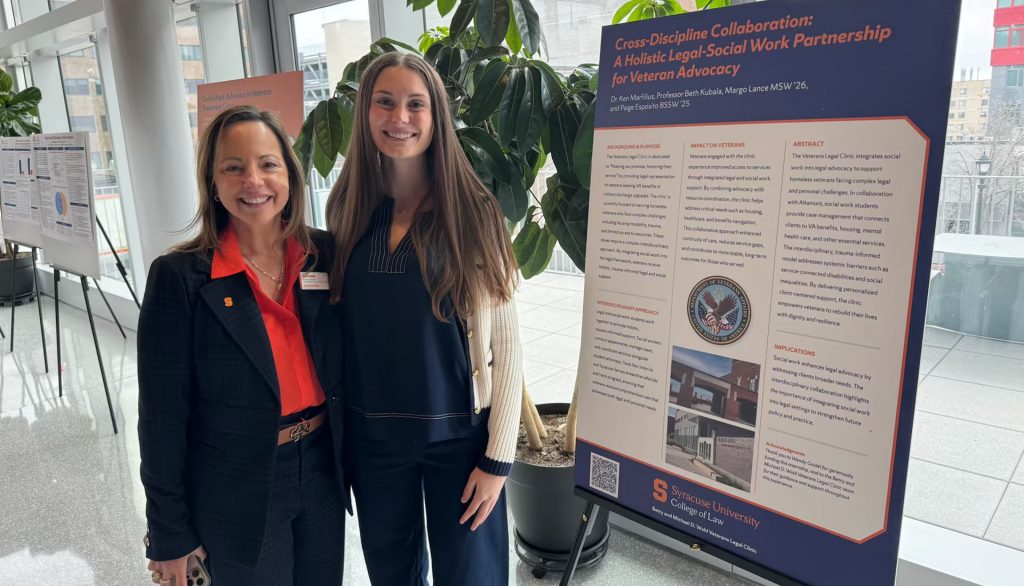
Building on its first year success, the Goidel Law Group Internship Fund expanded the Legal-Social Work Partnership program to include two Fellows for their second year, bringing in undergraduate Paige Esposito and graduate Margo Lance, to leverage their social work skills alongside the law school students tackling challenging legal issues for veterans. Realizing the various barriers and challenges it took for veterans to come to campus to receive support from the clinic, the team started travelling to Altamont, a local VA residential program in Syracuse, once a week to provide their services directly to clients.
“The legal process can be very overwhelming, confusing and frustrating,” Esposito said. “On top of having to navigate all the factors of homelessness, they’re getting a bunch of legal jargon and serious technical terms thrown at them, so we take a step back and touch on different things that the legal system does not, to focus on the person.”
The student-attorney’s main focus is on getting each veteran discharge upgrades that will lead to improved healthcare and financial support, but sometimes it takes a village to accomplish a simple step that is only one part of the overall legal process. While lawyers may not necessarily pick up a client and take them to a doctor’s appointment, for example, there are people who will, and understanding the different facets of a holistic veteran support team has only improved the VLC’s services. Getting client referrals directly from the Syracuse VA’s Health Care for Homeless Veterans program, Lance and Esposito have integrated themselves into the VA social work team as well, working with case managers and program directors that provide additional services to homeless veterans.
“What’s evident in year two is expansion of collaboration, it’s grown in both scope and impact,” Marfilius said. “Expanding the focus beyond traditional legal advocacy to really include comprehensive trauma-informed assessments and case management.”
While the law students are working to connect veterans with benefits, the social work Fellows assist with the intake process, figuring out what they think each veteran needs alongside the requests made by the clients themselves. Using enhanced communication platforms like UniteUs and SyracuseServes, Lance and Esposito are able to streamline referrals and coordinate care across disciplines, ensuring the veterans’ needs are being met.
“My role is to serve them outside of everything that this student attorney is doing…I interpret how I think social work can play into all the things that they do,” Lance said. “I focus on treating the whole person and that can be anything from food stamps up to if they’re interested in joining a church or engaging in community events.”
By working with the social work Fellows, law students can recognize how this support system helps to alleviate certain needs of their clients, understanding that veterans often face a whole host of challenges that must be addressed to move forward. By holistically identifying the needs of each client, the student-attorneys are able to focus on the areas in which they are best equipped to serve.
“You see tangible improvements in veterans’ stability, not just from a legal standpoint with discharges and upgrades, but also well-being in that stability,” Marfilius said. “There’s interdisciplinary success, the integration of law and social work has resulted in more comprehensive care that addresses both legal and psycho-social challenges.”
Building Up the Community, One Person at a Time
The legal challenges veterans face are unique, typically related to the details of their service, and require a specialized legal background and understanding to solve. As veterans age, these barriers can worsen and begin to involve different areas of their physical, social, and emotional health. Without an appropriate discharge status, many are unable to access the very services designed to support them.
“My dad is a U.S Army veteran and he’s now 100% service-connected. These benefits were something he earned, and the Syracuse Veterans Legal Clinic played a huge part in helping him finally get them,” Lance said. “Watching these student attorneys just jump right in and take care of all the things my dad once had to handle alone is incredible. Now, I’m able to assist people in this process where he didn’t have assistance, helping other veterans access the support they deserve. It’s the most rewarding thing in the world.”
Since its creation, the Legal-Social Work Partnership program has helped a large number of homeless veterans move into permanent housing and access VA healthcare. Now, almost ten clients have achieved an 100% VA rating, meaning they receive $4,000 in disability compensation each month.
“You want to know how to make a difference in a homeless veteran’s life? Get them eligible for healthcare in the VA medical center right here in town and get them monthly steady income,” Kubala said. “That is the kind of impact we’ve seen. We’re impacting veteran homelessness right here in our community.”
Every veteran’s story is different, and the Legal-Social Work Partnership program has proven the need for empathy, patience, and a willingness to figure out what will actually help in each case. What began as an innovative collaboration between Syracuse Law and School of Social Work has evolved into a model for community-driven change, and by meeting veterans where they are, both physically and emotionally, the Legal-Social Work Partnership program is helping to rebuild lives piece by piece.
“We’re taking an underserved and deserving population, and setting them up for a successful life,” Lance said. “It feels like it’s building up the community one person at a time.”
Clarisse De La Cerda, a College of Law S.J.D. candidate focusing on intellectual property law, moderated a “Table Topic” discussion at the International Trademark Association’s (INTA) annual meeting. The topic was “IP Protection for Video-Games: How Can Trademarks Contribute for Better Enforcement of Rights?”
“A video game encompasses multiple potentially overlapping IP protection issues. The discussion covered the most efficient strategy for IP protection and licensing, according to the participants’ experience. In the area of enforcement, we discussed how litigation can serve as a powerful weapon,” says De La Cerda.
The session ended with a Who Am I? game covering trademarks related to video games.
INTA’s Table Topics sessions offer focused discussions on trending issues and critical questions that bring together global experts from all aspects of trademark enforcement.
De La Cerda is also a member of INTA’s Academic Committee, which provides law students and professors with educational services and support.
Her S.J.D. dissertation focuses on applying an antitrust solution to the enforcement of invalid intellectual property rights. Her advisor is Professor Shubha Ghosh.
Thanks to the efforts of the Betty and Michael D. Wohl Veterans Legal Clinic (VLC) within the College of Law, hundreds of area veterans have received their benefits or successfully upgraded their military discharge through the pro bono, student-offered legal services since its founding in 2015.
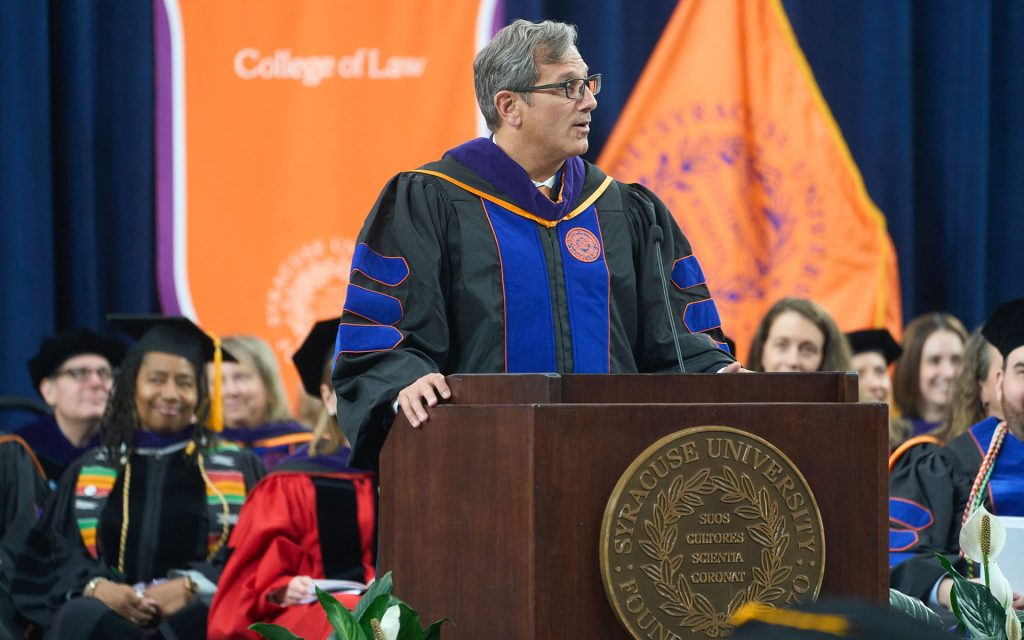
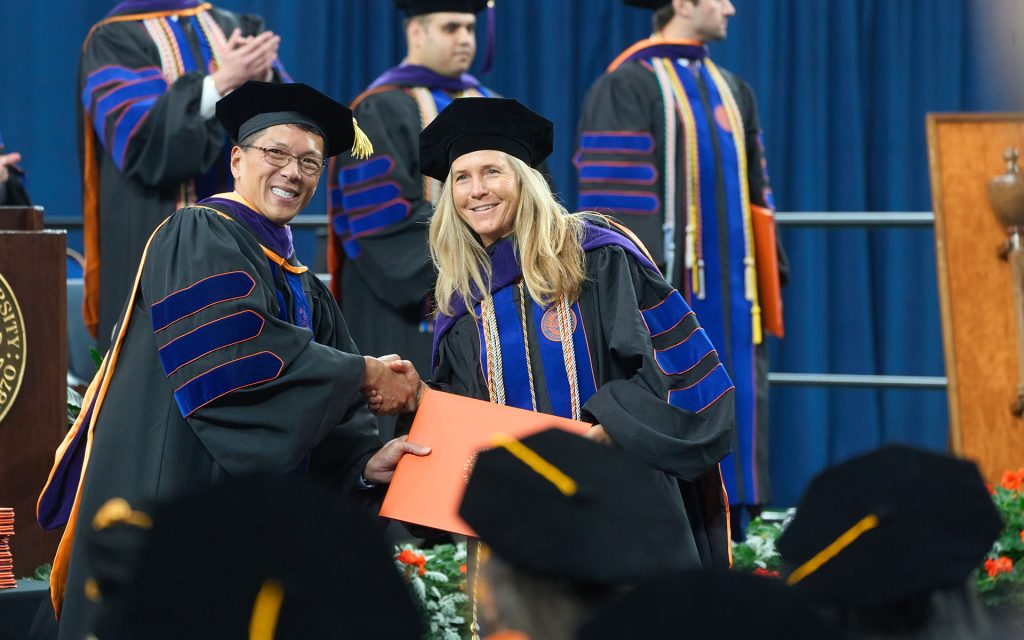
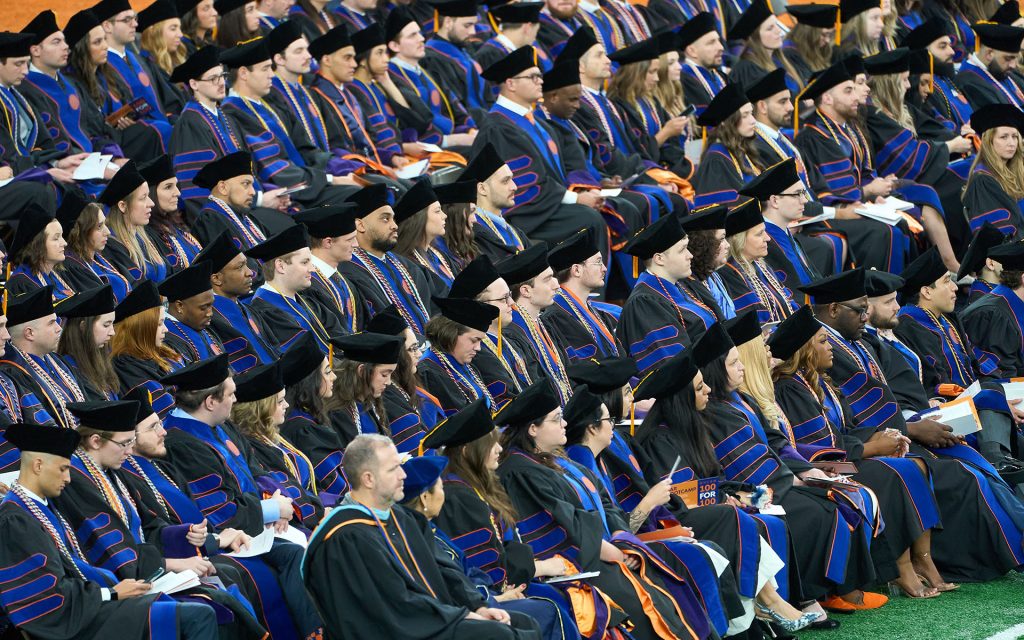
Syracuse University College of Law recently held Commencement exercises for the Class of 2025. The Class of 2025 includes 208 recipients of the J.D. degree and 24 LL.M. graduates.
Commencement Speaker Frank Ryan, Americas Chair, Global Co-Chair, and Co-CEO of DLA Piper and a Member of the Syracuse College of Law Board of Advisors.
Frank Ryan IV ’90, L’94, the Class of 2025 Commencement Speaker, emphasized the need for resilience as graduates step into the legal profession amid a time of complexity and uncertainty. “The finest and greatest professionals, who often are those who seem to be the happiest and most fulfilled in their professional lives,” he explained, “have three core characteristics: (1) they have a growth mindset, (2) they are anti-fragile, and (3) they understand the power of time.”
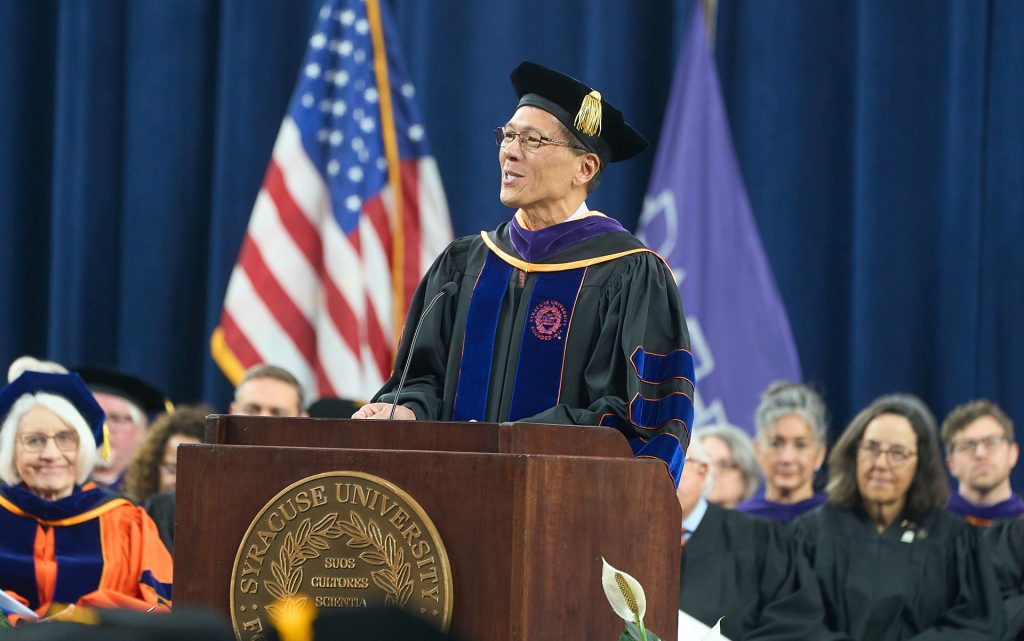
Dean Terence Lau addresses the Class of 2025.
In his first Commencement address, Dean Terence Lau reminded the Class of 2025 that above the main entrance of the Supreme Court of the United States are the words “equal justice under law.” And yet carved on the back, just as commanding, are the words “justice, the guardian of liberty.”
“These words remind us that liberty is not passive,” he said. “It doesn’t endure on its own. It’s protected and upheld every day by people like you. People who are called to serve justice with fairness, with wisdom, and with compassion. That’s the role of a lawyer. Not just to interpret the law, but to help make it work for everyone and ensure it is accessible and just. And in doing so, you help strengthen the public’s trust in the very foundation of our democracy.”
During Commencement, the J.D. Class of 2025 awarded Associate Professor of Law Laura Lape the Res Ipsa Loquitor Award (voted upon by the graduating class in recognition of a faculty member who has demonstrated exceptional commitment and service to the College of Law).
Associate Professor of Law Laura Lape carries the mace to begin the Commencement Ceremony, a symbol of tradition and academic excellence.
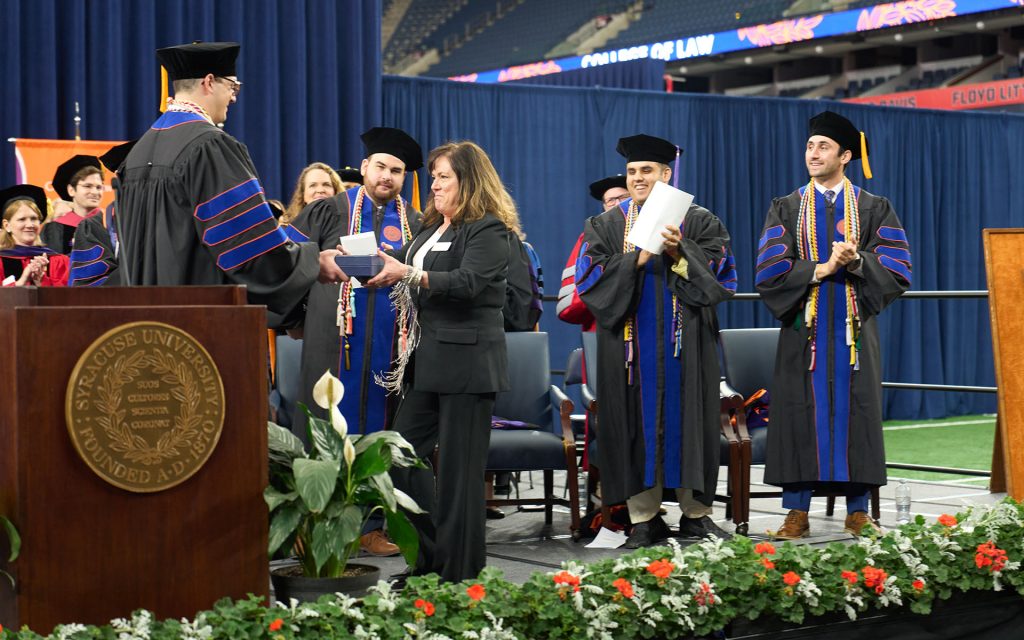
Associate Director of Academic and Bar Success Lou Lou Delmarsh was awarded the Staff Award (voted upon by the graduating class in recognition of a College of Law staff member in recognition of their support of students and faculty, and their accomplishments that make the College run day-to-day).
Lou Lou Delmarsh receives the Staff Award.
The LL.M. Class of 2024 awarded Teaching Professor of Law Richard Risman the Lucet Lex Mundum Award (voted upon by the graduating LL.M. class, it recognizes the professor who has made a significant impact on the success and experiences of LL.M. students during their studies).