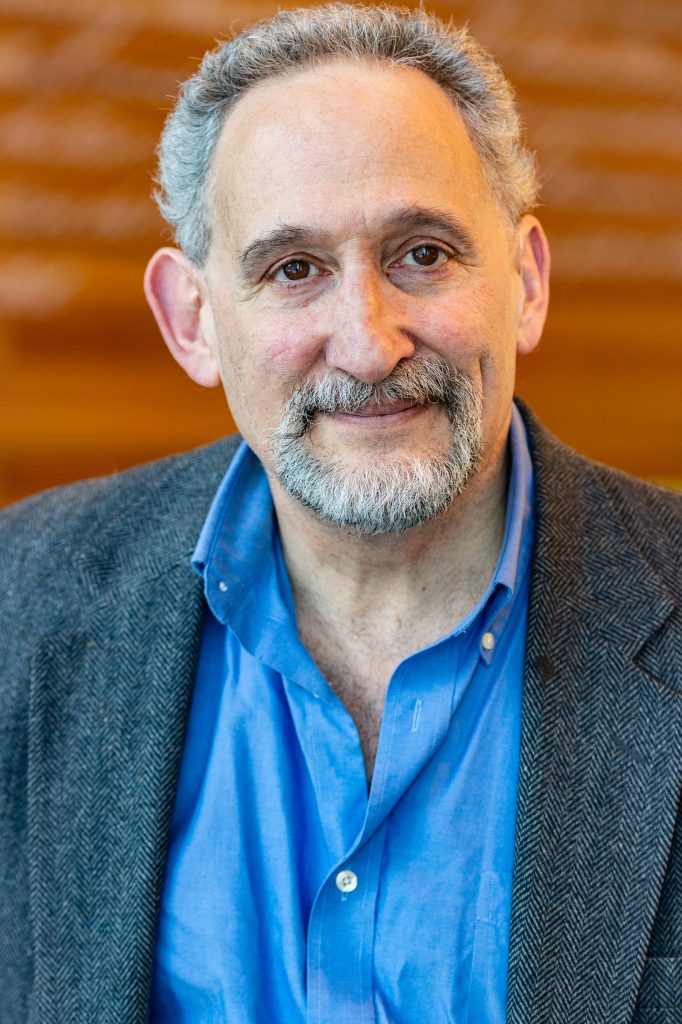
University Professor David Driesen participated on the panel, highlighting that the court stopped the EPA from enforcing regulations on coal-fired power plants. The agency initially attempted to reduce the industry’s emissions by 11 percent, but Driesen is unsure if the court will stop at the EPA’s original goal. “(The decision) might even be saying that there’s some number before that,” Driesen said.
Driesen is currently studying the impact of carbon pricing through his Fulbright Scholarship at the University of Ottawa, Canada.
Syracuse University College of Law has hired Adrienne Graves as its Director of Alumni Relations. Graves brings more than ten years of experience in higher education and alumni relations. Graves will lead the Office of Advancement and External Affairs’ alumni engagement work, with the goal of meaningfully engaging College of Law alumni and promoting philanthropic support of the College of Law’s mission. In her role, Graves will report to Assistant Dean of Advancement and External Affairs Sophie Dagenais and be responsible for maintaining and growing the College’s relationship with the Syracuse University Law Alumni Association (SULAA.)
“Adrienne’s extensive experience in alumni relations, her strong marketing and communications background, and her passion for Syracuse University’s mission and vision will help sustain our positive momentum, deepen the College’s bond with our alumni, and inform new pathways for engaging them meaningfully in service of our students who will follow in their footsteps,” says Dagenais.
Graves comes to the College of Law from Syracuse University’s School of Information Studies where she has held director-level roles in alumni relations and undergraduate recruitment.
“Our alumni play an essential role in shaping and executing on our mission. I am thrilled to welcome Adrienne to our team and look forward to capitalizing on her proven track record as a relationship builder as we cultivate our greatest ambassadors,” says Dean Craig M. Boise.
Graves holds a bachelor’s degree in in Communications; Public Relations and Advertising and a master’s degree in Professional Education with a Higher Education Concentration from LeMoyne College.
The Hon. James E. Baker has always known that he was meant for a life of public service. Growing up in Cambridge, Massachusetts, he was raised—as his mother once told him—to be a teacher. But he had other plans.
“I came to the conclusion at a young age that anybody who had the educational opportunities I was given had an obligation to perform public service,” says Judge Baker, a professor in Syracuse University’s College of Law and director of the Institute for Security Policy and Law. “Teaching is public service, but I embraced the concept of the citizen-soldier.”
Baker joined the U.S. Marine Corps at the age of 18 after spotting several recruitment brochures on the floor of the college post office. “I was looking for the hardest thing I could do and found it on the floor of the post office,” he says. He started his military career as an infantry officer in the Marine Corps and subsequently joined the staff of Sen. Daniel Patrick Moynihan. He was a judge on the U.S. Court of Appeals for the Armed Forces, a federal civilian court that hears military justice appeals, for 15 years before retiring in 2015.
It was Sen. Moynihan who urged him to go to law school, an idea that Baker initially wasn’t crazy about but eventually warmed to. “I do love the concept of rule of law. I want to live in a democracy and in a country that’s governed by law. Having the opportunity to support and defend the Constitution, I think, is as high a calling as you can have as a lawyer,” says Baker, who is partial to all corps such as the Peace Corps and AmeriCorps. “It is also the oath that service members take defining their ultimate duty: ‘to support and defend the Constitution.’”
Baker has taught at several law schools around the country and says Syracuse University’s commitment to veterans is one of the things that distinguishes the school. He says he encountered only a single veteran on the faculty of the other law schools where he taught. “College campuses tend not to be places where there’s a lot of military experience, and one of Syracuse’s strengths is that they value and embrace that experience,” he explains. “In academics, we recognize diversity as an educational value and a democratic principle. The military is the most diverse institution I have ever been associated with, which is likely one reason it puts so much emphasis on character, commitment and competence as virtues—not where you are from, your school or who your parents are.”
One of the ways the College of Law has been particularly helpful to active duty students is through its online law degree JDinteractive, Baker says. Many of the program’s students are active duty service members, veterans or military-connected. “Syracuse University and the College of Law provided the platform for these students, who otherwise wouldn’t have had the opportunity to attend law school.”
As the Orange community celebrates Veterans Day, Baker reflects on those who have served a greater good. “I always think about the people who served who didn’t come home. They hold a special place for all of us on Veterans Day.” Three years ago, Baker started a tradition of the law school holding its own Veterans Day commemoration. “I wanted to make sure that, even at a university like Syracuse that genuinely values military service, its law school also made that connection and celebrated this mission of supporting and defending the Constitution.”
Students: See our Study Aids webpage for access to many of the top legal study aids packages. Students will find links to CALI lessons, the Aspen Learning Library, West Academic Study Aids and the LexisNexis Digital Library.
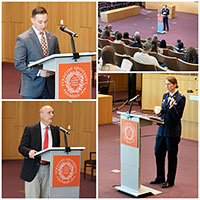
The College of Law hosted a special Veterans Day Ceremony in the Melanie Gray Ceremonial Courtroom this week, sponsored by the Institute for Security Policy and Law, the Betty and Michael D. Wohl Veterans Legal Clinic, and the National Security Student Association.
The ceremony began with a welcome by 3L R.J. Naperkowski, followed by the presentation of the SU Army ROTC Color Guard and National Anthem sung by the Weedsport High School Chorus. The Honorable James E. Baker, Director of the Institute for Security Policy and Law, then offered opening remarks and for the main event of the ceremony, Lieutenant Colonel Julia Muedeking, Assistant Deputy General Counsel, Intelligence, International and Military Affairs, Office of the Air Force General Counsel served as the guest speaker. The event concluded with an Armed Forces Salute by the Weedsport High School Chorus and Taps.
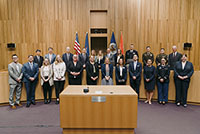
The College of Law hosted the U.S. Court of Appeals for Veterans Claims in the Melanie Gray Memorial Courtroom on Thursday, October 27.
Professor Elizabeth Kubala, Executive Director of the Betty & Michael D. Wohl Veterans Legal Clinic, Vice Dean Keith Bybee, and Gregory Block, Clerk of the Court delivered opening remarks for the event.
During the live oral argument, a three-judge panel held oral arguments on a current case, Encarnacion v. McDonough (No. 21-1411). The case involved the interpretation of federal regulations that guide adjudication of a widow’s entitlement to disability benefits.
Hosting the active court provided students, faculty and staff, alumni, and the local legal community with an opportunity to learn about veterans’ benefits, federal practice and administrative law.
As part of the CAVC visit, Court Judges also met with students to discuss judicial opinions and appellate advocacy. Professor Andrew Greenbergmoderated the panel. Following this event, Blockmoderated a career panel including the attorneys from the VA’s Office of General Counsel, the attorneys representing the appellant, and the judicial law clerks at the Court.
The U.S. Court of Appeals for Veterans Claims is a national court of record, established under Article I of the Constitution of the United States. The court has exclusive jurisdiction to provide judicial review of final decisions by the Board of Veterans’ Appeals, an entity within the Department of Veterans Affairs.
The court provides veterans an impartial judicial forum for review of administrative decisions by the Board of Veterans’ Appeals that are adverse to the veteran-appellant’s claim of entitlement to benefits for service-connected disabilities, survivor benefits, and other benefits such as education payments and waiver of indebtedness.
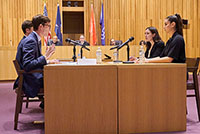
The team of 3Ls Anna Skandalis and Elyse Maugeri won the 11th annual Bond, Schoeneck & King Alternative Dispute Resolution (BSK ADR) Competition, held in Dineen Hall. They prevailed over 3Ls Cameron Rustay and Peter Calleri. Calleri was also named Best Overall Advocate in the Final Round.
Judging the final round were Brian Butler L’96, managing member of the Bond, Schoeneck & King PLLC Syracuse office; Dean Craig M. Boise; Alan Epstein L’74, President and CEO of CI Renewables LLC, the parent of KDC Solar; and the Honorable Danielle Fogel L’04, Supreme Court Justice in the Fifth Judicial District.
13 additional judges, including alumni and professors at the College of Law, judged the preliminary, quarterfinal, and semifinal rounds. Thank you to Professor Elizabeth August L’94, Brandon Bourg L’22, John Boyd II L’16, Dr. Maria Cudowska, Dean DiPilato, Dustin Dorsino L’21, Payne Horning L’21, David M. Katz L’17, Savanna Klinek, Amelia McLean-Robertson L’19, Elizabeth Morgan L’19, Donghoo Sohn, L.L.M ’13, and Maria Zumpano L’19.
Created in 2011, this annual competition continues to offer students at Syracuse Law the opportunity to grow as oral advocates and hone their experience in the world of negotiation. The competition gives students an opportunity to practice resolving clients’ conflicts through arbitration, mediation, and negotiation. Practitioners evaluate teams over the course of three days of preliminary rounds which culminate in a final round that is open to the public.
This year’s final round problem involved a dispute between two parties in a name, image, and likeness (NIL) antitrust settlement. Sedona Prince is a 6’ 7” basketball player who currently plays for the University of Oregon. Up until the Supreme Court’s decision in National Collegiate Athletic Association v. Alston on June 21, 2021, Prince was not allowed to profit from her NIL as a high school or Division 1 collegiate athlete, regardless of her success during these years. Sedona has filed suit against the NCAA for antitrust violations and lost wages and revenue.
Election software company Dominion Voting Systems last year filed multiple defamation lawsuits against conservative news outlets, alleging the networks had parroted false claims that Dominion had switched millions of votes from Donald Trump to Joe Biden. The eight defamation lawsuits are against various organizations and individuals including Fox News, Newsmax, One America News Network and attorneys Rudy Giuliani and Sidney Powell.
“Live news is challenging,” said Professor Roy Gutterman L’00, Director of the Tully Center for Free Speech, in an article by Yahoo! News. “If this case ends up going in the plaintiff’s side, I think news organizations that do live broadcasts might want to be careful with the things that they put on the air.”
In order to win its cases, Dominion must prove actual malice and show the news organizations knowingly or recklessly disregarded the truth.
A hallmark of the 80 federal judges confirmed so far during President Joe Biden’s time in office is their diversity, both demographically and in career background. That imprint could change if Republicans take control of the U.S. Senate in the midterm elections this week.
According to Vice Dean Keith Bybee in this Law 360 article, “the outcome of the midterm elections is critical. Should Republicans take control of the Senate, we can expect a burst of confirmations to follow in the lame-duck Congress following the election, but then I think you would see Biden’s confirmations in a Republican-controlled Senate grind to a halt.”
Resistance from Republicans to nominees with different career backgrounds than previous federal judicial nominees, such as public defenders, is likely to change the types of nominees if the Senate flips, experts say.
In an opinion piece for The Hill, University Professor David Driesen writes “How the 14th Amendment can reinforce the Jan. 6 committee’s Trump subpoena.”
On Oct. 13, the Jan. 6 committee voted to subpoena former President Donald Trump. In a previous subpoena of Trump in 2019 to obtain tax returns and information about his financial life, the Supreme Court held that Congress must justify a subpoena of a president’s information as serving a legislative purpose. The court suggested that the congressional subpoena power might serve as a tool for harassing the president, which it needed to reign in.
According to Driesen, the committee can greatly increase its chances of having the Supreme Court uphold the current subpoena if it justifies the subpoena as informing the congressional exercise of its power to exclude from office those who participate in or aid an insurrection under the 14th Amendment.